
Welcome Back from Summer and August!! Not really the official end of Summer yet with the Labor Day holiday next week, but schools are back, fall sports are launched and the Fall mid-term campaign is about to kick into high gear. On the sports page, Scottie Sheffler won golf’s FedEx Cup, while Curacao won the Little League World Series over the US’s Nevada team. And the US Open Tennis event in Flushing Meadow, NY hits its full stride this week, starting with a bang yesterday with Novak Djokovic was bounced in the first round.
Last week was busy with the Chamber of Commerce, API, American Cement Assn and several other leading business organizations (as well as 25 states) asking the Supreme Court to review a DC Circuit decision upholding the Biden-era NAAQS rules for PM2.5. There was also late action on Friday regarding a US joint venture with Venezuela’s interim government, securing majority US control over 65 billion barrels of proven oil reserves. Finally, the tariff battle between the US and Canada continues with some mentions of cross border electricity issues (oil imports/exports are not impacted). We are following all of these issues closely and can provide some background and context.
G20 Finance Ministers and Central Bank Governors are in Asheville , NC this week and the Innovation Ministerial is tomorrow and Wednesday in Chapel Hill, NC. Also, refiners and biofuels advocates are expected to be at the White House tomorrow to discuss the RFS and Small Refinery Exemptions. Finally, VP Vance and EPA’s Lee Zeldin will be in Las Vegas to speak to the Republican Jewish Coalition today.
The House is due back today, but only for a week. Then it has three weeks scheduled starting September 14th, and that’s it until after Election Day. The Senate returns in mid-September and will also be in session for only those three weeks. We are looking for permitting, defense legislation, a reduced farm bill (with an RFS/E15 push) and a surface transportation bill. House leaders will start this evening with what’s expected to be a bipartisan vote to push back the government funding deadline, ensuring that EPA, Interior, NOAA and other federal agencies don’t shut down on September 30th. They will also vote on legislation on mining permitting and delaying (for the second time) protections for the Right whale in order to boost the lobster and Jonah crab industries.
Hearings include a House Oversight Committee hearing on state and local natural gas bans, House Ways and Means Committee strategic partnerships to secure critical resources and supply chains, House Small Business on energy and small business and a House Oversight hearing on advancing US nuclear leadership. There are also several energy markups in House Energy & Commerce and House Resources that will address nuclear, permitting, AI and Water legislation.
Congrats to POLITICO for rolling out its new line up of newsletters starting today. Looking forward to seeing where all this goes. Labor Day is next Monday so see you on Tuesday next week. Call with questions.
Best,
Frank Maisano
(202) 828-5864
C. (202) 997-5932
FRANKLY SPOKEN
“You need to recognize that we are in a transition, and this bulls&%t of ‘it’s got to be green’ and ‘drill baby drill’ is the problem.”
Outgoing GOP Sen. Thom Tillis (N.C.) on the latest Critical Capital podcast
ON THE PODCAST
Landrieu, Segal Discuss Mid-Term Energy Politics on S&P Podcast – In this episode of S&P Global’s Energy Evolution podcast, Dan Testa discusses mid-term elections and the impact of energy issues with Mary Landrieu, a senior policy adviser at Van Ness Feldman LLP and former Democratic US senator from Louisiana, and Scott Segal, a partner at Bracewell LLP and a co-chair of the law firm’s Policy Resolution Group. They cover data center, rising demand, grid issues, the Iran Conflict, climate change and rising gasoline prices.
Columbia Energy Exchange: Bloomberg’s Javier Blas on Lessons from Closing Hormuz (So Far) – In this episode of the Columbia Energy Exchange podcast, Jason Bordoff talks to Bloomberg opinion columnist Javier Blas about how the strait closure and Iran war have impacted global energy markets so far. Blas discusses why this massive disruption hasn’t triggered a full-blown global economic crisis, what role China’s massive strategic stockpiles are playing, shifting demand patterns and the ongoing energy transition’s role in dampening the shock. Finally, Bordoff and Blas discuss the long-term security implications for global oil refining, shipping chokepoints, and future LNG infrastructure.
FUN OPINIONS
Harbert: NatGas Affordability Go Hand-In-Hand – In an op-ed in the Washington Examiner, AGA CEO Karen Harbertt argues while global energy markets have faced turmoil since the start of the Iran conflict, America’s robust supply of domestic natural gas has insulated natural gas prices here at home. Harbert says natural gas has helped keep costs lower for families and businesses who use natural gas directly for heating, cooking, clothes drying, and more.
CRES Q&A with Sen. Capito – Citizens for Responsible Energy Solutions (CRES) published a Q&A with Sen. Shelley Moore Capito (R-WV). Sen. Capito discussed her years of leadership on passing bipartisan permitting reform, from West Virginia’s experience with delays on projects like the Mountain Valley Pipeline to what comprehensive reform could mean for national energy security. She emphasized that meaningful reform must benefit all types of energy projects, not just fossil fuels, and pointed to her work as Chair of the Environment and Public Works Committee as part of a long tradition of bipartisanship on permitting. Sen. Capito shared her insights with CRES on the momentum behind bipartisan permitting reform. She highlighted her history of leadership on the issue, from West Virginia’s own experience with permitting delays on projects like the Mountain Valley Pipeline to what comprehensive reform could mean for energy security and an all-of-the-above energy future.
FROG BLOG
Moniz on US Saudi Nuclear Deal – In Foreign Policy, former Energy Secretary Ernest Moniz discussions the US-Saudi nuclear deal and non-proliferation questions. Moniz supports having a nuclear deal with Saudi Arabia, but if enrichment follows, the agreement must provide inspectors timely access to undeclared nuclear sites, a key provision of the 2015 Iran deal. If similar verification and transparency measures are implemented, the agreement can fulfill the stated objectives while adhering to the highest nonproliferation standards.
Biggest Hormuz Risk May Be Overconfidence – In an essay in Foreign Affairs, Columbia SEPA analyst Jason Bordoff and Harvard Kennedy expert Meghan O’Sullivan say the real hazard of the Hormuz crisis is not the shock that the world endured but the overconfidence it may foster. “The closure of the world’s most important oil chokepoint should have tipped the global economy into recession, and that it did not will tempt many to conclude that energy security risks no longer matter.”
FUN FACTS
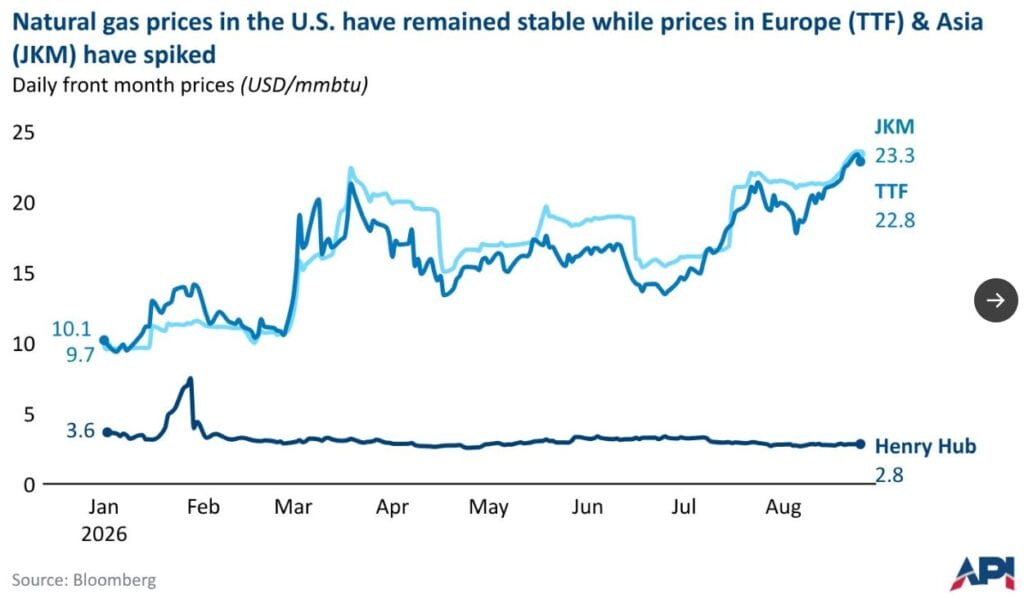
API: LNG New Resources have been key to Energy Success: U.S. LNG is delivering reliable supply to global markets when it’s needed most. With European storage at its lowest level for this time of year since at least 2008 and natural gas prices rising across Europe and Asia, abundant American energy is helping meet demand and strengthening global energy security.
IN THE NEWS
Euro Industry Groups Weigh In On Methane Rules – The EU Methane Regulation’s import rules take effect on January 1st, 2027. But a new letter from Eurogas together with 21 other companies and organizations says the systems needed to comply with them don’t exist yet. The letter also calls targeted amendments and a time-limited three-year postponement of Importer obligations. Eurogas fully support the objective of reducing methane emissions and remain committed to compliance. However, key accreditation, verification and certification frameworks are still not fully in place. A postponement would allow
- Complete accreditation, verification and certification at the scale required, both within the EU and in exporting countries
- Develop and deploy compliance solutions that are globally available and consistently recognized across Member States
- Assess the impact on Europe’s energy security, competitiveness and supply
- Establish legal certainty across Member States
The groups say this is not a call to weaken the Regulation or delay its ambitions, but a call to ensure that, when obligations enter into force, the systems required to fulfil them actually exist.
Key Groups Urge SCOTUS to Review NAAQS, Say It Is Blocking Critical Infrastructure – The U.S. Chamber of Commerce and several leading business organizations, as well as 25 states, asked the U.S. Supreme Court to review a D.C. Circuit decision that upheld a Biden-era Environmental Protection Agency (EPA) rule tightening the National Ambient Air Quality Standards (NAAQS) for fine particulate matter (PM2.5). The Chamber and its fellow associations are concerned about the rule’s sweeping consequences for permitting, infrastructure investment, manufacturing, energy production and economic growth. The vast majority (over 84%) of particulate matter emissions now come from non-point sources such as wildfires, construction and road dust – factors that are extremely difficult for individual regions and states to control. By contrast, only 16% come from industrial sources and power plants, with further improvements likely as new plants and emerging technologies come online. As the petition explains, the D.C. Circuit’s decision presents questions of exceptional importance that necessitate Supreme Court review. First, EPA may not revise national air-quality standards outside the Clean Air Act’s normal five-year review cycle without first completing a thorough scientific review, as Congress required. Second, EPA must consider the costs and consequences of exercising its authority before deciding to impose a new standard outside the normal review cycle.
Cement Industry Highlight Key Infrastructure NAAQS Plea – As part of the coalition, the American Cement Association (ACA) has formally asked the U.S. Supreme Court to review a D.C. Circuit decision upholding a Biden-era Environmental Protection Agency (EPA) rule for fine particulate matter (PM 2.5).
Sean O’Neill, ACA’s Senior Vice President of Government Affairs said keeping the PM 2.5 rule in place would be going completely against what the current Administration has been fighting so hard for in American manufacturing.
“This rule imposes overreaching and technologically unfeasible limits, which will lessen—not strengthen– cement production at our plants and directly interferes with our country’s ability to provide unparalleled national security and the resilient, dependable concrete infrastructure used by all Americans every day. A regulatory system that provides no practical margin for growth or reinvestment risks discouraging projects that would advance environmental progress. The PM 2.5 rule does not balance environmental stewardship with economic reality; instead, it penalizes the very industry that is building America’s future.”
The cement industry also warn that the unworkable regulations threaten to grind U.S. infrastructure development to a halt, jeopardizing critical highway, bridge, and transit projects nationwide – all essential for U.S. national and economic security. A robust, domestic cement industry is the literal foundation of American progress. Cement and concrete are the most consumed man-made materials on the planet, essential for building the critical infrastructure needed to keep the U.S. economy competitive. By imposing overreaching and technologically unfeasible PM2.5 limits, the EPA is directly interfering with the nation’s ability to rebuild its failing infrastructure, build affordable housing, and modernize supply chains.
Biofuels Groups Urge Trump to Reject Refinery Exemptions – Late last week, a broad coalition of agricultural, biofuel, and oilseed processing organizations sent an Aug 27 letter to President Trump urging the administration to reject expanded small refinery exemptions (SREs) under the Renewable Fuel Standard. The principal signatories include Clean Fuels Alliance America, the American Soybean Association, the National Farmers Union, the National Oilseed Processors Association, Bunge Global, POET and Darling Ingredients. Essentially, the letter warns that expanding SREs would devastate the rural economy by wiping out billions in value for corn and soybeans. It notes that compliance credit prices do not drive retail gas prices, noting that past waivers caused credit prices to plummet even while pump prices rose. Additionally, the letter argues that the waivers improperly benefit highly profitable medium-sized refiners at the expense of struggling American farmers.
AGs SRE Letter Urges E15 Compromise from EPA – The attorneys general of Iowa, South Dakota and Missouri sent a letter to EPA Administrator Lee Zeldin urging him to reject broad refinery waiver requests, arguing that recent glowing refining industry earnings reports undermine claims that refiners are suffering economic hardship. “The refineries want to have their cake and eat it, too,” the letter said. The AGs added awarding SREs undermines the RFS, creates incentives for certain refiners to restrain production at time when country needs every refinery running at full rates, and increases the costs of fuel for consumers and hurts farmers.
Wright Talks Alaska Oil, Gas – Energy Secretary Chris Wright attended the Alaska Oil & Gas Assn industry conference late last week and said the world depends on Alaska’s resources. ”The massive oil exports from Alaska are desperately needed in the world, and the message I get from everyone is: When are we going to get more Alaskan oil?” Wright has previously said the Alaska LNG pipeline is his No. 1 infrastructure priority. Wright also touted the Trump administration’s goal of unleashing the state’s resources and strengthening energy security.
DOE’s Critical Materials Innovation Hub Awards $10M for Early-Stage R&D – DOE’s Office of Critical Minerals and Energy Innovation awarded $10 million to seven projects that will accelerate the early-stage technology research and development necessary to more efficiently recover and refine critical materials required for energy technologies. Led by the Critical Materials Innovation Hub (CMI Hub), the projects will focus on rare earth elements, gallium, copper, and other critical materials. The selectees include projects from the following organizations:
- Case Western Reserve University: Process intensification enabled by chloride-based molten salt electrolysis for highly efficient heavy rare earth metal production
- Colorado School of Mines: Improving copper extraction from primary copper sulfides using hydro and bio-hydro metallurgical processes
- University of Arizona: A synergistic approach using nanobubbles, surfactants, and reactive oxygen species to enhance copper sulfide leaching
- FAST Metals: Creating new domestic sources of critical minerals: Gallium and rare earth mixed oxides from industrial byproduct residue streams
- Indium Corporation: Improved ion-exchange resin for gallium extraction from bauxite-alumina processing
- University of Illinois Urbana-Champaign: Development of redox-adsorbents for the selective electrochemical recovery of gallium from mining byproducts and end-of-life waste
- Oak Ridge National Laboratory: Transforming selective separation and recovery of gallium from zinc refinery residues using solid-phase extraction
ConservAmerica and ACC Announce Strategic Partnership –The American Conservation Coalition (ACC) and ConservAmerica have begun a strategic partnership to strengthen and enhance the conservative environmental movement. With nearly 150,000 passionate grassroots members, ACC represents the next generation of American conservation. Established in 1995, ConservAmerica is an organization recognized for its impact on federal policies, in part through the formation of the Roosevelt Conservation Caucus. This cross-generational collaboration will focus on advocacy, educational initiatives, and communications efforts to promote responsible stewardship of our natural resources.
ON THE SCHEDULE THIS WEEK
Petroleum Council Meets – Tomorrow at 11:00 a.m. , DOE holds a virtual meeting of the National Petroleum Council. The agenda includes Introductory remarks; Energy Department remarks; Presentations, discussion and consideration of the final report of the NPC Resource Assessment Committee; and Discussion of any other business properly brought before the NPC.
EPA’s Fotouhi Headlines ECOS Fall Meeting – The Environmental Council of the States (ECOS) holds its annual fall meeting from today to Wednesday in Jackson Hole. Deputy EPA Administrator David Fotouhi will keynote.
S&P Experts Discuss Global Trader Questions – Tomorrow at 9:00 a.m., S&P Global experts Daniel Yergin, Carlos Pascual, Rahul Kapoor, Jim Burkhard, and Daniel Evans hold a webinar that will be a forward-looking assessment of the geopolitical decisions, market shifts, and supply-chain adjustments redefining global energy trade.
CSIS Looks at China Impact of Iran Conflict – The Center for Strategic and International Studies holds a virtual discussion tomorrow at 9:00 a.m. on the implications of the Hormuz energy crisis in China. The discussion will explore the key lessons China is drawing from the crisis, how the priorities laid out in China’s latest energy-related five-year plans may evolve under a prolonged crisis scenario, and the implications of China’s energy strategy on regional and global energy architecture.
House Energy Markup Set – The House Energy & Commerce Committee’s Subcommittee on Commerce, Manufacturing, and Trade will hold a markup tomorrow at 10:15 a.m. Energy measures include the “Packaging and Claims Knowledge Act (H.R. 6832), the Recycled Materials Attribution Act (H.R. 7502), and the Nitrous Oxide Safety Act (H.R. 7945). Here is the full agenda.
Forum Looks at NATO, Grid innovation – Tomorrow at 2:15 p.m., the Security and Sustainability Forum, George Washington University’s Environmental and Energy Management Institute and the Alliance for a Sustainable Future hold a discussion tomorrow on where the financial and physical sides of the grid are out of alignment, what it means for the people and businesses on the other end of the meter, and practical paths to fixing it. Peter Fox-Penner and Scott Sklar are among the speakers.
Renewable Forum Set for DC – The Center for Resource Solutions’ Renewable Energy Markets conference will be held tomorrow to Thursday and will focus on states, companies, and organizations that choose clean, renewable electricity every day. The event focuses on leaders from federal and state governments, major corporate purchasers, the nation’s top utilities and electricity generators, policy experts, and renewable energy marketers. Activists Bill McKibben is keynote. Other key speakers include Grid Strategies Rob Gramlich, NYSERDA’s Doreen Harris, Gevo’s Joan Cetera, Geoff Dietz of the RNG Coalition, Ben Finzel, Sol System’s Susanne Fratzscher, Nodal’s Caroline Gentry, EPRI’s Arin Kaye, Larry Navin of the Methanol Institute and Gulf Energy Catalyst CEO Brett Perlman.
Forum Looks at Grasslands, Livestock Issues – Land & Carbon Lab holds a virtual discussion on Wednesday at 9:00 a.m. looking at monitoring the world’s grasslands and livestock. The event will bring four complementary datasets covering grassland extent and type, livestock distribution, short vegetation height and grassland productivity. It also explores an open, unprecedented view of ecosystems long overlooked in global monitoring — and to help shape what comes next.
House Science Looks at Nuclear – The House Science, Committee’s Energy Subcommittee holds a hearing on accelerating US leadership in advanced nuclear reactors on Wednesday at 10:00 a.m. Here is the witness list headlined by Oak Ridge’s Joe Hoagland.
House Oversight Addresses Gas Ban Impacts – The House Oversight Committee’s Economic Growth, Energy Policy, and Regulatory Affairs Subcommittee holds a hearing on Wednesday at 10:00 a.m. addressing state and local bans on natural gas and their impacts.
House Small Biz Looks at Energy – The House Small Business Rural Development, Energy, and Supply Chains Subcommittee holds a hearing on Wednesday at 10:00 a.m. looking at fueling future resource needs and small business opportunities.
House Resources to Markup Energy Bills – The House Natural Resources Federal Lands Subcommittee holds a hearing on pending legislation on Wednesday at 10:00 a.m. See the full agenda and list of bills here.
Rep. Panetta Headlines Hudson Forum on Trade Policy – The Hudson Institute’s Center for Peace and Security in the Middle East holds a discussion on Wednesday at 3:00 p.m. on US Trade Policy and the strategic and economic importance of Central Asia. The event will focus on countering China’s global economic influence, reducing Russia’s energy leverage over Europe, and strengthening access to critical resources. Rep. Jimmy Panetta (CA-19) joins Hudson for a conversation.
House Energy Committee Enviro Subpanel to Look at Water, Data Centers – The House Energy and Commerce Environment Subcommittee holds a hearing on Thursday at 9:00 a.m. focused on reliable water in the digital age. The hearing will examine legislation to strengthen drinking water systems and protect ratepayers.
Forum Looks at EV Batteries – The Henry L. Stimson Center holds a virtual discussion on Thursday at 10:00 a.m., on finding second life for EV batteries. This event will explore notable innovations and current obstacles in “urban mining,” the process of recovering metals from discarded electronics and electric vehicles. Speakers will discuss emerging policies and approaches for building robust EV battery reuse and recycling supply chains, like the EU Digital Passport System, and will examine opportunities to bring upstream governments and mining companies into the conversation on transparency and environmental regulations for batteries. The event will also spotlight promising second-life energy storage options for EV batteries being advanced through public-private partnerships in the US and Europe.
Forum Looks at SCOTUS Climate Litigation Case – On Thursday at 12:00 p.m., the Center for Progressive Reform holds a webinar focused on the environmental communities’ understanding of the Suncor v. Boulder SCOTUS case. The webinar will examine why enviros think the oil and gas industry should be held accountable, the main legal issues being raised in Suncor, and how the case fits into the industry’s broader efforts to shield itself from rules that apply to all other businesses.
POLITICO Reporters Look at Data Centers – On Thursday at 1:00 p.m., POLITICO Pro’s new energy and environment newsletter lineup hold a Pro Briefing on what they’re seeing — and hearing — as the data center story unfolds this fall. Kelsey Tamborrino (Power Moves), Arianna Skibell (State Power), Pavan Acharya (Morning Energy), and Alex Guillén (Morning Environment) and Ben Storrow (Surge) are on the panel.
RFF Looks at New Climate Finance Challenges – Resources for the Future (RFF) holds a webinar on Thursday at 1:00 p.m. introducing the Climate-Related Financial and Macroeconomic Risk Initiative (CFMRI) and providing an overview of risk drivers and transmission mechanisms, from physical risks and transition risks, to economic and financial outcomes. This webinar will be the first of a three-part webinar series, “The Economic and Financial Impact of Climate Change.” Harvard’s James Stock is among the speakers.
IN THE FUTURE
Fall Air Meetings Set for Raleigh – Association of Air Pollution Control Agencies (AAPCA) Fall Meeting is set for September 9th to 11th in Raleigh, NC. The meeting will feature presentations from state and local air quality agencies, U.S. EPA, and other air quality professionals. The agenda will cover Clean Air Act policy, legal, technical, and implementation updates, with a format similar to recent AAPCA meetings.
Clean Energy Week – Set for September 14th to 18th, National Clean Energy Week is an annual week-long celebration of clean energy innovation with conversations to help solve the world’s most pressing challenges in nuclear, solar, wind, wave, hydropower, geothermal, natural gas, biomass, carbon capture, storage and waste-to-energy technologies. National Clean Energy Week (NCEW)’s 10th Annual Policymakers Symposium kicks off Tuesday, September 15th at Convene Hamilton Square. The state of the energy industry forum includes AGA’s Karen Harbert, Hydro’s Malcolm Woolf, ACP’s Jason Grumet and NEI’s John Kotek, while Turn Forward’s Hillary Bright is also speaking on Grid Issues and offshore wind. Keynoters include BLM’s Steve Pearce, Reps Buddy Carter, Nikki Budzinski, Scott Peters, and Mariannette Miller-Meeks, as well as Sen. John Curtis.
RFF Hosts Clean Energy Forum – Resources for the Future (RFF) holds a webinar on Wednesday, September 16th for the second event in the series outlining the local, sectoral, national and international economic impacts of climate change. Panelists will discuss implications for federal, state, and local policies, as well as emerging policy needs. This webinar is the second in a three-part webinar series, “The Economic and Financial Impact of Climate Change.”
AGA Winter Heating Meeting Set – AGA will release its Winter Heating Outlook on Thursday September 17th.
Climate NYC Week – Climate Week NYC 2026 is set for September 22nd to 24th. The event features a multitude of activities and forums address climate, decarb, innovation, clean energy and much more. ClearPath and API host their usual Monday event while Bracewell hosts two events jointly with the Business Council for Sustainable Energy and another with Gevo. We have a comprehensive list of events if you are Interested.
ACP to Host Storage Event – ACP will hold a forum about the future of energy storage at RECHARGE26 on September 22nd to 24th in Aurora, CO, just outside Denver. The U.S. energy storage market is entering a period of significant opportunity—and uncertainty. This session will examine the policy, economic, technology, and demand-side factors that could shape market growth in the years ahead.
Agri-Pulse Forum Set for KC – The Agricultural Business Council of Kansas City and Agri-Pulse hold the 12th annual Ag Outlook Forum on September 21st and 22nd in Kansas City at the Marriott Downtown. The event includes Fireside chats with former U.S. Secretaries of Agriculture Mike Johanns and Dan Glickman. The Ag Outlook Forum brings together leaders from agriculture, government, finance, policy, and agribusiness to examine the issues shaping today’s agricultural landscape.
Bracewell Expert Speaks at Maritime Fuels Conference – The Argus Sustainable Marine Fuels Conference will be head in Houston, Texas on September 23rd to 25th bringing together stakeholders from across the marine fuels and bunkering value chain to address the practical realities of decarbonization in the North America market. The conference will examine viable near‑term fuel options alongside emerging supply chains, port and bunkering infrastructure readiness, the role of charterers and cargo owners, and the regulatory and policy developments shaping investment decisions. Bracewell’s Tim Urban speaks.
Critical Minerals Forum Set For CO – The 5th annual Payne Institute Critical Minerals Symposium will be held on September 24-25, 2026, at Colorado School of Mines in Golden, CO. Critical minerals are now a top tier business, technological and political priority in the United States and globally. The event will focus on the complexities and opportunities related to the future of Critical Minerals than this one at Mines.
RFF Series Looks Financial Sector – On Thursday, October 1st, Resources for the Future (RFF) holds a webinar describing the impact of climate change on small and large banks, insurance providers, investors, and asset managers. The panelists will discuss cross-sectoral spillovers, as well as policy implications for supervision, regulation, and disclosure. This webinar is the final in a three-part webinar series, “The Economic and Financial Impact of Climate Change.”
SCOTUS TO Take Up Suncor-Boulder Climate Case – The landmark climate change case Suncor Energy Inc. v. County Commissioners of Boulder County is scheduled for oral argument before the U.S. Supreme Court (SCOTUS) on Monday, October 5th. The court officially setting Suncor as the very first case to kick off the new 2026–2027 Supreme Court term.
Environmental Markets Association Meeting set for Annapolis – The Environmental Markets Association holds its 30th Annual Meeting in Annapolis on October 5th to 7th. EMA’s event covers the carbon markets, RECs, emerging instruments reshaping sustainable commerce and much more.