
With Bernie on the Ropes, Down-ticket Dems See New Opportunity
Insight - March 10, 2020
By: Liam Donovan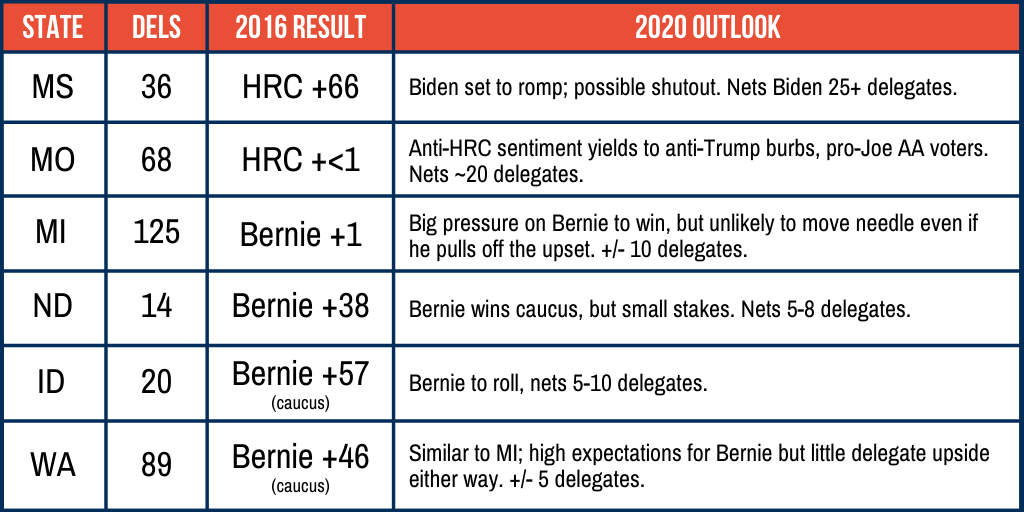
A week after former Vice President Joe Biden’s shocking romp across the Super Tuesday map, voters in another six states head to the polls this week to have their say. And while a number of them were favorable toward Bernie Sanders in 2016, these contests hold as much political peril for the Vermont senator as they do practical promise. And a look beneath the presidential surface suggests the race might be rapidly coming to a close.
At first glance, these are states where Senator Sanders should be expected to do well. After all, it was Bernie’s stunning upset in Michigan that portended the enduring strength of his 2016 campaign, and a primary trench war that would ensue through early June. The state of Washington netted Sanders 47 pledged delegates, his single biggest margin more than twice over. But recent polling suggests that Sanders has an uphill battle in the Wolverine State, and even if he is able to reprise the 2016 magic, a narrative necessity, it would hardly make a dent in Biden’s delegate advantage. Washington, for its part, has switched from a caucus to a primary, negating Bernie’s organizational advantage, and again setting up high expectations with little in the way of a proportional reward. With losses possible, if not likely, in the high-stakes contests, Bernie’s best hope to gain ground comes in North Dakota (14 delegates) and Idaho (20).
Meanwhile, Biden stands to run up big margins in the SEC states he has dominated thus far. Mississippi delivered Clinton her single biggest margin in 2016 en route to crushing Sanders more than 5-to-1. Despite allocating only 36 delegates, the Magnolia State is likely to net Biden more any other contest, and with Sanders polling below the viability threshold, a shutout is very much in play. On paper, Missouri should be more competitive, as it was decided by less than half a point in 2016, but with rural white voters proving resistant to Sanders this time around, it looks a lot like Oklahoma — a state where hostility toward Hillary inflated the Bernie baseline. Expect this one to be another big Biden win, with anti-Trump suburbanites and pro-Joe African-American voters combining for a significant delegate prize.
With a once-gripping primary quickly turning into a glide path for Biden, Tuesday may prove to be the anti-climax. Looking ahead to St. Patrick’s Day, Florida could determine the outcome once and for all, putting the former Vice President well on his way to a previously-unimaginable delegate majority heading into Milwaukee.
There is perhaps no better barometer for the state of the presidential race than the mood of the folks who will be sharing the ticket. Just two weeks ago, amid Bernie’s seemingly inexorable march to the nomination, Republicans scored an unexpected retention win in veteran incumbent Rep. Fred Upton, whose suburban Michigan district would is a top Democratic target. With Sanders on the ballot, the GOP could suddenly envision a clear path back to the House majority, while the fretting among frontline Democrats manifested itself in a sudden burst of swing seat endorsements for Biden. Flash forward and the shoe is on the other foot; Democrats notched a key retention victory of their own in Rep. Collin Peterson, whose ruby red western Minnesota district would have been an automatic pickup for Republicans.
But the more seismic shift comes in Montana, where erstwhile presidential hopeful and current Governor Steve Bullock will challenge GOP Senator Steve Daines. Despite near-constant entreaties from Chuck Schumer and national Democrats since leaving the race in December, Bullock was widely expected to forego a senate campaign in a state that is virtually certain to back President Trump in November. Super Tuesday changed all that, buoying the hopes of down-ballot Democrats and curbing the tail risk of a Sanders nomination. With Biden at the top of the ticket, and the economy showing signs of pandemic-related strain, the promise of delivering the Senate majority proved too compelling to ignore.
The Bullock recruiting coup puts a fifth state squarely in play for Senate Democrats, a critical expansion of the map as they are all but certain to give back a seat in Alabama. A net gain of four seats could give them a majority regardless of how controls the White House. And whether or not they are able to defeat Daines in Montana, the race immediately becomes competitive — and profoundly expensive — setting up a titanic clash that will draw upwards of $70 million, stretching resources and forcing inevitable trade-offs across the country.
All of this of course, is predicated on a Biden nomination. So while it is technically still a two-man race for the Democratic primary, the folks with the most at stake are betting with their feet. As we wait for returns on Mini-Tuesday, the wisdom of this wager will soon come into focus.