
Energy Update: Week of September 5th
Energy Update - September 05, 2023
Friends,
Happy Labor Day. With the end of summer (can you believe it is fall already?), we head out to the start of school/colleges (love all the social media posts on first school day/dorm room set up photos), the launch of football and of course, the tennis world descending upon NYC for the US Open. But we start today with sad news from our energy world with the passing of former Energy Secretary, UN ambassador and New Mexico Governor/Congressman Bill Richardson. My friend Ben Finzel worked with Richardson in Congress and at DOE and always spoke so highly of the Secretary. He did so many great things for the country and we are sad to lose him. Please read the NYT obit.
While the Senate returns this week to start on a series of nominations, the House remains out one more week even though there is a significant end-of-September deadline for keeping the government open. Get ready, it is going to be a crazy month with the spending bills, disaster relief challenges, permitting (which is totally up in the air), important tax guidance on hydrogen, SAFs, EV supply chains and the expected announcement of the Hydrogen Hub winners. For hearings, on Thursday Senate Environment looks at the Infrastructure law and water issues, while Senate Energy inspects the DOE’s role in AI.
Also on Thursday, SAFE holds a virtual webinar on critical minerals and materials lists from experts at Interior, Energy and DoD, while clean energy industry, stakeholders and advocates hold reception on Thursday night to celebrate progress after passage of the IRA.
NFL starts Thursday with the Lions and Chiefs. Climate Week NYC is just two weeks away. Call with questions.
FRANKLY SPOKEN
“Hydrogen is super important, not only because it's one of our biggest programs. It does move the needle — depending on how you count and how far you take possible hydrogen uses — 10 to 20 percent of American emissions. But not any 10 to 20 percent. Hydrogen has the potential to be the primary solution to the hardest-to-abate [industries]. Other countries have hydrogen programs,” he said. “But I think the United States is the only one that has put $6 billion against industrial decarb[onization].”
DOE undersecretary for infrastructure David Crane in a E&E News article by Brian Dabbs.
ON THE PODCAST
Bordoff, O’Sullivan Join Ezra Klein Podcast – Jason Bordoff and Meghan O’Sullivan have been at the forefront of mapping out the ways decarbonization will upend the world’s economic and geopolitical order.
In Bordoff and O’Sullivan’s view, decarbonization won’t just affect what kinds of cars we drive or how we power our homes. It will transform everything from the nature of international markets and trade relations to the global balance of military and diplomatic power. And it will create new economic superpowers, new alliances and new sources of geopolitical conflict in the process. This conversation with Ezra Klein explores the contours of this transformation and what it will mean for the future of the climate and world politics.
Catalyst: Utilities and Electrification – On the Catalyst with Shayle Kann podcast this week, Shayle talks to his colleague Andy Lubershane, partner and head of research at Energy Impact Partners about the movement to electrify everything. As we electrify the economy, adding gigafactories, charging stations and green hydrogen hubs to the grid, the demand for power is growing for the first time in decades. Utilities face massive challenges to deliver the power needed for electrification: yearslong interconnection queues, a shortage of transformers, an uncertain regulatory environment — the list goes on and on. It’s the electrification gauntlet.
FUN OPINIONS
Clean Energy Transition Requires Hydrogen – In an opinion piece in The Hill, UC-Irvine hydrogen expert Jack Brouwer writes our clean energy transition requires hydrogen so it must be treated fairly. Notably, clean hydrogen received a production tax credit to empower its competition against polluting fossil fuels. Hydrogen stands as a known clean energy source capable of enabling deep emissions cuts in the toughest-to-decarbonize sectors where direct electrification is ineffective. It can replace fossil fuels in petrochemical production and energy-intensive industries like heavy-duty shipping, freight operations, steel, ammonia and cement manufacturing. Brouwer writes to achieve a zero emissions future with all renewable and clean energy technologies functioning ideally, we need a realistic path forward. Implementing these suggested requirements now could undermine Congress’ goals of scaling clean hydrogen production and economy-wide decarbonization.
NY Post Column: Green Activists Hurt Environment in Hawaii, Cali – In a column in the New York Post, Heritage fellow and veteran conservative economist Stephen Moore writes while hot and dry weather and high winds were certainly a major factor in Hawaii, California and Canada, there were many contributing factors to those fires. He adds know risk mitigation didn’t happen despite years of warnings by climate experts, the utility companies and local residents. Hawaiian Electric repeatedly warned that “the risk of a utility system causing a wildfire ignition is significant,” yet the money that was spent on fire mitigation was less than 1% of what was recommended. Moore adds, it wasn’t fossil-fuel use that caused the fires. It was climate-change alarmists who “demanded all the money go to green energy rather than saving at-risk homes and lives.”
FROG BLOG
RFF Take on One-Year IRA – Recently, we marked the one-year anniversary of the Inflation Reduction Act (IRA) becoming law and allocating billions of dollars in federal funding for environmental and climate initiatives. “The IRA is the most comprehensive climate bill in US history,” says RFF President and CEO Richard G. Newell. “Unlike any other major US environmental legislation to date, the IRA relies heavily on ‘carrots’—financial incentives such as tax breaks that encourage investments in clean energy technologies—rather than ‘sticks’ in the form of mandates or fees.” RFF Researchers Aaron Bergman, Alan Krupnick, Joshua Linn, Nafisa Lohawala, Richard G. Newell, Karen Palmer, Daniel Raimi, Nicholas Roy, and Beia Spiller reflect on how the law may affect various aspects of the energy transition moving forward and what the law has done to change the climate-policy landscape of the United States.
FUN FACTS
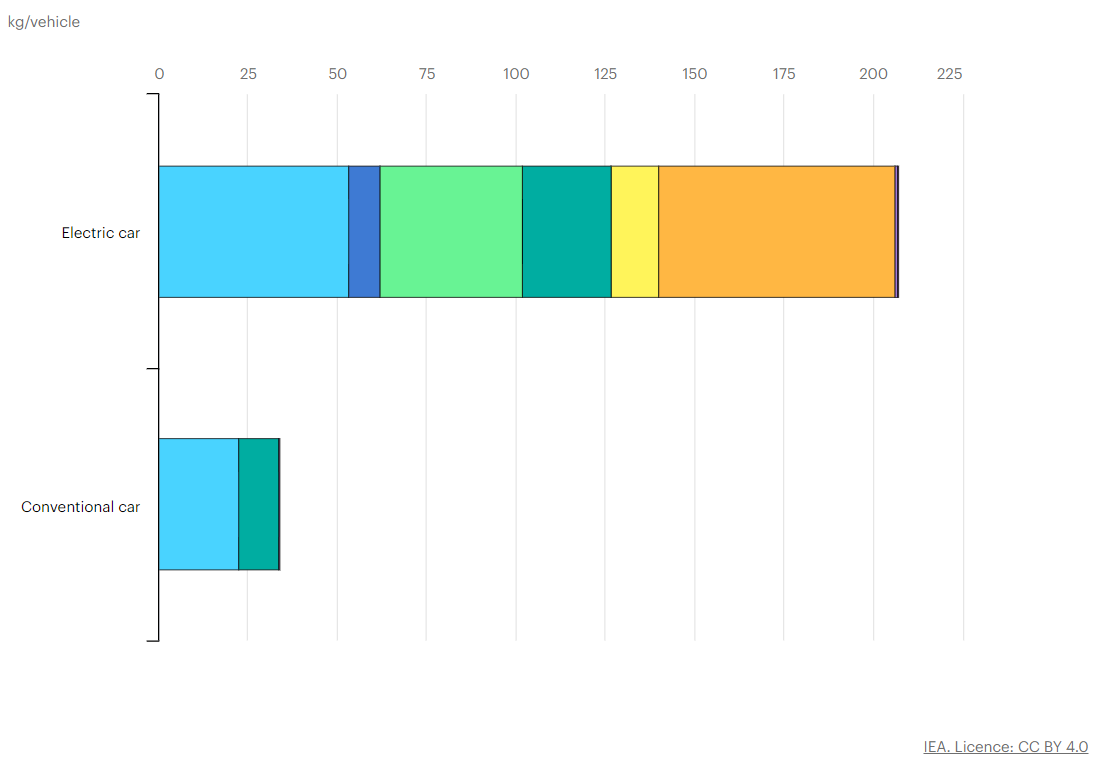
Critical Minerals in EVs versus Conventional ICE cars – Minerals used in electric cars compared with conventional ICE cars:
IN THE NEWS
CCS Report Details Opportunities, Challenges – The Global CCS Institute has published its second annual technology compendium titled State of the Art: CCS Technologies 2023. The compendium showcases a wide range of commercially available CCS technologies, providing readers with insights into the latest CCS advancements and solutions. In this second annual release – led and coordinated by the Institute’s Matthew Loughrey, Hugh Barlow and Shahrzad Shahi – the compendium provides an overview of over 45 technologies and solutions, along with details surrounding key benefits and relevant facts and figures tied to the innovations highlighted.
EPA Redoes WOTUS Rule – EPA revised the definition of the “Waters of the United States” rule to comply with a recent Supreme Court ruling – Sackett v. EPA – stripping federal protections from an estimated 1.2 million to 4.9 million miles of ephemeral streams. The agency also said up to 63% of wetlands by acres in the nation could be affected by the revision. AGA said it was deeply concerned that the revised rule fails to comply with the Supreme Court’s ruling. Rather than providing much-needed and long-awaited clarity on the definition of WOTUS, this rule adds a new layer of confusion to an already complex issue.
“Regulatory uncertainty directly undermines the Biden Administration’s ability to meet our nation’s infrastructure and energy priorities,” said Karen Harbert, AGA president and CEO. “It is the responsibility of the Environmental Protection Agency and the Army Corps of Engineers to act in accordance with legal precedent to ensure that industry and individuals alike can build critical infrastructure while remaining confident that they are abiding by the Clean Water Act and its regulations. Failure to do so risks slowing the rollout of low-carbon fuels and the construction of critical energy infrastructure—high priorities of the natural gas industry and the Administration.”
Report: Shale at Highest Levels in 3 years – A Rystad Energy analysis of 18 US independent shale oil producers that together account for 40% of US shale production found a reinvestment rate of 72% in the second quarter, the highest since 2020, attributed to efforts to mitigate accelerating well decline rates. However, the trend is likely short-lived, with companies expected to pivot back to prioritizing shareholder returns, said Rystad analyst Matthew Bernstein.
DOE Reports Gas Costs Least Expensive – DOE announced last week that natural gas is 3.3 times more affordable than electricity and significantly more affordable than several other residential energy sources for the same amount of energy delivered. The 2023 Representative Average Unit Costs of Five Residential Energy Sources says:
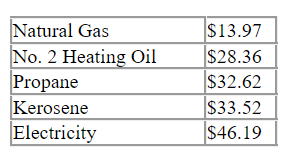
(Costs in Dollars per Million British Thermal Units (Btu))
Source: U.S. Department of Energy
AGA analysis shows that households that use natural gas for heating, cooking and clothes drying save an average of $1,068 per year compared to homes using electricity for those applications. Natural gas is projected to be half to one-third the price of other fuels through 2050. This affordability is enhanced by successes in energy efficiency. The typical residential natural gas consumer has cut their average fuel use by half since 1970, even as homes have become larger. This is the result of steady improvements in building and appliance energy efficiency, and the positive impacts of gas utility energy efficiency programs, and other measures that have contributed to steady improvements in energy efficiency.
“DOE's findings underscore why it's essential that consumers have the choice to select natural gas as their energy source” Karen Harbert. “Natural gas is not only a low-cost option but also the lowest-emissions resource for most consumers today. The infrastructure that delivers it continues to drive down emissions across the country, and continual innovations in renewable fuel supplies and energy efficiency will provide even more solutions for consumers looking to reduce their emissions in a cost-effective manner.”
ON THE SCHEDULE THIS WEEK
GWU Tackles Climate, National Security – Today at 12:30 p.m., the George Washington University Elliott School of International Affairs holds a discussion of the national security implications of climate change, particularly the nexus of geopolitical competition and climate change.
Forum Looks at Hydrogen Trucking – The Greater Washington Region Clean Cities Coalition and WGL holds a hydrogen forum today at 1:00 p.m. on expanding hydrogen transportation in the DMV. A national and global push is underway for increasing hydrogen usage in vehicles. There is a lot of work to do to create a regional hydrogen corridor for DC, Maryland, Virginia and the East Coast. Speakers will discuss the role of hydrogen in passenger, medium & heavy-duty vehicles.
CSIS Looks at Gulf States Cooperation on Climate – Tomorrow at 11:00 a.m., the CSIS Middle East Program holds a discussion on Gulf states’ strategies for dealing with climate change and an exploration of new opportunities for cooperation between Arab Gulf states and Iran. Speakers will include Kaveh Madani, Dr. Aisha al-Sarihi, and Amb. Douglas Silliman, with introductory remarks from former WaPo reporter Jason Rezaian.
ITA Forum Focuses on Nuclear – The International Trade Administration holds a forum on Wednesday at 11:30 a.m. on strengthening US leadership in the global nuclear energy landscape. With increased interest in nuclear energy to meet climate and energy security objectives, and growing foreign competition from state-owned entities, the United States can offer best in class products and services to help countries meet their civil nuclear energy goals.
USEA Looks at Carbon Management – The US Energy Assn holds a fireside chat on Wednesday at 2:30 p.m. on the importance of scale and economics in carbon management. Emitters who are focusing on the efficiency and energy penalty of carbon capture, de-risking of CO2 transportation and sequestration and regulatory changes, and possible feedback effects on plant operation, are able to chalk out a realistic roadmap for the safe energy transition. Dastur Energy CEO Atanu Mukherjee sits down with USEA’s Michael Moore to discuss.
Forum Looks at Solar Equity – On Wednesday at 3:00 p.m., Clean Energy States Alliance holds a webinar on equitable solar power. Speakers will showcase innovative approaches funders are taking to bring equitable solar to low- and moderate-income households. Speakers also will share examples of specific projects.
Forum Pushes IRA, Clean Energy Jobs – Climate Power holds a discussion on Thursday at 9:00 a.m. with business leaders on the clean energy boom since the passage of the Inflation Reduction Act. White House Senior Adviser for Clean Energy Innovation and Implementation John Podesta will be among the speakers.
SAFE Forum Looks at Critical Minerals – The SAFE holds a virtual webinar on Thursday at 10:00 a.m. on critical minerals and materials lists from experts at the U.S. Department of the Interior, Department of Energy, and Department of Defense. Minerals and materials are essential to many of society’s most important technological innovations: From semiconductors to solar panels and from smart phones to smart bombs. As the world becomes increasingly digital, connected, and electric, it will need additional supplies of these critical commodities to meet rising demand and to support countries’ economic competitiveness and national security. Speakers include USGS National Minerals Information Center Director Steve Fortier, DOE Senior Advisor on Critical Minerals Helena Khazdozian and DOD Strategic materials expert David Pineault. The event will be moderated by SAFE’s Head of the Center for Critical Minerals Strategy Abby Wulf.
Senate Energy Looks at AI – The Senate Energy Committee holds a hearing on Thursday at 10:00 a.m. on recent advances in Artificial Intelligence and DOE’s role in ensuring U.S. competitiveness and security in emerging technologies.
Senate Enviro Tackles Drinking Water, Wastewater – The Senate Environment Committee holds a hearing on Thursday at 10:00 a.m. looking at implementing the infrastructure Act with perspectives on The Drinking Water and Wastewater Infrastructure Act. Witnesses include North Carolina DEQ Secretary Elizabeth Biser, Washington Suburban Sanitary Commission (WSSC Water) GM & CEO Kishia Powell and North Dakota Rural Water Systems Association Executive Director Eric Volk.
DOE Clean Energy STEM Series Set – The Energy Department this September holds “EERE STEMtember Sessions: Careers in Clean Energy,” a weekly webinar series highlighting EERE careers in renewable energy, sustainable transportation and fuels, buildings & industry, and business operations. Each two-hour webinar will feature EERE leaders and employees, who will share their career journeys and explain why now is the most exciting time to be part of the clean energy revolution at DOE. The first will be Thursday at Noon.
Forum Looks at Solar, IRA One-Year – The Department of Energy holds a webinar on Thursday at 2:30 p.m. looking at the one-year anniversary of the IRA and what is next for the Solar Industry. Speakers will discuss how the Inflation Reduction Act has impacted domestic solar manufacturing and encouraged equitable solar energy deployment since it was passed last year—and where DOE sees the industry heading next.
Forum to Look at Hydrogen – Clean Energy Trade groups will hold a celebration of clean energy on the evening of Thursday from 5:30 – 8:30 p.m.
Forum Looks at Clean Energy Partnerships – The Atlantic Council’s Global Energy Center holds a forum on Friday at 8:00 a.m. for a discussion on US-emerging market clean energy partnerships to be held at the Atlantic Council headquarters in Washington, DC and virtually. Emerging markets are poised to constitute the lion’s share of global economic growth through 2050. To ensure growth in these markets continues both apace and in line with net-zero emissions goals, the US has a role to play in partnering with these markets on the deployment of clean technologies as a climate solution. Participants will engage in a public panel of experts and private sector representatives to discuss how the US clean technology sector can embrace the opportunity with emerging markets.
IN THE FUTURE
Forum Focused on Solar – The Smart Electric Power Alliance (SEPA) and the Solar Energy Industries Association (SEIA) hold RE+ 2023 on September 11th to 14th. The forum developed by the nation’s leading solar energy organizations reflects an ongoing entrepreneurial approach to renewing best practices across the clean energy landscape as the marketplace evolves.
RNG Forum Set – The Coalition for RNG holds RNG WORKS on Tuesday September 12th to Thursday the 14th in Nashville. The event educates, demonstrates and promotes RNG industry best practices, for purposes of helping realize sustainable development, deployment and utilization of renewable natural gas - and for purposes of helping achieve greater energy independence and access to domestic, renewable, clean fuel and energy supply.
WRI Look s at UN Report – Next Tuesday September 12th at 9:30 a.m., the World Resources Institute will hold a forum to unpack the UN’s Global Stocktake Synthesis Report. Climate experts will unpack the main findings from the United Nations’ synthesis report on climate action and outline concrete opportunities for how the Global Stocktake at the COP28 climate summit can serve as a springboard for bold steps to rapidly decarbonize economies.
USEA to Address Utilities Transition – The US Energy Assn holds a forum on Tuesday September 12th at Noon looking at the transformative future for utilities. From the wide adoption of renewable energy to new storage and new generation, including hydrogen and small modular reactors, the future is full of many hurdles and lots of excitement. Underlying it all is climate change and the growing importance of electricity in everything.
Forum to Look at Minnesota Utility Carbon Reductions – ICF International holds a forum on Tuesday September 12th at 1:00 p.m. looking at CenterPoint Energy’s Plan to Reduce Carbon Emissions. CenterPoint Energy, Minnesota’s largest natural gas utility, will share details of its innovative proposal to reduce carbon emissions, including renewable natural gas & hydrogen, a networked geothermal district energy system, end-use carbon capture, and advanced energy efficiency.
E&E Forum To Look at Carbon Capture – E&E News holds a forum on Tuesday September 12th at 1:30 p.m. with reporters Jean Chemnick, Carlos Anchondo, Corbin Hiar and Mike Soraghan to discuss the current state of play for carbon capture and where the emerging industry could be headed. Efforts to capture carbon pollution from smokestacks and the atmosphere have received strong support from Congress and the White House. Yet questions remain about the technology, economics, infrastructure and community support needed to scale up the carbon capture projects that the Biden administration is counting on to meet its climate goals. Will the legislative and regulatory incentives for carbon capture, pipelines and storage sites be enough to build a viable new industry?
Forum Looks at Climate-Smart Farms – The Environmental and Energy Study Institute (EESI) holds a briefing on Tuesday September 12th at 2:00 p.m. that explores the latest advancements in agricultural research, technology, and practices. The briefing will also explore how new policies could further support ongoing agricultural research. Among the speakers will be Stanford’s David Hayes, former Special Assistant to President Biden for Climate Policy.
BPC Addresses Ag Carbon Market – The Bipartisan Policy Center holds a symposium Wednesday morning September 13th looking at new horizons for the agricultural carbon market. The voluntary carbon market is expected to grow from $2 billion in 2021 to $10-40 billion by 2030. Agricultural carbon credits today comprise only about 1% of all carbon credits issued, but innovations to reduce livestock enteric methane emissions are poised to substantially grow. Former Ag Secretary Dan Glickman and former long-time Senate Ag Committee Director Chuck Conner are among the speakers.
BPC Focuses on Hydrogen – On Thursday at 1:00 p.m. at the US Capitol’s Senate Visitors Center, the BPC holds another forum on hydrogen’s potential to tackle critical energy challenges by providing a secure domestic source of reliable energy and reducing emissions from difficult-to-decarbonize sectors such as manufacturing and transportation. This congressional lunchtime briefing will examine the ways the private sector and the Federal government are working together to spur a U.S. hydrogen economy and how the Department of Energy is partnering with the private sector to achieve these goals. Speakers will include DOE Office of Technology Transitions Director Vanessa Chan, industry and Plug Power’s Erin Lane.
DOE Forum Focused on SAF – DOE’s Bioenergy office in collaboration with Argonne National Laboratory (ANL) and Idaho National Laboratory (INL) holds a forum on Thursday at 3:00 p.m. on Sustainable Aviation Fuel opportunities with bioenergy and how the Bioenergy Research and Education Bridge (BRIDGES) Program, a case study-based bioenergy education curriculum, can be incorporated. BETO and its partners have developed toolkits for four case studies covering Sustainable Aviation Fuel (SAF), upcycling plastics, bioenergy feedstocks, and waste-to-energy potential. Each case study toolkit includes a student and instructor guide and is focused on authentic research and development (R&D) scenarios using bioenergy technologies. A major advantage of teaching with BRIDGES case studies is that students will develop and strengthen skills in problem solving, complex decision making, and understanding R&D dynamics.
Forum Looks at Nuclear – The Carnegie Institution for Science holds a forum on Thursday September 14th at 6:30 p.m. on opportunities and challenges for advanced nuclear energy. The panel of experts will update and engage the audience about the state-of-the-art technology and future directions for its deployment, the rapidly evolving opportunities and challenges of deploying hundreds of advanced nuclear reactors in the U.S. and globally.
BCSE Hosts Masdar Exec to Discuss COP 28 – The Business Council for Sustainable Energy and the U.S.-U.A.E. Business Council are holding a luncheon discussion on Friday September 15th at Noon at Cafe Milano in DC with Mohamed Al Ramahi, CEO of Abu Dhabi Future Energy Company (Masdar). The event will also be live via Zoom. Al Ramahi will discuss Masdar’s plans to become one of the world’s largest renewable energy companies by 2030 by growing its clean energy capacity to 100 GW and 1 million tons per year of green hydrogen production. He will review Masdar’s extensive activities in the United States, where it has invested heavily in renewable energy and plans to invest further through the Partnership for Accelerating Clean Energy (PACE). He will also preview Masdar's goals, objectives and expectations for COP28, which will be held in the U.A.E. this year.
Climate Week NYC – Climate Week NYC starts on Sunday September 17th with the Opening Ceremonies. On Monday and Tuesday, September 18-19, Climate Group hosts The Hub Live, Climate Week NYC’s interactive program for innovative solutions, technologies and ideas that drive forward climate action now.
ACORE Forum on ESG Set for Climate Week – The American Council on Renewable Energy (ACORE) along with Climate Action and UNEP FI hold the 8th annual Sustainable Investment Forum North America, during Climate Week NYC on September 19th. The Forum will bring together industry leaders in sustainable finance and responsible investment, providing a platform to share best practices in financing the net-zero transition.
FP Hold UN Week Events – With the 78th UN General Assembly, Foreign Policy will hold FP @ UNGA 78 to explore the most pressing, complex, and interconnected global issues. Through a series of public briefings, roundtable discussions and forums, the events will examine the global energy transition, food security and sustainability, pandemic preparedness, universal health coverage, and the implications of digital transformation across the world. The events start next Tuesday at The Westin New York Grand Central for a discussion on artificial intelligence and the future of healthy cities. Then, on Wednesday Sept 20, FP delves into the health challenges posed by climate change, the future of universal health coverage, how we can strengthen food security amidst complex global challenges and the role of diagnostics in achieving SDGs. Finally, on Thursday Sept 21, experts on the role of technology in shaping international relations, and the global energy transition.
ASE Holds Efficiency Gala – The Alliance to Save Energy will celebrate the 31st annual Evening With the Stars of Energy Efficiency Awards Gala on Tuesday September 19th at the International Spy Museum in Washington, DC. The Gala draws hundreds of energy efficiency leaders from industry, government and academia together for an evening honoring the best and brightest in energy efficiency.
Columbia Forum Looks at Battery Transition Issues – On Thursday September 21st at 6:00 p.m., the Center on Global Energy Policy at Columbia University's School of International Public Affairs (CGEP) and Columbia Electrochemical Energy Center (CEEC) along with other influential figures across the battery supply chain, environmental groups, civil society stakeholders, and analytical experts holds a forum on balancing lithium production, investment, and policies for a sustainable energy transition. The event will foster a comprehensive and well-rounded conversation that considers tradeoffs from multiple perspectives by bringing together key players from various sectors to encourage an inclusive and open dialogue that delves into the complexities and challenges of lithium supply and its impact on the energy transition.
Critical Mineral Forum Set – The Colorado School of Mines and the Payne Institute for Public Policy are hosting their annual Critical Minerals Symposium on September 21 and 22nd in Golden, CO to convene world-class experts from government, business, investment and academics to engage in thoughtful discussion regarding the opportunities and challenges that lie ahead for the production and use of critical minerals, both internationally and domestically. The transition to a low carbon future will require an enormous amount of metals and minerals. Many of the key technologies, from renewable energy to electric vehicles, are witnessing dramatic growth. Critical minerals will become the backbone of the modern economy. However, the increase in demand for critical minerals will have profound impacts on the dynamics of trade, markets, and create new geopolitical challenges. Building on a long history of leadership in this area, Colorado School of Mines Critical Minerals Symposium will address these issues and more.
Clean Energy Week – National Clean Energy week will be held on September 25th to 29th. National Clean Energy Week is a celebration of the policies, industries, and innovations that power our daily lives while producing no or very little greenhouse gas emissions.
Forum to Look at Green Buildings – On Tuesday September 26th to Friday September 29th, the U.S. Green Building Council holds Greenbuild 2023: Building Transformation in Washington. Greenbuild’s theme highlights the decades-long legacy and unwavering commitment of the green building movement to transforming the built environment to serve, prepare and protect our communities in a rapidly changing world. The event will commemorate the USGBC’s 30th anniversary and mark the debut of LEED v5, the latest iteration of the LEED green building program that advances decarbonization, equity, health, biodiversity, and resilience in the built environment.
Natural Gas Conference Set – Hart Energy LIVE's second America’s Natural Gas conference will be held on September 27th in Houston and will focus on gas growth potential from the Marcellus and Haynesville to gas fairways in the Permian, Eagle Ford, and Gulf of Mexico. This conference unites American gas and energy players with world-leading influential experts, policymakers, decision-makers and business leaders to share their views on the significant issues shaping the global energy agenda.
RFF to Hold Geoengineering Forum – Resources for the Future (RFF) on September 28 and 29, for “Solar Geoengineering Futures: Interdisciplinary Research to Inform Decisionmaking", a two-day conference focused on the key questions informing ongoing research and decisionmaking on solar geoengineering. This hybrid event will feature an interdisciplinary group of leading solar geoengineering experts exploring the major challenges, uncertainties, and potential benefits related to this emerging set of technologies.
Forum to Look at Methane Issues, Policy – OurEnergyPolicy and bp America are a holding a luncheon Friday September 29th at Noon at the U.S. Capitol Visitor Center Room 217 on methane policy and issues. The event will kick off with opening remarks from Tomás Carbonell, followed by a panel featuring Carrie Jenks, Jon Goldstein, and Isabel Mogstad, moderated by Kyle Danish. The panel discussion will focus on business issues, climate challenges, and regulations regarding methane.
DOE to Host Hydrogen Forum – The Hydrogen Americas 2023 Summit & Exhibition will be co-hosted by the US Department of Energy and the Sustainable Energy Council (SEC) on October 2nd and 3rd in Washington D.C. 2023 will be a defining year for the hydrogen sector globally, with public and private sector investments flooding the market. The U.S. has taken the lead with its funding announcements, including the Inflation Reduction Act which is seen as a game changer. The EU, Canada and Australia are responding to the U.S. announcements with their own funding schemes, fueling a hydrogen race. The event features over 3000 industry leaders from across the value chain, including government representatives, hydrogen and energy stakeholders, service providers and offtakers who will be showcasing their latest technologies, project developments and policies.
SAF Forum Set for Houston – The Sustainable Aviation Futures series travels to North America on October 2nd to 4th in Houston to promote the development and adoption of practical solutions to produce and develop SAF and decarbonize the aviation sector. The event will combine structured networking activities alongside over 120 expert perspectives and more than 20 hours of content. Sustainable Aviation Futures North America will showcase the latest strategies for decarbonization, key industry challenges and exciting opportunities for airlines, corporates and fuel producers. DOE’s Valerie Sarisky-Reed, Gevo’s Tim Cesarek and Clean Fuels Alliance America’s Kurt Kovarik will speak.
Offshore Wind Forum Set for Boston – America’s Clean Power holds the Offshore WINDPOWER 2023 Conference & Exhibition on October 3rd and 4th in Boston, MA. The event has cultivated a dedicated and thriving global community of top developers and experts. As more steel goes in the water, this event will only continue to grow in value and scope.
Energy Efficiency Day Set – On Wednesday October 4th, Alliance to Save Energy, American Council for an Energy-Efficient Economy, U.S. Green Building Council and others host the 8th annual Energy Efficiency Day to showcase the benefits of energy efficiency. Each year, EE Day has drawn increasing support and, in 2023, the organizers aim to surpass last year’s 1,049 supporters sign on from local governments, utilities, organizations, companies, and utilities, and 47 cities, counties, states, or universities issued proclamations in support of EE Day as well as the U.S. Senate.
Biogas Forum Headed to St. Louis – The American Biogas Council holds a new Fall conference BUSINESS OF BIOGAS on October 10th to 12th in St. Louis for biogas project developers and investors who want to learn how to design projects to maximize biogas production and profitability.