
Energy Update: Week of September 26th
Energy Update - September 27, 2022
L’shana tovah!!! Coming to you on this Rosh Hashanah and wishing you a Happy New Year as we hit the Jewish high holidays this week and next.
After last week's big climate and clean energy conferences, this week is National Clean Energy Week and there will be a number of events focused on it. Republican Leader Kevin McCarthy will deliver remarks during the 2022 NCEW Policy Makers Symposium. He will be joined by nearly two dozen members of Congress as speakers including Sens. John Thune and Krysten Sinema, House E&C Republican Leader Cathy McMorris Rodgers and House Environment Subpanel Chair Paul Tonko, as well as Reps. Sean Casten, John Curtis, Debbie Dingell and Bruce Westerman, among others.
We start off this week though with a really important new analysis of Europe’s natural gas market and highlighted the immense potential of U.S. liquefied natural gas (LNG) to help Europe strengthen its energy security. The study from Rystad Energy shows that while the short-term outlook is challenging, new long-term supplies from abundant and affordable resources could fully replace Russian natural gas and rebalance the European market.
On the Hill this week, it is permitting time. On Sunday, Joe Manchin went all in to try and sell his effort to promote new permitting reforms and get it done in this week's government funding legislation, which has to be completed/extended by Friday night or else the government shuts down (which would not be good 40 days before an election). Not only did he make a hard push on Fox News Sunday, he also penned an op-ed in the Wall Street Journal making the case for moving now on permit reforms that will allow the clean energy transition to become a reality. This is what gets lost in this issue in my mind when we focus on progressive activist opposing the deal. If we don't have permit reform, the renewable energy transition will never occur in the time frame that activists want it to. I will be on Sirius XM's POTUS on Thursday morning at 6:20 a.m. with Julie Mason to discuss this very topic.
Finally, just want to put on your radar a potential announcement this week related to deep sea mineral collection. You may have seen the recent front-page NYT story that provides an important look at the issues related to deep-sea minerals collection and how much the available resource can have an impact on providing much-needed critical minerals for EVs and renewable energy projects. Stay tuned…
Keeping our eyes on Hurricane Ian this week so you don’t have to!!! Call with questions.
Best,
Frank Maisano
(202) 828-5864
C. (202) 997-5932
FRANKLY SPOKEN
"Absolutely not and that would be the road to Hell for America."
– Jamie Dimon, JPMorgan Chase & Co. CEO to Rep. Rasheeda Talib at a House Banking hearing when asked whether US banks should divest from fossil fuels.
"It's an exciting time. The politics of it are frustrating to guys like me sometimes. I personally think that this antiquated notion that if you're for fossil fuels, you're the political right, and if you're for clean energy, you're of the political left is totally outdated. We have to get past this. And I think conservatives and Republicans need to embrace the opportunities in the clean energy transition."
Neil Chatterjee, former Chairman of the Federal Energy Regulatory Commission (FERC) under President Trump on the Fueling the Future of Transport podcast with Tammy Klein to talk to us about the Inflation Reduction Act, electrification and the future of power generation in the U.S.
ON THE PODCAST
NYT Podcast Discusses Deep Sea Mining Promise, Peril – In this NYT The Daily podcast, host Natalie Kitroeff spoke with investigative reporter Eric Lipton about how The Metal Company and the International Seabed Authority, a regulator, are balancing billions of dollars in profits against the future of the ocean floor.
FUN OPINIONS
Manchin: Take advantage of Opportunity to Pass Permitting – In an op-ed in the Wall Street Journal, Sewn. Manchin writes in the midst of a global energy war, and the American people—Republican, Democrat and independent—are paying the price and need common-sense permitting reforms to help cut costs and accelerate the building of the critical energy infrastructure we need. He hammers the "extreme ideologies and politics" while pushing back on Republicans who in normal times would certainly favor the elements of his permitting plan. He also said he has worked with them during his entire career, even more than Sen. Bernie Sanders, who he never expects to support his approach.
FROG BLOG
WSJ Ed Board: Manchin Permitting Bust – The editorial board at the Wall Street Journal hit back at Sen. Manchin’s permit plan, calling it a disappointment. “His take-it-or-leave-it proposal includes some marginal improvements that will benefit renewables but it creates new regulatory risks for fossil fuels, which is the opposite of what he promised. We say this with regret because we had hoped the West Virginia Democrat had won more in return for his vote to pass his party’s tax increase and climate spending bill. The U.S. economy needs reform to break up regulatory and legal bottlenecks that delay projects for years if they are ever built. Mr. Manchin had political leverage, but the bill shows he traded his vote on the cheap.”
WaPo: Ratify Kigali HFC Treaty – Last week, the Senate ratified the Kigali HFC Phasedown amendment to the Montreal Protocol. In an editorial, the Washington Post ed board said the effort is rare for a climate change measure to win full-throated support from industry groups, environmental activists and lawmakers from both sides of the aisle. Ratifying the Kigali Amendment to the Montreal Protocol bolsters US manufacturing and shows US commitment to climate leadership — a true win-win. Yet even the most innocuous climate proposals tend to die in Congress, as politicians seek opportunities to score points with their base by engaging in climate demagoguery. For once, that [didn’t] happen — and on a measure that promises to do a lot of good.
FUN FACTS
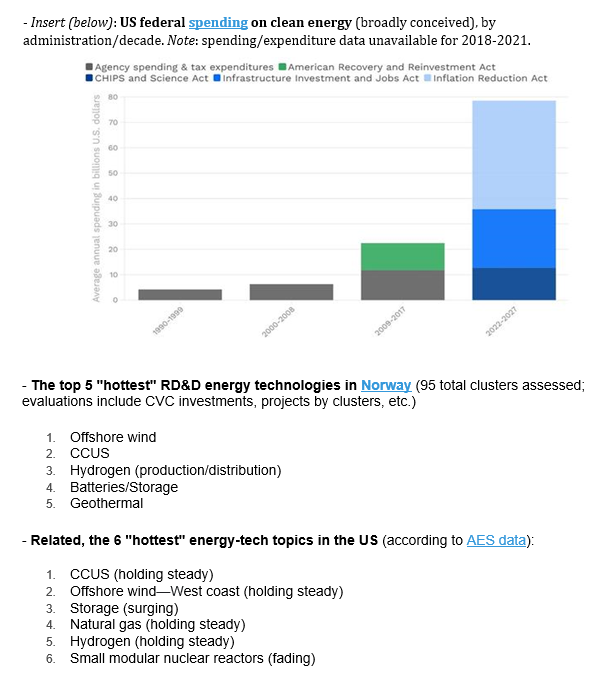
- Some Clean Energy Spending Stats:
IN THE NEWS
New Study: US LNG to Meet Europe’s Energy Needs in Short-, Long-Term – As global natural gas markets continue to tighten and Europe braces for a challenging winter, the American Petroleum Institute (API) and the International Association of Oil and Gas Producers (IOGP) today released a new analysis of Europe’s natural gas market and highlighted the immense potential of U.S. liquefied natural gas (LNG) to help Europe strengthen its energy security. The study, conducted by Rystad Energy, found that while the short-term outlook is challenging, new long-term supplies from abundant and affordable resources could fully replace Russian natural gas and rebalance the European market.
The Details: The study, “Rebalancing Europe’s gas supply: opportunities in a new era,” shows that abundant and affordable global natural gas resources will make it possible to substitute Russian imports before 2030 but warns that Europe will face a tight natural gas market over the next couple of years with limited short-term options to replace Russian supply. The study shows:
- Without Russian pipeline gas, Europe’s demand for LNG is projected to increase 150% from 2021-2040 as overall natural gas demand declines more slowly than domestic production and non-Russian pipeline imports.
- LNG is projected to meet approximately 50% of Europe’s natural gas demand through 2030. After 2030, LNG will meet an even greater share, reaching about 75% of demand by 2040.
- Growth in European LNG demand will be more than double the 50 bcm (4.8 bcf/d) specified in the March joint agreement between the Biden administration and the EU. While US LNG is already flowing to Europe at record levels, significantly more will be required to fully rebalance European gas markets.
Rebalancing Europe’s NatGas Market – The decisions European and U.S. policymakers make today will impact Europe’s ability to rebalance its natural gas market with dependable, affordable and sustainable energy in the years to come. The study concludes:
- To meet the shared energy security commitments of the U.S. and the EU, the U.S. will need to expand its LNG export capacity and the EU will need to expand its import capacity over the next several years.
- Long-term LNG purchases and infrastructure contracts are crucial to ensuring a stable supply of energy and should be supported by an appropriate European legal framework.
- Timeliness and transparency across the permitting and approval process for the full natural gas and LNG value chain is critical to helping the United States meet its commitments and strengthen global energy security.
U.S. proved reserves of natural gas have increased nearly every year since 2000 due to advancements in natural gas exploration and production technologies. According to the EIA, while U.S. natural gas consumption is expected to average a record 86.6 Bcf/d in 2022, steady gains in drilling activity have boosted U.S. natural gas production to near record highs, thus ensuring a well-supplied domestic market while simultaneously meeting rising global LNG demand.
Manchin Permitting Plan Surfaces – Sen. Joe Manchin pitched his permitting reform legislation to a crowd of global energy leaders and private sector executives as essential to achieving the full goals of the Inflation Reduction Act, he helped craft, POLITICO reports. Manchin told the Global Clean Energy Action Forum in Pittsburgh that the Senate would start voting on the permitting legislation next week, likely on Tuesday. But the legislation faces stiff opposition in both parties. The permitting bill would set limits on environmental reviews and require the president to identify energy projects of critical national importance, but details remain elusive.
Senate Ratifies Kigali HFC Phase Down – By a vote of 69-27, the U.S. Senate voted to ratify the Kigali Amendment, which calls for phasing down HFCs. The U.S. already has laws in place along similar lines. In 2020, Congress passed a bipartisan bill that requires phasing down HFCs by 85% over 15 years. HFCs are frequently used in appliances such as air conditioners and refrigerators and can be thousands of times more powerful than carbon dioxide in terms of warming the planet. U.S. implementation of the Kigali Amendment, which established a global structure for the phase down of high-global warming potential refrigerants, ensures that U.S. companies can continue to supply countries around the world with the most innovative, energy efficient HVACR and water heating products and equipment. Under provisions of the Amendment, non-ratifying countries face severe restrictions on the sale of such products past the 2033 ratification deadline. Successful phase out of HFCs will reduce global temperatures by 0.5° C by 2100. AHRI President & CEO Stephen Yurek noted that failure to ratify materially harms the interests of U.S. manufacturers and relinquishes U.S. technology leadership to China and other economic rivals for an industry vital to the health, safety, comfort and well-being of every American. The HVACR industry accounts for more than $256 Billion of economic output in the United States and employs more than 300,000 Americans. Yurek and E2's Bob Keefe wrote an op-ed in the NY Times making the case for ratifying the Kigali amendment last year, outlining the specific reason ratification is necessary. The US Chamber of Commerce has also made this “A Key Vote.” Here is the letter that was sent to the Members of the United States Senate, supporting ratification of the Kigali Amendment to the Montreal Protocol. With Senate ratification, the U.S. has joined 137 nations and the European Union in signing on to this crucial accord.
DOE Launches Industrial Sector Decarb Effort – The Department of Energy has launched the Industrial Heat Shot to dramatically reduce the cost, energy use, and carbon emissions associated with the heat used to make everything from food to cement and steel. It seeks to develop cost-competitive solutions for industrial heat with at least 85% lower greenhouse gas emissions by 2035which would put the American industrial sector on course to reduce its carbon equivalent emissions by 575 million metric tons by 2050, roughly equal to the annual emissions generated by all passenger cars currently on the road.
DOE Sets Hydrogen Hibs Funding Opportunity – Hydrogen Hubs Speaking of DOE, it said it will begin accepting applications for $7 billion in funding to build six to 10 clean hydrogen hubs across the country. As part of a larger $8 billion hydrogen hub program funded through President Biden’s Bipartisan Infrastructure Law, the H2Hubs will be a central driver in helping communities across the country benefit from clean energy investments, good-paying jobs, and improved energy security – all while supporting President Biden’s goal of a net-zero carbon economy by 2050.
ON THE SCHEDULE THIS WEEK
National Clean Energy Week Set – The 6th annual National Clean Energy Week 2022 (NCEW22) is this week. NCEW22 is a bipartisan opportunity to celebrate American clean energy innovation. REGISTER for the VIRTUAL Policy Makers Symposium AND hear from legislators, industry leaders, and clean energy advocates. NCEW is a weeklong celebration of the policies, industries, and innovations that power our daily lives while reducing emissions. Join us to recognize what an all-of-the-above clean energy future can bring: American energy independence, economic prosperity, & a healthier climate. Register for FREE here.
Forum to Look at Green Banks – Today at 4:00 p.m., the Atlantic Council Global Energy Center holds a discussion on the importance and role of a national green bank in accelerating an equitable transition to a clean energy economy. During this panel discussion, experts will discuss opportunities for the Biden Administration to successfully build a national green bank and unlock investment to support an equitable and just clean energy future.
Carbon Removal Conference Set – Tomorrow and Wednesday Northwestern’s Institute for Carbon Removal Law and Policy holds its 2nd Annual Carbon Dioxide Removal Law & Policy Conference. Panelists representing multiple carbon removal approaches will discuss regulatory frameworks, responsible deployment, community engagement, and effective governance. With promising solutions to reach cost-effective gigaton scale removal, startups offer a crucial and engaging perspective around responsible carbon removal deployment. DOE’s Jennifer Wilcox is the Keynote.
Forum Looks at Advanced Manufacturing – Tomorrow at Noon, Advanced Energy Economy hosts a webinar to look at advanced energy manufacturing. Advanced energy and transportation manufacturers will discuss how they’re planning to respond to the opportunity — and challenge — the Inflation Reduction Act presents, building a U.S. manufacturing base for the products that decarbonize the electric power and transportation sectors.
Axios Holds One-on-One with Shah – Tomorrow at 12:30 p.m., Axios Pro Climate Tech reporter Alan Neuhauser will host a one-on-one conversation with DOE Loan Program Director Jigar Shah. Shah heads the Department of Energy Loan Program Office, which has $290 billion in loan authority following enactment of the Inflation Reduction Act. This conversation will focus on long-term capital formation in climate-tech, and the role his office now plays in it.
Forum Looks at Community Solar – The World Resources Institute holds a forum tomorrow at 12:30 p.m. on advancing energy equity through community solar. Community solar can offer financial advantages and flexibility that make it an accessible and cost-saving offering for low-income households and disadvantaged communities. It can also help build community wealth, mitigate environmental harms and strengthen resilience.
R St Looks at Critical Minerals – The R Street Institute holds a webinar tomorrow at 12:45 p.m. on critical minerals, supply chains and domestic manufacturing. A global clean energy transition utilizing existing technologies like EVs and renewable electricity is an extraordinarily minerals-intensive proposition. A panel will explore major issues facing domestic mining, inventing substitutes, recycling and reprocessing.
Forum Looks at Solar IRA Issues – DOE Solar Energy Technologies Office (SETO) holds a forum tomorrow at 2:00 p.m. on the recent policy changes in the Inflation Reduction Act (IRA) have created and updated incentives for solar deployment and domestic solar manufacturing. These changes, along with other enacted policies and past actions, can reduce carbon emissions to 40% below 2005 levels by 2030, equivalent to the combined annual emissions of every home in the United States. SETO experts will discuss how these changes impact the future of solar deployment, manufacturing, innovation, and more. The webinar will also discuss the IRA’s broader implications for SETO’s Solar Futures Study analysis, which modeled the deployment of solar necessary for a decarbonized grid by 2035.
Brookings to Look at City Investments – Brookings Metro will host an event tomorrow at 2:00 p.m. to examine how city leaders can accelerate climate planning and action in the current era of historical federal investment. The event will build off the forthcoming Brookings Metro report, "The missing middle of decarbonization: Exploring gaps in city climate planning and the need for regional action," which analyzes the implementation potential of 50 different city climate plans. In addition to a presentation of the report’s major findings, the event will feature remarks from federal leaders on challenges and opportunities to advance climate action across the country, and a panel of local leaders discussing needs around goal setting, strategy execution, funding projects, and expanding equity.
Forum Looks at Hydrogen Infrastructure – Tomorrow at 2:30 p.m., the CSIS Energy Security and Climate Change program holds a discussion on hydrogen infrastructure featuring Ben Wilson (National Grid), Steven Hamburg (Environmental Defense Fund) and Melanie Kenderdine (Energy Futures Initiative). Joseph Majkut will moderate the event.
CRES Honors Republican Energy Leaders – During National Clean Energy Week, CRES honors select Republican policymakers who have gone above and beyond to protect our environment and our prosperity. This year’s CRES Clean Energy Champions are Sens. Dan Sullivan and Kevin Cramer as well as Reps. Dan Newhouse and Mariannette Miller-Meeks. The CRES Clean Energy Champions Reception will honor these leaders tomorrow at the Capitol Hill Club in Washington D.C. Drinks and conversation will begin at 5:30PM, and short remarks from attending honorees will be around 6:00 p.m.
Forum to Look at Middle East Challenges – TRENDS Research and Advisory and the Atlantic Council’s Scowcroft Middle East Security Initiative hold a two-day conference on “Sustainable Security of the Middle East: Climate Change, Challenges, and Prospects.” This event will take place from Wednesday and Thursday, both in person at the Atlantic Council Headquarters and online. This year’s conference will take the pulse of climate action in the region, explore environmental challenges and opportunities, and showcase ambitious solutions. The event’s plenary and panel sessions will offer unique perspectives that focus on resilience against climate risks, the transition to a low-emission economy, and collaboration to solve pressing challenges. The goal is to elicit insights from practitioners and experts from the region and beyond to formulate recommendations for policymakers.
Wilson Looks at Energy Innovation Cooperation in Japan-US – The Woodrow Wilson Center holds a forum on Wednesday at 9:00 a.m. on energy technology innovation and Japan-US decarbonization cooperation. The event will be a discussion on the challenges and opportunities of balancing the need for growth and sustainability, and prospects for cooperation between Tokyo and Washington in developing new energy technology in the Indo-Pacific.
Forum Looks at Africa Energy Transition – On Wednesday at 11:30 a.m., the Carnegie Endowment for International Peace’s Africa Program and The African Climate Foundation hold a forum covering negotiations of the Just Energy Transition Partnership, progress toward implementation in South Africa, implications for other African countries, and the changing role of the international community in mobilizing climate finance.
Forum to Address Thermal Energy – The Center for Climate and Energy Solutions (C2ES) holds a forum on Wednesday at Noon on thermal energy storage. Thermal Energy is a promising technology for replacing the heat demand of industrial facilities with electricity from renewable sources. Three innovative RTC companies that have developed thermal storage technologies to decarbonize industrial emissions Rondo Energy, Antora Energy and Brenmiller Energy will speak.
Forum to Look at Climate Action in Schools – The Environmental and Energy Study Institute (EESI) holds a briefing on Wednesday at 3:00 p.m. looking at catalyzing climate action in K-12 schools. From electric buses to energy-efficient, resilient buildings, implementing climate solutions in schools can reduce greenhouse gas emissions while also creating a healthier environment for students and teachers to learn and work in. During this briefing, panelists will discuss the federal policy levers needed to scale up climate mitigation and adaptation actions in schools to build a more sustainable, resilient, and equitable education sector.
Forum to Look at Grid Connections – On Wednesday at 3:00 p.m., the Clean Energy States Alliance holds a forum on solving grid connection problems. As the energy transition accelerates, an unprecedented number of clean energy projects have applied to connect to the power grid. This flood of proposed projects has created unprecedented delays, with the average wait time for a permit now exceeding three years. Speakers will include Joe Rand of the Lawrence Berkeley National Lab, Beth Soholt of the Clean Grid Alliance and Advanced Energy Economy’s (AEE) Jeff Dennis.
Forum Looks at Offshore Wind – The Departments of Energy, Interior, Commerce and Transportation launched ambitious initiatives to position the U.S. to lead the world on floating offshore wind design, development, manufacturing, and deployment. This included the Floating Offshore Wind Shot, a goal to deploy 15 GW of floating offshore wind by 2035, enough to power over 5 million American homes, and close to $50 million in R&D funding. This webinar on Wednesday at 3:30 p.m. will share more information about those efforts, including background and context, goals, focus, and next steps.
Conference Tackles Energy, Power – On Thursday, Sequire Energy and R St host an Energy and Power Conference featuring some of the industry’s leading experts, new technologies and features a sneak peek at the future of the energy and power sectors.
Hudson Hosts Sen. Sullivan – The Hudson Institute holds an American Energy Security Conversation with Sen. Dan Sullivan on Thursday at 10:00 p.m. Sullivan and Hudson Institute Senior Fellow Brigham McCown discuss the need for a clear and concise national energy policy that ensures an accessible, affordable, and reliable supply of domestic energy for the nation.
Republicans Outline Priorities for Energy, Enviro Policies – The Center on Global Energy Policy will host a panel Thursday at Noon featuring former senior Republican Congressional and Administration officials who will discuss their views on what Republican energy and environmental policy should be. Former U.S. Deputy Secretary of Transportation Jeffrey A. Rosen, former Chief Counsel for the Senate Energy and Natural Resources Committee Kellie Donnelly and former CEQ chair Jim Connaughton will discuss.
Forum to Look at Innovations, Tech Needed to Meet Climate Goals – On Thursday at Noon, Congressman McEachin hosts his annual legislative conference at the Washington Convention Center. The event will focus on nuclear, carbon capture and the technologies needed to meet climate goals. This discussion will consider the benefits and drawbacks of what technologies and policies are necessary to meet our climate goals and what their impacts may be on environmental justice and minority communities.
ACEEE Discusses Community Scoring Tool – On Thursday at 1:00 p.m., the American Council for an Energy-Efficient Economy holds a forum on how communities can use the recently released version of the Self-Scoring Tool (Version 6) to measure their efforts to save energy and reduce greenhouse gas emissions with energy efficiency and clean energy policies and programs. The tool, which places a greater emphasis on racial and social equity, allows communities to assess progress in five policy areas: community-wide initiatives, buildings policies, energy & water utilities, transportation policies, and local government operations.
House Climate Committee Looks at Climate Investments – The House Select Committee on the Climate holds a heating on Thursday at 1:30 p.m. on the recent new climate law. This hearing will examine how the climate investments in the Inflation Reduction Act will help lower electric and fuel bills for American families, create jobs, and expand investments in U.S. manufacturing of clean energy, clean vehicles and climate solutions.
House Resources to Look at Puerto Rico Power Issues – On Friday at 9:30 a.m., the House Resources Committee will hold a hybrid oversight hearing on Puerto Rico’s post-disaster reconstruction and power grid development.
Energy Happy Hour Set – On Friday, the US Energy Economists and Leaders in Energy host a happy hour at 6:00 p.m. at the Continental Pool Lounge & Beer Garden.
IN THE FUTURE
Forum to Look at Critical Minerals – Next Tuesday at 11:00 a.m., the Wilson Center and the U.S. Agency for International Development (USAID) hold an expert discussion on what better looks like when it comes to mining, processing, recycling, and consuming critical minerals such as lithium, cobalt, niobium, and titanium. Ford’s Christopher Smith is among the speakers.
Forum to Look at Equity Metrics – ICF International holds a forum on utility equity metrics. The forum will feature DTE Energy experts that will share details on its pioneering efforts to address energy equity in communities with the greatest need: customers with the highest energy burden and low adoption of incentives.
National Energy Efficiency Day – October 5th. See more here
Forum Looks at COP27 Goals, Just Outcomes – On Thursday October 6th, the Allied for Climate Transformation (ACT2025) consortium holds a high-level webinar where speakers from around the world will set clear expectations for a positive outcome at the UN climate summit in Egypt this November. During the event, ACT2025 partners will offer a united vision for success at COP27, including addressing loss and damage, scaling up support for adaptation action, strengthening climate targets and assuring climate finance promises will be met.
Forum Looks at Just Climate Policymaking – On Friday October 7th at 9:00 a.m., the Consortium for Science, Policy & Outcomes at Arizona State hosts Kaiping Chen (University of Wisconsin-Madison) for a New Tools in Science Policy seminar. Chen will share her research and practice in science communication to introduce how policymakers can harness online tools and strategies, and in-person community engagement for effective and inclusive public policymaking around issues like climate resilience. She will also showcase how to collect and analyze large-scale community data for evidence-driven policymaking in sustainability issues.
Hydrogen Day – Saturday, October 8th. The date October 8 was aptly chosen for the atomic weight of hydrogen (1.008).
DOE Hydrogen Summit Set – The Sustainable Energy Council and the U.S. Department of Energy announce the 2nd Hydrogen Americas Summit taking place on October 10 – 11th. The Summit convenes Government representatives, hydrogen and energy stakeholders, service providers and end-users to identify opportunities and get insights into the latest projects and policy developments that will be crucial to drive the Region’s industry forward. View the Program. Sect Granholm headlines a host of DOE and state speakers while Air Liquide CEO Adam Peters is among the industry speakers. See the list here.
Chamber Sustainability Summit Set – On Tuesday October 11th, the U.S. Chamber of Commerce Foundation will host the 2022 Sustainability and Circular Economy Summit in Washington, D.C. This event will convene corporate responsibility professionals, government leaders, academics, and sustainability changemakers to learn and educate one another on replicable, successful sustainability and circular economy initiatives. This year's conference will feature top leaders to discuss how companies are navigating these uncertain times, cutting-edge strategies for achieving sustainability goals, and how to leverage collaboration and innovation to channel emerging trends into lasting systemic change. Duke Energy’s Katherine Neebe speaks.
RFF To Look at Urban Wildlife Interaction – Resources for the Future (RFF) on Wednesday, October 12th for the second RFF Live event in the “Sparking Solutions” webinar series, where they will discuss the benefits and challenges of addressing the wildland-urban interface problem. The session will touch on the costs and effectiveness of alternative approaches, including land use policies, building codes, landscaping ordinances, homeowner education programs, and more; examples of community success stories; and other potential creative solutions. US Forest Service Rocky Mountain Research Station Patricia Champ is among the speakers.