
Energy Update: Week of October 9th
Energy Update - October 09, 2023

Friends,
First, our thoughts are with our friends in Israel with the attack over the weekend. We have many colleagues in the clean energy and innovation space over there and want to keep them and every one safe.
Happy Columbus/Indigenous Peoples Day. Starting today with my location this weekend: Providence and Boston. As an Italian-American, I try to spend just about every year in one of those two places where the cannolis are great and the Lasagna is even better. The only place that can rival it is Columbus, Ohio (of course) where I was last year. Also, I hope everyone celebrated Hydrogen Day yesterday (of course the weight of Hydrogen is 10.08). Maybe we will see some announcements on Hydrogen Hubs soon (but don’t think on 45V)…We are tracking both.
Speaker McCarthy did not survive a challenge from a handful of hard-line conservatives and was historically bounced out as Speaker last week. While it won’t be a major issue among our energy issues, it will be a distraction. NPR spoke with my colleague and all-around political expert Liam Donovan about what it says about the state of the GOP and what may be next this week. Liam also wrote a vignette for a POLITICO Magazine forum that asks why Republicans keep eating their young (and old.) The essay is worth the read.
This week, the House will be focused on electing its new Speaker with a Republican Conference meeting on Wednesday. The earliest we could have a vote would be Thursday, but it is very unclear as to how quickly this can be resolved. The clash in Israel started over the weekend may impact members’ willingness to speed up this process. Candidates include current House Whip Steve Scalise and House Judiciary Chair Jim Jordan. While I don’t have any opinions on either and energy issues won’t be a major factor in decisions, one thing to consider from an energy perspective: Scalise is much more substantive on the full array of energy issues given his Louisiana/energy heavy background. Jordan on the other hand, tends to focus more on the political aspects of energy issues which tend to be less substantive and more focused on culture. The Senate is out this week. Both have November 17th as the next key funding deadline.
Some good events this week all on a packed Wednesday including CSIS hosting the release of EIA’s International Energy Outlook 2023, and ACORE holding its major Grid Forum with FERC’s Allison Clements and DOE’s David Turk. The Brookings Initiative on Climate Research and Action hosts an event to dig into questions about climate policy with John Podesta, that also includes an IRA/Climate policy panel moderated by NYT Climate reporter Lisa Friedman. Finally, Semafor's Steve Clemons hosts Constellation CEO Joe Dominguez for an exclusive one-on-one discussion examining the state of the energy transition.
Finally, this Friday we have an October Friday the 13th, so get ready for some pre-Halloween scary stuff. So how often does Friday the 13th occur in October? Not often. Check out a listing of all the Friday the 13ths from 1801-2199 by clicking here. Sometimes they fall six years apart but most often, they come every 11 years. Some recent examples of when Friday the 13th falls in October: 2000, 2006, 2017, with the next one after this year in 2028. We are in the rare 6- and 11- cycle giving us one only five years apart in an 11th year. So be careful on Friday!!!
Lots of international climate focus this week with separate meetings in Marrakesh and Egypt as we run up to COP28. Let us know what you are tracking, especially with hydrogen. Feel free to check in for updates with Liam on the Speaker’s race.
FRANKLY SPOKEN
“The payoff from investments by the natural gas utility industry is immense and we’re seeing results in the form of lower bills for customers and through reduced greenhouse gas emissions. The tremendous energy savings achieved by these programs testify to their effectiveness.”
AGA VP, Energy Markets, Analysis and Standards Richard Meyer on a recent report on investments in efficiency.
ON THE PODCAST
Harder Talks Climate Week NYC, Deep-Sea Minerals with Energy Gang – In this week’s Energy Gang Podcast, Ed Crook’s talks with Cipher News head Amy Harder, mostly-focused on critical minerals and deep-sea mineral collection.
DOE Official Talks Grid Reliability – Gene Rodrigues, the Assistant Secretary of DOE’s Office of Electricity provides a deep understanding of the current grid challenges, especially in light of recent natural disasters and changing energy demands. On the Energy Central podcast this week, host Jason Price and Producer Matt Chester get OE's viewpoint on grid reliability amid these evolving challenges. Gene delves deep into the symbiotic relationship between the DOE and utilities, discussing grid edge resources, the strategy behind boosting generation and transmission capacity, and the undeniable impacts of deferred maintenance and supply chain strains post-pandemic.
FUN OPINIONS
Meyer: Appliance/Climate Is Key Fight than May Falter – In an opinion in The New York Times, Heatmap’s Robinson Meyer argues that the Inflation Reduction Act’s $9 billion effort to help people decarbonize their homes is faltering. The I.R.A. is going to change people’s lives — I have little doubt of that. But only eventually. And for the next year, many of the law’s benefits for average Americans will remain largely theoretical. The M.I.T. and Rhodium tracker says that of the $137 billion in announced clean-energy investment, only $37 billion — just 27 percent — has started to flow. There is a growing risk that as the presidential election arrives, the law’s most world-changing programs to stimulate clean electricity and E.V.s will have yet to show their impact, and its smaller programs will be mired in public operation headaches.
FROG BLOG
Critical Minerals Supply Chain Essentials – In a new essay by Brian Deese, former head of President Joe Biden's National Economic Council, and Columbia University and former head of President Obama’s NEC Jason Bordoff outlines the importance of critical mineral supply chains and why EVs and other climate-friendly tech don't simply replace oil reliance with a new form of resource insecurity. Bordoff and Deese say battery supply chain risks are real, but "minerals and batteries are inputs to manufactured products, not the daily flow of energy that keeps our lives running."
FUN FACTS
US Still Top Oil Producer: Since 2018, the US has been the world's top oil producer, currently at about 18 mb/d or 1/5th of the total global supply, and 75% of that total comes from five states: Texas, New Mexico, North Dakota, Alaska, and Colorado. (Note: US petroleum exports continue to set records.)
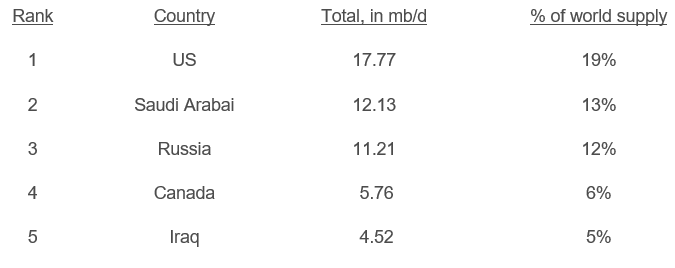
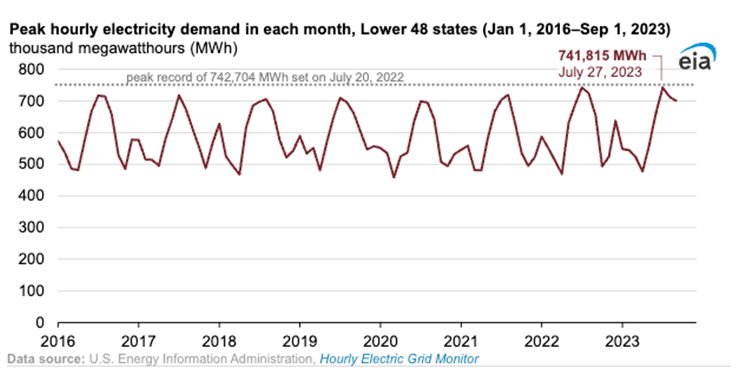
Chart on Electricity Demand: Peak hourly U.S. electricity demand in July was the second highest since 2016 according to EIA. Weather is a large driver of electricity demand, especially in summer months when homes and businesses use electricity for air conditioning. Peak hourly electricity demand in the United States typically occurs in either July or August when demand for space cooling is the highest.
IN THE NEWS
New Offshore Wind Report Rolled Out – The American Energy Society has published Winds of Change: The State of Offshore Wind on the US West Coast. This new report (and corresponding dataset of SMEs, organizations, policies, events, etc.) is probably the most comprehensive resource about the sector that is available right now. For more information. Please check it out here: https://www.energysociety.org/osw2023.html
AGA Releases Natural Gas Efficiency Programs Report – The AGA released its Natural Gas Efficiency Programs Report for 2020. This work, anchored in the bedrock of data derived from our annual energy efficiency survey, seeks to present an informed, objective, and robust analysis of our industry’s strides towards efficiency. Natural gas utility spending on energy efficiency programs reached nearly 1.6 billion in 2020, an increase of 391 percent since the survey began in 2007. In 2020 alone, U.S. natural gas efficiency programs saved 325 million therms of energy. This equates to 1.7 million metric tons of greenhouse gas emissions averted, or approximately the emissions generated by driving a car 4.6 billion miles. The report finds that the responding companies spent a total of $4.3 million each day on energy efficiency programs in 2020. Respondents indicated direct impact activities like energy efficiency audits or targeted implementation of energy-efficient upgrades in 93 percent of commercial and industrial programs, 74 percent of residential single-family programs, 89 percent of residential low-income programs, and 70 percent of residential multi-family programs.
HFC Rules Move Forward – EPA released its final rule on HFC Technology Transitions and its proposed rule on Emissions Reduction and Reclamation last week. The Air-Conditioning, Heating, and Refrigeration Institute (AHRI) expressed its support for the first; its optimism regarding the second. AHRI President Steve Yurek said they are heartened that the EPA respected our sincere comments on the Technology Transitions Rule, addressing many of our concerns, and creating the certainty that is so important for industry innovation and job creation. The rule establishes a very reasonable, 3-year sell-through period for HFC-containing equipment; and establishes effective dates that are within the first major step-down period under the AIM Act.
“While we and our member companies will – as always - carefully review the rule, we appreciate what we’ve seen in our initial review.
With respect to the refrigerant management proposed rule, we will carefully review it and will plan to submit extensive comments by the due date. Our initial response to the rule, however, is optimistic as it appears to establish parameters that could help our industry in its desire to streamline refrigerant management and increase reclamation and recycling efforts.”
OPEC Raises Demand Outlook – The Organization of the Petroleum Exporting Countries raised its global oil demand forecast by 16% to 116 million barrels a day in 2045, around 6 million barrels a day more than previously forecast. The growth will be driven by road transportation, petrochemicals and aviation, as India is expected to double its consumption to nearly 12 million bpd, while China is expected to gain 4 million bpd by that time.
Newsom Signs Wave Energy Legislation – California Governor Gavin Newsom today signed SB 605 into law, marking a significant step forward in bringing a new renewable energy resource to the state and further solidifying California’s commitment to a sustainable and clean energy future. The legislation calls for an extensive study and assessment of wave and tidal energy potential off California’s 840-mile coastline. The bill unanimously passed in both the California State Senate and Assembly. The bill directs the California Energy Commission to work with various state agencies and stakeholders to assess the feasibility, costs, and potential of deploying wave and tidal energy technology across California’s coastline. AltaSea at the Port of Los Angeles, a 35-acre ocean technology campus, is the primary sponsor of the legislation. AltaSea will soon be home to some of California’s first wave energy pilot stations, including Eco Wave Power’s first US onshore wave energy pilot station – the first of its kind built in the United States. AltaSea has also established a coalition of over 30 wave and tidal energy companies to help showcase its potential in California.
ON THE SCHEDULE THIS WEEK
Biogas Forum Headed to St. Louis – The American Biogas Council holds a new Fall conference BUSINESS OF BIOGAS today to Wednesday in St. Louis for biogas project developers and investors who want to learn how to design projects to maximize biogas production and profitability.
Hydropower Conference Set – Clean Currents 2023 takes place in Cincinnati, Ohio, tomorrow to Friday. Clean Currents 2023 programming is relevant to both technical- and business-focused professionals involved with waterpower. Attendees include conventional hydropower, pumped storage, small hydro, marine energy, government agencies, regulators, NGOs and consultants discussing a wide range of topics including dam safety, innovation, developing new projects, engineering, environmental protection, licensing and pumped storage.
Forum Looks at CA Power Situation – The California Energy Commission (CEC) and EPRI holds a two-day summit tomorrow and Wednesday, exploring affordable, reliable, and equitable pathways to electrifying buildings. The summit will take place in Sacramento, CA at the California Natural Resources Headquarters. Building electrification is a key pillar of California’s efforts to achieve net carbon neutrality by 2045. This cutting-edge event will convene government, industry, academia, non-profit organizations, and other stakeholders to discuss strategies and impacts of building electrification in California. Special emphasis will be placed on equity and publicly funded building decarbonization programs for low-to-moderate-income customers. Join leaders, experts, and implementers for panel discussions, presentations, and networking. Special emphasis will be on publicly funded building decarbonization programs for low-to-moderate income customers.
Legal Forum Looks at ESG Concerns – Tomorrow at Noon, the Federalist Society for Law and Public Policy Studies holds a discussion on "Wong v. NYCERS and ESG Action at the State and Local Level: A Debate on the Right." The event will focus on questions regarding the rights and responsibilities of pension funds, their fiduciary duties, and their capacity to act on broader societal and environmental concerns.
Forum Focuses on Domestic Lithium – Tomorrow at 1:00 p.m., the Clean Energy States Alliance holds a forum on what the US Government is doing to increase supply of domestic lithium. DOE is making large investments to increase the domestic supply of battery-grade lithium. Speakers will discuss how the US is advancing domestic lithium production and the expected impacts this will have on lithium-ion battery market trends.
Turk, Clements Headline ACORE Grid Forum – The American Council on Renewable Energy holds a Grid Forum on Wednesday focused on powering up our Nation's infrastructure. Speakers include FERC Commissioner Allison Clements delivers opening keynote remarks and Deputy Energy Secretary David Turk delivers a second keynote remarks.
Brookings hosts Podesta for Climate Discussion – On Wednesday at 9:00 a.m., the Brookings Initiative on Climate Research and Action will host an event to dig into questions about climate policy and more. John Podesta, senior White House advisor for clean energy innovation and implementation, will speak and then engage in a conversation with Brookings Fellow David Victor about the impact of the IRA on U.S. efforts to reduce greenhouse gas emissions. Following their conversation, New York Times Climate Change Reporter Lisa Friedman will moderate discussions with Brookings experts to unpack the multi-faceted impact of the IRA on U.S climate policy, as well as America's role in addressing climate change on the global stage. The first panel will focus on the domestic implications of the IRA for the U.S. economy, clean energy, employment, and equity. The second panel will cover the global implications of the IRA, including its impact on global trade, markets, and climate ambition.
Constellation CEO to Discuss Clean Energy Transition – On Wednesday at 9:00 a.m., Semafor's Founding Editor-at-Large Steve Clemons hosts Constellation CEO Joe Dominguez for an exclusive one-on-one discussion examining the state of the energy transition, next generation clean energy technologies and how to scale clean energy projects. The event will be in-person at Gallup at 901 F St, NW.
USEA Starts Grid in Rural Communities Series – Starting on Wednesday at 9:00 a.m., US Energy Assn and AmpUp consortium member NRECA International will lead a three-part webinar series to address operational challenges, strengthen mini grid service in communities, and increase efficiency in challenging environments. The first event will focus on grid operators in rural Sub-Saharan Africa and other parts of the world. On October 25th, the series turns to why community buy-in is crucial for the long-term success and sustainability of a mini-grid, and how to build and sustain community support. Finally, on November 8th, experts will share how they've reduced commercial losses and increase efficiency in challenging environments using innovative technology and business practices.
EIA to Discuss IEA 2023 Findings – On Wednesday at 9:30 a.m., EIA will release and discuss the findings of the International Energy Outlook 2023 (IEO2023) at a public event hosted by the Center for Strategic and International Studies (CSIS) in Washington, DC. The event will feature a presentation by the EIA Administrator, Joe DeCarolis, and the EIA Assistant Administrator for Energy Analysis, Angelina LaRose. Following the presentation, the Director of the CSIS Energy Security and Climate Change Program, Dr. Joseph Majkut, will join Dr. DeCarolis for an armchair discussion on IEO2023’s highlights and key assumptions.
ACCF Hosts Lighthizer on Trade – On Wednesday at 12:00 p.m., the American Council for Capital Formation (ACCF) hosts Robert Lighthizer, former United States Trade Representative and author of No Trade Is Free: Changing Course, Taking on China, and Helping America's Workers. Lighthizer served in President Trump’s cabinet as the US Trade Rep from 2017 to 2021 and was a deputy USTR under President Reagan.
Forum Looks at Just Transition, Global Challenges – On Wednesday at 2:00 p.m., New America holds a discussion on Global governance in an era of planetary disruption. Former Liberian President Ellen Johnson Sirleaf delivers remarks and speakers will discuss equity, climate change and financing a just transition.
Forum Looks at 50th Anniversary of 1973 Energy Crisis – On Wednesday at 5:00 p.m. in NYC, the Center on Global Energy Policy (CGEP) and the Institute of Global Politics at Columbia University's School of International and Public Affairs (SIPA) will mark the 50th anniversary of the Arab Oil Embargo. The event will feature a keynote address by Pulitzer Prize-winning author Dan Yergin that will examine the historical significance of the Embargo, as well as a panel discussion focusing on the details of the Arab Oil Embargo—what happened, and how did it shake up geopolitics and the global economy? The panel will then examine the lasting effects—how it has guided policymakers in the decades since, and what lessons does it hold for the current precarious geopolitical situation? This event will provide an excellent opportunity to re-examine a pivotal moment in energy history, and one that continues to shape policymaking, in manners both subtle and obvious. Our friend Vijay Vaitheeswaran of The Economist moderates a panel including Jason Bordoff, Citibank’s Ed Morse, Harvard’s Meghan O’Sullivan and Adnan Shihab-Eldin of the Oxford Institute for Energy Studies.
Forum Looks at Carbon Credits – The Center for Scientific Evidence in Public Issues holds a forum on Thursday at 12:00 p.m. exploring how carbon credits are evolving in the oil and gas sector. Speakers will explore the landscape of carbon credit markets with respect to reductions in greenhouse gas emissions in the oil and gas sector as well as the opportunities and risks related to carbon credits for properly decommissioning oil and gas wells.
EESI Looks at Weather Intel – The Environmental and Energy Study Institute (EESI) holds a briefing Thursday at 2:00 p.m. in 2168 Rayburn looking at on about the role of weather intelligence technology in helping predict and prepare for extreme weather events. Nonprofit, government, and private sector panelists will discuss the current state of weather intelligence technology and federal policy opportunities for improving weather intelligence, including the promotion of public-private partnerships. Rep Eric Sorensen speaks.
Forum Looks at IEA Gas Market Report – On Friday at 10:00 a.m., the Center on Global Energy Policy at Columbia University’s School of International and Public Affairs will host a panel of experts to discuss the latest edition of the International Energy Agency’s (IEA) medium-term gas market outlook, which provides a forecast to 2026, and a short-term update on recent gas market developments in 2023. Speakers include IEA’s Head of Gas, Coal and Power Markets Dennis Hesseling IEA Gas Analyst, Gergely Molnar and Andrew Walker of Cheniere Marketing.
IN THE FUTURE
Semafor Hosts Cyber Summit – Semafor holds The Cybersecurity Summit on Tuesday October 17th at the Gallup Building starting at 9:00 a.m. focused on securing the digital future. Industry experts and national stakeholders join a discussion exploring the threats, the solutions and the future of cybersecurity from the lens of business, policy, privacy and beyond.
USEA Presser Looks at Small Reactors – The US Energy Assn holds a presser on Tuesday October 17th at 11:00 a.m. looking at the questions surrounding small module reactors. The SMR briefing will feature a diverse panel of gifted and experienced executives who know the technology, the financing, the utility needs and the public acceptance. Experts include Holtec’s Tom Marcille, James Schaefer of Guggenheim Partners, NuScale CEO John Hopkins, Black & Veatch’s Mark Gake and EPRI’s Steve Chengelis. Reporters on the panel includes The Wall Street Journal’s Jennifer Hiller, Matt Chester of the Energy Center, Forbes Ken Silverstein and Pete Behr of E&E News.
Forum Looks at Energy, AI – On Monday October 23rd at Noon, the Center on Global Energy Policy at Columbia University’s School of International and Public Affairs holds a series of discussions on how the application of artificial intelligence (AI) in the energy sector can advance the discovery of new technologies, aid in the prediction of successful energy-related systems, and optimize operations. The first AI forum will feature a global expert leading the development of AI for scientific discovery, including for energy.
POLITICO Hosts Grid Reliability Forum – POLITICO holds a deep-dive conversation on what it will take to ensure a reliable electric grid for the future on Wednesday, October 25th at 5:00 p.m. EPA’s proposed standards for coal and new natural gas-fired power plants have implications for the future of the electric grid. These changes raise questions about how to ensure that America will have the electric power that it needs, where and when we need it.
Forum to Look at Oil, Gas Production Costs – The Center on Global Energy Policy (CGEP) at Columbia University's School of International and Public Affairs will host Lucija Muehlenbachs, CGEP visiting faculty member, associate professor of economics at the University of Calgary, and a university fellow at Resources for the Future, for a fireside chat on Thursday October 26th at 6:00 p.m. focused on some of these burdens, such as methane emissions and well-site cleanup, as well as recent policy developments.