
Energy Update: Week of October 16th
Energy Update - October 16, 2023

Friends,
Last week sure ended with a bang with the President in Philadelphia announcing $7B in Hydrogen Hubs and NY Gov. Hochul and the NY PSC undercutting the offshore wind industry by rejected inflation adjustments for ongoing projects that were headed for construction.
This is another very busy week with Congress rolling back into town with a full plate and less than a month to another funding deadline. Actions are further complicated by the leadership vacuum in the House as House Republicans try to find their leader with Rep. Jim Jordan in the lead now after Steve Scalise stepped aside late last week. Who knows where this goes, but there are also rumors that Democrats are now looking to weigh in. Votes start tomorrow, but there is also pressure on temp Speaker Patrick McHenry to play a larger role. My colleague Liam Donovan is all over the details here.
Hearings include Wednesday’s spicey look in House Resources at offshore drilling leasing/issues with Liz Klein and a Senate Environment heating on the Sackett SCOTUS decision implementation. On Thursday, Senate Energy hosts DOE’s David Crane and Jigar Shah on DOE spending on competitive grants from the IRA and Infrastructure laws.
One great event that you might be interested is tomorrow night’s clean energy event/reception (6:00 p.m.) at the Swiss Embassy on energy innovation with BCSE’s Lisa Jacobson, Energy Vault and ABB execs, the Swiss Ambassador and White House Infrastructure Czar Mitch Landrieu. The event is open to the press, but this is also a great chance for anyone working in the clean energy space to visit the Swiss Embassy and hear discussions of electrification, energy storage, solar and other key clean energy issues. please RSVP directly to washington.wirtschaft@eda.admin.ch
Other great events include tomorrow’s USEA presser on small modular nuclear reactors, API’s Mike Sommers headlining at Hudson Institute discussion on the Arab Oil Embargo 50 Years Later on Wednesday and a Thursday event on energy innovation at the Consortium for Science, Policy & Outcomes.
Finally, congrats to my former GW student Emily Carlin who takes over as Director of PR for the American Gas Assn. She previously worked on the Hill for Reps. Obernolte and Ohio Rep. Tony Gonzales.
See you at the Swiss Embassy, at Hudson or on the Hill.
FRANKLY SPOKEN
“Natural gas prices this year have been consistently lower than in 2022. Even if this winter is colder than forecast, we still expect households heated by natural gas to pay less for heat this winter.”
EIA Administrator Joe DeCarolis in announcing EIA’s 2023 Winter Fuels Outlook.
ON THE PODCAST
Invenergy Expert Discusses Transmission with RMI Podcast – In a recent episode of RMI’s Climate Now podcast, RMI’s James Lawler explores the challenges faced in developing new long-distance, high-voltage transmission lines, and the importance of transmission expansion in connecting renewable energy resources to the grid and achieving national decarbonization goals with Patrick Whitty, Senior Vice President of Transmission Public Affairs for Invenergy, a global developer, owner, and operator of energy infrastructure. They discuss obstacles creating challenges and policy solutions that can accelerate the buildout of transmission infrastructure, such as interregional power transfer requirements, transmission tax incentives, and streamlined permitting.
FUN OPINIONS
Critical Minerals Supply Chain Essentials – RealClearEnergy published an op-ed by Citizens for Responsible Energy Solutions (CRES) President Heather Reams outlining the opportunity for House Republicans to engage and advance clean energy and climate priorities under a new Speaker. “Speaker McCarthy’s departure does not signal an end to the tremendous progress conservatives have made towards strengthening U.S. energy leadership and protecting the environment. In fact, his legacy will be as a champion for American values in climate and energy. At its core, conservation of our resources is a conservative principle. We understand that clean, affordable, and reliable American energy is good for the environment and our economy. The opportunity for House Republicans to engage and advance clean energy and climate priorities is not fading into the background.”
FROG BLOG
Challenges/Crisis in Middle East Underscore Need for Energy Security – In a blog post, API’s Mark Green writes while Americans’ thoughts remain fixed on Israel and hopes that the hostages being held in Gaza may be freed or rescued soon, the new wave of hostilities raises questions about American influence and policy – particularly energy policy. American energy strength backstops U.S. foreign policy and provides opportunities for American energy leadership to help stabilize energy markets. Conversely, it only takes the simple perception of American policy unsteadiness, energy uncertainty or weakness to lessen U.S. global influence. We must have policies that make American energy strength and leadership unassailable. Not just to protect America’s security, but also to help protect America’s allies.
FUN FACTS
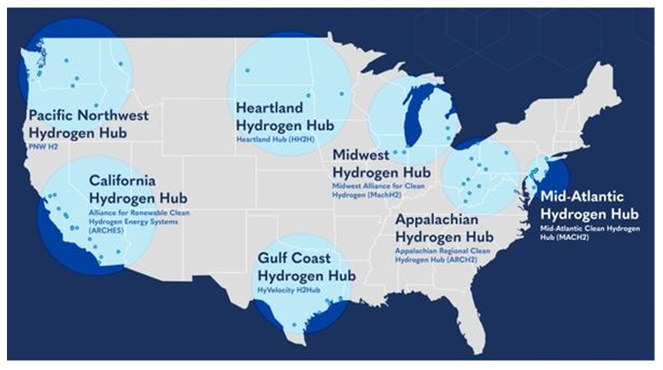
Hydrogen Hub Winners: The hydrogen hub program should be considered a national experiment to see what works and what doesn’t. Here are the 7 winning programs, in no particular order:
IN THE NEWS
Hydrogen Hubs Announced – President Biden and Energy Secretary Jennifer Granholm announced seven regional clean hydrogen hubs that were selected to receive $7 billion in Bipartisan Infrastructure Law funding to accelerate the domestic market for low-cost, clean hydrogen. Advancing clean hydrogen is essential to achieving the President’s vision of a strong clean energy economy that strengthens energy security, bolsters domestic manufacturing, creates healthier communities, and delivers new jobs and economic opportunities across the nation. The hubs selected for negotiation include:
- Mid-Atlantic Hydrogen Hub (Mid-Atlantic Clean Hydrogen Hub (MACH2); Pennsylvania, Delaware, New Jersey) — The Mid-Atlantic Hydrogen Hub will help unlock hydrogen-driven decarbonization in the Mid-Atlantic while repurposing historic oil infrastructure and using existing rights-of-way. It plans to develop renewable hydrogen production facilities from renewable and nuclear electricity using both established and innovative electrolyzer technologies, where it can help reduce costs and drive further technology adoption. As part of its labor and workforce commitments to the community, the Mid-Atlantic Hydrogen Hub plans to negotiate Project Labor Agreements for all projects and provide close to $14 million for regional Workforce Development Boards that will serve as partners for community college training and pre-apprenticeships. This Hydrogen Hub anticipates creating 20,800 direct jobs—14,400 in construction jobs and 6,400 permanent jobs. (Amount: up to $750 million)
- Appalachian Hydrogen Hub (Appalachian Regional Clean Hydrogen Hub (ARCH2); West Virginia, Ohio, Pennsylvania) — The Appalachian Hydrogen Hub will leverage the region’s ample access to low-cost natural gas to produce low-cost clean hydrogen and permanently and safely store the associated carbon emissions. The strategic location of this Hydrogen Hub and the development of hydrogen pipelines, multiple hydrogen fueling stations, and permanent CO2 storage also have the potential to drive down the cost of hydrogen distribution and storage. The Appalachian Hydrogen Hub is anticipated to bring quality job opportunities to workers in coal communities and create more than 21,000 direct jobs—including more than 18,000 in construction and more than 3,000 permanent jobs, helping ensure the Appalachian community benefits from the development and operation of the Hub. (Amount: up to $925 million)
- California Hydrogen Hub (Alliance for Renewable Clean Hydrogen Energy Systems (ARCHES); California) — The California Hydrogen Hub will leverage the Golden State’s leadership in clean energy technology to produce hydrogen exclusively from renewable energy and biomass. It will provide a blueprint for decarbonizing public transportation, heavy duty trucking, and port operations—key emissions drivers in the state and sources of air pollution that are among the hardest to decarbonize. This Hydrogen Hub has committed to requiring Project Labor Agreements for all projects connected to the hub, which will expand opportunities for disadvantaged communities and create an expected 220,000 direct jobs—130,000 in construction jobs and 90,000 permanent jobs. (Amount: up to $1.2 billion)
- Gulf Coast Hydrogen Hub (HyVelocity Hydrogen Hub; Texas) — The Gulf Coast Hydrogen Hub will be centered in the Houston region, the traditional energy capital of the United States. It will help kickstart the clean hydrogen economy with its plans for large-scale hydrogen production through both natural gas with carbon capture and renewables-powered electrolysis, leveraging the Gulf Coast region’s abundant renewable energy and natural gas supply to drive down the cost of hydrogen—a crucial step to achieving market liftoff. This Hydrogen Hub is expected to create approximately 45,000 direct jobs—35,000 in construction jobs and 10,000 permanent jobs. (Amount: up to $1.2 billion)
- Heartland Hydrogen Hub (Minnesota, North Dakota, South Dakota) — The Heartland Hydrogen Hub will leverage the region’s abundant energy resources to help decarbonize the agricultural sector’s production of fertilizer, decrease the regional cost of clean hydrogen, and advance the use of clean hydrogen in electric generation and for cold climate space heating. It also plans to offer unique opportunities of equity ownership to tribal communities through an equity partnership and to local farmers and farmer co-ops through a private sector partnership that will allow local farmers to receive more competitive pricing for clean fertilizer. The Heartland Hydrogen Hub anticipates creating upwards of 3,880 direct jobs–3,067 in construction jobs and 703 permanent jobs. (Amount: up to $925 million)
- Midwest Hydrogen Hub (Midwest Alliance for Clean Hydrogen (MachH2); Illinois, Indiana, Michigan) — Located in a key U.S. industrial and transportation corridor, the Midwest Hydrogen Hub will enable decarbonization through strategic hydrogen uses including steel and glass production, power generation, refining, heavy-duty transportation, and sustainable aviation fuel. This Hydrogen Hub plans to produce hydrogen by leveraging diverse and abundant energy sources, including renewable energy, natural gas, and low-cost nuclear energy. The Midwest Hydrogen Hub anticipates creating 13,600 direct jobs—12,100 in construction jobs and 1,500 permanent jobs. (Amount: up to $1 billion)
- Pacific Northwest Hydrogen Hub (PNW H2; Washington, Oregon, Montana) — The Pacific Northwest Hydrogen Hub plans to leverage the region’s abundant renewable resources to produce clean hydrogen exclusively from renewable sources. It’s anticipated widescale use of electrolyzers will play a key role in driving down electrolyzer costs, making the technology more accessible to other producers, and reducing the cost of hydrogen production. The Pacific Northwest Hydrogen Hub has committed to negotiating Project Labor Agreements for all projects over $1 million and investing in joint labor-management/state-registered apprenticeship programs. This Hydrogen Hub is expected to create more than 10,000 direct jobs—8,050 in construction jobs and 350 permanent jobs. (Amount: up to $1 billion)
NY PSC, Governor Undercut Wind Industry With Action – Gov. Kathy Hochul’s administration rejected a request from companies for bigger payments to complete large-scale wind, solar and offshore wind projects — leaving the developments in doubt and threatening New York’s ability to meet its climate goals. The move also makes President Biden offshore wind goals nearly unattainable. The dismissal sets off a scramble for developers to decide whether to cancel contracts with NYSERDA, sacrificing millions of dollars in security payments. It also places New York’s clean-energy ambitions in peril. The state’s landmark climate law requires 70% of electricity in 2030 to come from renewable resources. The projects seeking higher payments — four offshore wind and 86 land-based renewable projects — represent 25 percent of the forecast electricity demand in 2030.
ACP CEO Jason Grumet: “With one shortsighted decision, the NYSPSC has thrown New York’s environmental and clean energy future into peril. Absent a robust offshore wind industry, it will not be possible for New York State to achieve its climate or environmental justice goals. Moreover, critical economic benefits from new manufacturing facilities and the revitalization of ports will be squandered along with the creation of good paying union jobs. New York State has been a national leader in the clean energy transition. We urge New York State to maintain its clean energy commitment and reconsider this decision.”
Anne Reynolds, Executive Director of the Alliance for Clean Energy New York, said “The decision is short-sighted. We were hoping the Commission would act strategically on behalf of ratepayers and the environment; instead, their decision will result in increased costs and greenhouse gas emissions.”
"Today's PSC decision denying relief to the portfolio of contracted offshore wind projects puts these projects in serious jeopardy and deals a potentially fatal blow to the progress these projects have made to localize clean energy manufacturing, reinvigorate New York's ports and harbors, train and deploy New York's skilled union workers, and revitalize environmental justice communities," said New York Offshore Wind Alliance Director Fred Zalcman. "These four projects represent nearly half the OSW capacity New York has committed to develop by 2035, and should they be allowed to fail, the state must redouble its efforts to make up this shortfall and honor its commitment to climate progress."
EIA Projections Indicate Global Energy Consumption Increases Through 2050 – EIA projects that global energy consumption and associated CO2 emissions will increase through 2050 (assuming the global energy system remains on its current trajectory and absent new policy). Global population growth increased regional manufacturing, and higher living standards push growth in energy consumption beyond advances in energy efficiency, according to EIA’s projections in its International Energy Outlook 2023 (IEO2023). In IEO2023, EIA projects that global energy-related CO2 emissions will increase through 2050 in most of the cases modeled. Although EIA expects zero-carbon technology—renewables and nuclear—will meet the bulk of new energy demand through 2050, that growth is not sufficient to decrease global energy-related CO2 emissions in most cases under current laws and regulations. Takeaways:
- Increasing population and income offset the effects of declining energy and carbon intensity on emissions. Across all cases explored in IEO2023, global energy consumption increases, with the fastest growth in the residential and industrial sectors. Global consumption of liquid fuels increases through 2050, with the fastest growth occurring in industrial applications such as chemical production.
- The shift to renewables to meet growing electricity demand is driven by regional resources, technology costs, and policy. Compared with 2022, global electric power generating capacity increases by somewhere between 55% and 108% by 2050, depending on the case. Electricity generation increases between 30% to 76% over that period. Renewables, nuclear, and battery storage account for most of the growth in both global capacity and generation.
- Energy security concerns hasten a transition from fossil fuels in some countries, although they drive increased fossil fuel consumption in others.
In nearly all IEO2023 cases, growth in energy production from non-fossil fuel sources outpaces growth in fossil fuels, but that dynamic varies from region to region. In Western Europe and China, policy, rapid demand growth, and energy security considerations favor locally available resources such as wind, solar, and battery storage, prompting more of these types of installations early in the projection period. Regions with access to relatively affordable coal, such as the other Asia-Pacific region, consume more coal.
EIA Also Expects Most U.S. Households Will Pay Less For Heating This Winter – EIA also said they expect U.S. households that heat with natural gas or are in the West will spend less on heating costs this winter than last winter. In its 2023 Winter Fuels Outlook, EIA forecasts residential natural gas prices this winter will be about 21% lower than last winter. Natural gas is the most common source of heat for U.S. households. Costs for households heating with propane and electricity are likely to remain relatively flat. For homes that use heating oil, EIA expects that heating expenses will be somewhat higher this winter. Warmer-than- or colder-than-expected temperatures could affect heating oil costs. The United States typically consumes more heating fuels than it produces during the winter, so inventories become an important factor in commodity prices. Heading into this winter heating season, inventories for most heating fuels in most of the country are above the five-year average, following a relatively mild end to the 2022–2023 winter. EIA expects U.S. natural gas inventories will end October 6% above the five-year average, and propane stocks are currently 17% above the five-year average.
ON THE SCHEDULE THIS WEEK
NASEO Annual Meeting Set – The National Association of State Energy Officials (NASEO) holds its 2023 Annual Meeting today to Thursday in Portland, OR. This year, the event will focus on the clean energy innovation, resilience and affordability. State Energy Offices and their private sector partners are poised for action in deploying innovative clean energy solutions across America’s infrastructure – Grid, Buildings, Transportation, Manufacturing, and Agriculture.
Forum to Look at Russia Oil Blockade – Today at 2:30 p.m., Brookings Hutchins Center on Fiscal and Monetary Policy will convene a panel of experts to assess the price cap. The event will open with remarks from Brookings Economic Studies Vice President Ben Harris. Harris was an architect of the price cap while he was at the U.S. Treasury and described the origins of the plan here. Three private-sector energy experts who discussed the price cap at a Hutchins Center event in September 2022 will return. They will be joined by Eric Van Nostrand, acting Assistant Treasury Secretary for Economic Policy. David Wessel will moderate the conversation.
Semafor Hosts Cyber Summit – Semafor holds The Cybersecurity Summit tomorrow at the Gallup Building starting at 9:00 a.m. focused on securing the digital future. Industry experts and national stakeholders join a discussion exploring the threats, the solutions and the future of cybersecurity from the lens of business, policy, privacy and beyond.
Forum Looks at Voluntary Carbon Markets – The Business Council for International Understanding holds a virtual discussion tomorrow at 9:00 a.m. on the importance of voluntary carbon markets. Mark Kenber, Executive Director, Voluntary Carbon Markets Integrity Initiative (VCMI) is the speaker. Kenber's remarks will focus on the importance of voluntary carbon markets, how VCMI is key in the energy transition, and his work in achieving a low-carbon economy. He will also address opportunities for collaboration with the private sector and how the public and private sector can work together to create a more sustainable future.
WRI Looks at Climate Risk Data – The World Resources Institute holds a webinar on climate risk data tools tomorrow at 10:00 a.m. The webinar brings together WRI experts to explore four key tools: 1) Climate Watch: Uncover the latest climate data, insights, and visualizations. Learn how to leverage this dynamic platform to make informed decisions and drive climate solutions. 2) Aqueduct: Delve into water risk assessment like never before. Discover how Aqueduct equips you with invaluable water-related information, enabling sustainable water management in an increasingly water-stressed world. 3) AgriAdapt: Agriculture and climate resilience go hand in hand. Explore AgriAdapt's capabilities for adapting agriculture to climate change, ensuring food security, and promoting sustainable farming practices. 4) Systems Change Lab: Gain insights into systemic transformations and learn about the platform’s innovative approach to fostering climate resilience, addressing social inequities, and driving positive change.
USEA Presser Looks at Small Reactors – The US Energy Assn holds a presser tomorrow at 11:00 a.m. looking at the questions surrounding small module reactors. The SMR briefing will feature a diverse panel of gifted and experienced executives who know the technology, the financing, the utility needs and the public acceptance. Experts include Holtec’s Tom Marcille, James Schaefer of Guggenheim Partners, NuScale CEO John Hopkins, Black & Veatch’s Mark Gake and EPRI’s Steve Chengelis. Reporters on the panel includes The Wall Street Journal’s Jennifer Hiller, Matt Chester of the Energy Center, Forbes Ken Silverstein and Pete Behr of E&E News.
DOE Webinar Looks at EV Adoption – The Department of Energy holds a forum tomorrow at 11:00 a.m. on accelerating EV adoption. Speakers will explore the game-changing potential of EV adoption into existing infrastructure through demonstrated best practices.
Forum Looks at Power Markets – ICF holds a webinar tomorrow at 1:00 p.m. on navigating future power markets. ICF energy experts will discuss developments in U.S. energy markets and an overview of Q3 2023 views for MISO, SPP, and CAISO.
House Energy Looks at AI – The House Energy and Commerce Innovation, Data, and Commerce Subcommittee holds a hearing on Wednesday at 10:00 a.m. on safeguarding data and innovation by building the foundation for the use of Artificial Intelligence.
Senate Environment Looks at Sackett Case Implications – The Senate Environment Committee holds a hearing Wednesday at 10:00 a.m. on the implications of Sackett v. U.S. EPA for Clean Water Act of wetlands and streams.
Wilson Forum Looks at Ukraine – The Wilson Center Kennan Institute for Advanced Russian Studies holds a virtual discussion on Wednesday at 10:00 a.m. assessing Ukraine's political and energy resilience before winter. This panel will consider the key challenges for Ukraine and its society according to surveys conducted by the Ukrainian Institute for the Future, how Ukraine is preparing for the winter, the potential for elections in Ukraine, and the general economic situation in the country.
House Resources Pushes Back on Leasing Delays – On Wednesday at 10:15 a.m., the House Natural Resources Energy and Mineral Resources Subcommittee holds a hearing on examining the Biden Administration's obstruction of the BOEM (Bureau of Ocean Energy Management) Offshore Leasing Program.
House Energy Panel Looks at EPA Chemicals, Life-Saving Devices – The House Energy and Commerce Environment, Manufacturing, and Critical Materials Subcommittee holds a hearing Wednesday at 10:30 a.m. on exposing EPA efforts to limit chemicals needed for life-saving medical devices and other essential products.
Sommers Headlines Hudson Event on OPEC 50th – The Hudson Institute holds a discussion on the Arab Oil Embargo 50 Years Later on Wednesday at 10:30 a.m. featuring comments by API Head Mike Sommers. The event will address lessons learned and missed opportunities.
WaPo Hosts Climate Discussion on Renewable Energy – On Wednesday at 12:00 p.m., Washington Post Live hosts a forum on innovative technologies from renewable energy to electric vehicles to artificial intelligence. The event features conversations with Vinod Khosla, founder of Khosla Ventures, Sara Menker, founder and CEO of Gro Intelligence, and Arcady Sosinov, founder and CEO of FreeWire Technologies, about the role of technology in creating opportunities for a greener future.
Event Looks at Flooding in Asia – The Henry L. Stimson Center holds a virtual discussion Thursday at 9:00 a.m. on disasters and vulnerable infrastructure in the Himalaya. The event will look to place the Sikkim and Melamchi Floods in context. During this webinar, Stimson’s Energy, Water, and Sustainability team will also briefly introduce its new collaborative effort to develop monitoring and early warning processes.
Senate Energy Looks at Energy Grants, Funding – The Senate Energy Committee holds a hearing on Thursday at 10:00 a.m. looking at the Energy Department's due diligence process for awarding competitive grants and loans funded through the Inflation Reduction Act and the Bipartisan Infrastructure Law and the department's overall innovation investment strategy. DOE’s David Crane, Jigar Shah and IG Teri Donaldson are witnesses.
Forum to Look at Energy Innovation – The Consortium for Science, Policy & Outcomes holds a forum on Thursday at 1:00 p.m. looking at new perspectives on energy innovation. October 2023 marks the 50th anniversary of the 1973 oil embargo. The crisis also inspired new science and technology policies that drove innovation in nuclear, solar, wind and geothermal energy sources, among others, and new energy innovations alongside high oil prices.
Forum Looks at COP28 – On Friday at 2:30 p.m., the Business Council for International Understanding holds a virtual discussion on driving momentum to COP28, focused on partnership, impact and solutions.
IN THE FUTURE
Forum to Discuss Industrial Heat Shot – The US Department of Energy holds an Industrial Heat Shot Summit next Monday October 23rd at 11:00 a.m. Speakers will discuss the DOE Industrial Heat Shot that aims to develop cost-competitive industrial heat decarbonization technologies with at least 85% lower greenhouse gas emissions by 2035.
Forum Looks at Energy, AI – On Monday October 23rd at Noon, the Center on Global Energy Policy at Columbia University’s School of International and Public Affairs holds a series of discussions on how the application of artificial intelligence (AI) in the energy sector can advance the discovery of new technologies, aid in the prediction of successful energy-related systems, and optimize operations. The first AI forum will feature a global expert leading the development of AI for scientific discovery, including for energy.
Forum to Look at Carbon Border Adjustment – The Niskanen Center holds a lunch event next Monday October 23rd at Noon about the future developments of carbon border adjustments in the EU, the U.S., Canada, and the rest of the world. Our Deputy Director of Climate Policy, Shuting Pomerleau, will present her new research findings that the U.S. falls into the middle of the pack globally in terms of low-carbon industry. She will discuss why it is crucial for the U.S. to implement a border-adjusted carbon tax instead of standalone carbon tariffs. Following the presentation, Alex Flint will moderate a panel discussion with Shuting, Max Gruenig, and Barry Rabe to discuss the latest developments of carbon border adjustments globally and the legislative landscape in the U.S. They will also discuss the outlook of climate policies in the U.S.
Forum to Look at Decarbonizing Heavy Industries – The Atlantic Council Global Energy Center and Climate Advisers hold a virtual forum on Tuesday, October 24th at 9:30 a.m. for an expert discussion on strengthening international cooperation on trade policies to enable decarbonization of heavy industry. During the discussion, panelists will also address the outcomes of the EU-US Leaders Summit, scheduled for October 20, related to the harmonization of trade of emissions-intensive goods.
SEIA Forum Focused on IRA Low-Income Community Credit – The Solar Energy Industry Assn holds a webinar on Tuesday October 24th at 2:00 p.m. on low-income communities bonus credit. The event will provide detail on applying for the Inflation Reduction Act’s Equity-Focused Allocated Incentive. The IRA’s low-income communities bonus credit is a unique, allocated credit that will ensure that many of the gigawatts of clean energy capacity projected to come online in the next decade are built in or will serve historically marginalized communities.
ELI Forum, Dinner Set – The Environmental Law Institute holds its annual Firestone Policy Forum and Awards dinner next Tuesday October 24th starting at 3:00 p.m. The Policy Forum will lookg at preparing for the First Global Climate Stocktake where expert panelists who will discuss how much progress has been made nationally and globally toward greenhouse gas reduction targets. Of course, Bracewell is a major sponsor of the event. State’s Susan Biniaz is among the panelists. Dr. J. Marshall Shepherd, renowned scientist and weather-climate expert, is ELI's 2023 Environmental Achievement Award honoree.
USEA Hosts Mini-Grid Forum – The US Energy Assn continues its three-part webinar series, led by AmpUp consortium member NRECA International, to address challenges faced by mini-grid operators, as well as opportunities to overcome them and strengthen their presence and service to the rural communities they reside in. There also will be an overview of lessons learned, and innovative approaches to improve performance and sustainability. The second event is Wednesday October 25th at 9:00 a.m. on operating a successful mini grid involves support and buy-in from the community it serves.
POLITICO Hosts Grid Reliability Forum – POLITICO holds a deep-dive conversation on what it will take to ensure a reliable electric grid for the future on Wednesday, October 25th at 5:00 p.m. EPA’s proposed standards for coal and new natural gas-fired power plants have implications for the future of the electric grid. These changes raise questions about how to ensure that America will have the electric power that it needs, where and when we need it.
Latin American Energy Conference Set – The Inter-American Dialogue hosts the 7th Latin America Energy Conference on Thursday October 26th starting at 9:00 a.m. The conference will explore how the region can use tools like energy diplomacy, strategic investments, regulation, and technology and information to reconcile the need to urgently transition to low carbon economies with their use of natural resources to trigger sustainable development. The conference will convene energy company executives, US and Latin American government officials, and international and nongovernmental organizations to discuss the how the region will shape a new era of energy systems.
GW Law Event Discusses Climate Litigation – The GW Law School holds a forum in its Jacob Burns Moot Court Room on Thursday October 26th at 12:15 p.m. featuring Patricia Galvão Ferreira of Dalhousie University School of Law in Halifax, Nova Scotia. She will present on how National Courts are domesticating an equity principle of international environmental law and why that matters for climate justice.
Forum to Look at COP28 – The Environmental and Energy Study Institute (EESI) holds a briefing on Thursday October 26th at 2:00 p.m. looking at Congress’s role in the global effort to finance climate solutions. While investments in climate action are expensive, the impacts of climate change at home and abroad are even more costly. This briefing will bring together a panel to explore these questions and discuss possible policy solutions. NY Rep. Adriano Espaillat will provide intro remarks.
Forum to Look at Oil, Gas Production Costs – The Center on Global Energy Policy (CGEP) at Columbia University's School of International and Public Affairs will host Lucija Muehlenbachs, CGEP visiting faculty member, associate professor of economics at the University of Calgary, and a university fellow at Resources for the Future, for a fireside chat on Thursday October 26th at 6:00 p.m. focused on some of these burdens, such as methane emissions and well-site cleanup, as well as recent policy developments.
Climate Justice Forum Set For Georgetown – Georgetown University’s POCACITO hosts the 2023 Transatlantic Forum for Environmental and Climate Justice in the Copley Formal Lounge on Friday October 27th. The all-day event foregrounds the continuing work of organizers, activists, academics, and policy experts in the U.S. and Germany who are making sure that environmental and climate action is rooted in, and aspirational of, justice.