
Energy Update: Week of November 24th
Energy Update - November 24, 2025

Friends,
Ready for the Thanksgiving week – and with the government back open – the travel is likely to be much smoother. One thing I always mention about Thanksgiving: Maryland’s John Hanson issued the first Thanksgiving proclamation in 1782 that designated the last Thursday of November as a day of thanksgiving, a tradition that continues today. As the first President of the United States Continental Congress, he proclaimed a "day of solemn Thanksgiving" in November 1782, seven years before George Washington’s proclamation. But before we get on the move for the Thursday holiday, a few quick items from the busy last week.
Brazil’s COP 30 wrapped with a whimper. While many will try to say there was an “agreement”, it was pretty lame and clearly underscored massive divisions. The US remained quietly on the sidelines because President Trump just has no interest in international climate talks. It was clear China also was playing it low key despite some claims they would step up and play a bigger role. BCSE’s Lisa Jacobson said “a notable step forward was the Belém 4X Pledge on Sustainable Fuels to quadruple sustainable fuel use by 2035, applauding the commitment to accelerate progress in hard-to-abate sectors.”
The rest of the world has been coming closer to the US, even before people considered Donald Trump's hands-off approach. In fact, the reality is Donald Trump's approach to the UN climate talks actually may have hurt us in that respect. Energy and climate reality is hitting these global negotiations, which has been brewing for the last few years. Most nations are recognizing that they have to meet rising energy demand in a way that is technology innovative, cost effective, politically viable and climate friendly. This is the new energy/climate paradigm, and the difficulty of coming to agreements like this only underscore the new framework.
The House Resources Committee also passed Chairman Westerman’s permitting legislation last week, getting the ball rolling on a potential larger effort to reform permitting. The SPEED Act would limit the scope of permitting reviews and restrain legal NEPA challenges for projects. The Chamber’s Marty Durbin said advancing the SPEED Act and other critical permitting reform measures “represents a pivotal step toward streamlining permitting processes and enhancing predictability—accelerating critical infrastructure projects that bring investment and tangible improvements to communities across the nation.”
While there is limited action this week, we are always on-guard for last-minute regulation roll outs and will keep you in the loop. As for today, Canadian nuclear operator Bruce Power will sign an exclusive agreement with Siemens Energy for new high-pressure steam turbines for their nuclear plant. This is one of two such announcements this week from a nuclear operator saying they will rely on Siemens Energy to upgrade their plant – generating more power and extending the life of the plant. This follows last week’s announcement from Oklo detailing a binding contract with Siemens Energy for the design and delivery of the power conversion system for Oklo’s Aurora powerhouse.
Just a few reminders for busy next week. Next Monday, the North American Gas Forum starts with Secretary Wright for a fireside chat to launch the conference. Other speakers will include Interior Secretary Doug Burgum, AGA CEO Karen Harbert, ACP head Jason Grumet and many others. Wright will also join Sen. Pete Ricketts, Gevo CEO Pat Gruber and others at U.S. Energy Stream’s 6th Energy Innovation & AI Forum 2025 on next Wednesday and Thursday. Finally, next Wednesday, the National Petroleum Council (NPC) will release key findings and recommendations to reform oil and natural gas infrastructure permitting and gas-electric coordination at the Willard Hotel.
Finally, with the official launch of the holiday season, first lady Melania Trump takes delivery of a Christmas tree from a Michigan farm. It's the first time since 1985 and the third time on record a tree from Michigan will be in the White House.
And speaking of Michigan, it is rivalry weekend for College Football, and there is no bigger meeting than The Game on Saturday at The Big House in Ann Arbor when Michigan and Ohio State clash. The last two defending national champs meet up with the top-ranked Bucs looking for revenge after last year's surprising loss.
Enjoy the games, holidays and family; and we will see you next week.
Best,
Frank Maisano
(202) 828-5864
C. (202) 997-5932
FRANKLY SPOKEN
“What the government needs to give nuclear a fair playing field which is reform of the regulatory regime, reestablish the nuclear supply chain in our country and bring private capital back into nuclear power. The early moving projects will have a government credit guarantee or debt that is provided. We’ll be out of that business in 3 or 4 or, 6 years.”
Energy Secretary Chris Wright on CNBC.
ON THE PODCAST
World Energy Outlook Author Talks Turkey on the Report – In this week’s Columbia Energy Exchange, Jason Bordoff talks to Tim Gould about this year’s World Energy Outlook, the IEA’s flagship annual report. It projects a world with as much as 3 degrees of warming by 2100, under current policies, or with as little as 1.5 degrees of warming by 2100 if global energy systems quickly decarbonize. Gould is the International Energy Agency’s chief energy economist. As part of this role, he co-leads the World Energy Outlook. Tim joined the IEA in 2008 as a specialist on Russian and Caspian energy. Before joining the agency, Tim worked on European and Eurasian energy issues in Brussels.
CRES Chats with Chairman Westerman on Permitting – Citizens for Responsible Energy Solutions head Heather Reams sat down with House Natural Resources Chairman Bruce Westerman in an exclusive interview to speak about his bipartisan bill, the Standardizing Permitting and Expediting Economic Development (SPEED) Act. Westerman is Pushing hard for a heavy bipartisan approach saying both side need certainty. “If you're an investor, you want some certainty. You want to minimize risk. Sometimes you can't minimize risk, but this is one we can certainly minimize risk. And I will make the point that we can protect the environment even better if we have permit reform than under the current system.”
FUN OPINIONS
EEI: Permitting Essential to Dominance, Affordability – In an op-ed in the Washington Examiner, EEI head Drew Maloney writes America needs permitting reform to lower costs for customers, fuel economic growth and strengthen energy dominance. Permitting reform is simply a no-brainer for families and businesses already worried about rising costs. By cutting delays and allowing projects to be built faster, pro-growth permitting policies mean more electrons on the grid—easing cost pressures and delivering relief to customers at a time when affordability is top of mind.
FROG BLOG
Loris: Take The Politics Out of Permitting – In a C3 blog post, Nick Loris explains why modernizing the permitting process is essential for meeting rising energy demand, managing public lands, and keeping projects on time and on budget. Reforming permitting is not about lowering standards; it’s about restoring reason. Permitting reform will ensure that environmental safeguards are in place and that projects advance promptly.
FUN FACTS
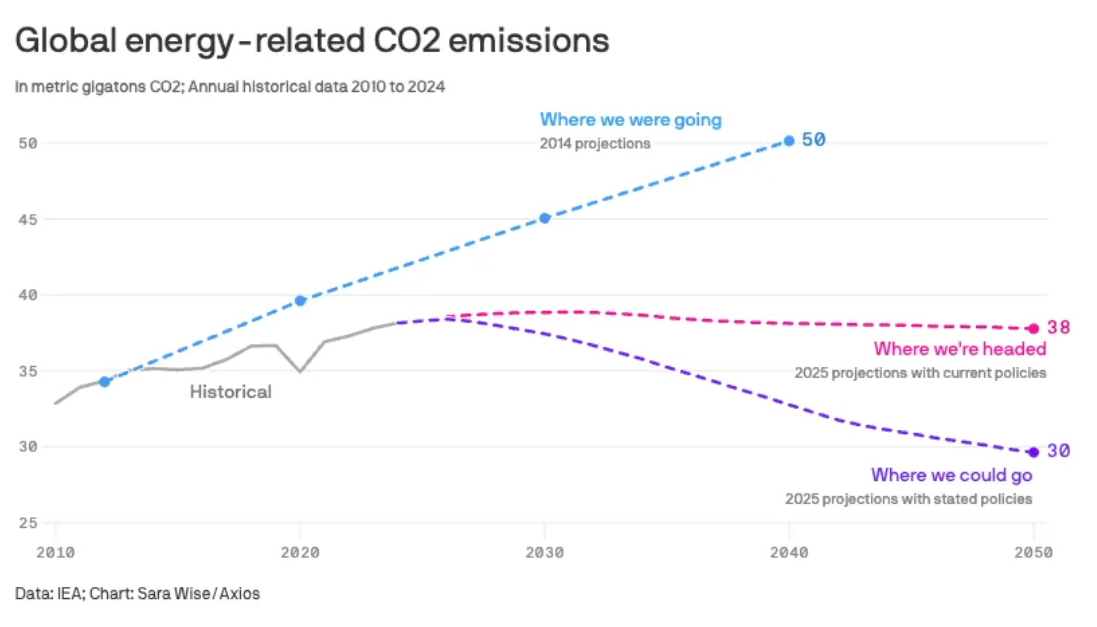
Clean Energy Progress on CO2 Emissions: Global temperatures are still rising—just not as much.
IN THE NEWS
Chamber SAF White Paper Calls for New Framework to Advance Clean Aviation Fuels – The U.S. Chamber of Commerce released a new whitepaper focused on the current landscape of the U.S. sustainable aviation fuel (SAF) market and provides suggestions for potential supportive policies that can help achieve scale. SAF is an alternative fuel made from renewable and waste resources, including agricultural and forestry residue; organic municipal solid waste; fats, oils, and greases from cooking waste and meat production; algae; and captured waste gases.
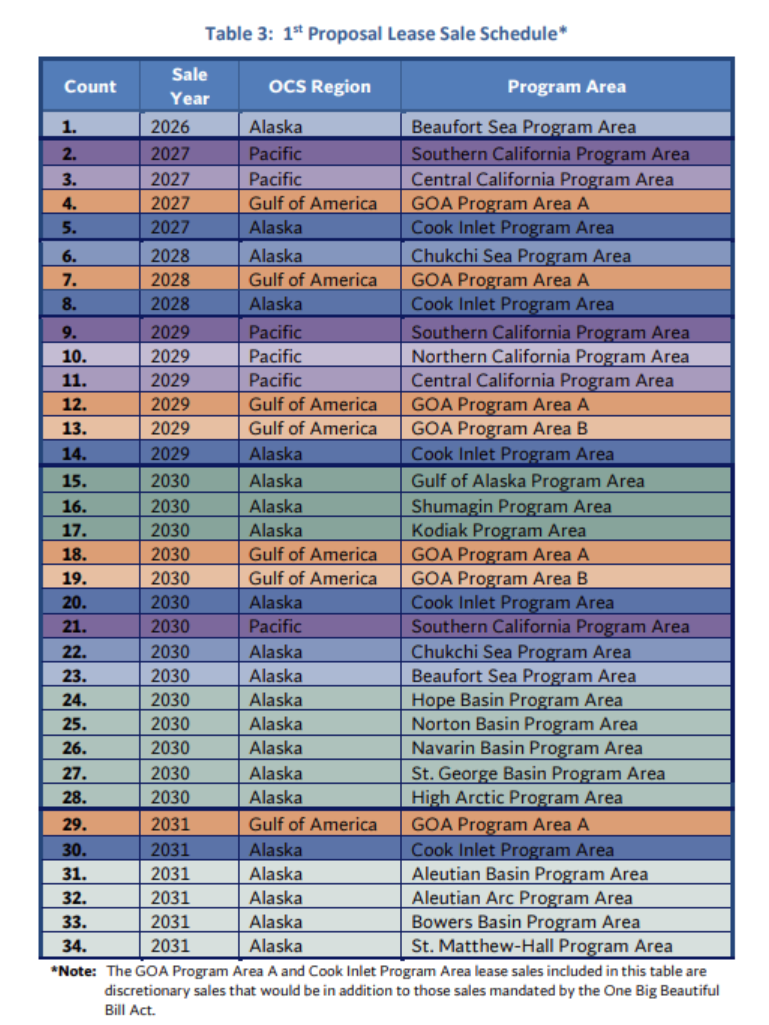
Five Year Plan Hits the Streets (or Waters) – The Interior Department finally released its 5-year plan for oil and gas leasing today. Under Section 18 of the Outer Continental Shelf (OCS) Lands Act, Secretary Burgum (through BOEM) is responsible for approving a schedule of OCS oil and gas lease sales for each 5-year period. This regular schedule was disrupted during the previous Administration and when they were forced by Congress (Sen. Joe Manchin), they proposed an option of no leases in a range. They also trying to block drilling in all offshore areas except the western Gulf of Mexico (America) as they left office in January of 2025. Interior proposed to lease large sections off the coast of California, the eastern (South Central) Gulf shore and the High Arctic (Alaska) for oil and gas drilling. The proposal cancels the oil and gas leasing plan issued under the Biden administration, and further outlines as many as 34 possible offshore lease sales for between 2026 and 2031. (See Chart Below) A predictable leasing program allows companies to plan and invest in these best-in-class systems, ensuring that offshore development moves forward with the highest levels of safety, environmental stewardship, and community engagement.
API’s President and CEO Mike Sommers said the new Plan includes including some of the most promising acreage offered in generations, as a secure source of affordable, reliable energy.
“After years of delay in federal leasing, this is a historic step toward unleashing our nation’s vast offshore resources. We applaud Secretary Burgum for laying the groundwork for a new and more expansive five-year program that unlocks opportunities for long-term investment offshore and supports energy affordability at a time of rising demand at home and abroad.”
The US Chamber’s Christopher Guith commended Secretary Burgum and Interior for producing a new five-year oil and gas leasing plan that would accelerate American energy production, especially inclusion of acreage adjacent to the Central Gulf Planning Area:
“This ambitious proposal would put offshore oil and natural gas production back on track after the previous program was allowed to lapse, resulting in a severe gap in new lease sales. The Administration’s plan will help America continue to lead the world in oil and natural gas production, boosting our energy security while delivering oil and gas with the lowest emissions intensity in the world.”
NOIA’s Erik Milito said the Gulf of America remains the gold standard for offshore energy: driving prolific production, supporting good-paying jobs, bolstering local and national supply chains, funding conservation programs nationwide and anchoring U.S. energy security.
“Energy security is national security. The Gulf is an energy powerhouse, producing nearly 2 million barrels of oil per day with production recognized as among the lowest carbon intensity in the world. A clear leasing schedule gives companies the certainty to invest, strengthens supply chains, bolsters communities, and keeps the U.S. competitive in a rapidly evolving global energy landscape.”
BACKGROUND – Interior Secretary Doug Burgum directed the Bureau of Ocean Energy Management (BOEM) in April to begin the process of developing a new schedule for offshore oil and gas lease sales. BOEM plans to hold a new lease sale in the Gulf of America in December of this year, the first offshore lease sale since 2023. America’s offshore oil and natural gas resources are not only vast, but also among the lowest carbon intensity barrels produced anywhere in the world. According to the U.S. Energy Information Administration, U.S. offshore production accounts for 14% of total U.S. crude oil production, or nearly 2 million barrels of oil per day. Robust offshore oil and natural gas development could generate over $8 billion in additional government revenue by 2040.
SCHEDULE
Bruce Power, Siemens Energy to Upgrade Turbines at Ontario Nuclear Plant– Bruce Power has signed an exclusive agreement with Siemens Energy Canada for new high-pressure steam turbines for its Bruce A nuclear units, a project that will provide new generation to help meet Ontario’s growing need for clean energy. The upgrades are expected to increase output by more than 30 megawatts (MW) per unit, delivering approximately 125 MW of additional clean electricity to Ontario’s grid following the turbine replacements, to be completed between 2028 and 2031. This project builds on Bruce Power’s existing Strategic Alliance Agreement with Siemens Energy and supports good jobs and Ontario’s economy. Siemens Energy has a significant footprint in Oakville and will support the project from its Port Elgin office which was established in 2019 to support the company's long-term strategic partnership with Bruce Power. Bruce Power’s Project 2030 is the lowest cost option for adding significant new generation to the Ontario’s energy grid. It includes replacements and upgrades to optimize output from existing assets and projects. Replacing turbines originally manufactured by C.A. Parsons (now Siemens Energy) ensures long-term reliability and will allow Bruce Power to meet future operational demands. The new turbines will support Bruce Power’s modernization and power uprate goals now and into the future.
CRES Releases LNG Recommendations – Citizens for Responsible Energy Solutions (CRES) Forum published an issue brief on the role U.S. Liquified Natural Gas (LNG) plays in achieving American energy dominance. This brief evaluates the geopolitical, environmental and economic benefits of U.S. LNG, while highlighting the challenges to the industry’s competitiveness, and providing key policy recommendations. The U.S. became the largest exporter of LNG in 2023. This October 2025, it became the first country to exceed 10 million tons of LNG exports in a single month. Studies show that replacing coal with LNG can lower greenhouse gas emissions by roughly 50%, offering a cleaner solution to countries whose power generation relies on traditional fueling sources. To secure America’s energy leadership and maintain a competitive advantage in global LNG markets, lawmakers should:
- Enact comprehensive permitting reform to expand energy production and LNG export capacity.
- Codify a transparent, time-bound process for “public interest” reviews for LNG projects.
- Ensure U.S. LNG projects are not precluded from accessing financing tools designed to enhance global competitiveness for American businesses.
- Leverage U.S. energy diplomacy to secure offtake agreements with trade partners.
- Support research, development and deployment of innovative technologies to increase competitiveness and lower emissions.
CSIS Paper Outlines Strategy to Meet Demand, Boost Energy – In a new CSIS paper, An Energy Strategy for National Renewal, Joseph Majkut outlines a strategy to boost energy generation, build transmission infrastructure, and approach greenhouse-gas emissions reductions while prioritizing global economic competitiveness. Forecasts suggest that U.S. electricity demand could rise by as much as 105 percent by 2040, driven by rapid growth in artificial intelligence (AI) data centers and strategic manufacturing. Capital investment in AI data centers could soar from $125 billion in 2024 to nearly $2 trillion by 2030, with facilities requiring electricity loads comparable to mid-sized cities. At the same time, the expansion of semiconductor and electric-vehicle production is straining regional grids. Together, these sectors are reshaping the U.S. energy landscape and propelling the need for increased generation and transmission capacity. The existing grid is unable to support the scale of new power demands, creating reliability problems, as the power sector operates on increasingly thin reserve margins during periods of peak demand. Majkut calls for strengthening generation, transmission, and distribution infrastructure while continuing to reduce emissions. He argues that the country needs to do so in a way that aligns our strategic competitiveness goals with climate concerns, as the carbon intensity of products is becoming a key competitive differentiator in international markets. America already holds distinct carbon-intensity advantages in key production sectors, but these need to be preserved by continuing to invest in clean energy and resilient infrastructure.
ON THE SCHEDULE THIS WEEK
Forum Looks at Mining in SE Asia – This morning at 9:00 a.m., the Stimson Center released new findings in a webinar of more than 2,000 unregulated rare earth and gold mining sites along rivers in the Mekong Region. This webinar launches an interactive dashboard that tracks mining and river contamination and brings together activists and experts to discuss solutions to the region’s looming health and environmental crisis.
Forum to Discuss COP30 Readout – The Environmental and Energy Study Institute (EESI) holds a Rapid Readout about the major outcomes from this year’s United Nations climate negotiations in Belém, Brazil (COP30) tomorrow at Noon. This Readout will unpack where key negotiations landed on issues including next steps on international climate finance, climate adaptation metrics, the intersection of climate and trade, and the implementation of carbon markets. The Readout will review the status of updated country commitments to reduce greenhouse gas emissions and increase adaptation efforts and the next steps in the global effort to assess progress towards collective climate goals. Speakers will unpack the U.S. presence at COP30, including federal, subnational, and private sector roles in the proceedings; highlight next steps following COP30; and explain what it all means for U.S. climate policy.
Forum Looks at Battery Storage Systems – IDTechEx holds a webinar tomorrow on Lithium-Ion battery storage safety, focusing on trends in fire prevention and thermal management for battery energy storage systems (BESS). New research from IDTechEx forecasts the global BESS thermal management and fire safety market to reach US$25.4B in value by 2036.
THANKSGIVING – Thursday November 27th
IN THE FUTURE
NatGas Forum is Set – The North American Gas Forum will be held on December 1st to 3rd in Washington, D.C.. to look at issues driving strategy and investment across the U.S. energy landscape. As policy shifts and infrastructure demands intensify, these sessions will set the tone for pragmatic, solutions-driven dialogue. Speakers include Interior Secretary Doug Burgum, AGA CEO Karen Harbert, ACP head Jason Grumet, AXPC head Anne Bradbury and a bunch of industry experts (including our friend Khary Cauthen of Cheniere).
CSIS to Host ExxonMobil Energy Outlook – On Tuesday December 2nd at 9:00 a.m., the CSIS Energy Security and Climate Change Program hosts a discussion on ExxonMobil’s 2025 Global Outlook with Tyler Goodspeed, Chief Economist at ExxonMobil for a conversation about the report’s key findings and how, despite the major shocks of the last decade, global energy trends remain persistent. The ExxonMobil Global Outlook is a comprehensive, data-driven assessment of long-term energy trends that explores how economic development, policy, and evolving technologies will shape global energy and emissions through 2050. The discussion will focus on the projections in the Global Outlook, including the changes in the global energy mix, the continued role of oil and gas, the growth of renewables, and efforts to reduce global CO₂ emissions and energy poverty.
Forum to Look at Energy, Tech Comms – Heatmap holds another live virtual webinar on energy and climate tech comms in 2026 on Tuesday December 2nd at 1:00 p.m. The event will look at what is coming and how to get ahead. This is the latest edition of Heatmap’s Climate Communications Series, with FischTank PR. It will bring together experts in climate and energy marketing for a discussion on the trends, risks, and opportunities shaping the sector in 2026.
NPC Report to Address DOEW Request on Permitting, Meeting Demand – On the morning of Wednesday December 3rd at the Willard Hotel’s Ballroom, the National Petroleum Council (NPC) will release key findings and recommendations to reform oil and natural gas infrastructure permitting and gas-electric coordination in response to Energy Secretary Chris Wright’s request earlier this year. NPC will share progress on its Future Energy Systems report. The NPC is made up of nearly 200 appointed leaders, and they will meet at 9:00 a.m. Following the meeting, the reported will be discussed at a press event in the Willard’s Buchanan Room around noon. Speakers will include Williams CEO and NPC Chair Alan Armstrong, TC Energy CEO François Poirier, Southern Gas CEO Jim Kerr and EQT CEO Toby Z. Rice.
National Journal to Talk AI – On Wednesday December 3rd at 1:00 p.m., National Journal holds its final 2025 segment of its Trump 2.0: From Platform to Policy webinar series. This episode will deep-dive into Reshaping Federal AI Strategy, a topic that has emerged as one of the most consequential policy areas in Trump’s second administration. Dean Ball, Senior Fellow at the Foundation for American Innovation and former Senior Policy Advisor on AI and Emerging Technology at the White House Office of Science and Technology Policy. We’ll examine how this administration’s AI agenda is driving regulatory change, shaping U.S. strategy in the global AI race, and affecting the industries leading the AI economy.
Secretary Wright, Gevo CEO, Senators, Reps to Address Energy, AI Forum – U.S. Energy Stream holds the 6th Energy Innovation & AI Forum 2025 on December 3rd and 4th at the Cosmos Club and it will feature Energy Secretary Chris Wright. Forum has been established as the premier bipartisan, off-the-record platform in Washington, DC, convening U.S. Senators, Members of Congress, and top executives from the energy, finance, manufacturing, and technology. During the Forum, we dive deep into the strategies, policies, and breakthroughs that strengthen the energy security and economic growth for the United States and our allies. Gevo CEO Pat Gruber, Sens. Pete Ricketts and Tim Sheehy (R-NE) and a bunch of House members will speak.
Forum to Look at Clean Energy, EE Issues – The Environmental and Energy Study Institute (EESI) holds a briefing on Friday December 12th at Noon looking at the state of federal clean energy and energy efficiency tax credits. This briefing will review how the One Big Beautiful Bill Act modified or altogether ended 12 key tax credits, including those for electric vehicles, renewables, biofuels, hydrogen, nuclear energy, and energy efficiency. The briefing will share ways companies and consumers are adapting to this new landscape, as well as the short- and long-term implications for the energy industry, developers, and manufacturers. Panelists will also explore the outlook for using federal tax policy to reduce greenhouse gas emissions, lower energy bills for households and businesses, and increase resilience to climate impacts while advancing U.S. competitiveness on the global stage.
CSIS to Holds 2025 Critical Mineral Summit – The CSIS Critical Minerals Security Program holds its flagship event, Critical Minerals: 2025 Year in Review & Looking Ahead to 2026 on Wednesday December 15th. This full day gathering will bring together policymakers, industry executives, and thought leaders to reflect on key trends in critical mineral markets and policy over the past year and explore what lies ahead. The event will feature a series of fireside chats and keynotes from Jarrod Agen, Executive Director of the White House’s National Energy Dominance Council, Senator Catherine Cortez Masto (D-NV), and Senator Bill Hagerty (R-TN), alongside panel discussions with leaders from government and industry. Speakers will explore how the minerals landscape has shifted in defense, domestic processing, and diplomacy, as well as offer a forward-looking forecast as the U.S. strengthens its mineral production and processing capabilities to meet evolving demand.
C3 Holds Energy Leadership Forum – On Monday December 15th at the Spy Museum, C3 hosts the American Leadership in Energy Innovation Summit where the event will explore the policies needed to ensure families and businesses have access to affordable, reliable power and how the United States can achieve energy dominance.
API Holds State of Energy Event – The American Petroleum Institute holds its annual 2026 State of American Energy forum on Tuesday January 13, 2026 at The Anthem starting at 8:00 a.m.
Chamber Sets State of American Business – The US Chamber holds It annual State of American Business event on Thursday December 15th at the Chamber HQ. Chamber CEO Suzanne Clark hosts key leaders from different sectors and certainly energy is likely to a major topic.
AGA Talks 2026 NatGas Outlook – the American Gas Assn holds its 2026 Natural Gas Policy Outlook at it DC office on Thursday January 15th at 11:00 a.m. In addition to the year outlook, AGA will introduce its new Chair.