
Energy Update: Week of May 26th
Energy Update - May 27, 2025

Friends,
Hope you all enjoyed your Memorial Day. Our weather in the DC area was fabulous. Perfect enough to get me out on the bike to begin my summer training regimen for the Pelotonia bike race for Cancer Charity in early August.
The run up to Memorial Day was filled with craziness. We had the Empire Wind stop work order lifted, budget package with significant IRA cuts passed, the California waiver votes passed in the Senate and the nuclear power Executive Orders signed on Friday afternoon. Full details in the “News” Section.
This week is slow with Congress in the District work period and President keeping a light schedule. Perfect for taking a deep breath and maybe grabbing a lunch or two.
One important event happening today at 2:30 pm: Experts at the American Gas Association will hold an IN-PERSON media event at the AGA headquarters to share an outlook from the natural gas industry on the strong future for natural gas as demand rises. It is a can’t miss… Please RSVP to Adam Kay at akay@aga.org.
On Wednesday morning, you might want to sign onto the Center for National Interest’s online webinar that discusses Europe’s reactions to April's massive power outage across Spain and Portugal. With a lot of misinformation about this blackout’s impacts and causes, tune in to hear from two leading European energy experts on the topic.
POLITICO’s E&E News agency reporters hold an in-depth briefing on Thursday looking at how agency overall changes could reshape the federal policy landscape.
Finally, I mentioned my effort to start riding more this summer for my Pelotonia Cancer Charity ride in Columbus. Of course, I am riding again this year for my younger brother Art who was diagnosed with brain cancer in December 2023. He is 18 months into his fight and he is pushing back hard, even walking now. I hope you will support my brother’s fight by donating. Any amount matters, so please head to this Pelotonia link and help.
Call with Questions.
Best,
Frank Maisano
(202) 828-5864
C. (202) 997-5932
FRANKLY SPOKEN
“It's a myth to say that what's good for gas is bad for renewables and what's good for renewables is bad for gas. We just don't see it that way. They each have a role to play. They're each playing complementary roles."
Roger Martella, GE Vernova's chief sustainability officer and head of corporate affairs, during a Q&A with Axios Generate’s Ben Geman.
ON THE PODCAST
Metals Co CEO Talking Trump Orders, Deep Sea Minerals – On today’s POLITICO Energy podcast, James Bikales talks with Metals Company CEO Gerald Barron a month after submitting their controversial first application to mine international waters under U.S. law. The podcast discusses their planned venture — and he defended the environmental profile of undersea operations. Barron discussed why he thinks deep-sea mining is important to the America's energy future, rebutted criticisms that his company’s moves may violate international law, and described how one of TMC’s mineral-rich nodules collected from the seafloor ended up on Trump’s Resolute Desk.
API Expert Talks on California Vehicle Emissions – On a radio show in Northern Michigan, API’s Will Hupman joined to discuss California’s vehicle mandates and the challenges they impose on other states. This past week, the Senate moved a Congressional Review Act waiver provision to prevent EPA from allowing California to set national efficiency standards.
FUN OPINIONS
Lippold: Undermining Offshore Wind is National Security Threat – In a recently published an op-ed in RealClearEnergy and RealClearDefense, former USS Cole Commander Kirk Lippold writes America must remain the world's energy leader by leveraging its technical and manufacturing ability to build the systems and infrastructure that power us into the 21st century. We cannot afford the vulnerability that comes with sidelining any energy source. Offshore wind is neither a luxury nor a scam—it’s a valuable tool in an unstable world. Now is the time for this Administration to embrace all sources of energy, including offshore wind, for the sake of our national security.
FROG BLOG
AEI: Tariffs, Battle with China – Even if the president continues to de-escalate the trade war with China, the United States’ broader relationship with China will continue to be defined by geopolitical and economic competition. In a new Foreign and Defense Policy working paper for the American Enterprise Institute, Nicholas Eberstadt assesses China’s efforts to develop its population’s “knowledge capital” and its important implications for future growth and the global balance of power.
FUN FACTS
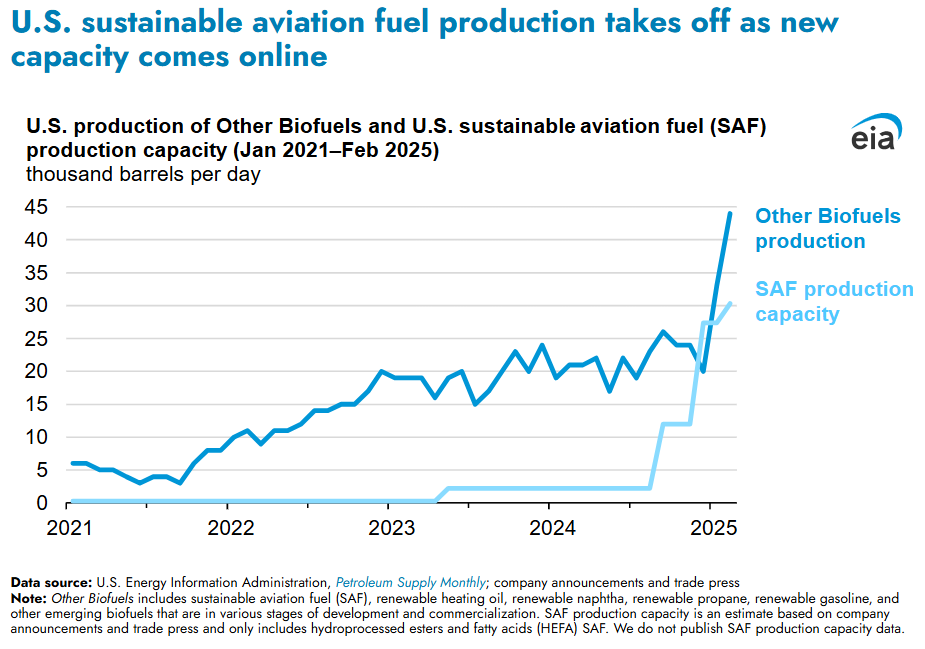
EIA Brief: SAF Biofuel Production Takes Off: Sustainable aviation fuel (SAF) production is growing in the United States as new capacity comes online. U.S. production of Other Biofuels, the category we use to capture SAF in our Petroleum Supply Monthly, approximately doubled from December 2024 to February 2025.
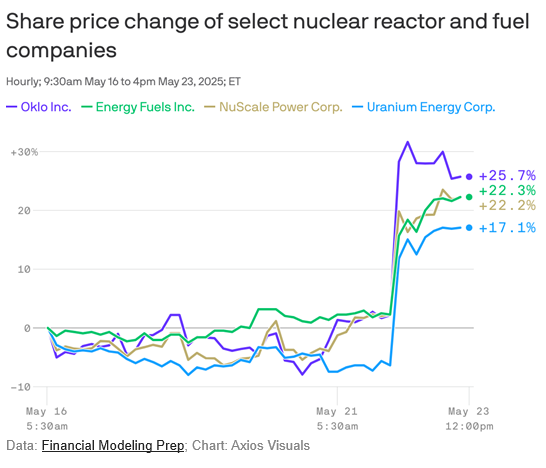
Nuclear Stocks, Utilities Get a Boost: Nuclear energy stocks received a major bounce after President Trump's executive orders aimed at speeding up nuclear project development. In this chart, small developers really bounced but they had a lot of room to move. Big nuclear space companies like Cameco (part owner of Westinghouse and GLE) (+12%) and large, incumbent power companies in the nuclear space including Constellation Energy (+5%) and Vistra Corp. (+2.5) also saw gains.
IN THE NEWS
President Signs Nuclear Orders – We did have good news and bad news late on Friday of Memorial Day. The good news was the President signed the long-awaited nuclear power executive orders. The bad news was we all still had to work because the President signed the long-awaited nuclear power executive orders. The series of executive orders aims to speed the deployment of new nuclear power reactors in the US. The orders also hope to reform the NRC permitting process, while jump starting the US uranium mining and domestic uranium enrichment capacity.
On the production/processing side, our friends at Global Laser Enrichment (GLE), a leading uranium enrichment company welcomed the focus on processing. They are happy to discuss the landscape. We also can help with mining and nuclear giant Cameco (who owns stakes in Westinghouse and GLE). Global Laser Enrichment (GLE) CEO Stephen Long:
“GLE applauds President Trump’s executive orders aimed at strengthening the U.S. nuclear energy sector. These directives recognize the critical role of nuclear energy and a robust fuel supply chain in ensuring American energy dominance, as well as the necessary actions to accelerate deployment. The administration has underscored the importance of expanding domestic conversion and enrichment capacity—priorities that align closely with GLE’s capabilities and mission. Our proposed Paducah Laser Enrichment Facility is uniquely positioned to support both of these objectives, advancing innovation and U.S. technology leadership and enhancing the nation’s energy security. The GLE team looks forward to collaborating with the administration, DOE, NRC, and our industry partners to implement these important initiatives.”
Nuclear executives attended the signing, including Constellation CEO Joe Dominguez and NEI president/CEO Maria Korsnick. Our friends at NEI have issued a holding statement while they review the Orders:
“We appreciate the Administration’s ongoing actions to preserve existing nuclear plants and usher in the deployment of next generation nuclear. Policies to strengthen nuclear power are essential to bolstering our national security and meeting our energy goals. We look forward to working with the Administration and other stakeholders to ensure the implementation of the orders will help us build a reliable, affordable, and increasingly clean energy system.”
Contact: Chizi Odidika, (202) 550-9525 (cfo@nei.org)
The United Coalition for Advanced Nuclear Power issued a statement that strongly supports the administration's Executive Orders to set the most ambitious national goals for nuclear power deployment in American history:
“Nuclear power is a critical capability to address a National Energy Emergency. The advancement and expansion of nuclear power can provide the reliable and resilient energy needed to drive the digital technology revolution and to enable a growing manufacturing economy.
“The immediate restoration, development, and deployment of our Nation's nuclear energy infrastructure called for in these Executive Orders fulfills an immediate and pressing priority for the protection of the United States' national and economic security.
“Nuclear energy can be employed to stabilize the domestic electric power grid, power a wide array of thermally intense industrial processes, augment capabilities for space, undersea, and remote operations, and play a key role in our national defense architecture.
These actions, among the many others in these Executive Orders, will reestablish the U.S. as the dominant provider of nuclear technology to the global market, countering the pernicious influence of geopolitical competitors such as Russia and China, all while creating tens of thousands of high-paying jobs and supporting a booming American economy.”
Contact: Lucian Niemeyer, (571) 277-3115; (Lucian@ucanpower.org)
Finally, if you need another great resource on Nuclear power issues, call Sam Thernstrom at the Energy Innovation Reform Project (EIRP). Sam is a great think tank-type policy expert that can address any general nuclear power impacts.
Samuel Thernstrom, (571) 257-5265; (sam@innovationreform.org)
BACKGROUND
The summaries our Bracewell team sent last Friday were based on a peak at drafts circulating at the time. We have not received updated drafts or the final orders yet. However, based on discussions we have had and coverage we have seen, we are comfortable with the following short summaries of the four orders and some indication of their significance. More precise summaries when we see text.
Executive Orders on Nuclear Energy – Signed May 23, 2025
On May 23, 2025, President Donald Trump signed four executive orders aimed at revitalizing the U.S. nuclear energy sector. These actions are designed to streamline regulatory processes, bolster domestic uranium production, and expand nuclear infrastructure, particularly in response to rising energy demands from sectors like artificial intelligence (AI) and data centers.
Executive Order Summaries
- Accelerated Reactor Licensing and Deployment
Objective: Mandates the Nuclear Regulatory Commission (NRC) to expedite the licensing process for new nuclear reactors, reducing approval times from over a decade to just 18 months. This order directs NRC to issue final licensing guidance within 180 days and prioritize advanced reactor designs. Drafts that circulated recently indicated that important NRC regulatory decisions on design safety would likely be reviewed by the White House Office of Information and Regulatory Affairs (OIRA) – as part of the Administration’s new approach to asserting authority over independent agencies.
- Overhaul of the Nuclear Regulatory Commission
Objective: Initiates a comprehensive restructuring of the NRC, including staffing evaluations and procedural reforms, to enhance efficiency and responsiveness in nuclear project approvals. The order also requires NRC to identify and sunset outdated or redundant regulatory requirements within 120 days. The “substantial reorganization” of NRC will result in “turnover and changes in roles. Total reduction in staff is undetermined at this point,” according to White House officials.
- Expansion of Nuclear Infrastructure on Federal Lands
Objective: Directs the Departments of Energy and Defense to collaborate on constructing nuclear reactors on federally owned lands and military bases, aiming to support national security and technological infrastructure needs, including AI data centers and “to power and operate critical defense facilities. The NRC will not have a ... direct role in that,” according to White House officials.
- Revitalization of Domestic Uranium Production
Objective: Invokes the Defense Production Act to reduce U.S. dependence on foreign uranium sources, particularly from Russia and China, by boosting domestic mining and enrichment capabilities. The Department of Energy is instructed to establish a new strategic uranium reserve and offer incentives for domestic production.
Significance of the Orders
These executive orders represent a strategic move to position nuclear energy at the forefront of America's energy policy. By addressing regulatory bottlenecks and supply chain vulnerabilities, the administration aims to ensure energy independence and meet the escalating power demands of emerging technologies. The emphasis on domestic uranium production and infrastructure development underscores a commitment to national security and economic resilience. “President Trump is taking truly historic action to usher in the American nuclear renaissance,” White House science adviser Michael Kratsios said in a briefing for reporters.
Market Reaction
The announcement of the executive orders triggered a significant rally in nuclear energy stocks. Companies such as Cameco, Constellation Energy, and NuScale Power saw share prices jump between 6% and 12% following reports of the orders. Market analysts cited growing investor confidence in a long-term federal commitment to nuclear as a stable, zero-carbon energy source amid grid reliability concerns.
Presidential Remarks
During the signing ceremony, President Trump emphasized the importance of nuclear energy in America’s future:
"It’s a hot industry, it’s a brilliant industry."
"With these actions, we have shown the world that America will build again, and the American nuclear renaissance can begin."
"We’re going to take the shackles off the nuclear industry. No more waiting 15 years for a permit. No more relying on foreign uranium. We are unleashing American energy – clean, reliable, and patriotic."
California CRAs on EPA Waiver for Car/Truck Rules – Senate Republicans passed Congressional Review Act action against a trio of California regulations yesterday, with H.J. Res. 88 reversing by a 51-44 vote the waiver that allowed California’s rule phasing out new gasoline-fueled cars by 2035. Michigan Democrat Elissa Slotkin joined Republicans in support of the CRA against the waiver. They also passed H.J. Res. 87, which targets California's zero-emissions heavy-duty truck rule, and H.J. Res. 89, which nullified California’s rule requiring heavy-duty trucks to significantly reduce their emissions of nitrogen oxides.
In a joint statement, refiner groups cheered the Senate move with AFPM’s Chet Thompson and API’s Mike Sommers saying the Senate delivered a victory for American consumers, manufacturers and U.S. energy security:
“Congress has made clear that California regulators have no authority to dictate what cars Americans can buy or to ban internal combustion engine vehicles. President Trump can now deliver on a major part of his campaign promise to end EV mandates in the United States. This is a massive win for consumers and working families all across the country.”
In its Hill Letter prior to the vote, the U.S. Chamber of Commerce said the ban on sales of internal combustion engine-powered cars and trucks, poses significant challenges and:
“…would severely restrict consumer choice and impose substantial costs on businesses, not only in California but also in other states that have adopted California’s regulatory programs. By mandating adoption of technologies not yet commercially viable at scale, and on a recklessly accelerated timeline, these rules risk significant increases to transportation costs and could hinder the movement of people and goods nationwide. Additionally, factors such as insufficient vehicle charging infrastructure, which are beyond the control of manufacturers, further deter market adoption of electric vehicles and exacerbate compliance challenges. Allowing California to set de facto national standards creates a fragmented regulatory landscape, complicating supply chains and compliance for businesses operating across state lines. This patchwork approach undermines the efficiency and predictability needed for thriving interstate commerce.”
California AG Rob Bonta has his lawsuit teams charged up and ready, but our experts think he may be only digging a deeper hole. My colleague Scott Segal writes the State of California or environmental groups would have a tough row to hoe in challenging a successful Congressional Review Act petition in court. Segal:
The question of whether Congress should entertain a CRA petition is matter of how Congress governs itself. Under Article I of the Constitution, the Congress is self-governing – and I can’t think of another example where a court would interpose its will on the manner or procedure of the actual rules of lawmaking. Remember also – a CRA petition is actually a full-blown act of Congress. Passed by both Houses. And subsequently signed by the President. It is an expression later in time than the very Clean Air Act that California depends on for its waiver. So, I just don’t think there is any real grounds to assert CRA malpractice. Courts are not likely to go there.
There is also the little matter that California may have been misusing the waiver in the first instance to regulate greenhouse gases when the clear intent of the waiver provision was to address conventional air pollution. Viewed in that light, the CRA petition seems like an appropriate legislative reaction. The US Supreme Court in WVa v. EPA ruled that major questions particularly under the Clean Air Act should be answered by reference to clear legislative language. The CRA petition is far closer to the original intent of the Clean Air Act than granting the waiver was in the first place.
Additional information:
- About The CA Waiver and the Congressional Review Act
- FAQs on CA’s Ban on Sales of New Gas Cars (Advanced Clean Cars II)
- Alliance for Automotive Innovation: Time is ticking to repeal CA’s gas vehicle ban
Of the dozen states that want to follow California’s ban, none are close to meeting ACCII’s 2026 target of 35% combined EV, fuel cell and PHEV sales. ACCII requires each individual automaker to meet the annual standards. In 2023, “ZEV” sales among incumbent automakers (those who are not pure-play EV manufacturers) were just 13% in California. They were lower in every other state.
IEA Report Highlights critical Mineral Challenges – The International Energy Agency (IEA) released its Global Critical Minerals Outlook 2025 today which includes a detailed assessment of the latest market and investment trends, along with their implications for critical minerals security. As in last year’s Outlook, it provides a snapshot of recent industry developments from 2024 and early 2025 and offers medium- and long-term projections for the supply and demand of key energy minerals, taking into account the latest policy and technology developments. The same day the IEA report was released, House Energy’s Oversight panel held a hearing on critical mineral competitiveness. SAFE’s critical mineral expert Abigail Hunter testified the United States faces a strategic chokepoint in the processing stage of critical minerals—a segment of the supply chain overwhelmingly dominated by China and essential to the future of American energy, technology, and defense.
“Processing is the linchpin between raw materials and finished technologies. It is where industrial capability is either captured or outsourced,” Hunter told the committee. “If current trajectories continue and processing remains dominated by China, the United States will remain dependent on foreign decision-making for the technologies that define future economic and national security leadership.”
Offshore Wind Project Restarted – Early last week, the NY-Based Empire Offshore Wind project being developed by Equinor has restarted construction after the Trump Administration lifted a stop-work order it has issues two weeks earlier. Full statement from Equinor with details is here.
ON THE SCHEDULE THIS WEEK
Cato Looks at Tariff Policy – Today at Noon, the Cato Institute holds a forum on tariffs, emergencies and presidential power. In this webinar, legal scholars Ilya Somin, a professor at Antonin Scalia Law School at George Mason University who is co-counsel in the pending tariffs case VOS Selections v. Trump, and Walter Olson explore the constitutional and statutory limits of presidential authority under the International Emergency Economic Powers Act (IEEPA) and other statutes. They’ll discuss President Trump’s recent efforts to justify sweeping trade measures under IEEPA, examine the historical role of Congress in setting tariffs, and consider broader stakes for the separation of powers.
AGA to Discuss 100 Days Progress, NatGas Leading Role for Energy Demand – This afternoon at 2:30 p.m., AGA will host a presser to share an outlook from the natural gas industry on the strong future for natural gas as demand rises. The event will include on-the-record remarks from AGA President and CEO Karen Harbert followed by a background briefing with AGA regulatory, policy and market experts and ample time for question and answer. Come in person for networking and snacks following the briefing.
EESI Look at Rail Transportation – The Environmental and Energy Study Institute (EESI) will hold a briefing tomorrow at 2:00 p.m. that will explore the past, current, and future role of rail in the U.S. transportation sector and highlight key rail programs under the surface transportation bill. Speakers will also describe opportunities to modernize railways through electrification, faster trains, track expansion, and safety improvements. Introductory remarks will be offered by Rep. Valerie Foushee (D-NC).
Forum to Discuss EU Blackout – The Center for National Interest holds a webinar on Wednesday at 10:00 a.m. to discuss Europe’s reactions to April's massive power outage across Spain and Portugal. Whatever occurred, the event could have important policy and political consequences across the European Union, which has emphasized renewable power both to reduce greenhouse gas emissions and to replace generation capacity lost following the near-total shutdown of Russia’s pipeline natural gas deliveries in 2022. The forum features two leading European energy experts—Tomasz Chmal and Andreas Goldthau.
RMI Looks at EV Charging in India – On Wednesday, RMI holds episode 3 of the Shoonya Webinar Series to focus on the critical role of charging infrastructure in accelerating India’s electric mobility transition. As electric vehicle (EV) uptake rises across ride-hailing, delivery, and personal use segments, charging networks are emerging as a central enabler—shaped by their availability, accessibility, and reliability. This episode explores the evolving landscape of EV charging infrastructure in India, existing challenges, and the enabling conditions driving progress—from forward-looking policies to private sector innovation.
POLTICO Talks Agency Changes – POLITICO’s E&E News agency reporters hold an in-depth briefing on Thursday at 1:00 p.m. looking at how agency overall changes could reshape the federal policy landscape. The forum will examine what’s on the chopping block, how internal agency dynamics are shifting, and what professionals across government, industry and advocacy need to prepare for next. Speakers include Robin Bravender, Sean Reilly (EPA), Brian Dabbs (DOE), Jen Yachnin (Interior/natural resources) and Manuel Quiñones (moderator).
Reagan Foundation Discusses Economic Policy – On Friday at 9:00 a.m. at the Reagan Library in Simi Valley, the Reagan Foundation holds its Reagan National Economic Forum focused on advancing a strong and prosperous economy for all Americans. DOE Secretary Chris Wright is the keynote at 7:00 p.m. and Sen. Cassidy talks energy. House Ways and Means Chair Jason Smith will talk tax policy There are a ton of other big speakers including Gov. Kevin Stitt (OK) and Greg Gianforte (MT) , House Financial Services Chairman French Hill, Sen. Mike Rounds, (R-S.D.) and Rep. Beth Van Duyne talk China and many more speak. Lots of our reporter friends are moderators as well, including NYT’s Ana Swanson, WSJ’s Greg Ip and Jen Hiller, WaPo’s Megan McArdle, Axios’ Neil Irwin and RealClearPolitic’s Carl Cannon. See the full list here.
IN THE FUTURE
CA Hydrogen Event Set – The California Hydrogen Leadership Summit will be held on June 3rd and 4th in Sacramento to explore key policies and programs driving hydrogen’s role in meeting air quality and emissions targets, enhancing energy resilience, and supporting sustainable growth.
Crapo to Address Energy Infrastructure Council – The Energy Infrastructure Council will hold its 2025 Annual Meeting and Legislative Conference in Washington, DC on June 9th and 10th. Senate Finance Committee Chairman Mike Crapo (R-ID) has confirmed that he will be our luncheon keynote at the event.
POLITICO Hosts Energy Summit – On June 10th, POLITICO hosts an energy summit featuring exclusive conversations with senior government officials, key lawmakers, and industry executives as they unpack the next era of U.S. energy policy at the Ronald Reagan International Trade Center.
Forum Talks NatGas, Power – The 29th annual LDC Gas Forum Northeast 2025 will be held in Boston on June 9th to 11th at the Vestin Copley Place. EQT CEO Toby Rice, NET CEO Danny Rice, BHE Gas Transmission Paul Ruppert, Macquarie Energy’s Kevin Little, Tenaska Energy Steve Bruns and DOE’s Executive Director of the Office of Energy Transformation Melissa Lavinson all speak.
ACP Talks AI – In its PowerTalks Series, ACP will hold a forum on June 17th at 1:00 p.m. to explore the high-stakes relationship between national security and the growing energy demands of AI, data centers, and the urgent need for energy solutions. AI and cybersecurity experts, Helen Toner and Harry Krejsa, will join ACP CEO Jason Grumet to analyze why clean energy must play a key role in powering AI as part of an all-of-the-above energy strategy while ensuring a safer America.
Chamber Hosts Innovation Summit – The U.S. Chamber of Commerce will host its 2025 Business Delivers Innovation Summit on Wednesday June 18th at its headquarters in Washington, DC. This event convenes corporate sustainability leaders, government officials, nonprofits, academics, and innovators to highlight the leadership of businesses in deploying innovative, resource-efficient technologies and practices that bolster economic growth, share best-in-class strategies, and identify effective policies.