
Energy Update: Week of March 4th
Energy Update - March 04, 2024

Friends,
This is a busy week generally with the beginning of March and really launches the politics and policy of the 2024 election year. And interestingly, it started off this morning with the Supreme Court ruling that President Trump cannot be taken off state ballots.
Starting with politics, tomorrow is Super Tuesday. Voters in 16 states and one territory will make their voices heard in the biggest primary election of the 2024 cycle, resulting in over a third of delegates assigned to determine the GOP presidential nominee.
Almost two years after it was proposed, the Securities and Exchange Commission will meet on Wednesday to consider a final version of its corporate climate disclosure rule. The expected rule would force public companies to disclose emissions and climate risks in filings to the agency. Rumors are that it will not cover Scope 3 emissions, or emissions from the use of your product, which is likely to draw howls from environmental activists.
Then on Thursday, President Biden delivers his State of the Union speech which many agree will feature some minor clues about how he'll discuss energy and climate in the 2024 campaign. It just doesn’t seem to be a super “high-priority” but is likely an area he will have to push to activate young voters. The problem is some of the latest backsliding on overly-aggressive proposals on fuel economy, power plants rules and other issues could put that at risk. Happy to discuss at any point.
Congress is focused on budgets this week with the new mini-bus coming out yesterday and President Biden FY2025 budget proposal coming soon. The mini-bus details include EPA ($9.2B), Energy ($17.3B) and Interior ($14.8), all modest reductions.
There will be a House Science Committee hearing on Wednesday on weather forecasting/modeling and also a Senate Environment hearing on producer responsibility on consumer packaging. For events, ACP holds a forum on its 2023 Market Report tomorrow, Axios holds a Clean Energy Forum on Wednesday with Secretary Granholm and John Podesta and the US Energy Association holds another virtual media briefing on Artificial Intelligence and electric utilities.
One important policy issue: A new open letter calls for further actions to cut emissions of short-lived pollutants such as soot, methane and refrigerant gases. I would suggest they are missing a significant amount of work already being done on methane and refrigerants both globally and in the US. On methane, the oil/gas industry is already moving rapidly to reducing methane while the HVACR industry is implementing the AIM law and the Senate ratified the Kigali Amendment which are the most significant moves ever to reduce emissions from refrigerants.
Finally, our friend Abrahm Lustgarten has a new book about climate change and how it could force tens of millions of Americans to rethink where they call home, called On The Move. You can read much more about the book at www.abrahm.com. It’s on Amazon, Powells and Barnes & Noble and even Target. But if you grab it from Tertulia and use the code: HEAT, you'll get 20% off. I urge you to pre-order it.
Daylight Savings March 10th… Don’t forget to Spring Forward, and while you are at it, sign up for next week’s SAFE Summit with Sect. Granholm! Call with questions.
Best,
Frank Maisano
(202) 828-5864
C. (202) 997-5932
FRANKLY SPOKEN
“The IRA is probably the most transformative bill and you’ve never heard the president say that we paid down $230 billion in debt. We wrote the IRA based on ... a balanced approach. You cannot be basically developing what you want unless you’re developing what we need. And that’s how it came about. You’re not going to put windmills and solar farms and everything you might want here and there and everywhere unless we’re producing the resources that we have. And we tie them together inextricably.”
Sen. Joe Manchin, who played a critical role in crafting and getting the landmark climate bill passed, saying he’s been “villainized” for his work on the IRA. He argued that despite its progressive reputation (aided by the fact that zero Republicans voted for it) its policies are actually quite moderate.
ON THE PODCAST
The Debate Over LNG Pause/Ban Hits Cap Crude – The US Department of Energy in late January hit "pause" on its work issuing key LNG export permits. About 30 million mt/year of probable export capacity additions in the US and Mexico are at risk because of the permitting hold. Climate activists have celebrated the White House decision as a massive win, while industry groups have warned that it could endanger future LNG projects and undermine the role of the US as an LNG exporter. But Arvind Ravikumar, co-director of the Energy Emissions Modeling and Data Lab and a professor within the University of Texas at Austin’s Department of Petroleum and Geosystems Engineering, believes this is the wrong debate to be having. S&P Global Commodity Insights Americas LNG reporter Corey Paul caught up with Ravikumar for the Cap Crude podcast. And Ravikumar shared his perspective on the way we should be thinking about the future of US LNG exports.
FUN OPINIONS
Freezing LNG Hurts National Security – In an opinion in The Hill, former Obama National Security Advisory James Jones writes America can’t ignore the national security concerns tied to the Biden LNG freeze. The former supreme allied commander of NATO says, stated simply, the LNG permit pause is a boost to Vladimir Putin and his persistent quest for leverage against our European allies and the transatlantic community. “Make no mistake, the resilience and energy security of NATO allies are squarely in the U.S. national security interest, particularly in these precarious times — without ignoring or diminishing the importance of working diligently and globally to meet the severe challenges posed by climate change.”
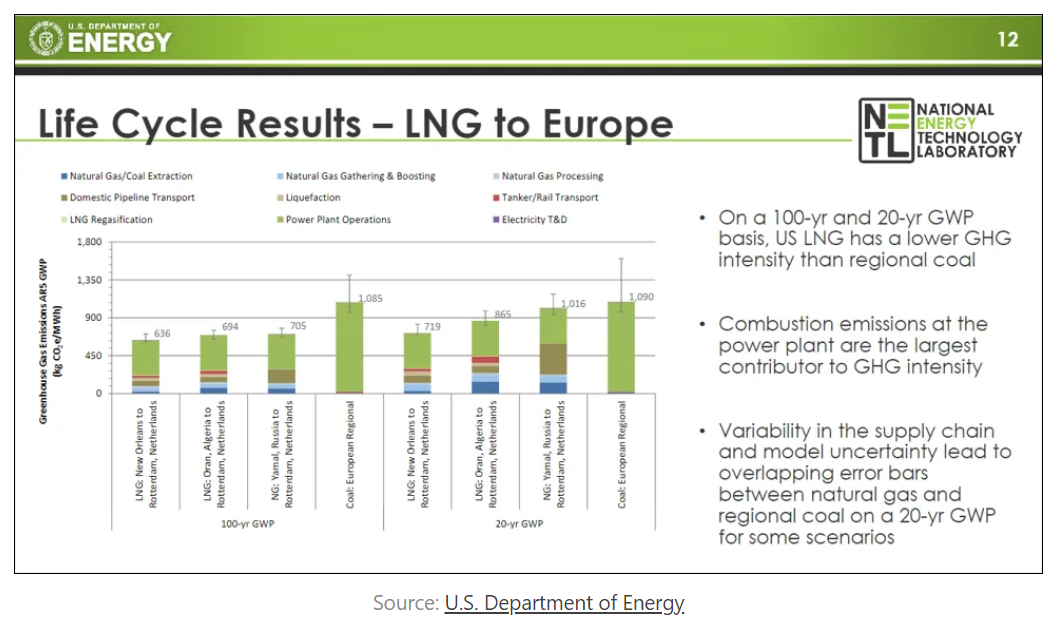
LNG Claims Under Fire – In a Substack post last month, Colorado U climate expert Roger Pielke Jr. said that climate activists claim that restricting LNG exports is needed to reduce greenhouse gas emissions and that exporting U.S. LNG is worse than using coal aren’t backed up by the facts. Pielke: “Suggesting that LNG is worse than coal in terms of greenhouse gas emissions,” which is the claim being made by Robert Howarth of Cornell University, “is both contrary to a broad scientific consensus on this issue and a lone outlier.” Pielke points out that the Department of Energy “has concluded that U.S. LNG exports to Europe” have fewer emissions “than coal or even LNG exports from elsewhere.” Pielke was referring to a 2019 report by the National Energy Technology Laboratory, which found that:
The use of U.S. LNG exports for power production in European and Asian markets will not increase GHG emissions from a life cycle perspective, when compared to regional coal extraction and consumption for power production. The results show that for all 100-year time horizon scenarios the generation of power from natural gas has lower life cycle GHG emissions than power generation from regional coal.
FROG BLOG
IRA Results, Predictions – In his Slow Boring blog, Matt Yglesias writes IRA seems to be struggling to have the effects that experts predicted based on a bunch of computer models. This seems reminiscent of the way that the ACA failed to change the healthcare system in the way that experts predicted based on their models. As soon as you start to think about any policy question at any level of detail, you will see really quickly that these questions are hard and that what you want to do politically hinges, at least in part, on the answers.
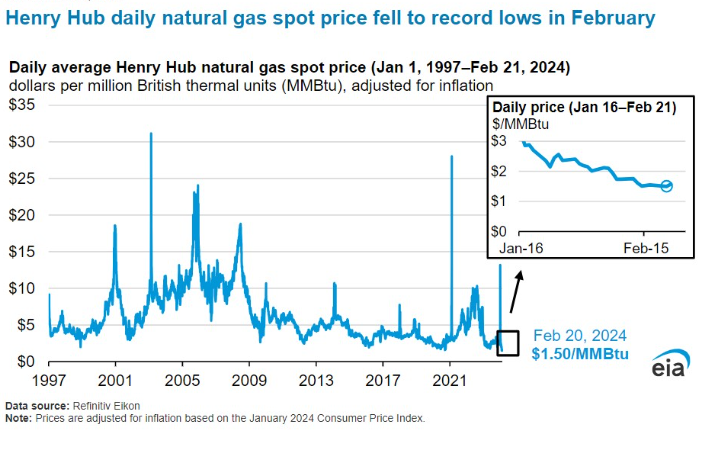
Low Domestic Prices Undercut LNG Freeze – In a blog post, API’s Mark Green writes that low domestic natural gas prices undercut the Biden Administration’s rationale for LNG freeze. According to the U.S. Energy Information Administration (EIA), on Feb. 20, the benchmark Henry Hub daily natural gas price averaged $1.50 per million British thermal units, the lowest price in inflation-adjusted dollars since at least 1997.
FUN FACTS
LNG vs. Coal: DOE has concluded that U.S LNG exports to Europe has far fewer emissions than coal or even LNG exports from elsewhere, as you can see below for Europe (Asia results not shown, but are similar).
IN THE NEWS
Commerce Pushes Back on Chinese EVs – The U.S. Department of Commerce issued an advance notice of proposed rulemaking (ANPRM) seeking public comment to inform the potential development of regulations to secure and safeguard the Information and Communications Technology and Services (ICTS) supply chain for connected vehicles (CVs). Commerce press release here. Avery Ash, Executive Director of the Coalition for Reimagined Mobility (a project of SAFE) said:
“It’s welcome news to see the Biden Administration taking concrete action today to understand and address the national security risks of connected vehicle technology designed, sold, and controlled by companies beholden to the People’s Republic of China. Advanced vehicle technologies will define the automotive and transportation sectors for the next 100 years and it’s essential that the U.S. act to maintain (and in some cases reclaim) our position as the global leader in this industry.
We expect U.S. Commerce Department’s investigation will document these threats as fundamental and pernicious; the PRC is cornering and leveraging key supply chains to geopolitical and economic ends, establishing access to remote data collection for strategic intelligence, opening vulnerabilities to cyber-attacks on U.S. soil, and more.
The alarm bells have been going off and it’s about time Washington woke up to the scope and urgency of this national security risk. We look forward to working with the Commerce Department, Administration, and leaders in Congress to focus attention and action on this topic.”
Last month, SAFE’s Coalition for Reimagined Mobility (ReMo) published Unlocking 21st Century Mobility System: How to Rethink the Future of Mobility and Restore Leadership in Transportation Innovation. The report highlighted these risks and documented the extent of catchup needed from the U.S. government and industry.
REPORT: IRA Drove Billions in Investment – According to new modeling from the Rhodium Group and the Massachusetts Institute of Technology’s Center for Energy and Environmental Policy Research, the federal government invested an estimated $34 billion through tax credits, grants and loans for U.S. manufacturing and deployment of clean energy and transportation technologies in the last fiscal year. The federal government’s investments spanned manufacturing, electricity generation and electric vehicles. Only a fraction of the spending was invested in emerging technologies such as carbon capture and storage, sustainable aviation fuels and clean hydrogen, although private sector investments in these technologies are growing at a fast clip.
Air Permitting Reform Legislation Released – Sens. Bill Cassidy and Kirsten Sinema (D-AZ) have released legislation reforming permitting under the Clean Air Act, the Modernizing Clean Air Permitting Act (MCAP). The bill reforms the National Ambien Air Quality Standard Program (NAAQS) to prevent natural events, disasters, and resilience measures from being considered in an area’s standard, thus making the standard more reasonable. It would require the Environmental Protection Agency (EPA) to consider current compliance, technological feasibility, and cost when revising a standard. Further, and important to the cement industry’s climate goals, it would reform the New Source Review program, to make it easier for manufacturers to install carbon capture equipment. PCA has been in discussions with both offices on permitting reform issues and is able to provide feedback on the bill. PCA requests members share their input to the bill.
EPA Finalizes Refinery Rule – EPA has finalized long-anticipated updates to the Risk Management Program (RMP), with several changes that aim to toughen the proposal issued in 2022. API Vice President of Downstream Policy Will Hupman said the safety and security of employees and local communities are top priorities for industry, and America has seen significant performance improvements across workplaces under the existing Risk Management Program regulations.
“EPA has failed to demonstrate a need for its rigid approach in this new rule, which could have adverse impacts to workers and consumers alike by undermining ongoing safety improvements, impacting energy production and diminishing the ability of U.S. refineries to compete in global markets. We will explore all options to address the flaws in this misguided policymaking while ensuring continued safety improvements.”
The final rule incudes a requirement intended to discourage the use of HF alkylation technology which some refiners use to make gasoline and other high-octane fuels. Restricting the use of this proven technology could have significantly impact refiners’ ability to produce the fuels that American consumers rely on every day.
OPEC Extends Production Cuts – In a news that has become much less important lately, OPEC and its allies are voluntarily taking more oil off the market through June. The decision to keep output cuts in place was expected and appears intended to bolster what might otherwise be weak oil prices. Some analysts forecast that the supply of oil will exceed demand in the first half of this year. Without continued cuts, prices might sink. Analysts suspect that the group is trying to keep a price floor of $80 per barrel for Brent crude.
ON THE SCHEDULE THIS WEEK
Forum to Look at Nuclear – Today at 1:00 p.m., the Center on Global Energy Policy at Columbia SIPA holds a session featuring opening remarks by Jeff Lyash, CEO of Tennessee Valley Authority. Lyash will share his insights on the potential deployment of small modular reactors and their integration into decarbonization strategies. Following his remarks, a panel of experts will delve into various topics, including the role of nuclear energy in decarbonization modeling, past cost overruns experienced in US reactor projects (including the AP1000 endeavors), and prospective strategies to achieve more cost-effective outcomes in the future.
Wilson Event Looks at Water, COP28 – The Wilson Center's Middle East Program holds a discussion tomorrow at 11:00 a.m. on water and energy in the Middle East and North Africa after COP28. This event will explore the issues of climate security and the water-energy nexus in the MENA region, featuring the work of two graduates of the Wilson Center Agents of Change Youth Fellowship and an expert commentator. This event will further explore the future of this nexus and technological and governance implications for providing energy and water security.
ACP Releases Market Report – The American Clean Power Assn holds a webinar tomorrow at 1:00 p.m. in 2023 clean energy year. ACP will present the data and trends that set 2023 apart from prior years for the U.S. clean energy market. The discussion will be led by ACP CEO Jason Grumet, ACP Board Member and ENGIE’s Chief Renewables Officer David Carroll, and ACP VP of Markets and Policy Analysis John Hensley.
Forum Looks at Climate in Middle East, Africa – The Arab Center Washington D.C. holds a virtual discussion Wednesday at 9:30 a.m., on climate change and environmental injustice in the Middle East and North Africa. The event looks at challenges and pathways forward.
House Science Looks at Weather Forecasting, Modeling – On Wednesday at 10:00 a.m., the House Science Environment Subcommittee holds a hearing on U.S. competitiveness in forecasting and modeling.
Senate Environment to Look at Responsible Packaging – The Senate Environment Committee holds a hearing on Wednesday at 10:00 a.m. looking at extended producer responsibility policies for consumer packaging. Witnesses include S. C. Johnson & Son Chairman/CEO Fisk Johnson, WWF’s Erin Simon and Dan Felton, Executive director of AMERIPEN.
Axios Looks at Clean Energy Investment – On Wednesday at 10:30 a.m., Axios holds a discussion on clean energy's investment boom. Axios senior climate reporter Andrew Freedman, energy reporter Ben Geman, and Axios Pro energy and climate reporter Nick Sobczyk will host one-on-one conversations with Energy Secretary Jennifer Granholm, Rep. Mike Levin and Senior Advisor to the President for International Climate Policy John Podesta.
USEA to Look at AI in Utility Sector – The US Energy Association has scheduled a virtual press briefing on the future of the electric power sector in the AI era for Wednesday at 11:00 a.m. For this briefing, the USEA has assembled a panel of experts qualified to answer questions from a panel of reporters on all aspects of AI, which is changing faster than its adoption rate by the electric utilities. Speakers include EPRI’s Rob Austin, Marc Spieler of Nvidia, Sacha Fontaine of SAS and David Derigiotis of Embroker, an authority on AI.
RMI Tackles Enviro Justice Initiatives – Resources for the Future (RFF) holds a forum on Wednesday, at Noon for the first event in its new Exposure event series. At this event, our panel of experts and community leaders will take stock of what’s happened since our 2021–2022 Exposure series, how the Justice40 Initiative priorities have been implemented across federal programs, and RFF’s work in measuring the initiative’s impact. Speakers include White House Justice40 official Monisha Shah and NRDC’s Matthew Tejada.
Forum Tackles Implications of Energy Transition – The Business Council for International Understanding holds a virtual discussion on Wednesday at 1:00 p.m. on the geopolitical implications of Global elections and the energy transition. Speakers include EDF’s Angela Churie Kallhauge, WWF’s Elizabeth Lien, WRI’s Dan Lashof and RMI’s Josh Henretig.
House China Committee Looks at Bioeconomy, Security – The House Select Strategic Competition Between the United States and the Chinese Communist Party Committee holds a hearing on Thursday at 9:00 a.m. on the bioeconomy and American national security.
House Resources Looks at Land Use – The House Natural Resources Oversight and Investigations Subcommittee holds a hearing on Thursday at 10:15 a.m. the implications of Biden's Strategy for natural capital accounting on land use issues.
RMI to Look at SAF – On Thursday at 11:00 a.m., RMI will hold a webinar to explore the federal and state policy landscape around Sustainable aviation fuel (SAF), as well as the path forward for Targeted Opportunity Regions — select regions that have relevant industrial networks and significant scaling opportunities. SAF is the only scalable tool to decarbonize aviation right now, which is why the US government is taking action to incentivize production and deployment. The webinar features opening remarks by Maria Martinez, Director, US Policy and Advocacy at Breakthrough Energy. Then there will be a short presentation by RMI experts and authors, Alex Piper, Aamir Shams, Corey Stewart, and Joey Cathcart who share their key learnings and recommendations from advising SAF projects as well as the opportunities for regions in the United States to accelerate their economic growth.
SXSW Set – From Wednesday to Thursday March 16th, South-by-Southwest (SXSW) will be held in Austin, TX and always has a great policy component to it. There is a Climate change track as well as an energy track. Two EPRI execs will be speaking at South by Southwest. 1) On Saturday, EPRI President and CEO Arshad Mansoor will be speaking about virtual power plants on a panel with CPS Energy CEO Rudy Garza and moderated by Canary’s Maria Gallucci SXSW 2024 Schedule . In addition, on Friday, EPRI Senior Technical Leader Lea Millet is speaking on local revitalization efforts of former coal facilities.
Forum to Look at Women in Hydrogen – Women+ in Hydrogen holds a forum on Friday to celebrate women in hydrogen. Cummins CEO Jennifer Rumsey and California Hydrogen Business Council CEO Katrina Fritz speak at the opening session. Others include EEI’s Emily Fisher, DOE’s Sunita Satyapal, ARCHES CEO Angelina Galiteva, OCI Chief Sustainability Officer Hanh Nguyen and FCHEA’s Jennfer Gangi.
Forum Looks at European Energy Security – On Friday at 9:00 a.m., the Atlantic Council holds a virtual discussion on women on the frontlines of European energy security. The forum focuses on Ukraine as part of International Women's Day. Speakers will explore opportunities for transatlantic engagement and cooperation across Ukraine’s energy sector, including feasibility studies, pilot projects, and new investments in Ukraine.
CSIS Tackles Women in Ag – The Center for Strategic and International Studies holds a discussion on Friday at 11:00 a.m. on bridging the gap for women in agriculture. The event will welcome Deputy Director Lauren Phillips and Senior Economist Nicholas Sitko from FAO’s Rural Transformation and Gender Equality for opening remarks, followed by keynote remarks from USDA's Xochitl Torres Small, a panel discussion between USAID's Ann Vaughan, U.S. Department of State's Christina Chan, and Lauren Phillips, and concluding remarks from FAO’s Chief Economist Máximo Torero.
IN THE FUTURE
Aspen Climate Event Set for Miami – The Aspen Institute is enlisting global and local policymakers, scientific experts, corporate leaders, inventors and innovators, artists, young leaders, influencers, and engaged members of the public to participate in Aspen Ideas: Climate 2024, a multi-day event on March 11–13th in Miami. The event will feature main stages both in and outdoors, breakout and roundtable sessions, tours of local and historic resilience points of interest, as well as fashion, food, art, and music activities. Aspen Ideas: Climate is designed to offer the public a chance to interact, learn, and collaborate with thinkers and do-ers whose actions are critical to addressing our collective future around the realities of a changing climate.
CSIS Looks at Critical Minerals – On Tuesday March 12th at 10:30 a.m., the CSIS Energy Security and Climate Change Program holds a conversation on the future of investment in critical minerals. Brian Menell, Chairman & CEO of TechMet, will join Gracelin Baskaran, Research Director and Senior Fellow in the Energy Security and Climate Change Program at CSIS, to discuss this and more.
RFF to Look at Critical Minerals – Resources for the Future (RFF) holds a forum on Tuesday March 12th on critical minerals, EVs and the Role of Innovation. In this webinar, we will present some of the challenges associated with critical mineral markets and how these connect to broader EV adoption. Then a panel of experts will discuss the role that technological innovation could play in mitigating the challenges caused by growing EV demand; potential limits to innovation; and policies that can help support innovation and make critical mineral markets more resilient. Speakers Include DOE’s Diana Bauer, GM’s Michael Maten and Rod Eggert of the CO School of Mines
ACEEE to hold Water, Heating Forum – On Tuesday to Thursday March 12th to 14th in Atlanta, ACEEE hosts its 2024 Hot Water Forum & Hot Air Forum. The event brings together two premier technical conferences — one on the efficient use of hot water and one that focuses on heat pumps. Both conferences will explore how these industries can reduce greenhouse gas emissions, improve grid resilience, and center equity. Stacey Abrams, DOE’s Kathleen Hogan, AO Smith’s Josh Greene and RMI’s Leah Louis-Prescott will be among the experts at the conference.
Ex-Im Bank Head to Address SAFE Summit – The SAFE Summit 2024 is set for March 12th and 13th in DC. The program will examine how geopolitical power dynamics are shifting and offer a compelling strategy—a systems approach to addressing energy security, climate change, supply chain deficiencies, a dwindling industrial base, and growing geopolitical tension—to reconfigure the foundational pieces that will enable a new global economy to thrive. Reta Jo Lewis, President and Chair of the Board of Directors of the Export-Import Bank of the US is one of the keynotes. International Seabed Authority SecGen Michael Lodge is also expected to discuss deep-sea minerals on a panel with TMC’s Gerard Baron.
Manchin Headlines POLTICO HealthCare Summit – At POLITICO's Health Care Summit on Wednesday March 13th at the Waldorf, Sen. Joe Manchin (D-WV) will sit down with POLITICO's Congressional Bureau Chief, Burgess Everett, to dive into the U.S. fentanyl epidemic and his recent bipartisan legislation, the FEND Off Fentanyl Act. While health care will be the topic of the day, one expects that energy issues will work there way into the questions.
CERA Week – CERA Week will be held from March 19th to 23rd in Houston. Get ready for the biggest energy show of the year. Energy Secretary Jennifer Granholm will be speaking, joining the world’s energy industry leaders, experts, government officials and policymakers, as well as heads from the technology, financial and industrial communities. EPRI President and CEO Arshad Mansoor is speaking Monday, March 18 at 5:30pm CT, about the power demand for AI, and then on Thursday, March 21 at 7:15am CT (yes, early!), he will be speaking about power system flexibility.
EPSA Forum Set – On Tuesday March 26th, the Electric Power Supply Association holds its 2024 Competitive Power Summit. The event will feature a day of expert panels and featured speakers discussing critical issues facing competitive power and the U.S. electric system.
SEJ Set for Philadelphia – The Society of Environmental Journalists annual meeting will be held on April 3-7, hosted by the University of Pennsylvania. EPA head Michael Regan is expected to speak and the Bracewell reception will be on again Thursday night!!!
Hochstein, Bechtel Headline Columbia Energy Summit – On April 16, the Center on Global Energy Policy at Columbia University SIPA holds its annual Columbia Global Energy Summit. This year’s day-long Summit will address myriad issues at the heart of today’s complex geopolitical, environmental and economic landscape, including the impact of climate change and the energy transition on geopolitics and security; the outlook for clean energy deployment in the face of growing policy support, as well as challenges such as interest rates, permitting reform and trade conflict; pathways to mobilize finance for clean energy in emerging and developing economies; energy justice imperatives; and the impact for energy and climate policy in key elections around the world in 2024. Speakers from around the world, including current and former minister-level officials, CEOs of major companies, leaders from civil society, and experts from academia and think tanks will offer valuable global and regional perspectives on critical challenges facing the global energy and climate community. Program highlights include Bechtel CEO Brendan Bechtel, former U.S. National Security Advisor Tom Donilon, Senior Advisor to the President for Energy and Investment Amos Hochstein and German State Secretary and Special Envoy for International Climate Action Jennifer Morgan.
EPA’s Uhlmann to Address Air Regulators – The Association of Air Pollution Control Agencies (AAPCA)holds its 2024 Spring Meeting on April 24-26th in Indianapolis. David Uhlmann, Assistant Administrator for U.S. EPA’s Office of Enforcement & Compliance Assurance (OECA) will provide the keynote.