
Energy Update: Week of March 30th
Energy Update - March 30, 2026

Friends,
The Final Four is set, baseball is back in town and the Cherry Blossoms are popping in DC. Braylon Mullins sank a desperation 3-pointer with 0.4 seconds left to give UConn an astonishing 73-72 victory over top-seeded Duke yesterday, while Michigan hammered Tennessee in a game that was never close. On Saturday, Arizona cruised past Purdue after taking an early Boiler punch, and Illinois outlasted fellow Big10 neighbor Iowa. Look out for that Michigan-Arizona semifinal on Saturday. On the Women’s side UCLA and UConn punched tickets to the Final Four with two spots to be determined tonight. The Frozen Four is also set with Michigan, North Dakota, Wisconsin and Denver heading to Las Vegas in two weeks.
CERA Week wrapped last week with the event’s focus quickly pivoting to industry and markets navigating conflict in real time. The shift was unmistakable, from long-term strategy to near-term risk management, as geopolitical events dictated tone and substance. My takeaway – which I shared with many of you – was that we are unlikely to see meaningful positive movement in energy markets or across industry until there is more clarity on the duration of the Iran conflict and the extent of the damage to critical infrastructure. As with most disruptions in the energy sector, recovery will take time.
The Senate swore in former Williams CEO Alan Armstrong to temporarily take Markwayne Mullin’s seat in the Senate. From an energy perspective, it will provide another voice to strengthen the Senate’s understanding of the challenge and complexity of energy markets, energy policy and permitting.
I wanted to flag three really important announcements from the weekend (MORE BELOW ON EACH):
- Glomar Minerals and Cobalt Blue announced a consortium agreement to process seabed minerals in the United States, making it the first commercial-scale polymetallic processing facility in the world (called Project Infinity) with activities already underway to secure an appropriate U.S.-based site.
- Gov. Andy Beshear announced the single largest capital investment in Western Kentucky history as Global Laser Enrichment (GLE) plans to develop the Paducah Laser Enrichment Facility (PLEF), a $1.76 billion project that will create 240 new high-wage positions in McCracken County.
- Gevo said it is developing plans for an expansion at the site of its Gevo North Dakota facility in Richardton, ND by adding a second ethanol production facility with targeted production capacity of up to 75 million gallons per year of low-carbon ethanol.
Today, a US District Court in Vermont holds oral arguments in a pair of cases challenging Vermont’s novel climate superfund law, USA v. State of Vermont and Chamber of Commerce v. Moore. Obviously, Let me know if you are tracking. Between Jeff Holmstead and the Chamber, we can help with background and insight.
The Valero Texas Open runs all week. It is last tournament before The Masters, the first PGA major.
With slower action in DC with upcoming the Passover and Easter, it will be a good time to see the cherry blossoms, which peak this week. And don’t forget the White House Easter Egg Roll next Monday – one of the best White House traditions. Call with questions.
Best,
Frank Maisano
(202) 828-5864
C. (202) 997-5932
FRANKLY SPOKEN
"This is a defining moment for us. The things we do today are going to secure our nation’s energy security and help us reestablish global leadership if we all work together.”
NRC chair Ho Nieh, speaking at CERAWeek last Thursday on nuclear power
““We’re making a lot of strategic investments, billions of dollars in grants and loans, taking equity positions — doing things that hadn’t been hadn't been done before. But that has to be paired with aggressive, ambitious trade policy and real cooperation among and between nations.”
Alex Fitzsimmons, the Energy Department’s acting undersecretary of energy, discussing critical minerals strategy from the stage at CERA Week.
ON THE PODCAST
Bordoff, Klein Discuss Iran Oil Impacts, Concerns – In this episode of the Ezra Klein Show, Columbia’s Jason Bordoff answers questions about the crisis so far and how things could spin out from here, the strategic positioning of the United States, Europe, Iran, Russia and China, the developing countries likely to suffer the most and the lessons the world might take from this.
Blas Joins Columbia Podcast from CERA Week – In a special edition of Columbia Energy Exchange podcast from CERA Week, Bordoff talks to Bloomberg opinion columnist Javier Blas to recap the events of the past week and to discuss how oil and gas supply disruptions are reverberating across the industry.
FUN OPINIONS
Bazilian: Iran Challenges Could Wreak Market Havoc – In an op-ed in the Washington Post, Colorado School of Mines expert Morgan Bazilian and Brandon Owens of AIxEnergy write that the race to build artificial intelligence infrastructure is no longer abstract. It is visible in land deals, the growing demand on the power grid and the expansion of data centers across the US.
Blocking Experts Could Pressure Iran – In an op-ed in the New York Times, CSIS expert Clay Seigle proposes the US conduct a blockade of Iranian exports as a first step before attacking Kharg Island. The key to securing — or blockading — gulf energy exports is not at the Strait of Hormuz. Even if the United States fully secures the strait for commercial traffic, Iran will retain the firepower and range to continue striking ships and the facilities that load those ships throughout the region. Securing the strait would impose no pressure on Iran to ease up, because the country would continue exporting oil. Seigle adds the best approach to curbing Iran’s oil exports is to impose a naval blockade of tankers carrying Iranian oil. By smartly exploiting Iran’s own vulnerability to energy disruptions, the United States and its allies will be in a stronger position to pursue a badly needed offramp from this crisis.
FROG BLOG
Cameco Exec Talks Nuclear’s Moment – On the Rober Bryce Podcast and substack post, Cameco President Grant Isaac spoke with Bryce for nearly 20 minutes about Cameco's ultra-high-grade deposits, uranium prices, enrichment, Russia, the AP1000, and more.
Lawler, Reams Highlight Affordability, “All of the Above” Energy – In an opinion in the Washington Examiner, CRES head Heather Reams and Rep. Mike Lawler (R-N.Y.) said affordability plays a key role in an “all-of-the-above” energy approach. A diverse energy portfolio reduces risk and ensures electricity is available when demand is highest, whether during the coldest days of winter or the hottest days of summer. New York already benefits from a varied energy mix. Hydropower, natural gas, wind, solar and emerging technologies all play a role in a balanced energy portfolio. Rather than picking winners and losers, policymakers should encourage investment across the energy sector and allow markets and innovation to determine where different technologies work best.
FUN FACTS
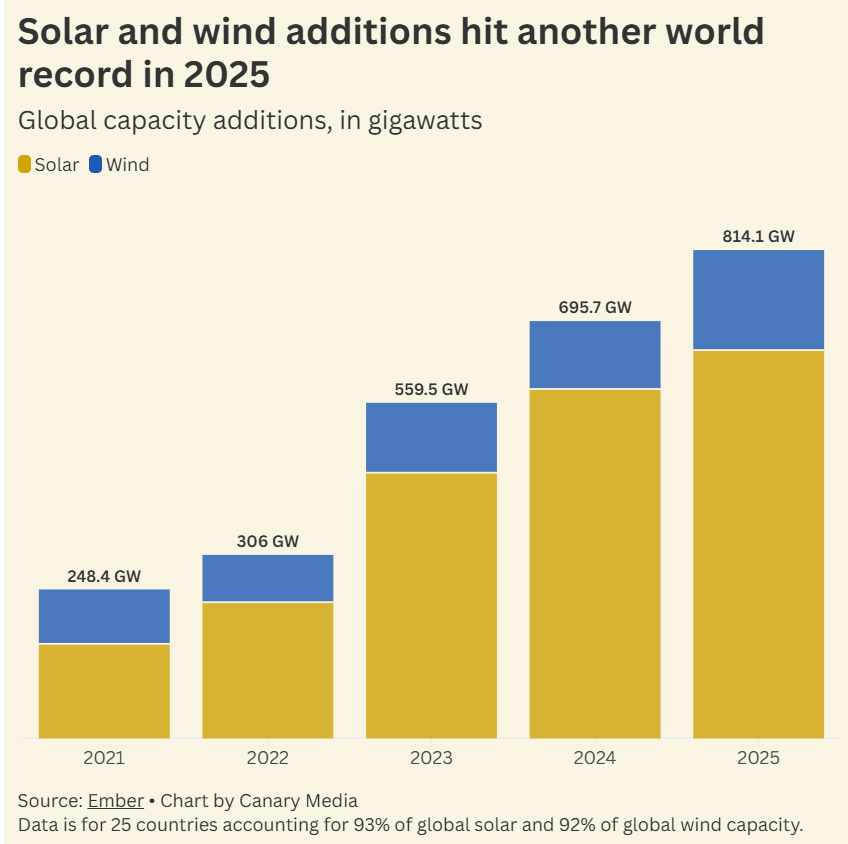
Solar, Wind Still Hitting Records: The world installed a record 814 GW of new solar and wind capacity in 2025, 17% more than in 2024 (696 GW) according to new data from global energy think tank Ember. The latest additions bring the combined global installed capacity of wind and solar to 4,174 GW (over 4 TW), highlighting the rapid expansion of the two fastest-growing sources of electricity in history.
IN THE NEWS
Glomar, Cobalt Blue to Build Major US Critical Minerals Processing Facility – Glomar Minerals and Cobalt Blue announced this morning in Australia a consortium agreement to process seabed minerals in the United States. The consortium will aim to build the first commercial-scale polymetallic processing facility in the world (called Project Infinity) with activities already underway to secure an appropriate U.S.-based site. The agreement leverages Cobalt Blue’s proprietary flowsheets, engineering work and pilot testing facilities in Australia, and Glomar’s extensive work to secure, explore, and develop seabed minerals — a near limitless resource. Glomar Minerals is an American critical minerals company dedicated to exploring, collecting, and processing seabed polymetallic nodules to develop a new, secure and reliable, long-term supply of essential materials. Glomar Minerals draws its inspiration from the legendary Hughes Glomar Explorer, first commissioned by the CIA to recover the sunken soviet submarine K-129, later used by Lockheed Martin in the Clarion Clipperton Zone to demonstrate the industrial feasibility of seabed minerals. Glomar Minerals, through its wholly-owned and affiliated subsidiaries, holds the rights to significant exploration licenses in the Clarion Clipperton Zone, including two leading polymetallic nodule projects and a minority stake in a third joint venture. Together, these projects rank among the world’s largest and most advanced holdings of high-grade polymetallic nodules rich in cobalt, copper, nickel, and manganese — which are critical inputs for energy, defense, and advanced manufacturing supply chains.
“Undersea minerals represent a gamechanger to redefine U.S. critical mineral dependence the way shale oil and gas reshaped global energy geopolitics — but it is only one piece of the puzzle. Processing is the other — making this consortium instrumental to both economic and national security. The ability to extract six minerals from a single polymetallic nodule (cobalt, copper, nickel, manganese, iron, and rare earths) is a true force multiplier. Glomar Minerals is excited to lead in this effort and focus on processing with Cobalt Blue, so that the United States can win in this critical race for undersea mineral supremacy,” said Robbie Diamond, Executive Chairman of Glomar Minerals.
Glomar Minerals is actively expanding both its global exploration footprint and its plans for vertical integration as part of its mission to strengthen supply chain resilience. With this new consortium, Glomar is on the fast track to become the world’s largest and most diversified holder of undersea minerals, while leading as the first to market with a fully-integrated harvesting to processing value chain.
“Our collaboration with Glomar provides a compelling opportunity to utilize Cobalt Blue’s patented hydrometallurgical technology for a new, significant multi-commodity feedstock,” said Dr. Andrew Tong, CEO & MD of Cobalt Blue.
Cobalt Blue Holdings Limited (ASX: COB) is a listed Australian minerals processing and mining company with interests in cobalt, copper, silver and sulfur. Its critical minerals strategy focuses on building new midstream processing capabilities in Australia and with likeminded partners to develop new, secure supply chains. Cobalt Blue has already successfully demonstrated a robust metallurgical flow sheet for polymetallic nodules.
Gevo Plans Major ethanol Expansion in ND – Gevo said it is developing plans for an expansion at the site of its Gevo North Dakota facility in Richardton, ND by adding a second ethanol production facility with targeted production capacity of up to 75 million gallons per year (“MGPY”) of low-carbon ethanol. Paul Bloom, President of Gevo:
“As we pursue strategic opportunities for growth, the expansion of production at Gevo North Dakota is at the top of our list. It is one of the best sites in the U.S., in a pro-agriculture and pro-energy state and with local farmers who continue to increase productivity year after year. We already have the core elements in place in North Dakota, including proven carbon capture and sequestration infrastructure and access to pore space.”
Earlier this year, Gevo announced plans for incremental expansion of its ND ethanol facility from 67 MGPY to 75 MGPY over the next year. The integrated system combines ethanol production, CO₂ capture and permanent sequestration, which enables Gevo to monetize its carbon in voluntary carbon markets and low-carbon fuel markets, generating meaningful revenue by producing energy with reduced lifecycle carbon intensity, including cost-effective alcohol-to-jet pathways to scale production of synthetic aviation fuel. The ND Plant site would be expected to produce approximately 150 MGPY of low-carbon ethanol, more than 400,000 metric tons of captured CO₂ and additional animal feed and corn oil.
Kentucky Awards GLE Uranium Processing Funding – Kentucky Gov. Andy Beshear said Global Laser Enrichment (GLE) has received preliminary approval of a comprehensive incentive package with the Commonwealth of Kentucky and McCracken County to support the ongoing development of the planned Paducah Laser Enrichment Facility (PLEF). The PLEF represents a transformational investment opportunity for the greater Paducah region and is expected to be the single largest capital investment in Western Kentucky’s history. The performance-based incentive package will potentially provide up to $98.9 million in tax and other economic incentives should GLE reach agreed investment and job creation thresholds.
“This is a game-changing investment for Western Kentucky and our entire commonwealth, and I am excited to see this project and the 240 great jobs come to life for families in Paducah and the surrounding region,” said Gov. Andy Beshear. “This project solidifies our role as a leader in the country’s nuclear power sector and will transform our economy, creating opportunities for Kentucky families for generations.”
GLE’s 665-acre Paducah site is strategically located adjacent to the U.S. Department of Energy’s (DOE) former Paducah Gaseous Diffusion Plant. The PLEF is currently under license application review by the Nuclear Regulatory Commission. Once licensed, the facility is expected to re-enrich over 200,000 metric tons of high-assay depleted uranium under a 2016 contract with the U.S. Department of Energy – accelerating DOE’s site cleanup mission, reducing long-term federal costs, and providing a new fuel source for nuclear power generation.
Clean Edge Look at Clean Energy Indices – Clean Edge, last week announced the results of the semi-annual evaluation of the following indexes:
- Nasdaq OMX Clean Edge Smart Grid Infrastructure™ Index (QGRD™)
- ISE Clean Edge Water™ Index (HHO™)
- Nasdaq Clean Edge Global Water™ Index (GHHO™)
- Nasdaq Clean Edge Green Energy™ Index (CELS™)
- ISE Clean Edge Global Wind Energy™ Index (GWE™)
Click on the above links to get more details. All changes became effective prior to today’s market open as a result of the semi-annual evaluation. Exchange-traded funds (ETFs) based on the indexes are offered by First Trust in the U.S. and Europe under the ticker symbols GRID, FIW, H20, QCLN, and FAN, respectively. All U.S. and global tracking financial products of Nasdaq Clean Edge indexes equaled $12 billion in assets under management as of March 15, 2026. Clean Edge, Inc. develops and publishes thematic research on clean energy, transportation, water, and the grid. Founded more than 25 years ago, the firm was the first analyst company to promote the concept of “clean tech” to a business audience.
MI Unions Push Clean Energy Jobs Approach – Unions in Michigan launched Michigan Climate Jobs, a coalition of labor unions building a worker-led affordable clean energy future now and into the future. The coalition also unveiled a comprehensive report from Cornell University’s Climate Jobs Institute outlining a blueprint for a worker-led clean energy future in the Great Lakes State. Ryan Bennett, president of the Michigan Pipe Trades Association:
“We launched Michigan Climate Jobs to ensure a worker-led clean energy future that puts labor in the driver’s seat to lead on combating the climate crisis, making energy affordable and reliable, and protecting workers today and for generations to come. The jobs needed to create the clean energy economy must absolutely be union jobs because it’s union jobs that will deliver family-sustaining wages, good benefits, and safety for workers.
ON THE SCHEDULE THIS WEEK
Valero Open Set – The 2026 Valero Texas Open takes place this week at TPC San Antonio’s Oaks Course. The event serves as the final PGA Tour event before The Masters and has donated millions to charities over the years.
Vermont Superfund Law Hits Court – The U.S. District Court in Vermont will hold oral arguments today in a pair of cases challenging Vermont’s novel climate superfund law, United States of America v. State of Vermont and Chamber of Commerce v. Moore. In 2024, Vermont passed a groundbreaking new law modeled after the federal Superfund program that holds major fossil fuel producers liable for GHGs, requiring them to help pay for climate change adaptation projects in the state. The law was the first of its kind and its passage marked a breakthrough for climate accountability efforts. New York then followed Vermont’s lead and passed a similar law just months later. The US Chamber of Commerce and the American Petroleum Institute sued with 24 Republican-led states joining as intervenor plaintiffs. The Trump Administration also filed suit.
Stimson Looks at Iran Conflict Impacts – Tomorrow at 2:00 p.m., the Stimson Cetner holds a forum to explore the reverberating effects of the Iran war – from Kyiv to Beijing to global markets – as the war stretches into its second month. From maritime chokepoints to shifting alliances, the discussion will explore how these dynamics are reverberating across the Indo-Pacific – placing new pressures on U.S. partnerships and reshaping the global balance of power far beyond the Gulf.
JHU to Look at Energy Transitions – The Johns Hopkins University School of Advanced International Studies holds a virtual discussion tomorrow at 6:00 p.m. focused on financing energy transitions in developing economies. The event features a climate and energy chat with Ken Berlin, a nonresident senior fellow and the director of the Financing and Achieving Cost Competitive Climate Solutions Project at the Atlantic Council’s Global Energy Center. He previously served as president and CEO of the Climate Reality Project, founded by Al Gore, expanding its global reach and grassroots climate network.
Forum Looks at Energy Shockwaves – The Carnegie Endowment for International Peace holds a discussion on Wednesday at 9:30 a.m. on long-term implications of the U.S.-Israel-Iran war. Carnegie Endowment’s Middle East program panel will be moderated by the FT’s Abigail Hauslohner, and feature experts to examine the long-term impacts that the war will have on regional security, and on the United States’ and other international actors’ policies in the Middle East.
Conservative Law Group Looks at Major Questions Doctrine – The Federalist Society for Law and Public Policy Studies holds a virtual discussion on Wednesday at 2:00 p.m. looking at the "Major Questions Doctrine” by focusing on cases from West Virginia v. EPA to Learning Resources. The event will focus on the practical implications of Learning Resources for administrative law practitioners, agency counsel, and litigants challenging executive action.
Passover – Passover begins the evening of Wednesday through next Thursday April 9th
ELI Hold Discussion of Exiting International Agreements – The Environmental Law Institute hosts discussion on Thursday looking at the environmental effects of the U.S. withdrawing from international organizations. Panelists will explain where the United States is withdrawing and the potential implications of its withdrawal. They will also discuss the long-term, global environmental and human rights challenges that could arise from this shift away from multilateralism.
Good Friday – Friday April 3rd
Easter Sunday – Sunday April 5th
IN THE FUTURE
RFF Holds Climate Forum – Resources for the Future (RFF) holds an RFF Webinar on Tuesday April 7th looking at the global energy outlook for 2026 and whether the world has lost the 1.5°C goal. The event coincides with the release of the 2026 Global Energy Outlook—RFF’s annual report that synthesizes global energy market projections and analyses from leading energy organizations and corporations. During the webinar, RFF researchers will discuss key findings on a variety of topics, including how the world veered off track from achieving international climate goals, rapidly rising global electricity demand, the uncertain global outlook for coal, evolving projections for transportation fuels, and more. The webinar will also feature an in-depth panel discussion that will dive deeper into the topics explored in the report, along with the energy impacts of developments in Venezuela and the Middle East. Panelists will also discuss the outlook for future international climate negotiations, domestic industrial strategy, and more.
Atlantic Council Holds Prosperity Forum – On Thursday April 9th, the Atlantic Council's Freedom and Prosperity Center for its annual Global Prosperity Forum. This year's event will bring together experts and leaders shaping the global development landscape. Discussion topics include achieving strategic objectives through investment and development finance, the future of democracy assistance, responsible mining in the critical minerals industry, China's soft power strategies in the Global South and using energy compacts to promote growth. This event will also mark the kickoff of the Entrepreneurship Policy Initiative through a high-level panel discussion with the project's stakeholders. In addition, they will introduce the 2026 Country Atlas. Key speakers including Tom Haslett, Director of Energy and Critical Minerals Policy at the US International Development Finance Corporation.
Daines, Total Energies CEO to Headline Semafor World Economy Forum – Semafor holds its annual World Economy Forum on April 13th to 17th. Across the week, our editorial tracks will explore global finance, geopolitical unpredictability, healthcare, and the rapid changes AI is generating. The session I’m most excited about, however, is Powering the Future — where I’ll be sitting down with some of the leaders shaping the next era of energy. Speakers include TotalEnergies CEO Patrick Pouyanné, Sen. Steve Daines, Baker Hughes CEO Lorenzo Simonelli and GE Vernova CEO Scott Strazik, among others.
SEJ Goes to Chicago – On April 15th to 18th, SEJ’s 35th annual conference will be held at the University of Illinois Chicago (UIC), is a leading public research university and national authority in environmental health, sustainability, urban planning and climate science. SEJ2026 will bring together journalists, scientists, academics, students, policymakers and nonprofit leaders to explore urgent environmental, climate and health issues. Of course, on Thursday, Bracewell and the American Cleaning Institute will co-host our annual popular reception.
Columbia Global Energy Summit Looks at Geopolitics – On April 21st in New York City, the annual Columbia Global Energy Summit, hosted by the Center on Global Energy Policy at Columbia University SIPA, will focus on energy, security and geopolitics in the New World Order. Over the course of the day, speakers will provide thought-provoking commentary and analysis on key issues, such as the collapse of the rules-based international order, the impact of geopolitical shifts on the global economy, and how both of these dynamics shape the global energy industry. Program topics include demand flexibility and the rapid expansion of the AI industry, great power competition and the energy transition, increasing competition throughout critical mineral supply chains, energy affordability and permitting reform.
DC Climate Week Set – DC Climate Week is a community-organized week of events, exhibitions, tours, screenings, and gatherings across Washington, DC on April 21st to 26th. For the Second year, the event will explore the challenges of the climate crisis and discover the solutions that give us hope. Bracewell will host several events so stay tuned for details.
Forum Looks at Climate Data – The Environmental and Energy Study Institute (EESI) and Climate Central hold a briefing on Thursday April 23 at 4:00 p.m. in 2168 Rayburn to discuss a key underpinning of the U.S. economy: publicly-available weather and climate data. In this new information environment, universities, nonprofits, and national associations are stepping up to fill the gaps in maintaining weather and climate data left by the federal government. Panelists will share where to look for these datasets and explore how these organizations are maintaining public access to critical information without the resources afforded by the federal government. They will also describe the implications of these changes for end users, from individuals using weather apps to multinational corporations making significant business decisions.
Energy Forum Set for San Antonio – The 13th Energy Thought Summit (ETS)will be held in San Antonio, TX on April 27th to 30th. The event will reflect on the industry's past achievements, while discussing the limitless opportunities that lie ahead. Immerse yourself in the collective wisdom of industry pioneers, thought leaders, and visionaries, inspiring us all to push the boundaries of what is possible when it comes to shaping our new energy future.
SAFE Summit to Tackle Critical Mineral, Energy Security Challenges – SAFE Summit 2026 is set for April 27th and 28th at the Walter E. Washington Convention Center – 3rd Floor Ballroom in DC. The event will convene innovators and leaders at a premier conference event for high-stakes and high-impact conversations shaping the nation’s energy, transportation, and minerals future. Session topics focus on AI, batteries, mineral security policies, transmission, energy, Detroit’s China EV problem and More. Spotlighting SAFE’s The Pillars of Power: A Strategy for Energy Security and Industrial Resiliency, the Summit will focus on rebuilding America’s industrial base, securing critical supply chains, and embracing energy abundance.
Chamber Holds Energy Summit – On May 1st, the U.S. Chamber of Commerce and RealClearEnergy hosts its 2026 Energy Future Forum. Affordability has become the watchword of the year, driving conversations across AI aspirations, reshoring efforts, mineral mining and refining, LNG exports, and more. Join leaders from industry, policy, and technology for a full day of discussions on how cost pressures are shaping the future of energy and innovation. Featured speakers include Energy Secretary Wright, Southern CEO Chris Womack, EQT CEO Toby Rice, FERC Commissioner David Rosner and Siemens Energy President Matt Neal.
USEA Holds Energy Forum – On May 5th, the US Energy Association will convene the US Energy Policy Forum in Washington, DC, to shift the national dialogue from high-level discussion to "Prioritizing Action." This landmark event will gather a select group of visionaries and decision-makers to bridge the gap between policy and practice, defining the next era of our energy landscape.
CCS Forum Set For DC – The Global CCS Institute holds its 2026 Americas Forum on Carbon Capture and Storage on Tuesday May 12th in Washington, D.C. hosted at the Embassy of Australia. The Forum program will feature keynote remarks, experts panels, and in-depth discussions on policy, technology, investment, and project developments. The event will also discuss Carbon Removal by Howard J. Herzog (MIT) and Professor Niall Mac Dowell (Imperial College London), both of whom will be speaking at the Forum