
Energy Update: Week of March 2nd
Energy Update - March 02, 2026

Friends,
Hope you are enjoying the first week of the lunar New Year. Last week at my daughter Hannah’s place in Philly’s Chinatown, things were popping! BTW, today is her 28th birthday! How is that possible!!!
We are closely watching the crude oil market impacts of the military action in Iran. Key issues that will dictate the state of play include the flow of tanker traffic in the Strait of Hormuz, the number of barrels disrupted and how the long the disruption may last. An issues to watch are the administrative challenges of short-term re-routing the world’s energy markets. In a piece in the FT, analyst John Kemp writes the Iran military action will test the vulnerability of oil markets. Meanwhile Columbia’s SIPA experts have a very detailed piece that says it remains unclear how the crisis will evolve or be resolved, but what seems more certain is that it will have lasting geopolitical and energy implications. Finally, my friend Kevin Book of ClearView Energy is continuing to publish on this topic regularly, so feel free to check in with him to get his latest take.
The midterms are coming in November, but tomorrow is the first move when voters in Texas, North Carolina, and Arkansas will head to the polls for the cycle’s first round of primaries. Most interesting will be the Texas Senate primaries where, on the Republican side incumbent, Sen. John Cornyn has trailed AG Ken Paxton. But with Rep. Wesley Hunt keeping the primary voters below 50%, this is likely to be decided in a May runoff. On the Democratic side, Rep. Jasmine Crockett and State Rep. James Talarico are exchanging dueling leads in separate polls, so it is not clear where this will finish. In North Carolina’s Senate race, look for former Gov. Roy Cooper and former RNC chair Michael Whatley to set up for an important thriller in November.
Washington is back into appropriations issues this week with the Homeland Security budget dispute taking center stage. We will most certainly see War Powers Act votes as well, given the Iran military action.
In Congress, Wednesday is the big hearing say with Senate Environment reviewing the TSCA Fee Reauthorization and Improvement Act, House Energy reviewing pipeline safety authorizations, House Resources providing oversight of the Migratory Bird Treaty Act and the House Energy’s Environment panel reviewing brownfields site issues.
Finally, other events include the Electric Power Supply Assn’s 5th annual Competitive Power Summit tomorrow at the Grand Hyatt, looking at the critical issues facing competitive power and the U.S. electric system with speakers DOE’s James Danley and FERC Commissioner David Rosner. And Wednesday evening, the Hudson Institute holds a discussion focused on securing America's critical mineral supply chain with Rep. Rob Wittman.
It is March and that means NCAA basketball conference tournaments and of course, NCAA March Madness. Start getting your favorites and sleepers lined up. I have been tracking Michigan and Arizona – two big guns in our house. It also means just three weeks to CERA week in Houston. I am locked in and starting to plan the Bracewell “Starbucks Office” agenda, so let me know if you will be there.
Call with any questions.
Best,
Frank Maisano
(202) 828-5864
C. (202) 997-5932
FRANKLY SPOKEN
“Despite the challenges around high cost of debt, constraints in site permitting, grid connection bottlenecks, and policy uncertainty, clean power deployment was sustained by rising electricity demand and continued interest from corporate buyers.”
The BloombergNEF and the Business Council for Sustainable Energy Sustainable Energy in America 2026 Factbook report.
ON THE PODCAST
Offshore Wind Challenges Focus of Study – On this week’s version of the US Energy Assn Power Sector podcast, Oliver Stover, Associate Principal with the Energy Practice for global business consultant Charles River Associates, discusses the recently disrupted Atlantic coast offshore wind projects’ potential key role in reliably meeting the growing demand for electricity in Northeastern population centers.
Conversation with Cleantech Investor, Podcast host on Clean Energy Questions – In this episode of Volts, Dave Roberts chats with Catalyst podcast host Shayle Kann about the most pressing unresolved questions in the clean energy world today. They explore whether data center gigantism will break the grid, if the smart home revolution is destined for platform enshittification, whether billionaires should start testing solar geoengineering, and more.
POLITICO Podcast hosts Maloney on Utilities – Toay on the POLITICO Energy podcast, reporter Zack Colman interviews EEI head Drew Maloney. Maloney and Colman discussed electricity prices, the need to fix PJM’s generation shortfall, grid reliability, coordination with the White House and technology companies, and the “vibe shift” among policymakers toward building new energy infrastructure.
FUN OPINIONS
Offshore Wind Stop Work Orders Are Bad for Already-Built Projects – In an op-ed in the Washington Times, the conservative think tank Raney Center CEO Sarah Hunt writes we should not block infrastructure that's already built and paid for. When the federal government issues stop-work orders that stall five large-scale, nearly completed offshore wind projects, we should be honest about what that means for everyday people: It makes the problem of rising electricity bills worse.
NE Grid Performed Well During Storm, But Must Keep Improving – In an opinion in Utility Dive, New England Power Generators Association president Dan Dolan says for nearly three weeks in January and February, arctic temperatures combined with over two feet of snow to create the tightest energy conditions in nearly a decade. Peaker facilities that rarely run were able to operate for weeks. Baseload plants lived up to their name and served as work horses setting a steady foundation. And mid-merit needs from natural gas and hydro facilities met unique load shapes and persistently high demand over holiday weekends and Super Bowl Sunday. We also saw real contributions from offshore wind and some solar peeking through the snow.
FROG BLOG
Loris: Trump Should Accept the Win on Offshore Wind – In an opinion blog on The National Interest website, conservative energy expert and President of advocacy group C3 Nick Loris writes to unlock an energy abundance agenda, permitted wind projects like those offshore on the East Coast should proceed…and comprehensive permitting reform must follow. Regulatory whiplash undermines the certainty markets need to finance pipelines, power plants, transmission lines, and emerging technologies alike. Finding new and creative ways to stall or block disfavored projects only fattens the playbook for an anti-fossil fuel administration to keep America’s abundant natural resources in the ground.
FUN FACTS
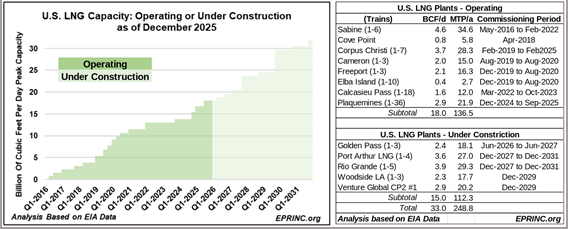
LNG’s 10-Year Roll: LNG producers have increased their commitments either to expansion of current facilities or more new projects. Currently, there is an additional 13.3 BCF/d (101.3 MTP/a) of capacity that has received permitting but has not yet commenced construction. As of December 2025, total operating U.S. LNG export capacity stood at 18 BCF/d, or 136.5 million metric tons per annum (MTP/a). Currently, there is another 15 BCF/d (112.3 MTP/a) that is under construction scheduled to be commissioned between June 2026 and December 2031
IN THE NEWS
New Study Shows Sustainable Energy Technologies Met Rising Demand Growth in 2025 Despite Uncertainty – In 2025, U.S. electricity demand rose considerably for the first time in decades, coinciding with rising electricity prices. At the same time, far-reaching and unpredictable policy changes provided both major challenges and a few unanticipated opportunities for the energy sector, according to the 2026 Sustainable Energy in America Factbook published today by BloombergNEF (BNEF) and the Business Council for Sustainable Energy (BCSE). Wholesale and retail power prices both increased in 2025, concurrent with a renewed political focus on energy affordability. Overall, retail demand for electricity climbed 2% year-on-year in 2025 and was up 8% over the past decade following more than a decade of near-flat electricity demand. But despite major headwinds, a diverse mix of energy sectors – including energy efficiency, renewable energy, energy storage, natural gas, and sustainable transportation – continued to grow across the country, driving U.S. power generation to a 20-year high.
Reshaping the Energy Landscape: Data Center Demand Has Quintupled in the Past 10 Years
The 2026 Factbook reports that data centers are now a dominant force behind rising U.S. power demand and the associated impact on the grid. They are also increasingly under scrutiny for rising electricity prices. Data center electricity demand has grown more than 400% in the past 10 years and 150% in the last five years. Development shows no signs of slowing. Through the first quarter of 2025, a cumulative 23 gigawatts (GW) of data center IT capacity was live in the United States with 48 GW under construction or committed to be built. Across the entire U.S. economy, total primary energy consumption ticked up 1.2% in 2025 but was outpaced by GDP growth of 2%. This is a direct result of decades-long investments in energy efficiency technologies, which have allowed consumers to save billions of dollars while improving U.S. economic competitiveness. Amid data center load growth and a broader political focus on affordability, electricity costs are increasingly top of mind for policymakers. Wholesale power prices increased sharply in the natural gas-heavy Northeast and Mid-Atlantic, reflecting higher gas prices, pressure on capacity markets, and grid constraints. Prices rose 62% year-on-year in New York State, 60% in New England, and 45% in the PJM power market that stretches across 13 states and the District of Columbia. Despite growing focus on specific markets, retail prices nationally inched up just 2.3% year-on-year. Over the past decade, U.S. residential electricity prices have risen 32%.
Despite Major Headwinds, Sustainable Energy Technologies Continued to Expand
The United States built the most new power-generating capacity in more than two decades in 2025 with 54 GW of new utility-scale generation and storage capacity commissioned. Renewables accounted for 61% of new capacity, with utility-scale solar specifically leading with 27 GW alternating current commissioned. Utility-scale energy storage emerged as a central component of new capacity, with a record 15 GW added in 2025, up 35% year-on-year. Natural gas capacity additions also doubled year-on-year. U.S. investment across all of the energy transition sectors BloombergNEF tracks – including renewables, electrified transport, decarbonization of industrial processes, and grids, among others – grew 3.5% year-on-year to a record $378 billion. Corporate power purchase agreements signed for zero-carbon electricity reached 29.5 GW in 2025, the highest annual total on record. Last year was marked by a growing share of nuclear, hydropower, and geothermal contracts as tech giants doubled down on clean, baseload power for AI data centers. EV sales reached a record 1.6 million vehicles in 2025, 3.7% higher than 2024, reflecting consumer uptake ahead of the phaseout of federal tax credits in October 2025. With the push to add new electric generation, capital deployed to support expansion and reinforcement of the grid also rose to a record $115 billion in 2025.
Business Certainty Needed for Speedy Deployment
The growth in energy investment and deployment in 2025 came even as the industry grappled with uncertainty driven by federal policy changes. No less than 87 new U.S. trade and tariff policies were announced in 2025, creating unpredictability for companies and investors with exposure to cleantech supply chains. Businesses relying on the 10-year timeline of federal tax incentives enacted in 2022 had to adjust development plans as many credits were abruptly phased out in late 2025. In addition, federal permitting revocations and restrictions, especially impacting wind and solar projects, have added additional delays to already lengthy approval timelines. The slow pace at which infrastructure projects can secure necessary permits and advance remains a key obstacle for energy deployment. In 2025 alone, 377 GW of new capacity applied to interconnect in the seven U.S. independent system operators, with energy storage projects making up the majority. It can take years for these projects to connect to the grid and bring power online. From transmission rights-of-way to carbon sequestration, reforms to federal permitting and siting regulations could help alleviate these difficulties and accelerate the pace of the U.S. energy expansion.
Utilities Generating Record Amounts of Renewables – In light of the FACTBOOK date, EIA reported this week that US utilities generated a record amount of energy from renewable sources last year, even as the Trump administration implemented a range of policies to slow renewable. Some 1,162 TW-hours of the country’s electricity was generated from renewable sources in 2025, a 10% increase over the prior year. That represents 26% of all US electricity made — enough to power about 108 million US homes for a year. Some months were even greener. Last March, renewables generated over 30% of the country’s electricity.
ON THE SCHEDULE THIS WEEK
Brookings Focused on Electricity Prices – The Brookings Institution’ Center on Regulation and Markets holds a discussion today at 2:00 p.m. on rising electricity prices in the U.S. and what can be done about it. The event is part of the center’s ongoing series, Reimagining Modern-day Markets and Regulations, and will kick off with a keynote fireside chat with Joseph Bowring, president of Monitoring Analytics. Following the keynote, a panel of distinguished experts including Brendan Pierpont (Energy Innovation), Abe Silverman (Johns Hopkins), Ryan Wiser (Lawrence Berkeley National Laboratory) will offer their analyses and a path forward for policymakers and industry alike.
EPSA Competitive Power Summit Hosts Danley, Rosner – The Electric Power Supply Assn holds its 5th annual Competitive Power Summit on tomorrow at the Grand Hyatt. The event features a day of expert panels and featured speakers discussing critical issues facing competitive power and the U.S. electric system, as well as what it takes to build what’s needed at the pace required to keep power both reliable and cost-effective. Headline speakers include DOE’s James Danley and FERC Commissioner and former Chair David Rosner.
EESI Looks at Wildfires – The Environmental and Energy Study Institute and the Federation of American Scientists (FAS) hold a briefing tomorrow at 3:00 p.m. on progress and a path forward for wildfire policy. One year after the catastrophic wildfires that blazed through southern California, the briefing will look at emerging solutions to tackle the wildfire crisis, and the federal policy strategies for getting these solutions into the field. This briefing will highlight efforts to address this crisis, including wildfire preparedness, response, and recovery policies and innovations in the United States. Panelists will identify evidence-backed approaches—from smart zoning and upgraded building codes to fuels management and early detection—and the role of federal policy in supporting the rapid development and cost-effective implementation of these tactics at scale. Speakers will include Sens. John Curtis and Alex Padilla.
CCS Forum Set – The Global CCS Institute holds its annual Europe Forum on Carbon Capture and Storage on Wednesday in Brussels, Belgium. The event is a key platform for policy leaders, NGOs, industry experts, academics, financial institutions, and the public to explore the latest developments in carbon capture and storage (CCS) across Europe.
Senate Environment Looks at TSCA – The Senate Environment Committee holds a hearing on Wednesday at 10:00 a.m. reviewing the Toxic Substances Control Act Fee Reauthorization and Improvement Act of 2026.
House Energy Reviews Pipeline Safety – The House Energy and Commerce Energy Subcommittee holds a hearing on Wednesday at 10:15 a.m. on authorizing pipeline safety.
House Resources Looks at Migratory Bird Regs – The House Natural Resources Water, Wildlife and Fisheries Subcommittee holds a hearing on Wednesday at 2:00 p.m. to provide oversight of the Migratory Bird Treaty Act.
House Energy Panel Looks at Brownfields – The House Energy and Commerce Environment Subcommittee holds a hearing on Wednesday at 2:00 p.m. reviewing legislative proposals to unleash the potential of America's Brownfields sites.
Atlantic Hosts EXIM Bank Head on Competitiveness – On Wednesday at 3:00 p.m., the Atlantic Council hosts its upcoming ACFrontPage event featuring EXIM Bank Chairman John Jovanovic on US priorities for global competitiveness.
House Armed Services Looks at Energy, Enviro at Installations – The House Armed Services Readiness Subcommittee holds a hearing on Wednesday at 3:30 p.m. focused on energy, installations and environment update.
Hudson Looks at Critical Mineral Supply Chain – The Hudson Institute holds a discussion on Wednesday at 5:00 p.m. focused on securing America's critical mineral supply chain. The event features a discussion with Rep. Rob Wittman (R-VA) on his recently introduced Securing Essential and Critical US Resources and Elements (SECURE Minerals) Act and Congress’s role in securing America’s economic security.
IN THE FUTURE
Water Power Week to Highlight Key Hydro Role – The week of March 9th, the National Hydropower Association holds its annual Water Power Week 26 in Washington, DC. Sen. Lisa Murkowski will headline the event.
Energy Abundance Forums Set – The American Energy Abundance Alliance, a new initiative of BCSE, is holding the 2026 Energy Abundance Forum in Washington, DC on March 11th and 12th to address connect with fellow BCSE members and learn the latest updates on energy policy.
EESI to Look at Affordability Programs – The Environmental and Energy Study Institute (EESI) holds a briefing on Thursday March 12th at 3:00 p.m. in 2168 Rayburn to look at readily-available solutions to help reduce energy costs for homes and small businesses. This briefing will convene experts from around the country with on-the-ground experience in bolstering energy efficiency and delivering savings to consumers. These panelists will explore the benefits of energy-saving solutions available to households and small businesses. They will also identify key federal programs that support these initiatives, such as the Low-Income Home Energy Assistance Program, ENERGY STAR and the Weatherization Assistance Program.
Burgum, Wright Headline Japan Energy Forum – The Indo-Pacific Energy Security Ministerial and Business Forum (IPEM) is being held on March 14th and 15th in Tokyo, Japan convening of Ministers, CEOs and senior leaders shaping the future of energy security in the Indo-Pacific. IPEM brings together government and industry to advance trusted partnerships, unlock investment and strengthen resilient, secure energy supply chains across the region. US officials attending include Secretary Burgum, Secretary Wright, Ex-Im Bank President head John Jovanovic and many more. Look for an energy deals on LNG to be featured here.
Hydropower Conference Set – CEATI holds it 16th hydropower conference in San Diego, CA on March 17th and 18th. CEATI gathers utility leaders, experts and influencers at this prestigious event to share practical insights and breakthrough developments shaping the future of hydropower. The 2026 event will feature utility professionals from a variety of leadership roles, including Dam Safety Engineers, Hydro Plant Managers, Engineering Directors, Hydrologists, Water Resource Managers and Business Executives.
Forum Tackles Nuclear Questions – OurEnergyPolicy is hosting an upcoming luncheon on the technology, regulatory and financial status of advanced nuclear on Wednesday March 18th at the National Press Club in Washington, D.C. The panel will feature Bradley Crowell from the Nuclear Regulatory Commission, Bill Jessup from Natura Resources, and Doug True from the Nuclear Energy Institute.
Decarb Conference Set – The Climate Registry hosts the 2026 Climate Leadership Conference event: Carbon Disclosure and Decarbonization Forum in Pasadena, CA on March 19th and 20th. This year’s program features policymakers, sustainability experts, and university changemakers who are shaping the future of decarbonization. BCSE experts will be there.
USTDA, NEDC to Coordinate Forum – Mark your calendars of for a major LNG event in advance of CERA Week on Friday March 20th. the U.S. Trade and Development Agency, LNG Allies, and the U.S. Chamber of Commerce for the launch of a new initiative to advance American energy dominance by expanding U.S. exports across the global gas value chain. The event will feature expert panels and presentations highlighting emerging market opportunities and strategies to leverage U.S. government partnerships and resources. Invitees include U.S. business executives, senior U.S. government officials, representatives from Capitol Hill, and industry leaders from key emerging markets.
CERA Week Set – CERAWeek is on for March 22nd to 26th. The event is the most prominent energy Conference of the year and features three mutually reinforcing platforms: The Executive Conference, the Innovation Agora and Partner Programs. The industry's foremost thought leaders convene to cultivate relationships and exchange transformative ideas. Our programs are designed to advance new ideas, insight and solutions to the biggest challenges facing the future of energy, the environment, and climate.