
Energy Update: Week of March 20th
Energy Update - March 20, 2023

Friends,
Welcome to the VERNAL EQUINOX!!! Today at 5:24 p.m. we hit it, with the daylight getting longer from here on out. Spring means March Madness and the NCAA Tournaments are off and running. There were some big surprises in the first weekend, with maybe the biggest being #15 Princeton bouncing out Arizona and moving to the Sweet 16 by knocking out Mizzou. And how about #16 Fairleigh Dickinson, who busted many energy industry brackets (including mine) by bouncing out #1-seeded Purdue (Boiler Down and Out!). Furman ousted UVa in one of the other major upsets and the Sweet 16 sees #9 Florida Atlantic, #8 Arkansas, #7 Michigan State, #6 Creighton, #5s Miami and San Diego St, #4s UConn/Tennessee, #3s Xavier/Kansas St., #2s Texas/UCLA and #1s Alabama and Houston. On the Women’s side, top seeds rolled so far with half of the Sweet 16 set (only Ole Miss knocked out #1 Stanford and #2 UMd and #1 VA Tech moved on). Second half of the 16 is determined today.
At the White House, President Joe Biden will mark Nowruz today, a feast celebrated for 3,000 years in Persia and Iran and he delivers remarks at the Conservation in Action Summit at Interior tomorrow. Biden heads to Canada on Thursday so expect some climate/energy discussions there. The House won’t be in until Wednesday, as Republicans are holding their annual issues conference in Orlando through tomorrow. When they return to Washington, the action will turn the sweeping energy and permitting package, unveiled last week. A vote, though, isn’t likely to come until next week. I talked about this some last Thursday with Julie Mason on Sirius XM’s P.O.T.U.S. 124.
The Budget hearings start to hit full speed this week with Senate Environment hosting EPA on Wednesday, while the Senate Interior Approps panel (Wed) and their House counterparts (Thurs) host the US Forest Service. Also Wednesday, Senate Budget holds its third climate hearing on insurance issues. Finally, Thursday, Energy Secretary Granholm heads to the House Approps.
UN’s International Seabed Authority meets this week in Jamaica to begin discussions around regulations for deep sea mineral collection of critical minerals. This is a HUGE issue for supplying our need for EVs, solar panels, steel and other every-day staples. Tomorrow, the Metals Company CEO Gerard Barron will do a backgrounder to provide insight and process info to the UN ISA process, its potential timeline and its Nauru partnership. (Let me know if you want to the details to attend). As well, two important pieces on deep sea mineral issues: First, one by Scott Segal in the American Bar’s Journal that argues seabed minerals, and in particular polymetallic nodules, offer a preferred solution to challenges facing the uptake of renewable electricity, electric vehicles, and other technologies to reduce greenhouse gas emissions; Second, a guest essay in the NYT from scientist (but also anti deep-sea activist) Diva Amon saying it should be stopped.
Only one week from the SAFE Summit on EVs, critical mineral supply chains and transportation that offers practical next solutions that will build out robust and reliable supply chains and supporting infrastructure for the EVs and the broader energy transition. One key speaker is Gerard Barron mentioned above as well as a trove of Administration officials including John Podesta. Also, a great cast of moderators including Bloomberg Detroit-based auto reporter Gabby Cappola, Reuters’ metals lead reporter Ernest Scheyder, DC auto policy reporter at Reuters David Shepardson, Axios’ Joann Muller and hopefully CNBC’s Pippa Stevens (still tentative). You won’t want to miss this event.
One other interesting item worth the read: yesterday at the Kennedy Center, Adam Sandler received the Mark Twain Prize for American Humor and there is a great feature in the WaPo from Friday about it. Check it out.
Finally, the Men’s Frozen Four was announced on Sunday (MN, Quinnipiac, Michigan and Denver) are top seeds with games starting on Friday. Just before the Selection show, the Wisconsin Lady Badgers snuck by Ohio State 1-0 in Duluth to win the Women’s Frozen Four, their 7th national championship and second in three years. The Lady Bucs were going for back-to back NCAA Championships.
FRANKLY SPOKEN
Peter Reinhardt, CEO of carbon sequestration startup Charm Industrial, which banked at SVB to Semafor’s Tim McDonnell
ON THE PODCAST
BCSE Jacobson Talks Clean Energy FACTBOOK with Volts – In the most recent Volts Podcast, host David Roberts is joined by the Business Council for Sustainable Energy President Lisa Jacobson about the Sustainable Energy in America Factbook, in partnership with BNEF, which contains a compilation of charts, graphs, and statistics about the clean-energy industry and where it's headed. To chat about some of the numbers, I contacted Lisa Jacobson, president of BCSE. We talked about the momentum behind clean energy, the enormous investments uncorked by the Inflation Reduction Act, the supply-chain difficulties that plagued the industry this year, the backlash to ESG investing, and the surge in energy storage.
FUN OPINIONS
Experts Look at Bank Failure Impact on Clean Tech – In an op-ed in The Hill, Colorado School of Mines Payne Energy Institute experts Morgan Bazilian and Brad Handler write the Silicon Valley Bank (SVB) played a critical role in the climate tech industry, particularly for early-stage companies. Its collapse will be felt even though its depositors will get their money back, but one can expect some project investments to be delayed and the financial costs to startups to rise as a new risk appetite emerges. They add if the bank’s demise eventually leads to a much more diverse set of financing sources, then climate tech will be the better off for it.
FROG BLOG
Experts Look at Deep Sea Minerals –With Delegates headed to Jamaica for discussions regarding regulations for deep sea mineral collection of critical minerals, my colleagues Scott Segal and David Bernstein write in the ABA Journal that seabed minerals, and in particular polymetallic nodules, offer a preferred solution to challenges facing the uptake of renewable electricity, electric vehicles, and other technologies to reduce greenhouse gas emissions. Given the urgency with which the world needs to reduce dependence on fossil fuels, it is imperative for ISA member states to reach expeditiously a consensus regulatory framework on seabed minerals. Meanwhile, deep mineral opponent, Diva Amon wrote in the New York Times that the rush to mine the deep sea must be stopped. She says more countries must step up and say they will not approve deep-sea mining unless and until there is sufficient scientific research on the potential risks and strong regulations can be put in place to protect these hidden but vitally needed ecosystems.
FUN FACTS
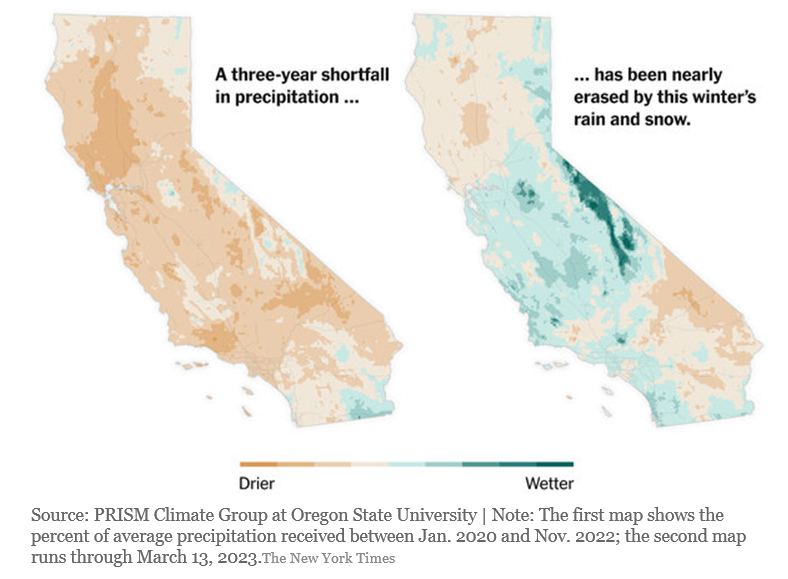
California Snow/Rains Have Cut into Drought Status: A great chart from the New York Times:
IN THE NEWS
New Study Finds CCS Project will Save Over $11 Billion Climate Abatement – The LSU Center for Energy Studies today released the results of an economic impact study commissioned by Gulf Coast Sequestration (GCS) titled: The Economic Implications of Carbon Capture and Sequestration for the Gulf Coast Economy. The study finds that the GCS hub could abate climate damages, support jobs and workers, and protect the regional energy industry. Key numbers from the report: $11.3 billion in climate damage abatement; $698 million in earnings for U.S. workers during the anticipated five-year construction period (with approximately $560 million in Louisiana and Texas); 1,149 jobs nationally during construction (with more than 970 in Louisiana and Texas); 375 jobs nationally once the project is completed, paying $21 million in earnings annually; and assistance in the decarbonization of - and thus protection of - an industry that employs approximately 150,000 workers directly in Texas and Louisiana alone. Read the full report here. GCS is planning to build the first hub in the United States to permanently store carbon dioxide emissions. The company has two applications for Class VI Underground Injection Control permits in front of EPA and is prepared to move forward to construction once permits are received. This report comes one week after GCS was included in a proposal submitted to DOE for funding from the Bipartisan Infrastructure Law’s Regional DAC Hubs program. That project, led by Battelle, would see DAC industry leaders Climeworks and Heirloom capturing carbon from the ambient air and GCS safely and permanently storing that carbon underground. More here.
Gevo to Measure, Report, Verify Carbon Intensity to Improve SAF/Ethanol Projects – Gevo said Thursday that it has entered into a joint development agreement with Southwest Iowa Renewable Energy (SIRE) to measure, report and verify carbon intensity (CI) through the entire value chain, inclusive of climate-smart agriculture practices to lower the carbon footprint of SIRE’s product portfolio. Utilizing the Verity Tracking platform under Gevo's newly created Verity Carbon Solutions business, this joint development agreement will focus on implementing tracking technology and developing the market for carbon inset credits that will help farmers and biofuel producers quantify the CI reductions for their products. This initiative plans to track reductions of CI to produce fuels and nutritional products through the use of “climate smart” agricultural practices, improvements in energy efficiency and potential use of defossilization of the input energy. With these tools in place, companies like Gevo and SIRE should then be able to source low-carbon grain from farmers and reward them for their contributions to overall CI reductions.
EIA Projects Reduced US Energy-Related CO2 Emissions by 2050 – US energy-related CO2 emissions drop 25% to 38% below what they were in 2005 by 2030, according to projections from EIA’s Annual Energy Outlook 2023 (AEO2023). By end of the projection period, 2050, U.S. energy-related CO2 emissions are 17% lower in this year’s Reference case compared with last year, after EIA accounted for the effects of the Inflation Reduction Act (IRA), energy technology costs and performance updates, a changed macroeconomic outlook, and other factors. EIA’s projected reductions are driven by increased electrification, higher equipment efficiency, and the deployment of renewables in the electric sector. Emissions reductions are limited, however, by longer-term growth in U.S. transportation and industrial activity. The AEO2023 is published on the EIA website today, along with a separate Issues in Focus paper that examines the impacts of the IRA, taking into account uncertainty around some of the policy provisions. In the Reference case, implementation of the IRA results in a 33% reduction in energy-related CO2 emissions by 2030 relative to 2005 compared to a 26% reduction in the No IRA case. Because of the complexity of the IRA and related challenges to modeling some of its provisions, not all of its energy system impacts are represented in AEO2023.
Cooking, Not Gas Stoves Causes Emissions – Claims that natural gas stoves are harming residential health are unrealistic and undermining decision-making aimed toward protecting human health, according to a recent report published by Catalyst Environmental Solutions (CES) and commissioned by the California Restaurant Association and the California Building Industry Association. The analysis finds natural gas is, “not a significant determinant of residential indoor air quality, and that the food type is more important than the fuel used to cook it.” The timely report counters the ongoing narrative from officials who continually cite flawed indoor air quality studies from environmental activists that use the topic as a route to limit consumer choice by attacking natural gas. The CES report stresses the importance of ventilation as a measurable reduction on the cooking process’s indoor air quality impacts. The report clarifies that “the literature is clear that there are many factors that influence the nature and extent of chemical emissions during the cooking of food,” and when ventilation is included in the analysis, indoor air pollutants is reduced to safe standards outlined by the National Ambient Air Quality Standards and California Ambient Air Quality Standards in most cooking arrangements and scenarios. A Dept. of Energy sponsored study showed that the emission rates from the act of cooking is considerably greater than what is generated from natural gas stoves themselves. For example, using a common cooking ingredient like olive oil generates over 11 times more emissions per hour than what is produced from the gas range.
Chang Getting FERC Buzz – Judy Chang, who played a major energy role from Gov. Charlie Baker (R-Mass.) as undersecretary of energy and climate solutions from June 2020 through January 2023, is a front-runner to join the Federal Energy Regulatory Commission replacing former Chair Rich Glick, according to E&E News reporting. Prior to working for Baker, Chang was a principal at the highly-respected Brattle Group, where she spent more than two decades researching renewable energy, electric power markets, FERC policies and other issues.
ON THE SCHEDULE THIS WEEK
EPA Holds Risk Comms, Climate Webinar – Today at 1:00 p.m., EPA holds a workshop exploring how to help communities prepare and mitigate for climate change health risk through more impactful communications.
WaPo Looks at US Industrial Policy with Granholm, DeWine – The Washington Post Live holds a virtual discussion today at 2:00 p.m., on US industrial policy and competitiveness. The event will feature back-to-back conversations with Energy Secretary Jennifer Granholm and Ohio Gov. Mike DeWine (R) about the state of US industrial policy and American competitiveness.
Book Review Focused on Climate Migration – The Carnegie Endowment for International Peace holds a virtual book discussion today at 3:00 p.m. on climate change and the next American migration. The event features a conversation and audience Q&A featuring Jake Bittle and Noah J. Gordon on Bittle’s latest book, The Great Displacement: Climate Change and the Next American Migration.
CSIS Looks at Future of US Climate Leadership – Today at 4:00 p.m., CSIS holds a discussion on U.S. climate leadership. The IRA is reshaping the U.S. energy economy toward low-carbon options. At the same time, the United States will remain a large producer and exporter of oil and natural gas. How will these two trends affect our geopolitical and economic future, and to what extent can they be leveraged to improve energy security and reduce global emissions? Understanding these questions is key for stakeholders—in U.S. states, foreign governments, industry, and civil society. Speakers Include White House Advisor Ali Zaidi, EEI’s Emily Fisher, WRI’s David Waskow and Qcells Scott Moskowitz.
UN Holds Water Conference – The UN holds its 2023 Water Conference tomorrow through Thursday In New York. The Conference, co-hosted by the Governments of Tajikistan and the Netherlands, will feature an opening and closing ceremony, six plenary meetings and five multi-stakeholder interactive dialogues. It will also feature a number of high-level special events and side events organized by Member States, the UN system and other stakeholders.
EPSA Summit Set – The Electric Power Supply Assn holds its Competitive Power Summit tomorrow at the Mayflower Hotel in Washington, D.C. This year's Summit will focus on reliable power solutions delivered through competitive electricity markets. NERC CEO Jim Robb and PJM CEO Manu Asthana are keynotes and speakers include our friends Stacey Dore of Vistra, ClearView’s Christie Tezak and Katherine Blunt of the WSJ.
Forum to Look at Arctic Ocean, Climate – The Wilson Center's Polar Institute and the Centre for the Ocean and the Arctic (Norway) hold a discussion tomorrow about research and ocean-related cooperation in the context of current geopolitical tension regarding the Arctic Ocean and climate/energy challenges. Maine Rep. Chellie Pingree keynotes while other speakers include White House OSTP advisor Jane Lubchenco, US Arctic Research Commission Michael Sfraga and others.
Forum to Looks at Nuclear Security Threats – Tomorrow at 10:00 a.m. Foreign Policy, in partnership with Schmidt Futures and the International Strategy Forum, convenes an expert panel of scientists, policymakers and defense officials to strategize ways to protect critical infrastructure through scenario planning, investment, and partnership building.
Forum to Release Report on Decarbonizing Cities – On Wednesday at 9:00 a.m., the Atlantic Council’s Global Energy Center and bp hold the launch of the new report: “A Model for Decarbonizing Cities”, featuring case studies on Rotterdam, Netherlands and Valencia, Spain and a discussion on decarbonization efforts in other port cities around the world. This discussion will review policies and initiatives that have been instrumental to their success and identify key challenges and opportunities for each city. The discussion will attempt to draw out potential lessons for other cities seeking to pursue an effective decarbonization pathway while achieving societal buy-in and maintaining key economic activities. What policies are necessary for cities, especially port cities, to unlock opportunities and meet decarbonization goals?
Forum Looks at IRA at 6 Months – The AU Center for Environmental Policy and George Washington’s Environment and Energy Management Institute hold a conference on Wednesday to look at a six-month look at the IRA. The full-day conference will convene national experts to discuss successes and assess challenges federal agencies face when implementing the climate and energy provisions in the Inflation Reduction Act. It will explore progress, barriers, and lessons-learned six months post enactment. We will also examine the extent to which federal support and programs for renewable energy and climate mitigation and adaptation are effective, and where federal programs can be improved to better serve communities and achieve the country’s climate goals.
Senate Environment Hosts EPA – The Senate Environment Committee holds a hearing Wednesday at 10:00 a.m. on the EPA's Proposed FY2024 Budget. Administrator Michael Regan testifies.
Forest Service Heads to Senate, House Approps Panel – The Senate Appropriations Interior, Environment Subcommittee holds a hearing on Wednesday at 10:00 a.m. featuring a review of the FY2024 President's Budget for the US Forest Service. They will move over the same House Approps subpanel on Thursday at 10:00 a.m.
Senate Budget Looks at Insurance Markets Climate – The Senate Budget Committee holds a hearing on Wednesday at 10:00 a.m. looking at climate change and insurance markets.
OEP to Focus on Permitting – OurEnergyPolicy holds a forum on Wednesday at 12:00 noon to tackle the problem of permitting. The event will feature a discussion on the permitting process and the hurdles that energy projects face at the local, state and federal level. Rep. Pete Stauber provides opening remarks while API’s Lance West and Karen Hanley of the Permitting Institute will speak.
Senate Energy to Explore Cybersecurity on Energy Infrastructure – The Senate Committee on Energy holds a hearing on Thursday at 10:00 a.m. to examine the cybersecurity vulnerabilities to the United States' energy infrastructure. DOE’s Puesh Kumar and AEP’s Stephen Swick testify.
WRI Looks at Carbon Removal – WRI holds a high-level webinar on Thursday at 10:00 a.m. featuring IPCC authors, government representatives and leading carbon removal experts to discuss how carbon removal is a critical tool in our toolbox to address the climate crisis. Speakers will examine what the latest IPCC report says about carbon removal, which approaches are progressing the fastest, who are the frontrunners in the carbon removal market, how to address equity concerns, and what investments governments and businesses need to make now to rapidly scale up CDR deployment over the next 10 years if we are to avert climate disaster.
Granholm Heads to House Approps Panel – The House Appropriations Committee hosts Energy Secretary Jennifer Granholm to discuss the FY 2024 Department of Energy funding on Thursday at 10:30 a.m.
EESI Reviews Organic Ag – On Thursday at Noon, the Environmental and Energy Study Institute (EESI) and the Natural Resources Defense Council (NRDC) hold a briefing on expanding organic agriculture. The briefing will feature the firsthand experience of organic farmers and findings from NRDC’s new report, Grow Organic: The Climate, Health, and Economic Case for Expanding Organic Agriculture. As Congress crafts the next reauthorization of the Farm Bill, this briefing will cover how federal policies can support the expansion of organic farming and ranching. Recommendations include reducing barriers to scaling up organic agriculture, ramping up federal resources for organic agriculture, and ensuring just and equitable participation, especially for Black, Indigenous, and people of color. Panelists will describe how these steps can provide benefits to the climate, health, and local economies.
Report Looks at Decarb Practices – The Clean Energy States Alliance holds a forum on Thursday at 1:00 p.m. on states energy storage policy and best practices for decarbonization. A recent report, “States Energy Storage Policy: Best Practices for Decarbonization,” summarizes findings from a 2022 survey of energy storage developers and provides a deep dive into energy storage policymaking in several key states. In this webinar, report authors from CESA and Sandia will present their findings.
House Science Tackles Next Gen Energy Infrastructure – The House Science Committee’s Subcommittee on Energy holds a hearing on Thursday at 2:00 p.m. that will serve as a legislative hearing for three bills that would authorize research, development, and demonstration activities carried out or supported by the U.S. Department of Energy in the areas of grid security, hydrogen, and pipelines.
Forum Looks at Middle East Water Challenges – The Middle East Institute holds a discussion on Thursday at 2:00 p.m. looking at the future of water security in the Middle East and North Africa as part of World Water Day. An expert panel to discuss the critical challenges and potential opportunities available to policymakers and vulnerable local communities as they seek to enhance the MENA region’s water security.
Discussion to Look at Holistic Ag – On Friday at 12:30 p.m., the Business Council for International Understanding holds a discussion on regenerative agriculture, referring to a holistic approach to agriculture that focuses on the interconnection of farming systems and the ecological system as a whole.
IN THE FUTURE
USEA Hosts Forum on Utilities In Arid Regions – The US Energy Assn holds a forum next Monday at Noon looking at increasing challenges to provide reliable power amidst climate change and extreme weather events. During this webinar, speakers from Pakistan, Kenya, and southwestern states of the United States will discuss how their electric utilities are adapting to climate change related risks. Power systems in semi-arid and arid regions are at risk of increased occurrences of extreme heat, wildfires, flash flooding, and drought. Speakers from these regions will discuss how climate change has impacted their service territory and how their organizations assess risks to make electrical infrastructure, operations and services more resilient.
SAFE Summit To Address EV Supply Chains, Infrastructure – Senior business leaders from the world’s leading automobile, mining, and transportation corporations as well as White House and senior government officials are scheduled to headline the SAFE Summit: A Pathway to Electrification from Minerals to Market, on March 28-29th in Washington, D.C. The summit aims to seize the historical moment provided by the Inflation Reduction Act (IRA) and the Infrastructure Investment and Jobs Act. The two-day event, co-hosted by SAFE and the Electrification Coalition, will offer practical next solutions that will, in collaboration with U.S. allies and partners, build out robust and reliable supply chains and supporting infrastructure for the mass adoption of electric vehicles (EVs) and the broader energy transition. John Podesta, Senior Advisor to the President for Clean Energy Innovation and Implementation will address the summit on the Biden Administration’s agenda and priorities; as will Jigar Shah, Director of the Loan Programs Office at the Department of Energy. Top-tiered sponsors and speakers include FedEx Chairman Fred Smith, Nissan Motor Company, and Teck Resources Limited CEO Jonathan Price. Additional SAFE Summit sponsors include Lithium Americas, Lyten, The Metals Company (TMC) and DLT Labs.
Forum to Look at Power Market Drivers – ICF International holds a forum on Tuesday March 28th at 1:00 p.m. on key drivers and developments in US power markets. Panelists will discuss how the Inflation Reduction Act is expected to impact supply and power prices, expected changes in supply and key assumptions including gas, commodity and capital costs, and regulations, and power price trends and congestion and curtailment patterns.
RFF Hosts Global Energy Outlook – On Tuesday March 28th at 3:00 p.m., Resources for the Future (RFF) will host a virtual RFF Live Event, “The Global Energy Outlook 2023: Sowing the Seeds of an Energy Transition.” This event coincides with the release of the 2023 Global Energy Outlook—RFF’s annual report that synthesizes global energy market projections and analysis from leading energy organizations, academics, and corporations—and an accompanying interactive web tool. The only report of its kind, RFF’s 2023 Global Energy Outlook harmonizes analyses from other organizations to allow for a clear understanding and easy comparison of potential future energy markets, climate trajectories, and policy options at global, regional, and national levels. The event will feature an in-depth panel discussion on some of the potential long-term outlooks for energy markets, and how the global energy system will change as a result of the Inflation Reduction Act and other energy-related pledges and policies. It will also feature discussion of the role that energy plays in the rapidly changing geopolitical landscape across Europe, Eurasia, North America, and the Pacific. Our friend Amy Harder moderates a panel that includes bp’s Michael Cohen, CSIS’s Jane Nakano, RFF’s Richard Newell and Harvard Kennedy School Meghan O'Sullivan.
WRI Looks at Measuring Climate Action – On Wednesday March 29th at 8:00 a.m., WRI hosts a webinar to hear about the Initiative for Climate Action Transparency (ICAT) Non-State and Subnational Action Guide – a tool that provides guidance for countries on how to carry out assessments for non-state and subnational climate action. You will hear from WRI climate experts who will introduce the guide and discuss how a better understanding of the role of non-state and subnational actors can help support national governments in meeting or exceeding their mitigation targets. Importantly, you will also hear from those countries who have used the guide for determining their collection action.
House Small Biz Looks at Rural Energy – The House Small Business Committee’s Subcommittee on Rural Development, Energy, and Supply Chains holds a hearing on Wednesday March 29th at 10:00 a.m. highlighting the role of small businesses in domestic energy production.
Stanford Holds Climate Event at Press Club – The Stanford Woods Institute for the Environment holds a forum at the National Press Club on Wednesday March 29th at 12:30 p.m. on clean water issues. This event will feature a panel of Stanford scholars and other experts examining the challenges and potential solutions to ensuring communities across the United States have access to clean water. Topics will include water resource management practices, benefits of green infrastructure and nature-based solutions, and access and affordability with a particular focus on under-resourced communities - both urban and rural.
Forum Looks at Shifting Transport – The World Resources Institute holds a forum on Thursday March 30th at 10:00 a.m. for a synopsis of key actions that are necessary to decarbonize the global transport system, followed by training on how to discover rich insights about the sector on the Systems Change Lab and Climate Watch data platforms. Participants will learn about the 5 key shifts needed to transform the sector, which includes ramping up use of public transit, decarbonizing the shipping and aviation industries, accelerating the transition to electric vehicles and more.
Brookings Looks at Social Cost of Carbon – On Monday April 3rd at 11:00 a.m., the Hutchins Center on Fiscal and Monetary Policy at Brookings is convening a panel to explain why putting a number on the social cost of carbon is so important. Participants include New York Times reporter Coral Davenport, Noah Kaufman of Columbia, RFF’s Brian Prest and Glenn Rudebusch of Brookings.
Hydrogen Conference Features bp Hydrogen Speaker – The S&P Global Hydrogen Markets Americas Conference will be Held on April 3rd to 5th in Sand Diego. The event gathers hundreds of energy professionals from across North America to discuss the growth of hydrogen as part of the move toward de-carbonization. Keynotes include bp’s head of Hydrogen North America Tomeka McLeod and Air Products VP for Hydrogen Mobility Eric Guter.
Air Pollution Control Conference Set for OKC – The Association of Air Pollution Control Agencies’ (AAPCA) holds its 2023 Spring Meeting on April 4th to 6th at the Sheraton Oklahoma City Downtown Hotel. AAPCA’s 2023 Spring Meeting will feature presentations from state and local air quality agencies, U.S. EPA, and other air quality professionals on timely Clean Air Act topics.
MIT Energy Conference Set – MIT holds its annual energy conference on April 11th and 12th in Boston. The event brings experts across the three key fields of technology, finance, and global policy to discuss critical solutions that will shape the future of the energy landscape, particularly during this time of uncertainty, urgency, and hardship. Our friend Laura Parkan of Air Liquide will speak.
CGEP to Host Granholm – To kick off the celebration of its 10th anniversary, Columbia Center for Global Energy Policy (CGEP) will host a special 10th Anniversary Global Energy Summit on April 12th where they will discuss turbulence in global energy markets, the growing gap between climate ambition and reality, and the tensions between today’s energy needs and tomorrow’s energy transition imperative. Speakers include Energy Sect. Jennifer Granholm, NRDC CEO Manish Bapna and BlackRock Investment Institute chair and former US National Security Advisor Tom Donilon, among others.
G7 Energy Ministerial Set – The G7 holds its Energy Ministerial on April 15th and 16th in Sapporo, Japan. The 2023 Group of 7 (G7) Ministers’ Meeting on Climate, Energy and Environment will take place under the Japanese G7 Presidency, and consider priority issues in the areas of climate, energy, and the environment. Recently, the U.S. Chamber and other organizations sent a letter to Japanese Prime Minister Fumio Kishida following a meeting held with G7 nations on the sidelines of the CERAWeek conference regarding the inclusion of a discussion about the role of natural gas at the upcoming G7 meeting hosted by Japan
Power Conference Set – The 38th Platts Global Power Markets Conference is set for The Wynn in Las Vegas on April 17-19th. The event brings together leaders from utilities, regulators, finance and more to discuss the trends moving the power markets forward. Keynote speaker is Xcel Energy CEO Robert Frenzel to discuss his views on sustainability and how companies are generating clean, affordable, and accessible energy, as well as what lies ahead. Other topics include trends and opportunities around infrastructure, the IRA and its implications, wholesale power markets, global and emerging power market investment, supply chain challenges, impact of global energy market upheaval and much more.
FP Hosts Climate Summit – On Wednesday April 26th, Foreign Policy holds its third annual Climate Summit, where they will convene climate-minded leaders and experts for high-profile discussions on maintaining momentum from COP27 and following through on commitments. With a focus on achieving net-zero, addressing climate justice and the logistics of implementation, this event will look at the first steps of making the world’s answer to climate change a reality. The event will also explore how governments and organizations are making progress, identifying, and implementing best practices and navigating the road ahead to COP28.
BioGas American Set for Chicago – The American Biogas Council holds 2023 BioGas Americas in Chicago at the Sheraton Grand Chicago Riverwalk on May 15th to 18th. The event is the biggest event in the US for biogas/RNG.