
Energy Update: Week of March 11th
Energy Update - March 11, 2024

Friends,
Sending this from Hawaii this morning! It is 5:00 a.m. here in Kauai in the Aloha State where I am celebrating a visit to my 50th state. Yes, Hawaii is the only state I have never visited until now. But not even that can get in the way of delivering a packed, weekly Bracewell Energy update for you! It also was very weird hearing all the Oscar winners before dinner. Oppenheimer took seven Oscars including Best Picture, director (Christopher Nolan), actor (Cillian Murphy), supporting actor (Robert Downey Jr.), editing, cinematography and score. Talk about a landslide.
We are off and running to November 2024. Last week, President Biden delivered his third State of the Union address, articulating his vision (with some fire and some stumbles) for a resilient America and delivered some good shots at Republicans and presumptive nominee, former President Trump. The President was pretty partisan (as would be expected in any campaign-year SOTU), covering a vast array of pressing domestic and international policy issues, underscoring the strides made under his administration towards economic recovery, healthcare reform, but not virtually anything on energy and climate. My colleague Liam Donovan may have said it best:
Things could have gone very poorly for Joe Biden on Thursday. The stakes were high, the lights were bright, and the murmurs from his own side were increasingly audible. Instead, he easily cleared a low bar, itself the byproduct of a brutal stretch, and—at least for now—bought himself time and space with an anxious Democratic coalition.
Sure, it dragged here and there. He had a few characteristic verbal stumbles. But nowhere did Biden have the sort of memorable, meme-able incident that stands to haunt him, and he even generated a few spontaneous moments of banter with Republicans that should be enough to convince antsy Dems the old man might still have a few tricks up his sleeve.
Finally, look for more action on Saturday when the President attends the 139th Gridiron Dinner, always an interesting in campaign season, but even crazier likely this year.
The President rolls out his budget today, but as usual, it will likely just be a campaign messaging document, highlighting funding priorities that will focus on his agenda. Congress will promptly toss it in the trash by hitting the “Delete” key (at least we are saving paper nowadays) and start its own effort even as they already are continuing to move on this year’s funding bills.
Over the weekend, the Senate moved a massive funding bill to the President’s desk where Biden signed it to keep almost half the government open, including energy. Next up, the other tougher half, but this week is short as Republicans head for their planning/strategy retreat Wednesday to Friday. As for hearings, House Oversight holds the big hearing tomorrow looking at the reliability of the electric grid with FERC Commissioner James Danley.
The big event of the week is the SAFE Summit being held tomorrow and Wednesday, The speaker line up is GREAT: Granholm, Amos Hochstein, Govs. Roy Cooper(D-NC) and Henry McMaster (R-SC), Rep. Rob Wittman and Kathy Castor and loads of corporate execs like Gerard Barron of the Metals Company, FedEx’s Fred Smit, Circulor’s Doug Johnson-Poensgen and mining exec JB Straubel to name a few. Tomorrow mostly focuses on critical mineral issues and solution while Wednesday is looking at transportation mobility and decarbonization. If you are not already register, please jump in. You won’t want to miss it.
Also, the Aspen Ideas: Climate 2024 starts today in Miami Beach. The event will feature a number of great speakers including Energy Secretary Granholm, EPA head Michael Regan and Interior Secretary Haaland, as well as Bill Nye. Others include our friends Jason Bordoff, Rich Powell, Gina McCarthy, Dina Cappiello, Amy Harder and many more.
Finally, after several great years, the Capitol Crude podcast is unfortunately coming to an end. For its last episode, API head Mike Sommers joined the podcast to give the rundown on the policies and rulemakings that could have the biggest impact on the oil sector. He also shared how the sector is coping with the elections frenzy and how who ends up in the White House for the next four years could shape the industry’s future.
Next week is CERA Week. I will get there on Monday morning so make sure you let me know if you are going to be there. As you know, I will likely be found in my “office” at the Starbucks in the Hilton lobby. See you there!!!
Almost time to start NCAA March Madness. Conference tournaments start this week for both hoops and ice hockey. Call with questions.
Best,
Frank Maisano
(202) 828-5864
C. (202) 997-5932
FRANKLY SPOKEN
“We are not going to change our capital requirements to reflect climate risk or anything like that. I am really determined that we are not a climate policymaker, and that that is really the business of elected officials."
Federal Reserve Chairman Jerome Powell (h/t Ben Geman)
"The climate change movement often expresses frustration at not being taken seriously. Export halts for the US, protests for the EU, and fairness for China, whose emissions are 80% higher than the US and EU combined. This is why."
Derek Scissors of the American Enterprise Institute in a recent blog post highlighting the sad joke of climate change politics.
ON THE PODCAST
Jacobson Discusses Clean Energy Fact Book – In this week’s Climate Positive podcast, BCSE’s Lisa Jacobson and BNEF’s Tom Rolands-Rees join the pod to break down the latest clean energy trends from the 2024 Sustainable Energy in America Factbook.
Volts Talks Biden Industrial Policy – In this episode of Volts, host David Roberts talks Industrial policy in a conversation with Todd Tucker of the Roosevelt Institute. Dave and Todd go deep on industrial policy and discuss what it is, why it’s needed, what Biden’s particular version of it looks like, and how it could evolve if President Biden wins a second term.
FUN OPINIONS
Zycher: EV Mandate Sliding into Reality – In an op-ed in The Hill, AEI tax and environmental expert Benjamin Zycher writes reality is forcing President Biden to roll back his electric vehicle mandate in a development that can surprise no one. The policy push to shift the vehicle fleet from conventional internal combustion engines to electric vehicles is sharply different. Large numbers of consumers must be induced to move away from conventional vehicles in favor of purchasing EVs, or else it simply will not happen.
FROG BLOG
PROVE IT Makes US more Competitive – In an RealClearEnergy op-ed, CRES President Heather Reams highlights how the Providing Reliable, Objective, Verifiable Emissions Intensity and Transparency (PROVE IT) Act will increase American competitiveness and decrease global emissions. It is essential that we prioritize American innovation and competitiveness in our policies and recognize the pivotal role we must undertake to reduce global emissions.
FUN FACTS
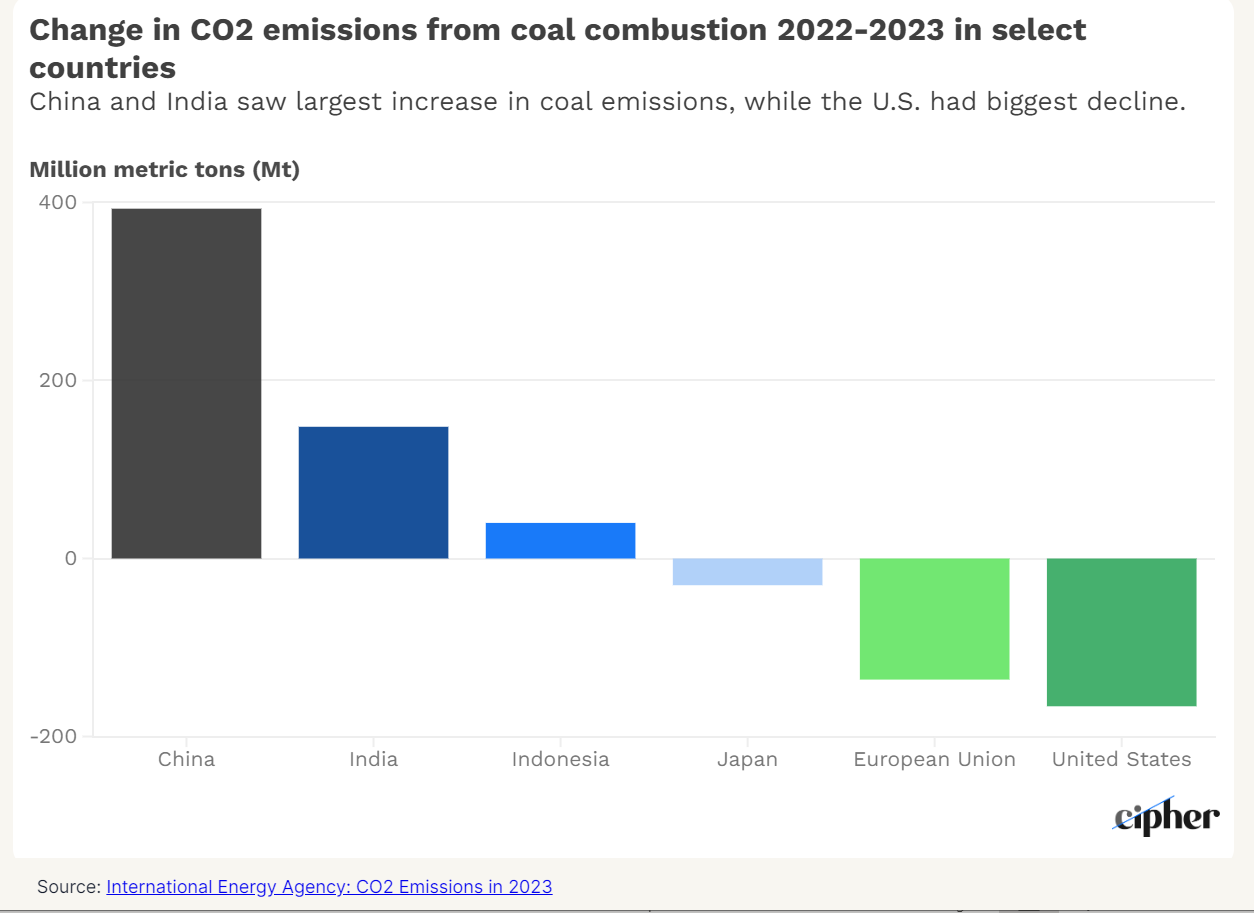
China, India Expanding Coal: In a recent story in Cipher, Amena Saiyd writes China and India are leaning on coal-fired power to shore up economies. The emissions increase from coal-fired generation in these two countries along with emissions from other emerging economies more than offset the declines in coal power achieved by the United States, the European Union and other wealthier economies.
IN THE NEWS
SEC Moves on Climate Disclosure, Doesn’t Cover Scope 3 – The U.S. Securities and Exchange Commission on Wednesday adopted climate reporting standards that will require some of the nation's largest companies to publicly disclose their greenhouse gas emissions, though they will not be required to report the so-called Scope 3 emissions of their suppliers as originally proposed.
Chamber of Commerce Center for Capital Markets Competitiveness EVP Tom Quaadman said:
"For two years now, the U.S. Chamber of Commerce has raised significant concerns about the scope, breadth, and legality of the SEC’s climate disclosure efforts. We are carefully reviewing the details of the rule and its legal underpinnings to understand its full impact. While it appears that some of the most onerous provisions of the initial proposed rule have been removed, this remains a novel and complicated rule that will likely have significant impact on businesses and their investors. The Chamber will continue to use all the tools at our disposal, including litigation if necessary, to prevent government overreach and preserve a competitive capital market system.”
Meanwhile, API Senior Vice President and Chief Counsel Ryan Meyers added:
“Despite some changes by the Commission, this flawed rule will still subject investors to countless billions in additional costs without meaningfully advancing a dialogue on climate that has been occurring for many years between companies and their shareholders. The Commission should have reproposed the rule for further input in light of its statutory obligation to protect investors, maintain well-functioning markets and ensure capital formation.”
API submitted comments on the SEC’s proposed rulemaking in June 2022. In the comments, API reiterated its support of timely and accurate reporting of greenhouse gas emissions from all emitting sectors while raising concerns that the proposed rule would overwhelm investors with information they do not seek while imposing historic costs on companies and their shareholders.
Two New Papers look at Russian Energy Challenges – The Energu innovation Reform Project released two new papers on Russia’s coal sector and its increasing effort to export energy to China. The first by Irina Mironova looks at the pinch Russian coal faces with the combination of sanctions and the global energy transition. While coal is a smaller share of Russia’s economy and its budget and export revenues, the coal industry is the backbone of Russia’s metallurgy sector as well as its rail system. No less important, coal miners have had outsized political influence in Russia’s past. How the sector manages sanctions—requiring new markets and straining Russia’s rail system—and efforts to “phase down” coal use will be important for Russia in the years ahead. The second by Timur Kulakhmetov looks at Russia’s increasing energy exports to China and India. In the wake of Russia’s invasion of Ukraine, Russian firms have largely succeeded in finding new markets for the country’s oil exports, with some 90% of Russia’s oil going to China and India in 2023. Still, Russian companies face continuing difficulties repatriating earnings, and have turned to various schemes to convert payments in rupees, in India, into rubles in Russia. Russia’s natural gas exporters are confronting much bigger problems, especially in developing the infrastructure necessary to boost exports.
New Galveston Ferry Made More Efficient and Cleaner With Siemens Energy Technology – On Friday, the Texas Department of Transportation (TxDOT) will christen a new ferry in Galveston Bay. Named for the first female chair of the TxDOT and first Latina Secretary of State, Esperanza “Hope” Andrade, this ferry marks a new era of efficiency, sustainability, and safety. The Siemens Energy technology onboard reduces emissions and operational costs and also enhances performance and passenger security. The ferry is outfitted with diesel-powered and electrical engines and Siemens Energy’s BlueDrive PLUSC™ power and propulsion system, which reduces fuel consumption by regulating speed, shifting control from port to starboard as necessary, and operating the diesel engines as minimally as possible. As part of Siemens Energy's commitment to the energy transition through technological advancement, this cutting-edge system is engineered to deliver superior performance while minimizing the environmental impact of marine transportation. Siemens Energy’s BlueVault™ Energy Storage System uses an advanced lithium-ion battery designed to maximize life, performance, and safety. The system can store surplus power while the ferry is in operation and dispatches it on-demand. This efficiency boost translates to improved fuel economy, reduced operational costs, and increased sustainability for the Esperanza ‘Hope’ Andrade.
Americans Access to Life Saving Medicine Relies on Natural Gas -- AGA unveiled Advancing America’s Pharmaceuticals: The Value of Natural Gas to U.S. Pharmaceutical Manufacturing, the latest entry in its ongoing Advancing America series. This study reveals that the American pharmaceutical and healthcare sectors could not continue to operate as they do without natural gas and other petrochemicals. The loss of these vital feedstocks and energy sources would cripple the production of vital supplies, make sanitary care vastly harder, and raise the cost of pharmaceuticals for customers. Natural gas and other petrochemicals are effectively irreplaceable for manufacturing medicines, with 99% of pharmaceutical feedstocks and reagents derived from natural gas and other petrochemicals. Face masks, disposable gloves and syringes are also manufactured from petrochemical feedstocks like natural gas and are critical to combatting the spread of disease. The amount of these resources needed is staggering – each year, petrochemical feedstocks are used for 129 billion face masks, 300 billion medical gloves, and 979 million American vaccine syringes. Pharmaceutical manufacturing consumes as much natural gas each year as all residential households in Missouri. Without natural gas, drugs would cost more to manufacture, increasing the burden faced by Americans who rely on medications. A majority of adults – 86% – agree that lowering out-of-pocket costs for health care should be a top priority for policymakers. Natural gas costs half to a third as much as alternatives like electricity and is projected to remain so through at least 2050. Without natural gas, higher costs and associated economic impacts would cost the U.S. economy approximately $7.22 billion through 2050 alone, surpassing the federal investment in clean hydrogen hubs. The decline in economic activity would also result in the loss of 22,000 job-years.
Summit's CO2 Pipeline Project Adds Valero as Partner – Valero Energy has agreed to supply greenhouse gases from eight of its ethanol plants in the Midwest to Summit Carbon Solutions proposed $8 billion, 2,500-mile carbon pipeline. The project aims to collect 20.4 million short tons of CO2 annually from 57 plants in Iowa, North Dakota, South Dakota, Nebraska and Minnesota for underground storage in North Dakota.
ON THE SCHEDULE THIS WEEK
Reuter Report to Discuss Mining Book – Today at 4:00 p.m., The Center for Strategic and International Studies holds a book discussion on “The War Below: Lithium, Copper, and the Global Battle to Power Our Lives.” The event features a conversation with our friend and author Ernest Scheyder.
Aspen Climate Event Set for Miami – The Aspen Institute is enlisting global and local policymakers, scientific experts, corporate leaders, inventors and innovators, artists, young leaders, influencers, and engaged members of the public to participate in Aspen Ideas: Climate 2024, a multi-day event on today through Wednesday in Miami. The event will feature main stages both in and outdoors, breakout and roundtable sessions, tours of local and historic resilience points of interest, as well as fashion, food, art, and music activities. Aspen Ideas: Climate is designed to offer the public a chance to interact, learn, and collaborate with thinkers and do-ers whose actions are critical to addressing our collective future around the realities of a changing climate.
House Science Tackles ARPA-E – The House Science Committee’s Energy panel holds a hearing tomorrow at 10:00 a.m. on ARPA-E's role in developing breakthrough technologies.
Senate Energy Looks at Wildfires – The Senate Energy and Natural Resources Committee holds a hearing tomorrow at 10:00 a.m. on the findings and recommendations of the Wildland Fire Mitigation and Management Commission.
House Oversight Looks at Grid Reliability -- The House Oversight and Accountability Economic Growth, Energy Policy, and Regulatory Affairs Subcommittee holds a hearing tomorrow at 10:00 a.m. examining the reliability and security of America's electrical grid. Witnesses will include FERC Commissioner James Danley, CATO Institute expert Travis Fisher and former PJM official Jonathon Monken.
Forum Looks at climate Ag, Fashion – The Business Council for International Understanding holds a virtual discussion tomorrow at 10:00 a.m. on the importance of cotton in combating climate change, supporting smallholder farmers, and the role of cotton in regenerative agriculture and fashion. It features Eric Trachtenberg, Executive Director of the International Cotton Advisory Committee, an association of 29 of the largest cotton-producing countries in the world.
CSIS Looks at Critical Minerals – Tomorrow at 10:30 a.m., the CSIS Energy Security and Climate Change Program holds a conversation on the future of investment in critical minerals. Brian Menell, Chairman & CEO of TechMet, will join Gracelin Baskaran, Research Director and Senior Fellow in the Energy Security and Climate Change Program at CSIS, to discuss this and more.
RFF to Look at Critical Minerals – Resources for the Future (RFF) holds a forum tomorrow on critical minerals, EVs and the Role of Innovation. In this webinar, we will present some of the challenges associated with critical mineral markets and how these connect to broader EV adoption. Then a panel of experts will discuss the role that technological innovation could play in mitigating the challenges caused by growing EV demand; potential limits to innovation; and policies that can help support innovation and make critical mineral markets more resilient. Speakers Include DOE’s Diana Bauer, GM’s Michael Maten and Rod Eggert of the CO School of Mines.
ACEEE to hold Water, Heating Forum – Tomorrow to Thursday in Atlanta, ACEEE hosts its 2024 Hot Water Forum & Hot Air Forum. The event brings together two premier technical conferences — one on the efficient use of hot water and one that focuses on heat pumps. Both conferences will explore how these industries can reduce greenhouse gas emissions, improve grid resilience, and center equity. Stacey Abrams, DOE’s Kathleen Hogan, AO Smith’s Josh Greene and RMI’s Leah Louis-Prescott will be among the experts at the conference.
Granholm, Hochstein Energy Leaders Headline SAFE Summit – The SAFE Summit 2024 is tomorrow and Wednesday in DC. The program will examine how geopolitical power dynamics are shifting and offer a compelling strategy—a systems approach to addressing energy security, climate change, supply chain deficiencies, a dwindling industrial base, and growing geopolitical tension—to reconfigure the foundational pieces that will enable a new global economy to thrive. Key speakers include Energy Secretary Jeenifer Granholm, Sen. Lindsay Graham, South Carolina Governor Henry McMaster, FedEx Executive Chair Fred Smith, U.S. Export Import Bank head Reta Jo Lewis, Rep. Rob Wittman (R-VA), Rep. Kathy Castor (D-FL), Gabe Klein of the Joint Office of Energy and Transportation and former CARB Director Mary Nichols, among others. International Seabed Authority SecGen Michael Lodge is also expected to discuss deep-sea minerals on a panel with TMC’s Gerard Baron.
House Foreign Affairs Committee Looks at Russian Nuclear – The House Foreign Affairs Europe Subcommittee holds a hearing tomorrow at 2:00 p.m. on ending global dependence on Putin's nuclear energy sector.
Wilson Event Looks at US, Canada Energy – The Wilson Center's Canada Institute holds a virtual discussion tomorrow at 2:00 p.m. looking at Progress on the partnership between U.S.-Canada on energy. Ambassador of Canada to the United States Kirsten Hillman and Ambassador of the United States to Canada David Cohen will provide a three-year update on the Roadmap and outline ongoing avenues of collaboration.
Manchin Headlines POLTICO HealthCare Summit – At POLITICO's Health Care Summit on Wednesday at the Waldorf, Sen. Joe Manchin (D-WV) will sit down with POLITICO's Congressional Bureau Chief, Burgess Everett, to dive into the U.S. fentanyl epidemic and his recent bipartisan legislation, the FEND Off Fentanyl Act. While health care will be the topic of the day, one expects that energy issues will work their way into the questions.
Forum Hosts NNSA Head – On Wednesday at 10:00 a.m., the Strobe Talbott Center for Security, Strategy, and Technology at Brookings will host former Brookings scholar Frank Rose, principal deputy administrator of the National Nuclear Security Administration, to discuss the steps the U.S. nuclear enterprise is taking to preserve stability and deliver credible deterrence.
Forum to Look at Clean Energy in Africa – The Atlantic Council Global Energy Center holds its next episode of EnergySource Innovation Stream, a series that highlights energy innovations with the potential to reshape the global energy system through discussions with the companies and individuals working diligently to enable these technologies. On Wednesday at 10:00 a.m., the Global Energy Center will host Shingai Samudzi, CEO and Founder of Asoba, to discuss the expansion of clean energy in Africa.
WaPo Live Talks Decarb with Rep. Peters – On Wednesday at 12:00 p.m., Rep. Scott Peters (D-Calif.) and Birger Steen, CEO of Freyr Battery join Washington Post Live for conversations about the new opportunities for industrial innovation, the impact of recent legislation on clean energy development and their assessment of the challenges ahead.
CSIS Hosts EIA Briefing – The CSIS Energy Security and Climate Change Program will holds a conversation on Thursday at 8:30 a.m. with two leading analysts on global energy markets. Dr. Amrita Sen, Founder and Director of Research at Energy Aspects, and Dr. Joseph DeCarolis, Administrator of the U.S. Energy Information Administration (EIA), will provide presentations on the supply and demand outlooks. shifts, and other trends.
Senate Homeland Looks at Wildfire Threats – The Senate Homeland Security and Governmental Affairs Committee holds a hearing on Thursday at 10:00 a.m. focused on responding to the increasing wildfire threat.
Climate Smart Ag Forum Set – On Thursday at Noon, the League of Conservation Voters and the National Sustainable Agriculture Coalition hold a discussion with farmers and ranchers from across the United States on federal climate-smart agriculture programs. Speakers include Agriculture Undersecretary for Conservation Robert Bonnie and Senate Agriculture Chair Debbie Stabenow.
Forum Looks at Ag, Jobs Act – The Environmental and Energy Study Institute (EESI) holds a briefing on Thursday at 3:00 p.m. about the implementation of the bipartisan Infrastructure Investment and Jobs Act (IIJA) and the Inflation Reduction Act (IRA) in rural America. Panelists will address these questions and share the latest updates on U.S. Department of Agriculture, Department of Energy, and other agency programs that provide for rural communities. They will outline how these laws directly help rural communities—from farms and ranches to rural town centers. Using specific examples from around the country, panelists will also discuss key topics from a rural perspective, including electricity provision, broadband access, drinking water availability, and pollution reduction.
Forum Looks at Climate, Security Challenges – The RAND Corporation's National Security Research Division holds a discussion on Thursday at 3:00 p.m. about the implications of climate change on the security environment in the CENTCOM area of responsibility. Specifically, the panel will consider how climate hazards will exacerbate long-standing economic, social, and governance stressors, and how this in turn will affect stability and the frequency of conflict in the region. Speakers will include State’s Chris Backemeyer and DoD’s Greg Pollack, as well as RAND experts.
Forum Looks at Water Security in SE Asia – On Friday, the Wilson Center, in partnership with USAID and Integra, will host an expert panel to explore the MODSNOW tool and how it can be deployed to strengthen water security in Central and South Asia.
IN THE FUTURE
CERA Week – CERA Week will be held from March 19th to 23rd in Houston. Get ready for the biggest energy show of the year. Energy Secretary Jennifer Granholm will be speaking, joining the world’s energy industry leaders, experts, government officials and policymakers, as well as heads from the technology, financial and industrial communities. EPRI President and CEO Arshad Mansoor is speaking Monday, March 18 at 5:30pm CT, about the power demand for AI, and then on Thursday, March 21 at 7:15am CT (yes, early!), he will be speaking about power system flexibility.
Forum Looks at Congress Funding Energy – On Tuesday March 19th at 1:30 pm, E&E reporters Manuel Quiñones, Kelsey Brugger, Emma Dumain and Andy Picon will examine the most recent funding measures, whether permitting reform is feasible in the coming months and expectations ahead of a changing congressional landscape come November. Congress is slowly working to meet multiple funding deadlines and lawmakers recently released six spending bills, many of which cover federal energy and environment programs. More are due later this month. Most Democrats and Republicans are grudgingly accepting the compromise, which includes both funding boosts and reductions.
EPSA Forum Set – On Tuesday March 26th, the Electric Power Supply Association holds its 2024 Competitive Power Summit. The event will feature a day of expert panels and featured speakers discussing critical issues facing competitive power and the U.S. electric system.
SEJ Set for Philadelphia – The Society of Environmental Journalists annual meeting will be held on April 3-7, hosted by the University of Pennsylvania. EPA head Michael Regan is expected to speak and the Bracewell reception will be on again Thursday night!!!
Hochstein, Bechtel Headline Columbia Energy Summit – On April 16, the Center on Global Energy Policy at Columbia University SIPA holds its annual Columbia Global Energy Summit. This year’s day-long Summit will address myriad issues at the heart of today’s complex geopolitical, environmental and economic landscape, including the impact of climate change and the energy transition on geopolitics and security; the outlook for clean energy deployment in the face of growing policy support, as well as challenges such as interest rates, permitting reform and trade conflict; pathways to mobilize finance for clean energy in emerging and developing economies; energy justice imperatives; and the impact for energy and climate policy in key elections around the world in 2024. Speakers from around the world, including current and former minister-level officials, CEOs of major companies, leaders from civil society, and experts from academia and think tanks will offer valuable global and regional perspectives on critical challenges facing the global energy and climate community. Program highlights include Bechtel CEO Brendan Bechtel, former U.S. National Security Advisor Tom Donilon, Senior Advisor to the President for Energy and Investment Amos Hochstein and German State Secretary and Special Envoy for International Climate Action Jennifer Morgan.
EPA’s Uhlmann to Address Air Regulators – The Association of Air Pollution Control Agencies (AAPCA)holds its 2024 Spring Meeting on April 24-26th in Indianapolis. David Uhlmann, Assistant Administrator for U.S. EPA’s Office of Enforcement & Compliance Assurance (OECA) will provide the keynote.
Cement Techs on Display at Denver Forum – The cement industry holds its 66th annual IEEE Industry Applications Society (IEEE-IAS) and the Portland Cement Association (PCA) Conference in Denver, Colorado on April 28th to May 2nd at the Colorado Convention Center. Keynoters include Baseball great Jim Abbott and geologist Rob McCaffery.
CLEANPOWER Set for Minnesota – The American Clean Power Assn holds its annual CLEANPOWER 2024 forum on May 6th to 9th at the Minneapolis Convention Center in Minnesota.