
Energy Update: Week of July 1st
Energy Update - July 01, 2024

Friends,
Happy July 4th Week. Here in DC we have the Capitol Fourth Fireworks on the National Mall and it is always a great show/experience. A short update this week given that most everybody is probably not working much after last week’s crazy last few days with the Presidential debate and the rush of major SCOTUS decisions.
My air expert colleague Jeff Holmstead offered many of you comments late last week on the rulings on Chevron and the EPA’s ‘good neighbor’ policy. And there has been a lot of excellent analysis, including a couple great pieces from CapAlpha’s Jim Lucier and former Reuters legal report Clark Mindock.
On the debate: Wow!!! That was terrible on both fronts. On our issues, it was expected that climate and energy issues/questions might play a more significant role, but Trump and Biden only briefly traded barbs over climate and the weak responses from both candidates were complete nonsense. Given Biden’s record, he should have been able to score major points for the young progressives who are demanding that he do even more, but he didn’t. As for Trump: what are “the best environmental numbers ever”? What does that even mean? Ugh… Republican Convention is less than two weeks away. DNC just over a month.
By the way, an important new bid from DOE on expanding US nuclear enrichment issues rolled out Friday under the radar. I get into the details below “In The News” but I wanted to make sure you saw it.
One good event today where POLITICO reporters discuss the impacts of the SCOTUS “Chevron” and “Good Neighbor” rulings at 3:00 p.m. And on Wednesday at 4:00 p.m., Julie Mason and I will discuss the SCOTUS rulings and debate fall out on her Sirius XM P.O.T.U.S. Ch. 124 show, so tune in if you can.
Finally, another reminder that I am just over a month away from my annual 100-mile Pelotonia Ride for cancer research at Ohio State’s James Cancer Center. As you may know, this really hits home this year as my younger brother in in the midst of a massive fight against brain cancer after being diagnosed at the end of last year. You have all been so supportive in the past of my effort to raise funds for fighting cancer, but I am doubling my fundraising goal this year to honor/support my brother’s fight, so I hope you can help me reach that goal. Any amount matters, so please head to this Pelotonia link and help.
Call with any questions.
Best,
Frank Maisano
(202) 828-5864
C. (202) 997-5932
FRANKLY SPOKEN
Chief Justice John Roberts in the majority opinion overturning the Chevron doctrine in the Loper Bright Enterprises v. Raimondo case.
ON THE PODCAST
Energy Vault CEO Piconi Talks Long-term Battery, Gravity Storage – In this final episode of the USEA Power Sector Podcast series on energy storage, Rob Piconi, CEO and Board Chair of Energy Vault, answered questions by journalist Herman K. Trabish about his company’s unique multiple technology business model based on battery energy storage systems, gravity energy storage, and green hydrogen and about his perspective on the future of the energy storage sector and these technologies.
FUN OPINIONS
BioGas is a Great Solution – In an opinion piece in Utility Dive, American Biogas Council executive director Patrick Serfass writes to help solve the grid load dilemma, the U.S. could produce at least 166 terawatt hours of renewable electricity just with the methane captured from biogas projects and recycling our organic waste. There should be zero doubt that more biogas projects are needed and needed now. We have a lot of waste and emissions, and we need more renewable energy. To maximize deployment, every end use for biogas should be incentivized, ranging from renewable fuel programs and hydrogen production to renewable electricity generation.
FROG BLOG
Implementing Post Chevron Will Be Challenge – In his Landmark Substack blog, former Reuters energy/environment legal reporter Clark Mindock writes legal experts have warned that last week’s U.S. Supreme Court decision killing the foundational Chevron deference legal precedent will stir chaos in the courts, emboldening a wave of litigation challenging an array of federal environmental rules that aim to combat the climate crisis. But it also may cut both ways. “The harmful ruling will cut both ways: future administrations eager to deregulate will confront the sobering reality that the best interpretations of regulatory environmental laws do not support deregulation,” NRDC’s John Walke told Landmark.
FUN FACTS
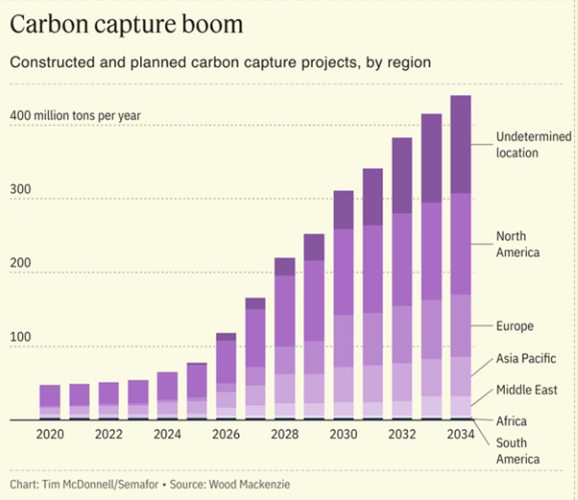
More Global Carbon Capture Projects Needed: Carbon capture projects aren’t being built fast enough, a Wood Mackenzie analysis found. Total global carbon capture capacity is on track to reach 440 million tons per year by 2034, up from 65 million today. But that’s about 200 million tons short of what is needed to decarbonize the power and industrial sectors in a net zero scenario.
IN THE NEWS
DOE Expands Uranium Enrichment Effort – You may have missed this with all the debate and Chevron talk on Friday but DOE published an RFP to expand the nation’s low-enriched uranium enrichment capabilities underpinned by $2.7B in funding from Congress. As we talk about expanded opportunities for large-scale nuclear power and small modular reactors in the United States, the questions about domestic uranium production and its supply chain become much more important. The domestic nuclear fuel supply chain has been decimated by decades of Russian state subsidized production. The recent passage of a ban on Russian uranium imports, along with DOE’s $2.7B RFP, provides an opportunity to revitalize domestic fuel production capabilities. DOE has a tremendous opportunity to not only support an expansion of domestic capabilities to move away from Russian supply but also can support diversity and competition in the market, facilitate innovation through the deployment of next generation technologies, and prevent monopolistic entities from getting larger. Below are comments from Global Laser Enrichment. GLE was formed in 2007 to develop and commercialize laser-based uranium enrichment technology capability in the US:
“GLE applauds the bi-partisan Congressional support and leadership from the Biden Administration to pass legislation aimed at rebuilding domestic nuclear fuel capacity. Key to this package is the Nuclear Fuel Security Act, which directs DOE to promote diversity of supply and technologies and utilize a broad set of tools to incentivize new LEU capacity. DOE can support an expansion of domestic capabilities while also supporting diversity and competition in the market, thereby facilitating innovation through the deployment of next-generation technologies. Building upon the SILEX uranium enrichment technology, GLE has the potential to supply critically needed new U.S. capacity to produce both natural uranium (conversion) and LEU, reduce DOE’s legacy depleted uranium liability, revitalize the Western Kentucky economy, grow our Wilmington, NC operations, and provide energy security as the U.S. and its allies pivot from Russian supply. Nuclear energy constitutes the largest source of domestic carbon-free power, and a diverse, resilient domestic enrichment market is essential to supporting nuclear energy’s role in the clean energy transition.”
Chevron Decision Unfolds – The U.S. Supreme Court overturned “Chevron” precedent today that instructed judges when they could defer to federal agencies' interpretations of law in rulemaking, depriving courts of a commonly used analytic tool. The precedent, Chevron v. Natural Resources Defense Council, is one of the most cited in American law. There have been 70 Supreme Court decisions relying on Chevron, along with 17,000 in the lower courts.
Jeff Holmstead, Bracewell Parter and former EPA Air Office Administrator, released the following comments regarding the decision:
“This will certainly change the way that agencies make regulations. Now, regulators sometimes start with a regulatory program in mind and then try to come up with a plausible statutory interpretation to justify it—hoping that the courts would find it ‘permissible’ even if it’s clearly not the best reading of the statute. Going forward, they’ll need to start with the statutory language and decide what Congress actually wanted them to do.
“This will make it harder for the Biden Administration to pursue its ‘whole of government approach’ to addressing climate change. There are political appointees in virtually every federal agency—including agencies that have nothing to do with the environment—who are trying to find ambiguities in statutory language that would allow them to pursue their preferred policies. They have been hoping that, under Chevron, courts would defer to their creative reading of a statute, which courts often determined such readings as ‘permissible.’ Now, courts will be asking whether it’s actually the best reading of the statue and whether that was the intent of Congress.”
West Virginia Attorney General Patrick Morrisey, who led a 27-state coalition that asked U.S. Supreme Court to overrule the doctrine.
“The U.S. Supreme Court made the right decision to revisit and overrule the Chevron doctrine, a misguided doctrine under which courts defer to legally dubious interpretations of statutes put out by federal administrative agencies. Congress’s words matter, not agencies’ policy preferences. And agencies shouldn’t be permitted to take advantage of statutory silence or ambiguity to extend their powers beyond what Congress intended.”
US Chamber of Commerce President/CEO Suzanne Clark:
"The court’s decision is an important course correction that will help create a more predictable and stable regulatory environment. The Supreme Court’s previous deference rule allowed each new presidential administration to advance their political agendas through flip-flopping regulations and not provide consistent rules of the road for businesses to navigate, plan, and invest in the future. The Chamber will continue to urge courts to faithfully interpret statutes that govern federal agencies and to ensure federal agencies act in a reasonable and lawful manner."
API’s General Counsel Ryan Meyers:
"We agree with the Court that agency actions must faithfully implement the laws passed by Congress. Today’s decision is a reminder that it’s time for both parties to work together and advance bipartisan, commonsense policies that provide regulatory certainty and secure an affordable, reliable energy future."
The Air-Conditioning Refrigeration and Heating Institute is impacted by a wide array of DOE energy efficiency rules. AHRI General Counsel Marie Carpizo said:
“This landmark decision by the Supreme Court now places a greater burden on administrative agencies to ensure that the regulations put forth meet the explicit requirements of the law set by Congress and any interpretation of ambiguities in the law are reasonable and not arbitrary or capricious, an abuse of discretion, or contrary to law. Courts will be required to review the facts of the case to ensure that the challenged regulation met the requirements of the law rather than deferring to the administrative agencies.”
SCOTUS Pulls Back EPA “Good Neighbor” Policy – The Supreme Court issued a decision to stay the U.S. EPA’s ‘Good Neighbor Rule.” Bracewell Parter Jeff Holmstead, a former EPA Air Office Administrator, released the following comment.
“The Supreme Court today agreed with the states of Ohio, Indiana and West Virginia, and stayed EPA’s good neighbor plan, or GNP. The GNP was promulgated to ensure compliance with the 2015 ozone national ambient air quality standard by imposing an inflexible and costly plan on industry in certain upwind states. The Court’s majority agreed that irreparable damage was likely to occur in the absence of a stay. What today’s decision demonstrates forcefully is that the Supreme Court is watching carefully the analysis proffered by EPA, and is not afraid to enter a stay when appropriate. As the courts next turn to the legality of power plant rule under Section 111 of the Clean Air Act, today’s action will be on their mind.”
API General Counsel Ryan Meyers applauded the decision saying while they support EPA’s goal of reducing emissions, the Supreme Court’s decision to stay this flawed rule is welcome.
“Americans are looking for pragmatic energy solutions, not misguided policies that threaten to undermine energy reliability by forcing operators to take pipeline engines — a vital technology to ensure natural gas can reach consumers — out of operations. The Court’s decision prevents the risk of electric power outages and crippling delays to industrial supply chains for now. Still more is needed from Washington to ensure long-term energy reliability for American consumers.”
Port Arthur Offtake Grabbed by Aramco – Aramco, one of the world's leading integrated energy and chemicals companies, and Sempra, one of North America's leading energy infrastructure companies, announced a 20-year sale and purchase agreement for 5 million tons of yearly LNG offtake from the Port Arthur LNG Phase 2 expansion project. Port Arthur LNG is a natural gas liquefaction and export terminal in Southeast Texas with direct access to the Gulf of Mexico. The Port Arthur LNG Phase 1 project is currently under construction and consists of trains 1 and 2, as well as two LNG storage tanks and associated facilities. The Port Arthur LNG Phase 2 project is a competitively positioned expansion of the site to include the addition of up to two trains capable of producing up to 13 Mtpa. Port Arthur is an important part of enhancing global energy security and resilience. Moreover, Sempra Infrastructure is actively advancing infrastructure projects within the Port Arthur Energy Hub, addressing both the rising demand for lower-carbon fuels and carbon intensity reduction. This includes the proposed Titan Carbon Sequestration project.
Coalition Pushes Back Against Fuel Economy Rules – API filed a lawsuit in the Fifth Circuit Court of Appeals challenging the National Highway Traffic Safety Administration (NHTSA) Corporate Average Fuel Economy (CAFE) standard for model year 2027-2032 passenger cars and light-duty trucks. The CAFE rule mandates stringent new standards that appear ultimately designed to phase out liquid fuel powered vehicles. Today’s filing follows two recent lawsuits led by API challenging the EPA’s light-duty and heavy-duty vehicle rulemakings. The National Corn Growers Association, American Farm Bureau Federation, Texas Corn Producers Association, Texas Farm Bureau and a group of six auto dealers representing sixteen brands and collectively operating dozens of dealerships in major markets across the country join API as co-petitioners in today’s lawsuit. The auto dealers include Mickey Anderson, president and CEO of Baxter Auto Group; Thomas Maoli, president and CEO of Celebrity Motor Cars; Roger Elswick, president and CEO of Community Auto Group; Steve Gates, owner of Gates Automotive Group; Phillip Tarver, owner of Lake Charles Toyota; and Bob Loquercio, owner of Bob Loquercio Auto Group.
ON THE SCHEDULE THIS WEEK
POLITICO Looks at Chevron – Today at 3:00 p.m., POLITICO Pro reporters Alex Guillen (energy), John Hendel (tech) and Erin Schumaker (health care) hold an exclusive briefing on the fallout of the Chevron deference ruling and what comes next for the administration, courts and Congress. Friday’s decision presents major new challenges for the Biden administration’s climate agenda – and the ability of federal agencies to regulate in a broad range of areas including energy, health care, and technology – from telecoms to AI.
Forum Looks at Climate, North-South Issues – The Carnegie Endowment for International Peace holds a virtual discussion today at 4:00 p.m. on the Polycrisis Summer, focusing on the intersection of climate change, political economy and global North-South dynamics. Among the speakers will be New York Times Opinion columnist David Wallace-Wells.
CANCELLED: Turk, Birol Discuss Future of US Energy – The Atlantic Council discussion tomorrow on the future of U.S. energy with U.S. Deputy Secretary of Energy David Turk and Fatih Birol, executive director of the IEA will be RESCHEDULED.
Thursday – JULY 4th Celebration on The National Mall with fireworks at 9:00 p.m.
IN THE FUTURE
Bloomberg Green Festival Set – The Bloomberg Green Festival will be held in Seattle on July 10th to 13th. The event is a global collaboration between innovators, policymakers, entrepreneurs, artists, activists, musicians and more, to explore new solutions spanning the entire climate spectrum. The festival will cover four themes vital to creating practical, collective change: Technology and Innovation, The Climate Economy, Greener Living and Green Policy. Through dining experiences, performances, installations and cultural moments, guests will be immersed in interactive learning, participate in data-driven experiences and build relationships with world-renowned experts.
FERC’s Phillips to Address NERO – THE National Energy Resource Organization (NERO) will host FERC Chair Willie Phillips on Thursday July 11th at its annual dinner at the Hyatt Regency on Capitol Hill.
Republican Convention Heads to Milwaukee – The RNC holds the Republican National Convention on Monday July 15th to Thursday July 18th in the Baird Center in downtown Milwaukee.
Dems Head to Chicago – The DNC holds its Convention in Chicago on Monday August 18th to Thursday August 21st at the United Center.