
Energy Update: Week of January 6th
Energy Update - January 06, 2025

Friends,
Welcome to 2025!!! Wow…only one long vote for Speaker on Friday! And everyone was losing their minds over it in advance, so they must have been disappointed. We’re off and running, even in the midst of a DC “Snow Storm.” We got about 6 inches last night in the region with 4 or so more on the way, so the DMV is going nuts despite the fact that it will likely disappear soon. My Michigan-Wisconsin younger self is wanting to get in the Jeep and have some fun at least today.
As Punchbowl said this morning: “It snowed. Fun! But Congress will be in session to certify the 2024 election.” So, we’ll see what a snowy Washington means for certification, which is expected at 1:00 p.m. today. Newly-reminted House Speaker Mike Johnson is intent on having Congress certify the presidential election today. The House GOP leadership told members to stay in town over the weekend and many did, according to Punchbowl. Johnson and Senate Majority Leader John Thune are expected to have enough lawmakers present to conduct the proceedings. Johnson and Thune could theoretically delay the proceedings if necessary. The statute says Congress “shall be in session” but doesn’t say it needs to finish on Jan. 6.
Other than this, this week is going to be pretty quiet in DC, mostly organizing. We saw the list of new Dem members being added to the Senate Energy (Gallego) and Senate EPW (Alsobrooks, Blunt-Rochester, Schiff). New Senate Energy Committee leader Martin Heinrich plans to meet this week with Trump’s DOE and Interior nominees, Chris Wright and Doug Burgum. Finally, tomorrow evening (7pm to midnight) and Wednesday (7am) to Thursday (7am), former President Jimmy Carter lies in state in the Capitol Rotunda, with funeral services Thursday morning at the National Cathedral.
This morning, President Biden said he will use a 1952 law to try and block all future oil and gas drilling across more than 650+ million acres of federal waters. Biden will aim to prohibit future federal oil and gas leasing across large swaths of the Atlantic Ocean, the Pacific Ocean, the eastern Gulf of Mexico and the Northern Bering Sea in Alaska. Remember, President Trump has already prevented drilling in most of these areas until 2032, so this won't do much and portions that are questionable (like maybe slivers of the Eastern Gulf are likely to be the focus of quick Congressional action (as new Senate Energy Chairman Mike Lee has already mentioned). The Biden effort is not quite “epic” or historic action. In fact, it is largely symbolic yet completely tone deaf to the demands of Americans on energy. Perhaps, it is why President Biden and Vice President Harris were tossed out of office by voters in November.
Of course, this morning’s action overruns Friday’s action that released the long-awaited, controversial 45V hydrogen tax credit rules. More on this below. As well, mark your calendars for next week for key events, including: 1) Dan Yergin on world energy issues at the Atlantic Council on Monday; 2) API’s State of American Energy on Tuesday morning; 3) the US Chambers’s State of American Business on Wednesday and finally, 4) award-winning Energy Blog author Frank Maisano’s birthday on Thursday (any gifts welcomed).
For those of you not watching the Lions-Vikings game last night, you were probably watching the first of the Awards Shows, the Golden Globes. But honestly, besides Nikki Glaser – the who was (and is always) hilarious – and The Brutalist, I don’t know that there was much to best movies, TV shows, actors, producers or musical scores. Seemed like a bit of a sleeper. Maybe you can tell me if I’m wrong.
OK, back to the Lions. Seriously, Detroit fans, as a native since 1968, I still can’t be all in for the Lions until they at least make it to the Super Bowl (which they have NEVER done). On Sunday, they showed they are close to for real with a huge win over the 14-2 Minnesota Vikings. Now, if they can avoid any of the risky missteps they take that can hurt you in one-and-done playoff games, maybe they will get there. College Football Playoff Semis this week and Ohio St., Penn St., Texas and Notre Dame have proven their mettle while some of the pretenders were exposed. Congrats to North Central College in Illinois, who finished an unbeaten 15-0 season last night by defeating Mount Union in the Amos Alonzo Stagg Bowl to claim its 3rd NCAA D III Football National Title.
Call with questions, we are around even with the SNOW!!! Best,
Frank Maisano
(202) 828-5864
C. (202) 997-5932
FRANKLY SPOKEN
“Strained”
The American Energy Society’s annual “one-word to describe the energy sector” in 2024, used with and related to the US electricity grid, OPEC, green hydrogen, the global climate, the global insurance industry and global democracy in a year of elections.
ON THE PODCAST
Volts Hosts NHA’s Wolff – In this episode of Volts, Dave Robers is joined by National Hydropower Assn CEO Malcolm Wolff to discuss hydropower's underappreciated role in America's clean energy landscape. While providing most of our energy storage and thus supporting solar and wind deployments, hydropower faces significant challenges, with a decade-long relicensing processes and inadequate market compensation. They discuss why preserving and expanding this reliable, clean firm energy source is crucial as we transition to renewables.
Sankey Video Highlight Key Energy Needs for 2025 – Energy Analyst Paul Sankey released an energy analysis video for 2025. It highlight the LNG study, the Ukraine-Russia pipeline deadline and the challenge the US can/will address with expanded production and export.
Energy Gang Talks 2024/2025 Energy Predictions – As the year wraps up, The Energy Gang’s Ed Crooks, Melissa Lott and Amy Jaffe revisit their January 2024 predictions to see who nailed it and what took everyone by surprise. Listen now and subscribe to catch their predictions for 2025.
FUN OPINIONS
WSJ: LNG Study Undercuts DOE – In an editorial, the Wall Street Journal board writes Secretary Granholm and Whiter Advisor John Podesta wanted a permanent LNG ban, but a DOE study shows natural gas exports are in the U.S. ‘public interest.’ Granholm also claims that more U.S. exports aren’t needed since the world will soon be awash in gas. Europeans and Japanese disagree, and the DOE study stresses that “U.S. LNG has played a role in enhancing supply security for markets looking to reduce coal in their energy mix while prioritizing both renewables and gas.”
Seattle Times Says Don’t Block Will of Voters on NatGas – In an editorial in the Seattle Times, the board urges Washington State leaders to not block the will of voters on natural gas after nearly 2 million residents voted to approve Initiative 2066, which aims to protect the use of natural gas as an energy source in state law and within Washington’s building codes. Like it or not, natural gas is going to provide a bridge to a clean energy economy. Inslee and ruling Democrats’ climate goals will put an end to harmful coal-generated electricity at the end of 2025. But in its place is not — yet — a robust network of clean energy power production.
FROG BLOG
Permit Reform is National Security Imperative LNG Pause Folly Policy – In a post on The National Interest, former State Department Asst Secretary for Energy Resources Frank Fannon writes China is waging a war against the United States through minerals and refineries. It’s past time for Washington to acknowledge this reality so America can adopt the war footing necessary for victory. Trump won the White House by talking directly to the American people. He has the platform to do so again and explain the costs, time, and likely shared sacrifice required to win this new war. The United States won World War II, the Space Race, and the Cold War by doing just that. It is time to do so again.
FUN FACTS
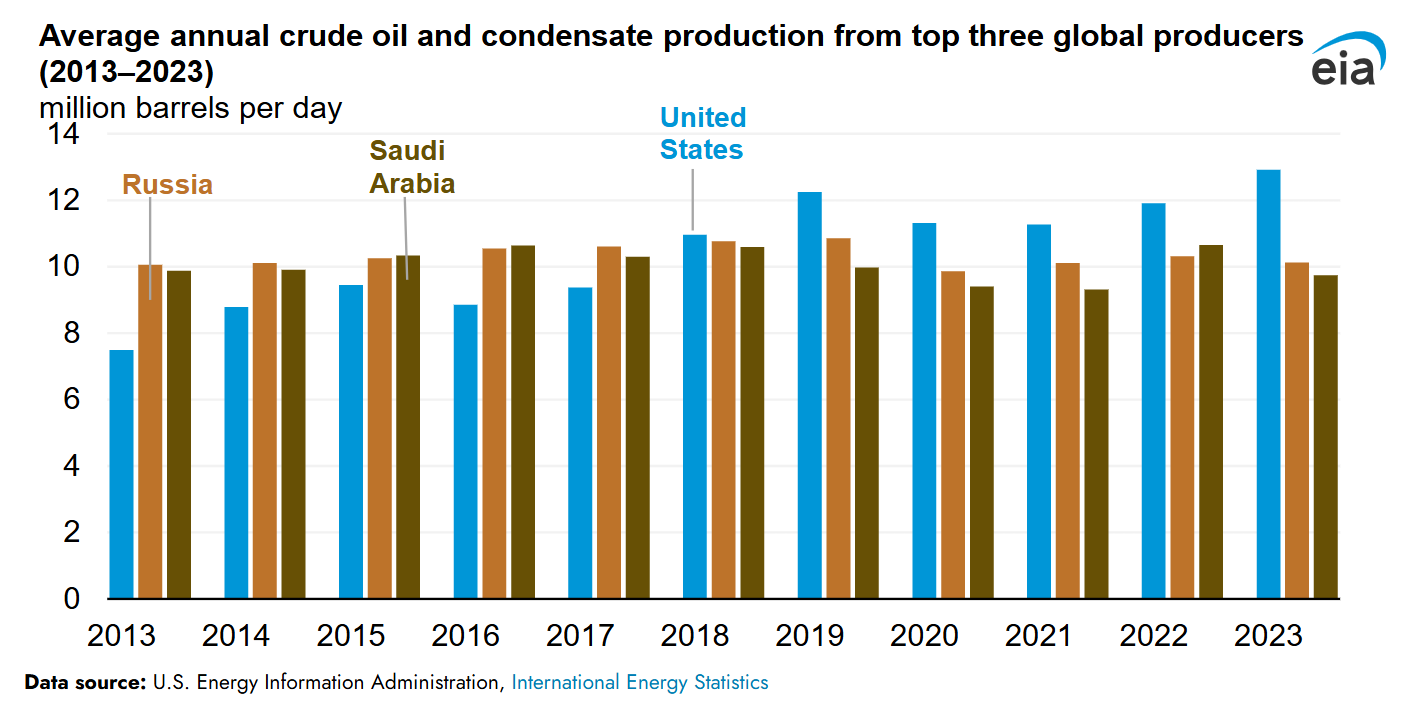
EIA Highlights in STEO in 2024: The US produced more crude oil than any nation at any time, according to EIA’s International Energy Statistics, for the past six years in a row. Crude oil production in the United States, including condensate, averaged 12.9 million barrels per day (b/d) in 2023, breaking the previous U.S. and global record of 12.3 million b/d, set in 2019. Average monthly U.S. crude oil production established a monthly record high in December 2023 at more than 13.3 million b/d.
IN THE NEWS
Hydrogen Rule Rolls Out – The Treasury announced the complex rules that clarify how producers of hydrogen, including those using electricity from various sources, natural gas with carbon capture, renewable natural gas (RNG), and coal mine methane can determine eligibility for the credit.
See the Release here: https://home.treasury.gov/news/press-releases/jy2768
Here are the final rule: https://www.federalregister.gov/public-inspection/2024-31513/credit-for-production-of-clean-hydrogen-and-energy-credit
While administration made some improvements and considered industry feedback in several instances when crafting this final rule compared to the initial proposal, the rule is still extremely complex and will require intense evaluation by project developers to understand all the nuances and how they will apply to their specific facilities. There are also multiple areas where implementation and timing will be up to the incoming Trump-Vance Administration, so efforts will continue to address key issues both in the new Congress and with the incoming Administration.
Other thoughts on 45V Rules:
Fuel Cell Hydrogen Energy Assn
Frank Wolak, the President and CEO of the Fuel Cell and Hydrogen Energy Association (FCHEA) issued the following statement in response to the U.S. Department of Treasury final guidance published on the hydrogen production tax credit (45V):
“After years of strategic engagement and persistent advocacy, the issuance of this Final Rule now affords project developers the basis for evaluating opportunities to scale clean hydrogen deployments.
The administration made significant improvements and considered industry feedback in several instances when crafting this final rule compared to the initial proposal, including the delayed implementation of hourly matched accounting for electrolytic hydrogen, support for more sources of renewable natural gas (RNG), removal of the first productive use requirement for RNG, among other changes.
However, this rule is still extremely complex and will require intense evaluation by project developers to understand all the nuances and how they will apply to their specific facilities. There are also multiple areas where implementation and timing will be up to the incoming Trump-Vance Administration.
This issuance of Final Rules closes a long chapter, and now the industry can look forward to conversations with the new Congress and new Administration regarding how federal tax and energy policy can most effectively advance the development of hydrogen in the US.”
Plug Power
Andy Marsh, CEO, Plug Power
“The new hydrogen PTC rules mark significant progress, with notable revisions to the incrementality requirement for certain nuclear power facilities and hydrogen projects in states with clean energy policies. The extension of hourly matching to 2030, alongside more flexible incrementality, lays a stronger foundation for U.S. manufacturing in the hydrogen economy. While these updates are encouraging, we look forward to collaborating with the new administration to refine the regulations in a way that aligns with congressional intent, supports their goal of reducing overregulation, and ensures national energy security.”
US Chamber of Commerce
Marty Durbin, president of the U.S. Chamber’s Global Energy Institute:
“Hydrogen has the potential to accelerate the clean energy transition while creating jobs and economic growth, but launching an entirely new industry won’t happen without government policy that attracts the necessary investment. The final 45V rule falls short. While the rule provides some of the additional flexibility we sought, especially in recognizing the importance of natural gas as a cornerstone of a hydrogen economy, we believe that it still will leave billions of dollars of announced projects in limbo. The incoming Administration will have an opportunity to improve the 45V rules to ensure the industry will attract the investments necessary to scale the hydrogen economy and help the U.S. lead the world in clean manufacturing.”
American Petroleum Institute
API Senior Vice President of Policy, Economics and Regulatory Affairs Dustin Meyer on the U.S. Department of the Treasury’s final regulations for the Section 45V Clean Hydrogen Production Tax Credit:
“Clear, consistent policy is essential for building a lower-carbon hydrogen industry and strengthening America's energy leadership. Treasury's 45V guidance marks a meaningful step forward, encouraging innovation while driving progress on emissions. This framework offers an opportunity for natural gas, when paired with carbon capture and storage, to compete more fairly in new markets and meet growing demand for affordable, reliable, lower-carbon energy. We look forward to collaborating with the incoming administration to uphold technology-neutral hydrogen policies that position the U.S. as a global leader in innovation.”
Business Council For Sustainable Energy
Lisa Jacobson, President of the Business Council for Sustainable Energy (BCSE), offered the following statement in response to the U.S. Department of Treasury and Internal Revenue Service (IRS)’s final rules for the Section 45V Credit for Production of Clean Hydrogen:
“The release of the final rules will allow project developers and investors to better assess credit eligibility and open investment opportunities in the U.S. hydrogen industry. The rule provides clarity and flexibility in several areas but will also require continued engagement with the Trump Administration and Congress on a number of critical open implementation issues. This release of the 45V final regulations builds on the opportunity that the portfolio of energy tax credits provides to leverage private sector capital to improve American competitiveness and meet increasing energy demand through home-grown energy supply.”
BCSE previously submitted written comments on the proposed regulations related to the Section 45V Credit. Since the passage of federal energy tax credits in August 2022, BCSE has made numerous submissions to shape the design and implementation of the incentives funded by the legislation. BCSE’s relevant policy actions can be found here.
American Clean Power
The American Clean Power Association (ACP) Chief Executive Officer Jason Grumet after the U.S. Treasury Department released its final guidance for tax credits for clean hydrogen projects:
“This is a disappointing conclusion to an unnecessarily belabored process. The overly rigid regulations are at odds with the innovation needed in this nascent sector and will prevent the U.S. from realizing global leadership in clean hydrogen production, as Congress intended. ACP and others have voiced the need for additional flexibility throughout this process and proposed changes that would launch this game-changing industry. Unfortunately, today’s final guidance falls far short and unnecessarily stringent requirements, such as burdensome time-matching standards, will remain a significant deterrent for developers and investors alike. This is a missed opportunity.”
Biden to Limit Further Offshore Drilling – This morning, President Biden said he will use a 1952 law to try and block all future oil and gas drilling across more than 625 million acres of federal waters. Biden will issue two memorandums that prohibit future federal oil and gas leasing across large swaths of the Atlantic Ocean, the Pacific Ocean, the eastern Gulf of Mexico and the Northern Bering Sea in Alaska. None of those are really active and interesting to the oil industry other than a small sliver of perhaps areas of the Eastern Gulf. A couple of important items:
- Trump imposed a 10-year moratorium on offshore oil exploration off the coasts of Florida, Georgia and South Carolina when courting voters there during his 2020 campaign.
- Gulf producers 14% of US output and is a huge economic engine for the region supporting thousands of jobs and millions of dollars of economic activity.
- Offshore drilling through its revenue sharing provides millions to Gulf coastal restoration projects.
- In November, voters overwhelmingly supported an increase in energy production to meet consumer, business and community needs while reducing costs and protecting the environment.
Finally, this action will require an act of Congress to undo, which in this case could take the form of a Congressional Review Act (CRA) provision or even some part of the early-year budget/tax resolution. In fact, incoming Senate Energy Chair Mike Lee said he is already drawing up a CRA petition for this Biden drilling actions.
API President and CEO Mike Sommers said:
“American voters sent a clear message in support of domestic energy development, and yet the current administration is using its final days in office to cement a record of doing everything possible to restrict it. Congress and the incoming administration should fully leverage the nation’s vast offshore resources as a critical source of affordable energy, government revenue and stability around the world. We urge policymakers to use every tool at their disposal to reverse this politically motivated decision and restore a pro-American energy approach to federal leasing.”
Ukraine Pipeline Supplies Cut as Russia LNG Deal Expires – Russian gas supplies sent via to Europe through Ukraine for more than 40 years are scheduled ended on January 1 after Ukraine's Naftogaz refused to renew its latest five-year transit deal with Russia's Gazprom because of its ongoing war. Europe will potentially need to adapt to the abrupt shortage in Russian gas, supplementing its supplies with LNG shipments from alternative sources, such as the U.S. and Qatar, as happened following Russia's invasion. The Russia pipeline deadline only underscores two of the biggest differentiators for US LNG vs international competitors: security of supply from an ally, and flexibility to deliver cargoes where demand is greatest. And it flies in the face of claims in the recent DOE report that somehow Europe does not need more US sourced LNG.
Banking Climate Group Losing Members – Bank of America, Goldman Sachs, Wells Fargo, Citigroup and Morgan Stanley have departed the United Nations-backed Net-Zero Banking Alliance. Citi and BofA on Tuesday announced their departure from the global climate coalition — whose members have committed to aligning their financial activities with the aim of reaching net-zero emissions by 2050 — with Morgan Stanley following suit on Thursday. The exits come a few weeks after Goldman Sachs announced its decision to quit NZBA and against a backdrop of climate-focused alliances facing increased scrutiny from the Republican party, which has initiated probes on ESG policies across multiple fronts.
Equinor Locks Up Financing For Empire Wind – Equinor’s Empire Wind 1 project in the US has now secured a project financing package of over USD 3 billion. Financial close was reached at the end of December 2024. Empire Wind 1 will power 500,000 New York homes and is expected to reach its commercial operation date in 2027. The expected total capital investments, including fees for the use of the South Brooklyn Marine Terminal (SBMT), are approximately USD 5 billion including the effect of expected future tax credits (ITCs). Equinor acquired the Empire Wind lease area in 2017. In June 2024, Equinor announced the execution of the Purchase and Sale Agreement (PSA) with the New York State Energy Research and Development Authority for Empire Wind 1 power for 25 years at a strike price of USD $155.00/MWh. The investment level and support framework are in line with the developing US offshore wind industry. Equinor intends to farm down in the Empire Wind 1 project to a new partner to further enhance value and reduce exposure.
ON THE SCHEDULE THIS WEEK
RESCHEDULED: Yergin Headlines Discussion on World Energy – This morning at 10:00 a.m., the Atlantic Council was supposed to hold a discussion on the forces shaping the World Energy Outlook. But due to the weather conditions, they rescheduled the event for Next Monday at the same time.
2024 Election Certification – Congress will certify the 2024 Presidential election starting at 1:00 p.m. today.
Forum Looks at SAF 2050 Goals – The Institute for Policy Studies holds a virtual discussion on Wednesday at 7:00 p.m. on 2050 climate goals for Sustainable Aviation Fuels. Panelists include WRI’s Dan Lashof, Chuck Collins of the Institute for Policy Studies, and MIT governing board member Neil Rasmussen.
Forum Focused on Tools to Decarb Cement, Concrete – RMI and partners hold a webinar on Thursday to look at RISE PA Industrial Decarbonization Grant application best practices, with a focus on the cement and concrete sector. RISE PA is a Pennsylvania statewide industrial decarbonization grant program funded through the US Environmental Protection Agency’s Climate Pollution Reduction Grants under the Inflation Reduction Act. The webinar covers key steps in the grant process, such as strategies for creating a strong application and meeting requirements, tips for incorporating community engagement, and insights to make your project stand out.
Cato to Address Regs that Can be Rolled Back – On Thursday at Noon, Cato scholars will discuss specific executive orders and directives that the incoming Trump administration should revoke or amend that affect energy policy, environmental policy, health care, the federal workforce, foreign policy, defense, and other social policies. Recently, Cato published the Cato Handbook on Executive Orders and Presidential Directives to recommend revoking or amending several executive orders, proclamations, and other directives to move public policy in a more libertarian direction. Cato experts include Michael Cannon (Cato Director of Health Policy Studies), Chris Edwards (Cato Fiscal Studies expert), our friend Travis Fisher (Cato Director of Energy and Environmental Policy Studies), Eric Gomez (Cato Defense and Foreign Policy expert and Alex Nowrasteh (Cato VP for Economic and Social Policy Studies).
IN THE FUTURE
Yergin to Headline Event on World Energy – Next Monday January 13th at 10:00 a.m., the Atlantic Council’s Global Energy Center will host Daniel Yergin, vice chairman of S&P Global and a Pulitzer Prize-winning author, in a discussion on the key drivers shaping the future energy system and what they mean for the world energy outlook. In this conversation, moderated by Global Energy Center Senior Director Landon Derentz, Yergin will look at the dynamic year ahead for the global energy landscape and discuss what enduring lessons can be learned from his book The Prize.
Brookings Forum Looks at US-China Climate Issues – Next Monday January 13th at 11:30 a.m., the Brookings John L. Thornton China Center will host a high-level discussion on the evolving dynamics of U.S.-China relations on climate change and green technology. Panelists will share key insights and policy recommendations from their recent research, addressing critical topics such as U.S.-China export bans on vital minerals and technologies, investments in clean energy and innovation, and decisions from policymakers in Washington and Beijing to secure global leadership in the emerging green economy. Former WSJ reporter and Stanford Doerr School of Sustainability editor Jeff Ball, as well as Brookings experts David Edelman and Samantha Gross are panelists.
API Holds State of Energy – The American Petroleum Institute's State of American Energy will be held on Tuesday January 14th at The CAPITAL TURNAROUND. It is the annual kick-off event for the industry’s policy agenda.
Semafor Hosts Hern for Small Biz Discussion – Semafor will host a forum on Tuesday January 14th at 9:00 a.m. featuring Rep. Kevin Hern, co-chair of the bipartisan Congressional Small Business Caucus, and Trump campaign economic adviser Stephen Moore. They will discuss what's ahead for U.S. small businesses as President-elect Trump and Congressional Republicans eye tax cuts, regulatory reform and more.
Chamber Preps for State of American Business – The US Chamber will hold its annual State of American Business forum on Wednesday January 15th.
Bracewell Hats off to Energy – On Friday January 17th at 10:00 a.m., Bracewell will hold a “Hats off to Energy” breakfast for the members of the new Congress at the Capitol Hill Club.
Presidential Inauguration Set – The 60th Presidential Inauguration will be held on Monday January 20th in Washington, D.C. The ceremony will be held on the west front of the U.S. Capitol.
World Economic Forum Set – The World Economic Forum will be held in Davos on January 20th to January 25th. There will be numerous events there including programming form Semafor and Axios.
USEA to Host State of Energy Industry – The US Energy Assn holds its 21st annual State of the Energy Industry Forum on January 23rd from 10:30 a.m. to 5:00 p.m. at the National Press Club.
Washington Auto Policy Day, Show Set – The Washington Auto Show will be held from January 31sat to February 9th at the Washington Convention Center. The Washington, D.C. Auto Show is renowned as the nation’s premier “Public Policy Show,” offering a one-of-a-kind opportunity to connect with the key figures driving the future of the automotive industry. This 10-day consumer event kicks off with an exclusive gathering of automotive leaders, government officials, and media representatives, where they come together to discuss the current state of the U.S. auto sector and its future initiatives. This year, speakers include Presidential advisors Ali Zaidi and Alex Jacquez, DOE’s David Turk, DOT’s Polly Trottenberg, Joint Office of Energy and Transportation Gabe Klein, and a Congressional panel with Reps. Debbie Dingell, Mike Kelly, Marcy Kaptur, Bob Latta and Roger Williams.