
Energy Update: Week of January 29th
Energy Update - January 29, 2024

Wow, was that a crazy end to last week with the political play by the Administration on LNG? While there is a long thread of things to discuss here (and we do below), it seems the move has accomplished the one key goal for the White House: it cancelled the climate activist s planned protest on the topic at DOE in early February.
The action has also brought the US Chamber, BusinessEurope and Keidanren (Japan’s Leading business group) together to express concern over the pause delaying export approvals saying it would “send a troubling signal to allies, investors and energy markets” while making it more difficult for Europe and Japan to diversify away from Russian gas. Superblogger Matt Yglesias has a great post on his Slow Boring blog and I can send it to you, but I highly-recommend subscribing (it is worth the $8/month). Finally this morning, API head Mike Sommers joined CNBC’s Squawk Box to discuss the Biden administration’s decision last week to pause new LNG export permits indefinitely.
This week, we are looking for the next environmental shoe to drop – and it is one we have been waiting for a while, the PM NAAQS decision from EPA. We expect the administration to take a position that will be completely unreasonable given the potential impacts of ozone background and wildfire impacts that threaten the economic activity of most of the country. It is not just industry and local officials that say this may be a problem, but Democrats like KY Gov. Andy Brashear (can send you his letter). Finally, here is a great opinion piece from the 3 CEO of the cement-related trade associations on the impacts on the Biden Administration’s infrastructure buildout.
In Congress, it is a busy week. Tomorrow, House Energy & Commerce panels are looking at the dismantling Snake River dams and the Green Bank funding. On Wednesday, Senate Environment methane and landfills, while House Energy looks at cyberattacks on US drinking water systems. And there is some rumor that the House may start consideration of its tax bill: H.R. 7024 – Tax Relief for American Families and Workers Act of 2024, here.
The best timed planned event of the Year is Wednesday’s CSIS Energy Security and Climate Change Program conversation on the economic, geopolitical, climate, and market implications of U.S. liquefied natural gas (LNG) exports. Excellent timing CSIS!!! WaPo Live hosts an EV discussion featuring California Energy Commission Chair David Hochschild.
Finally, Super Bowl LVIII is set and boy was that a miss. My three teams: Lions (hometown), Ravens (current residence) and Green Bay (first job/team shareholder) all should have been in there. But should’ve is not what gets you there. The 49ers, who somehow slipped past the Packers last week after trailing the entire game, erased a 17-point deficit to defeat the Lions and break the hearts of Detroit/Michigan. They will meet the Chiefs, who benefited from two HUGE Ravens turnovers and defeated clearly the best team in the NFL this season. The game, in Las Vegas in two weeks, will be a rematch of the 2020 Super Bowl, where the Chiefs scored 21 4Q-points to get the comeback win. I remember it because it was Super Bowl LIV, which we still call my daughter Olivia!!
FRANKLY SPOKEN
“…while it may be true that economics wins out over politics in the long run, we will say it again: in politics, there is no long run (especially not in an election year).”
Kevin Book in a ClearView Issue Brief on the DOE LNG pause
“When we export clean-burning American natural gas to countries in Asia it reduces emissions. So all they are doing is sucking up to their far left base, undermining jobs, undermining national security and undermining the environment."
Alaska Sen. Dan Sullivan on the DOE LNG pause decision.
ON THE PODCAST
Podcast: EVs Cold, Carbon Capture, Virtual Power Plants – This week on Climate News Weekly, host James Lawler is joined by Julio Friedmann, Darren Hau, and Canary Media Reporter Julian Spector. They discuss the various issues facing EV users and owners during the US' recent cold snap, new developments in British carbon capture projects, concerns that recent US electricity demand will strain the grid, and the latest developments in Hawaii's newest virtual power plant.
Ethanol Decarb Strategy Discussion – On this week’s Capitol Crude podcast, Brian Jennings, CEO of the American Coalition for Ethanol, joins Jasmin Melvin to discuss the administration’s recent policy decisions, and outline additional actions the industry is seeking. The ethanol industry is angling to be a bigger part of the US decarbonization strategy, but so far, the Biden administration has sent some mixed signals on the issue.
FUN OPINIONS
America’s Aging Grid Threatens National Security – In an opinion piece in Utility Dive, Admiral Michelle Howard writes America’s aging grid threatens national security but we can strengthen it by getting strong regional transmission planning and cost allocation rules out. Without expanded, reliable transmission, the collection of demands spells trouble for the security of the United States’ electricity system. We know the steps that must be taken to modernize and secure our nation’s grid system. The outcome is predictable if we fail to modernize. It’s time to move forward. The safety and security of America depends on it.
FROG BLOG
Yglesias: Nobody Seems to Care about Details on LNG Move – In a substack blog Slow Boring on last week’s LNG decision, political pundit and former Vox/Slate/American Spectator gadfly Matt Yglesias writes one certainly can’t object, in principle, to the idea that the government should run the numbers on LNG and try to reach a decision. That said, I think it is clear that the climate advocacy community is not asking for a sober-minded calculation. “Generally speaking, it’s a bad idea to spend a lot of time listening to the ideas and priorities of activities who are this cavalier about their policy analysis. I don’t think it’s politically wise for Biden to spend more time kowtowing to climate activists, but I also acknowledge that LNG exports are not a salient issue for anyone other than climate activists.” The full blog is really good. I can send it to you but I highly-recommend subscribing (it is worth the $8/month)
RFF: Unpacking Clean Hydrogen Tax Credit – In a blog post for Resources for the Future (RFF), fellow Aaron Bergman offers a sober assessment of the Hydrogen clean energy 45V tac credit. “Treasury has spent a lot of time on the proposed guidance for the 45V credit and is trying hard to reduce any increases in emissions from hydrogen production. The requirements in this guidance likely will further that goal—but at the cost of an increase in the price of clean hydrogen, alongside lower levels of clean hydrogen production than otherwise could have been achieved through guidance with less restrictive requirements. Finding the right balance for this inherent trade-off between stimulating hydrogen production and limiting life-cycle emissions ultimately will be a judgment call.”
FUN FACTS
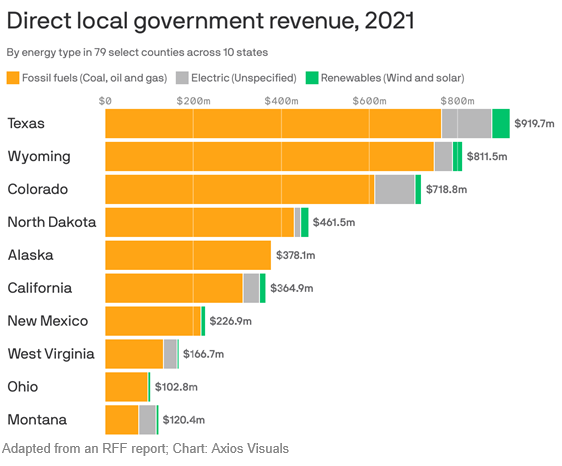
Fossil Fuel Revenues are Hard to Displace: New research from Resources For the Future and the University of Michigan explores how different forms of energy provide revenues in 79 counties across 10 states. Limiting climate change will require moving away from fossil fuels. Yet they provide vital tax revenue and other money streams for services like schools, roads, and safety. Wind and solar increasingly do too — with more to come as they grow. But these things often aren't fungible. In areas with rather low fossil revenue dependence, wind and solar are a viable replacement, the study's authors note. But for highly fossil-reliant areas, state or federal support for essential services is needed "under any deep decarbonization scenario." Lead author Daniel Raimi of RFF said programs through the 2021 infrastructure law, 2022 climate law, and executive moves are helpful but insufficient for several reasons because they are coal-focused, while oil and gas are a much larger public revenue source.
IN THE NEWS
The Great DOE/White House LNG Pause – On Friday, the DOE and White House said they were pausing LNG export facilities issues. This really isn’t just about a “delay” or a “review” or about one project—their intent is clearly to restrict U.S. LNG, catering to climate activists and reversing course from the administration’s own pledge in 2022 to support our allies. This is nothing more than a gift to our foreign adversaries as Russia and Iran are moving forward with new LNG export projects. Let’s make sure were clear: this has very little to do with the substance or legality of any decision/Executive Order. It is purely about politics and appeasing climate activists that the President needs for his 2024 reelection bid. Great resources for On-The-Record: You should talk to Marty Durbin at the US Chamber thru Matt Letourneau mletourneau@uschamber.com or Mike Sommers at API thru Andrea Woods woodsa@api.org.
Major Business Groups Push Back on LNG Pause – Three of the largest business lobbying groups in the United States, European Union and Japan are urging Biden to reconsider his LNG pause. In an unusual joint letter, the U.S. Chamber of Commerce, BusinessEurope and Keidanren expressed concern over the pause “in light of the unique and vital role of American natural gas in meeting the critical energy security and Paris Agreement objectives that our nations share.” Delaying export approvals would “send a troubling signal to allies, investors, and energy markets” and make it more difficult for Europe and Japan to diversify away from Russian gas.
Industry Trade Letter – API, the Chamber of Commerce, American Exploration and Production Council (AXPC), Center for LNG (CLNG), Independent Petroleum Association of America (IPAA), LNG Allies, and dozens of other industry groups from across the liquefied natural gas (LNG) value chain today in urging the Biden administration to reject calls to halt permits for U.S. LNG export facilities. In a letter to Secretary Granholm and senior administration officials, the groups emphasized the critical role that continued U.S. LNG exports play in safeguarding national security, creating U.S. jobs, supporting our European allies and contributing to global climate goals.
“Our nation’s abundant supply of natural gas is an impactful geopolitical tool, helping insulate American consumers from increasing global instability while advancing American national interests and ensuring the energy security of key U.S. allies,” the groups wrote. “Moving forward with a pause on new U.S. LNG export approvals would only bolster Russian influence and undercut President Biden’s own commitment to supply our allies with reliable energy, undermining American credibility and threatening American jobs.”
Internal Administration Squabble – There is an internal Admin squabble between the politicos (Podesta) and the security folks (Sullivan, Ladislaw, Hochstein, Pyatt) which too means leans too much on political pressure from climate activists. A Bloomberg story says that a presidential decision memo on the issue is expected in the coming weeks, even as senior administration officials remain divided. National Security Advisor Jake Sullivan, presidential energy adviser Amos Hochstein, and Sarah Ladislaw, Biden’s special assistant for climate and energy, have all raised concerns. This is a real problem.
The Real Joe Biden on LNG – Let me give you a little of the real views of Joe Biden in a few past speeches.
Remarks by Vice President Joe Biden to Atlantic Council in 2014:
- But here in Europe, energy is -- energy security is an especially vital regional security interest because of Russia’s track record in using the supply of energy as a foreign policy weapon against its neighbors in violation of basic commercial and international norms.
- This is a huge strategic problem for many countries that rely on Russia for their energy supply. But the truth is this is also a unique moment for Europe. Europe has a real opportunity to change their circumstances. We believe -- the President and I -- we believe that energy security is the next chapter in the European project of integration and market expansion that began decades ago with European coal and steel.
- As a matter of economic and national security, that means we need governments and the European Commission to work hand-in-hand with the private sector to ensure diversity in sources of fuel from hydrocarbons to renewables; diversity in countries of origin, from North Africa, to the Eastern Mediterranean, to the United States; more interconnections, that supply routes that are more reliable -- everything from new pipelines to LNG facilities.
Remarks by Vice President Joe Biden at the 20th Annual CAF Conference
- “The good news is, thanks to our abundance of natural gas and clean and renewable energy resources in North America, North America is now the epicenter of energy for the 21st century.”
- “And the United States is now a net exporter. Earlier this year, we inaugurated a new liquefied natural gas export terminal. The first shipment left Louisiana for Brazil in February. And now that the new Panama Canal expansion is up and running, there are even greater opportunities to supply the energy needs of our partners in Latin America and around the world if we make smart investments to upgrade our infrastructure, to accommodate post-Panamax ships, and to procure new LNG carriers.”
Remarks by Vice President Biden on the Caribbean Energy Security Initiative
- “We have technologies in natural gas that are moving forward. And we shouldn’t expect this to be a panacea for everyone, but it’s also true there are more options at your disposal now for natural gas delivery than there have ever been -— from small-scale barge trades of LNG, to floating import terminals. And they're not just -- these aren’t just designs on paper. They exist. They operate.”
- “You can now purchase gas on the open market from many countries, including your neighbor, Trinidad and Tobago right now. There’s also LNG exporters in the United States with licenses to export to any of your countries, whether you have a free trade agreement or not. If you want gas, go talk to them.”
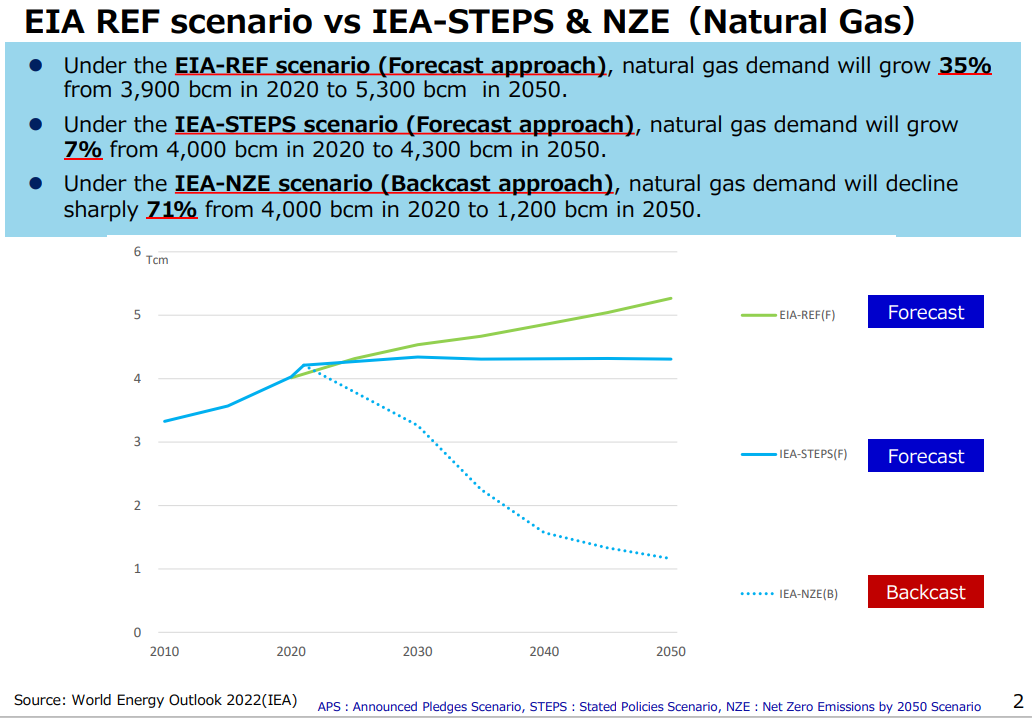
Will there be Demand for Natgas in Europe, Globally – Below is data from IEA on 2050 LNG shortfall, and note that IEA is conservative on total gas demand compared to EIA, so the shortfall is likely larger. Below is a link to the IEA report with the key stat highlighted, showing a 240 bcm LNG shortfall in 2050. That is very likely a large underestimate, because you’d have to believe every country achieves its existing climate laws in order for gas demand to stay flat (no way that’s happening in Europe). By contrast, EIA is projecting global gas demand growth of 1200 bcm (+30%) between now and 2050, so if you believe Biden’s DOE, the shortfall IEA is projecting will actually be much larger.
Outlooks for gas markets and investment: a report for the G7 (windows.net)
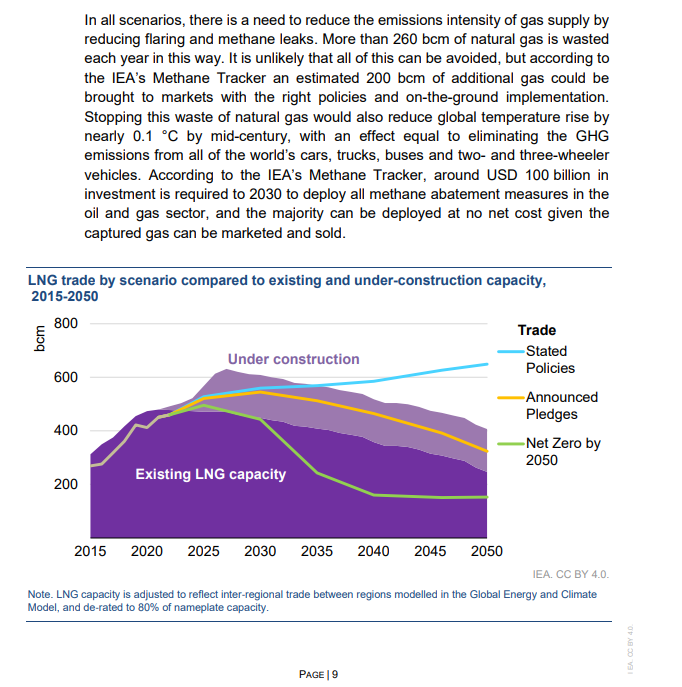
Around half of all upstream gas projects approved in the last five years have been explicitly tied to LNG export projects. In the STEPS an additional 240 bcm per year of LNG export capacity is needed by 2050 above what currently exists or is under construction (even as the rate of growth in LNG trade between 2021 and 2030 falls to one-fifth of the levels of the last five years). In the APS, only projects currently under construction are required. In the NZE Scenario, a sharp decrease in natural gas demand globally means that even these projects are in many cases no longer necessary. This wide spectrum of LNG requirements creates a dilemma for sponsors of new LNG projects, where the risk of unrecovered capital increases with greater climate ambition. The main exposure is via lower equilibrium gas prices. In some cases, this risk is mitigated by long-term contracts offering stable pricing conditions; however, for importers there is a risk of exposure to relatively high gas prices for decades, in a broader context of demand uncertainty.
Progressive Energy Expert Don’t Agree With Climate Activists – There even is division within the progressive activists’ ranks at the experts policy level. Progressive Policy Institute analysts Elan Sykes and Neel Brown penned an op-ed in The Messenger last week emphasizing the national security, environmental and economic dangers of discounting U.S. LNG.
“Who benefits from this new push to stymie the U.S. LNG infrastructure buildout? Ultimately, it would be the coal industry and Putin. Out of a misguided fear of stranded assets and infrastructure lock-in, some greens believe that turning off U.S. exports will reduce emissions, simple as that. However, America exports LNG to meet real global energy demand, and simply cutting off supplies of gas does not mean that demand disappears; instead, energy importers will be forced to buy dirtier fuels and are likely to reward autocratic suppliers like Russia.”
European Gas Experts Express Concern – This is the biggest problem inside Europe. President of Eurogas Dideier Holleaux emphasizes Europe’s dependence on U.S. LNG to help replace Russian piped gas and notes that any pause in U.S. LNG export approvals could risk increasing and prolonging a global supply imbalance.
“If additional US LNG export capacities would not materialise it would risk increasing and prolonging the global supply imbalance. This would inevitably prolong the period of price volatility in Europe and could lead to price increases with the consequent implications that would have for economic turmoil and social impact. In the past two years since the Russian invasion of Ukraine, Europe has worked extremely hard to secure price stability of natural gas – with the important contribution of like-minded countries including the United States. It is essential that the United States stands with Europe, especially at a time of war where we are working together to protect our values and does not deliberately spark a new period of price volatility in Europe caused by policy driven LNG shortages.”
Asian Leaders Express Similar Concerns – In a letter to Secretary Granholm, Asian Natural Gas and Energy Association President Paul Everingham stressed the importance of U.S. LNG to help Asian nations reduce their GHG emissions while continuing economic growth.
“Without sufficient access to gas imports, energy security and the energy transition will be elusive for the people of Southeast Asia, and that in turn places at risk the ambitious decarbonization plans spearheaded by Japan, which take into account Asian nations’ specific requirements.”
Russia Still Sending a lot of Gas to Europe – Note in particular that Eurogas calls directly on Biden admin to reverse course and says that (contrary to McKibben gaslighting) they DO need more USLNG and in fact still imported almost 50 bcm from Russia in 2023.
Europe is committed to phase out its dependency on Russian gas, which provided about 155bcm (40%) in 2021 of total European Union gas supply. That has been cut to less than 50bcm in 2023. However, we have increased our imports of US LNG from slightly more than 20bcm in 2021 to around 50bcm in 2022 and 60bcm in 2023. This LNG has been a relief for Europe and contributed to the stabilisation of gas and electricity prices in Europe for consumers, after a long period of record high prices caused by the Russian supply drop. This LNG does not fully replace the gas we had in the past from Russia, we still have a supply gap - and as such we need additional LNG imports from the US. Moreover, additional volumes of US LNG are set to play a crucial role for European energy security in case of other possible supply shortfalls caused by geopolitical instability in the future. US LNG exports are important for energy security globally, including in Asia, and especially for US allies.
…We therefore urge the US administration to avoid an unnecessary prohibition or limitation of new LNG exports to Europe, in addition to ensuring the delivery of cargoes to European customers via already agreed long-term contracts. We need to support each other at this critical time in the Ukraine war.
IEA Report: Global Power Demand to Rise, but Not Emissions – The International Energy Agency's outlook sees demand growth speeding up, rising at an average annual rate of 3.4% in 2024-2026. A record amount of wind, solar, hydropower and nuclear power capacity slated for deployment will help satisfy electricity demand growth through 2026. IEA said low-emissions energy technology will cover all of that growth as nuclear power hits a record high and renewable energy surpasses coal for the biggest slice of the global power mix. Also, IEA’s quarterly Gas Market Report says the IEA projected that use of natural gas would grow by 2.5% in 2024, which it attributed to colder winter weather and greater use of natural gas for residential heating. This also comes as the global supply of gas remained tight in 2023. American gas production increased last year, but still could not fully offset the decline in Russian gas exports to Europe, and overall gas production fell short of IEA’s projections.
Enverus: 4Q M&A Transactions Boom – Enverus Intelligence Research (EIR) released its summary of Q4 and full-year 2023 upstream merger and acquisition (M&A) activity. Q4 recorded a massive $144 billion in upstream M&A, the largest quarter EIR has tracked. That pushed full-year 2023 value to more than $190 billion, also setting a record. Driving the surge in value were two historic deals: ExxonMobil’s $65 billion acquisition of Pioneer Natural Resources in the third-largest upstream deal ever by enterprise value and Chevron purchasing Hess for $60 billion in the fourth largest ever. In 2023, upstream M&A was overwhelmingly focused on oil, with $186 billion in deals targeting crude compared to just $6 billion in gas-centric acquisitions. The largest gas deal wasn’t announced until nearly the end of the year when Tokyo Gas purchased Rockcliff Energy in the Haynesville for $2.7 billion in December 2023. Last year’s gas M&A total has already been topped in 2024 with Chesapeake Energy merging with gas peer Southwestern Energy for nearly $12 billion including Southwestern’s debt. There is likely to be increasing interest in gas assets as the long-awaited U.S. LNG ramp nears with the U.S. slated to add 10 Bcf/d of LNG export capacity over the next 36 months. That should eventually offer relief for producers from low natural gas prices, although they will likely need to be patient. With gas storage filling and production still strong, gas prices through most of 2024 are likely to be as low or lower than the challenged 2023 market.
ON THE SCHEDULE THIS WEEK
Forum Looks at Renewables In Dominican Republic – The Atlantic Council holds an event today at 3:00 p.m. on opportunities for the US to advance nearshoring and the renewable energy transition in the Dominican Republic. The event features an in-person conversation with H.E. Víctor Bisonó Haza, Minister of Industry, Commerce, and SMEs of the Dominican Republic on how to advance economic stability and supply chain resilience in what will be a consequential year for an important US partner.
JHU Forum Looks at Climate Disasters – The Johns Hopkins University Paul H. Nitze School of Advanced International Studies holds an event tomorrow at 10:00 a.m. on climate shocks, focusing on "the increasing frequency of climate disasters and what the world must do to build resilience and help impacted communities prepare. U.S. Agency for International Development Administrator Samantha Power speaks.
Trade Agency Hosts Hydrogen Briefing – The U.S. Trade and Development Agency will host a Business Briefing for South African delegates tomorrow in Houston to present on clean energy needs and goals and hear from U.S. firms with solutions. The Business Briefing is part of USTDA’s South Africa Green Hydrogen Reserve Trade Mission to connect public and private climate-smart institutions with U.S. best practices and solutions in clean energy and climate infrastructure. South African delegates will speak about their current capabilities, anticipated needs, and potential procurement opportunities. Technologies to be discussed include electrolyzers, hydrogen fuel cells, hydrogen-ready turbines, innovative hydrogen production designs, green hydrogen fueling stations, and more.
House Energy to Look at Dam Removal – The House Energy and Commerce Energy, Climate and Grid Security Subcommittee holds a hearing tomorrow at 10:00 a.m. focused on efforts to dismantle the Snake River Dams. The hearing will focus on the impacts to the U.S.
House Energy Oversight Panel Hits Green Bank Spending – The House Energy and Commerce Oversight and Investigations Subcommittee holds a hearing tomorrow at 10:30 a.m. on the misuse of the Green Bank funding.
Real Clear Energy Holds Webinar on EU Energy Report – Real Clear Energy holds a webinar tomorrow at Noon on whether the U.S. Follow Britain’s Disastrous Energy Path. Britain is the poster child for Net Zero, with its energy policies based on the notions that renewable energy is cheap and the cost of Net Zero is trivial. Rupert Darwall’s new report shows both premises are false. Britons are paying sky-high prices for electricity. Britain’s economy, in terms of growth and productivity, is delivering its worst performance since 1780. The Biden administration wants to achieve Net Zero in America too, with a complete decarbonization of power generation by 2035. What will be the economic consequences if America continues to follow Britain’s Net Zero path? Energy and policy experts will discuss Rupert Darwall's recent report, "The Folly of Climate Leadership – Net Zero and Britain’s Disastrous Energy Policies"
AEI Hosts Ag, International Trade Forum – Tomorrow at 1:00 p.m., AEI hosts an event on US International Trade Policy and the Agricultural Sector. A panel of experts analyze what to expect in 2024 and beyond.
House Science to Look at Earthquake, Disasters – The House Science, Space and Technology Research and Technology Subcommittee holds a hearing tomorrow at 2:00 p.m. on risks and resilience. The hearing will look at reauthorizing the earthquake and windstorm hazards reduction programs.
Commerce Sect, Euro Commission official Discuss EU-US Economic Ties – Tomorrow at 3:00 p.m., the Atlantic Council holds an event on the future of US-EU economic ties featuring US Commerce Secretary Gina Raimondo and European Commission Executive Vice President Margrethe Vestager.
Gevo Expert to Address BNEF New Energy Finance Forum in SF – The Bloomberg New Energy Finance Summit will be held on San Francisco tomorrow and Wednesday at the Four Seasons Hotel. The event provides the ideas, insights and connections to formulate successful strategies, capitalize on technological change and shape a cleaner, more competitive future. The event includes numerous speakers from CARB, CEC and other policy officials. Gevo expert Chris Ryan speaks on a panel focused on the drive to scale up clean fuels by shifting from traditional roles in the fuel supply sector. Maersk is spinning off a startup to produce green methanol, and airlines are partnering with refiners to develop renewable fuel production capacity.
House Resources Marks up Legislation – On Wednesday at 10:00 a.m., the House Natural Resources Federal Lands Subcommittee holds a hearing on five pieces of legislation. Then at 2:00 p.m., they will head back for four more pieces of legislation.
Senate Environment to Look at Methane from Landfills– The Senate Environment and Public Works Committee holds a hearing on Wednesday at 10:00 a.m. looking at avoiding, detecting and capturing methane emissions from landfills. Witnesses include Tia Scarpelli of Carbon Mapper, RMI’s Tom Frankiewicz and Anne Germain of the National Waste & Recycling Association.
CSIS Looks at LNG – On Wednesday at 10:00 a.m., the CSIS Energy Security and Climate Change Program holds a conversation on the economic, geopolitical, climate, and market implications of U.S. liquefied natural gas (LNG) exports. Leslie Palti-Guzman, Head of Research and Market Intelligence, SynMax, Ben Cahill, Senior Fellow, Energy Security and Climate Change Program, Kunro Irie, Visiting Fellow, Energy Security and Climate Change Program, and Joseph Majkut, Director, Energy Security and Climate Change Program, will discuss recent U.S. policy announcements on export terminals as well as international developments.
WaPo Hosts CEC Chair on EVs – On Wednesday at 11:00 a.m., David Hochschild, chair of the California Energy Commission, and Apoorv Bhargava, CEO and co-founder of WeaveGrid, join Washington Post Live for a series of conversations that assess the demand for electric cars, federal legislation promoting the purchase of EVs and the role of the grid in powering the vehicles. Although sales of electric vehicles continue to rise across the United States, growth has slowed in recent months over concerns about prices, battery range and charging options.
Chat to Address Oil, Gas Production Impacts – The Center on Global Energy Policy (CGEP) at Columbia University's School of International and Public Affairs will host Professor Lucija Muehlenbachs, CGEP visiting faculty member, associate professor of economics at the University of Calgary, and a university fellow at Resources for the Future, for a fireside chat on Wednesday at 6:00 p.m. The conversation will focus on some of these burdens, such as methane emissions and well-site cleanup, as well as recent policy developments.
SAFE Holds Book Talk with Reuters Mining Reporter – SAFE’s Book Talk Series returns on Thursday at 2:00 p.m. featuring author Reuter mining reporter Ernest Scheyder. Scheyder will join Abigail Hunter, director of SAFE’s Center for Critical Minerals Strategy to discuss his new book, “The War Below: Lithium, Cooper, and The Global Battle to Power Our Lives.” The book explores where, how, and why our world procures critical minerals, the building blocks of the energy transition, and the geopolitical consequences of where they come from.
IEA to Release Gas Market Report – On Thursday at 10:00 a.m., the Center on Global Energy Policy at Columbia University’s School of International and Public Affairs holds a discussion on the main findings of the latest quarterly Gas Market Report by the IEA. The Q1 2024 edition of the International Energy Agency’s (IEA) Gas Market Report provides an in-depth review of market developments in 2023 and a short-term outlook for 2024. As part of the IEA’s Low-Emission Gases Work Program, the Report includes a section on short-term developments related to biomethane, low-emission hydrogen, and e-methane. Recognizing the importance of international cooperation to reduce greenhouse gas (GHG) emissions along gas supply chains, the Report features an overview of the initiatives, policies, and regulations enacted by the largest natural gas and LNG producers and consumers in this sphere.
Forum Looks at Unregulated Fisheries – The Brookings Institution and World Wildlife Fund USA hold a virtual discussion on Thursday at 10:30 a.m. on illegal and unregulated fisheries. The discussion will focus on the changing dynamics of IUU fishing and conflict to help forge a better understanding of the relationships at play and the options for prevention. The event will offer a roadmap for improved policy and examine the progress and opportunities, new data, technologies, and partnerships available to help manage potential conflict.
USEA Looks at Utility Challenges – The US Energy Association holds a virtual media briefing Thursday at 11:00 a.m., on utilities' 2024 challenges. The event will examine the electricity supply situation and address how utilities and independent system operators hope to cope this year. Experts include DOE’s Gene Rodrigues, Portland Gas & Electric CEO Maria Pope, ERCOT board member Jean Ryall, PJM’s David Souder and former Maryland Energy Administration director Mary Beth Tung.
RMI Forum Looks at Hydrogen Report – On Thursday at 1:00 p.m., RMI explores the findings of our latest report Delivering Equitable and Meaningful Community Benefits via Clean Hydrogen Hubs in a webinar. The webinar features opening remarks by DOE’s Dr. Sunita Satyapal, director of the Hydrogen and Fuel Cell Technologies Office, who coordinates activities across offices for the US DOE Hydrogen Program. A panel discussion with leaders in the clean hydrogen industry and state energy policymakers will follow the presentations.
Forum to Look at African Energy Transition – On Thursday at 1:30 p.m., the CSIS Energy Security and Climate Change Program holds a conversation on achieving universal energy access in Africa amid global decarbonization. Andrew Herscowitz, Executive Director of ODI and former inaugural coordinator of President Barack Obama’s Power Africa initiative, will join Gracelin Baskaran, Research Director and Senior Fellow in the Energy Security and Climate Change Program at CSIS, to discuss this and more.
Forum looks at DOE EarthShots – The Environmental and Energy Study Institute holds a briefing on Thursday at 2:00 p.m. on DOE’s Energy Earthshots. Panelists from the Department of Energy and its partners will share the latest updates on each Earthshot’s progress. They will describe tangible work undertaken at the federal level, at national labs, and across the private sector to turn the Earthshot targets into reality. Speakers will also explore how the different Earthshots complement each other to advance a just and equitable transition to clean energy. Reps Frank Lucas (R-OK) and Deb Ross (D-NC) will speak, along with DOE Deputy Sect David Turk, DOE’s Carolyn Snyder, Form Energy’s Nidhi Thakar and NREL Director Peter Green.
IN THE FUTURE
Forum Chats with World Bank Head – The Center for Global Development holds a fireside chat with World Bank President Ajay Banga on Monday February 5th at 9:00 a.m. Banga holds a conversation with CGD’s Masood Ahmed to discuss his progress, the obstacles he’s confronting, and how he defines success.
Forum to Look at Modeling on Energy Transition – On Wednesday February 7th at 10:30 a.m., the NYU School of Law’s Institute for Policy Integrity holds a forum on modeling the energy transition. Prominent researchers and government officials will share insights from their energy system modeling and discuss its implications for policymaking. The discussion will explore comparisons between cutting-edge models, dataset choices, the incorporation of political economy insights, and the trajectory of the energy transition in the United States.
Climate Justice Series Launches – On Friday February 9th at 10:00 a.m., the Ambedkar Initiative at the Institute for Comparative Literature & Society, the India Program at the Center on Global Energy Policy (CGEP) at Columbia University’s School of International and Public Affairs, the SIPA Diversity, Equity, Inclusion, Climate & Engagement (DEICE) Committee, Columbia Climate School, and South Asia Institute hold their next session in a series of discussions examining social and economic justice issues related to climate change and the energy transition in India. The session, “Segregation and Environmental Injustice,” will integrate hard data and social sciences to frame environmental injustice in India as essentially caste injustice. This discussion will include an introduction to Ava DuVernay’s new feature film Origin, adapted from Isabel Wilkerson’s book, Caste, on global systems of hierarchy, oppression, and access to resources.
Forum Looks at Weather Forecasting – The Environmental and Energy Study Institute (EESI) holds a briefing on Thursday February 15th at 3:00 p.m. about the latest innovations in weather forecasting and communication to improve community resilience, awareness, and preparedness. At this briefing, speakers will discuss exciting technologies that can help deliver accurate, timely, and actionable forecasts to those who need it most. Panelists will also underscore the importance of climate communication and emergency outreach, and how weather and disaster information can be delivered to the public in ways that support equitable, accessible, and effective community preparedness.
National Ethanol Conference Set for San Diego – The Renewable Fuels Assn holds its annual National Ethanol Conference in San Diego on February 19th to 21st. Political guru Charlie Cook will be the main Luncheon speaker. GEVO CEO Pat Gruber, LanzaJet CEO Jimmy Samartzis and API’s Lance West join RFA’s Geoff Cooper as speakers.
SCOTUS to Hear Pollution Case on Feb 21 – The Supreme Court said Friday it will hear arguments over whether to stay EPA’s "good neighbor" rule. The court ordered an hour of arguments in EPA v Ohio over the requests from red states and industry to block the rule, which targets interstate pollution that forms smog and is already effectively blocked in a dozen states due to litigation.
Sustainable Energy Factbook Set for Release – The 12th edition of the Sustainable Energy in America Factbook, produced by BloombergNEF and the Business Council for Sustainable Energy, will be released on February 21st and available to download for free at bcse.org/factbook. Designed for a broad audience – from energy professionals to public policymakers – the Factbook offers an insightful and in-depth look at economic, market, and investment dynamics and technology trends. Experts from the BCSE, its members and BloombergNEF will hold special briefing on the 2024 Factbook findings.
BOEM Klein to Headline ACORE Forum – The 2024 ACORE Policy Forum will be held in Washington, D.C. on February 28th and 29th. Liz Klein, Director of the Bureau of Ocean Energy Management (BOEM) will give keynote remarks. Experts will discuss breaking issues such as defending the IRA, increasing clean energy investment, securing the supply chain, and more.
Ex-Im Bank Head to Address SAFE Summit – The SAFE Summit 2024 is set for March 12th and 13th in DC. The program will examine how geopolitical power dynamics are shifting and offer a compelling strategy—a systems approach to addressing energy security, climate change, supply chain deficiencies, a dwindling industrial base, and growing geopolitical tension—to reconfigure the foundational pieces that will enable a new global economy to thrive.
CERA Week – CERA Week will be held from March 19th to 23rd in Houston.
EPSA Forum Set – On Tuesday March 26th, the Electric Power Supply Association holds its 2024 Competitive Power Summit. The event will feature a day of expert panels and featured speakers discussing critical issues facing competitive power and the U.S. electric system.