
Energy Update: Week of January 27th
Energy Update - January 27, 2025

Friends,
Now, THAT was a crazy week…. With the Day One Executive Orders heavy on energy, we were very busy jumping from issue to issue (LNG, Paris, funding pauses, land/offshore wind, Oil/gas leasing/drilling) and then adding Tariffs. Thanks goodness, my Bracewell colleague Scot Segal (who was in transit to Texas for events) ended up holed up in NOLA for the historic BLIZZARD. Because of the snow lockdown, Segal was solely focused on answering most of your questions about the EOs and offering you legal perspective and political insights.
I expect this week to continue the slam of activity as the administration fills the ranks. We know a ton of people both heading and moving out, but I want to highlight one with special pride: Congrats to my former GW SMPA student Alex Fitzsimmons on taking over as Chief of Staff for pending DOE Secretary Chris Wright. Expect votes on Burgum, Wright and Zeldin soon despite the Congressional Republican planning retreat in Doral, FL this week. Speaking of the retreat, we fully expect to hear the beginnings of a budget strategy and whether we will have “One big, beautiful bill” or some other form. We also expect to see Commerce nominee Howard Lutnick head to the Senate (expect a lot of tariff discussions).
A few good events this week as tomorrow CSIS looks at the Trump EOs with Mike Catanzaro and Kevin Book, Wednesday RFF hosts its Big Decisions 2025 forum and Washington Auto Show Policy Day launches on Thursday at the Convention Center. FCHEA’s Frank Wolak also headlines a Society of Auto Engineers panel on hydrogen trucking as well.
Super Bowl LIX (59 for those of you who have never heard of Roman numerals) is SET after the Eagles crushed Washington and the Chiefs somehow again escaped past the Buffalo Bills setting up a rematch of Super Bowl LVII when the Chiefs won 38-35 in a great game. And for those of my tennis friends, how about the two-hour epic Australian Open final with American Madison Keyes winning her first Grand Slam title (at 29) after defeating world No. 1 Aryna Sabalenka in three thrilling sets Saturday. On the men’s said, Jannik Sinner blasted past Alexander Zverev to a dominant 6-3, 7-6 (4), 6-3 victory and back-to-back triumphs in Rod Laver Stadium at Melbourne Park.
We are tracking the energy movements and staff changes, so continue to call with questions. Best,
Frank Maisano
(202) 828-5864
C. (202) 997-5932
FRANKLY SPOKEN
“The Consideration of Greenhouse Gas Emissions in Natural Gas Infrastructure Project Reviews proceeding is terminated.”
Unanimous order from FERC Commissioners Friday officially terminating its long-stalled proceeding that would have assessed how pipeline and liquefied natural gas infrastructure contributes to climate change
ON THE PODCAST
Fannon Join Energy Exchange to Talk Trump II Energy – On this week’s Columbia Energy Exchange Podcast, host Jason Bordoff visits with Frank Fannon, former State Department energy official during Trump’s first term on how energy politics and policy will change under a second Trump administration and what shifts in U.S. policy will impact global energy geopolitics as a result of the Trump administration’s energy agenda
FUN OPINIONS
Grumet: We Need all of the Above Energy – In a letter to the Wall Street Journal, ACP head Jason Grumet writes the U.S. needs an all-of-the-above energy policy that includes wind and solar, as well as all others. President Trump’s call for increasing American energy dominance is the right direction for the country. Retreating to a “some of the above,” strategy that pits the federal government against any aspect of the American energy industry is bad politics and bad policy.
FROG BLOG
Nordhaus Highlights Permitting Challenges – In a blog post for the Breakthrough Institute, expert Ted Nordhaus writes opposition to reform has predominantly come from progressive environmentalists—mainstream environmental and climate NGOs, the environmental justice movement, and progressives generally skeptical of regulatory reform of all sorts. Their primary argument has been that making it easier to build clean energy projects would also make it easier to build fossil energy projects. While some opponents insist that no change to NEPA is necessary, many others argue that only reforms that apply solely to renewable energy projects are acceptable. Now with President Trump’s day one executive order pausing all permitting for renewable energy on public lands until a full assessment of their environmental impacts has been completed, the shoe is now on the other foot. What should be clear is that defending the permitting status quo has already brought substantial negative environmental consequences and scorched earth resistance to reasonable reform in the last Congress has made it harder for Republicans to stand up for technology-neutral and evidence-based permitting reform in this Congress.
FUN FACTS
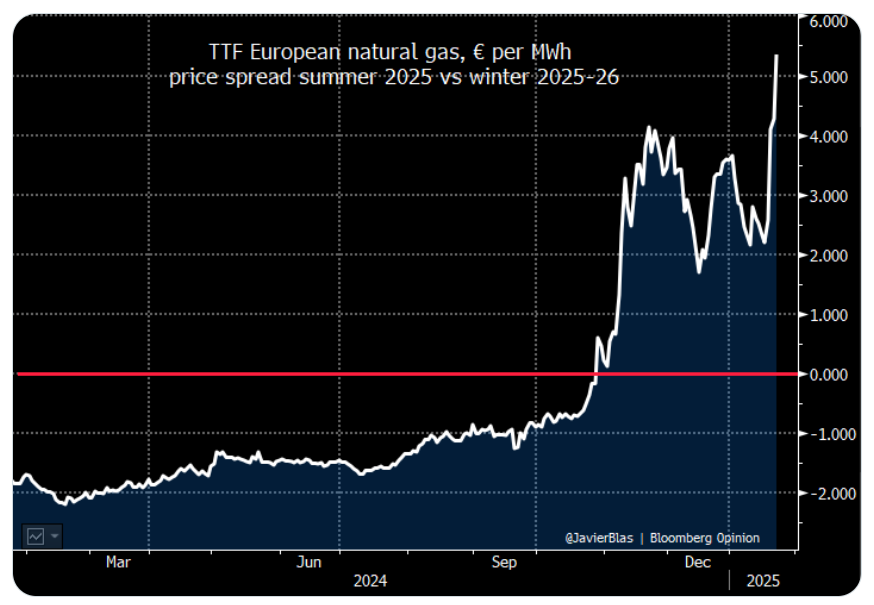
EU Nat Gas Woes: Javier Blas of Bloomberg has a chart with European gas summer 2025 vs winter 2025-26 price spread is flying >€5 per MWh in his recent opinion column. He writes it is an accident waiting to happen. The result of depleting inventories too quickly this winter coupled with EU mandates to re-build them.
IN THE NEWS
LNG Cargos Diverted to Europe – LNG providers and traders diverted at least six cargoes of LNG from Asia to Europe earlier this month, drawn by higher European prices, according to analysts and shipping data. The diverted cargoes could help meet additional European demand as countries seek to replace piped Russian gas after the Ukraine transit deal expired on January 1, while weather forecasts point to lower temperatures in northwest Europe. The vessels had loaded in the U.S. and were initially destined for China, South Korea, Thailand and Singapore according to Kpler Analytics. The vessels were then diverted in the Atlantic Ocean between Jan. 8 and Jan. 14, changing course for Europe.
Fix Our Forests Passes – The House passed bipartisan legislation Thursday that would make it easier to reduce the risk of catastrophic wildfires. The Fix Our Forests Act, which still must be approved by the Senate, would expedite federal approvals to allow co-ops to harden their grids against wildfires and remove the hazardous vegetation that fuels blazes. The bill also aims to reduce the number of “frivolous” lawsuits that delay wildfire mitigation projects. The legislation, which passed the House by a vote of 279-141, would greatly expand the ability of utilities, co-ops and others to remove “hazard trees” that are in danger of sparking fires by falling from federal property onto electric lines. Currently, only trees and other vegetation within 10 feet of their power lines and rights of way can be removed. The Fix Our Forests Act allows a limit of 150 feet of power lines. The bill, introduced by House Natural Resources Chairman Bruce Westerman, R-Ark., and Rep. Scott Peters, D-Calif., would streamline the process to obtain federal permits to modernize their systems to make them more resistant to wildfires.
US, Canada Energy Leaders Sound Alarm Over Tariffs – US and Canada energy leaders are warning that proposed tariffs on Canadian exports would disrupt the deeply intertwined energy trade, putting jobs and decades of shared economic growth at risk. Tariffs would "directly undermine energy affordability and availability for consumers while eroding the US oil and natural gas industry's competitiveness both domestically and globally," the American Petroleum Institute wrote in a letter urging the Office of the US Trade Representative to exempt oil, gas and refined products. API CEO Mike Sommers:
“We import a lot of oil from both Mexico and Canada, and we refine it here in the most sophisticated refinery system in the world. We’re going to continue to work with the Trump administration on this so that they understand how important it is that we continue these trade relationships.”
Handbook Helps Companies Integrate a Community Benefits Approach into Decarb Plans – The Renewable Thermal Collaborative (RTC) published its new Community Benefits Handbook. The Handbook is designed to help RTC Members, Solutions Providers, and other large thermal energy users successfully partner with community stakeholders to deliver tangible, equity-based benefits to their local communities. The new handbook was produced for the RTC by the World Wildlife Fund (WWF), Sustain Our Future Foundation, and WSP. The Handbook, released today and discussed in a webinar featuring the report authors, helps users align sustainability with social, economic, and environmental co-benefits for local and disadvantaged communities, and also meet community benefits requirements tied to state and federal tax credits, grants, and municipal ordinances. As the leading global coalition for companies, institutions, and government entities committed to scaling up the use of renewable heating and cooling at their facilities to drastically cut carbon emissions, the RTC has an ambitious goal to slash U.S. industrial thermal energy emissions by 30% over the next decade. The RTC is committed to advancing a thermal energy transition that is just, equitable, inclusive, and accessible.
ON THE SCHEDULE THIS WEEK
CSIS Looks at Energy Orders – The Center for Strategic and International Studies holds a discussion tomorrow at 9:00 a.m. on the energy emergency order and interpreting other Executive Orders on energy and climate. Joseph Majkut, Director of the CSIS Energy Security and Climate Change Program, will moderate a discussion with Kevin Book, Michael Catanzaro, and Clay Seigle.
Forum Looks at Nuclear Power in Central Asia – The Center for the National Interest will host a forum tomorrow at 1:00 p.m. focused on nuclear power in Central Asia. Part of a monthly series of expert discussions organized by the Center’s Central Asia Connectivity Project, the event will look at how nuclear power could factor into longer-term energy strategies in Central Asia and how Rosatom views these markets. Finally, the event will look at how local and international politics influence these decisions.
CSIS Looks at Uranium – The Center for Strategic and International Studies holds a virtual discussion on Wednesday at 9:30 a.m. on the future of uranium to jumpstart nuclear power in the 21st Century. The CSIS Critical Minerals Security Program conversation features Miriam D'Onofrio, Acting Senior Director for Energy and Investment at the White House National Security Council. She will discuss strategies for reducing U.S. dependence on Russian uranium, revitalizing the domestic uranium industry, and establishing an international order book for advanced nuclear reactors.
Forum Looks at Clean Energy – The American Enterprise Institute for Public Policy Research holds a discussion on Wednesday at Noon looking at environmental sustainability and clean energy. The event is the next installment of the “On the Front Porch” series as AEI’s Brent Orrell and the Brookings Institution’s Tony Pipa talk with Michelle Moore of Groundswell and Benji Backer of the American Conservation Coalition about their companies’ distinct approaches to environmental sustainability. Moore will highlight how clean energy policy can revitalize rural America, while Backer will emphasize market-driven solutions. Together, they’ll explore how communities across the country can address environmental challenges through innovative and locally focused strategies.
Forum Looks at Next Climate Action – The Business Council for International Understanding holds a virtual discussion on Wednesday at Noon looking at post-election climate forecast and what is next for global environmental initiatives. Speakers include Michael Gerrard of the Columbia University's Sabin Center for Climate Change Law, former CEQ head and current Deputy Los Angeles mayor of energy and sustainability Nancy Sutley, WWF’s Elizabeth Lien and John Verdieck of the Nature Conservancy.
Climate Policy Forum Set – EESI’s first Climate Camp briefing will be held on Wednesday at 2:00 p.m. in 2168 Rayburn and serve as an interactive refresher on the drivers of climate change and the latest deployable solutions to address the challenge. The briefing will cover climate concepts and terminology—from types of greenhouse gases to renewable energy technologies—to help you identify policy solutions at the intersection of these issue areas. At this briefing, panelists will showcase tools—like the EN-ROADS simulator, co-developed by MIT Sloan and Climate Interactive—that staff can use to easily digest climate data and generate policy ideas. They will also highlight federal agency resources essential to understanding the climate challenge and innovative solutions to address it.
RFF to Look at Big Decisions – Resources for the Future (RFF) and leaders from across government, business, philanthropy, and media will connect on Wednesday at 2:00 p.m. to discuss the big decisions anticipated in 2025. The event explore the priorities of the incoming Trump administration and the 119th Congress, as well as offer expert insights to inform research and policy agendas for the coming year. Alex Flint, Roger Martella and NYT’s Eliza Barclay are all panelists
Webinar Looks at TVA Transmission Options – ACORE holds webinar on Thursday at 1:00 p.m. looking at TVA transmission issues and Congressional options for reform. At this event, ACORE and SREA will webinar release a new report, “Recommendations for Reducing Costs and Improving Reliability for Tennessee Valley Authority Customers,” followed by an expert panel discussion detailing options available to Congress to modernize TVA’s governance and help the country achieve energy dominance.
Washington Auto Policy Day, Show Set – The Washington Auto Show will be held from Friday to February 9th at the Washington Convention Center. The Washington, D.C. Auto Show is renowned as the nation’s premier “Public Policy Show,” offering a one-of-a-kind opportunity to connect with the key figures driving the future of the automotive industry. On Thursday, the 10-day consumer event kicks off with an exclusive gathering of automotive leaders, government officials, and media representatives, where they come together to discuss the current state of the U.S. auto sector and its future initiatives. This year, speakers include Presidential advisors Ali Zaidi and Alex Jacquez, DOE’s David Turk, DOT’s Polly Trottenberg, Joint Office of Energy and Transportation Gabe Klein, and a Congressional panel with Reps. Debbie Dingell, Mike Kelly, Marcy Kaptur, Bob Latta and Roger Williams.
FCHEA Leads Hydrogen Trucking Discussion at SAE, Auto Show – On Thursday at 3:00 p.m. at the Society of Automotive Engineers government policy symposium (alongside the auto show), FCHEA President and CEO Frank Wolak will moderate a panel on hydrogen in the heavy duty sector. Panelists will discuss progress and challenges surrounding the buildout of hydrogen in the on-road trucking sector as a decarbonization strategy. Speakers will include Amgad Elgowainy of DOE’s Argonne Nation Lab, William Elrick of the Hydrogen Fuel Cell Partnership and Hyzon’s Bappa Banerjee, among others.
IN THE FUTURE
BNEF Summit Set for SF – The annual Bloomberg New Energy Finance San Francisco Summit is set for February 4th and 5th at The St. Regis Hotel. The BNEF Summit provides the ideas, insights and connections to formulate successful strategies, capitalize on technological change and shape a cleaner, more competitive future. Tom Steyer is among the Keynote Speakers.
RFF Hosts Fossil Fuel Worker Discussion – On Wednesday February 5th, Resources for the Future holds a webinar where study authors Jacob Greenspon and RFF Fellow and Director of the Equity in the Energy Transition Initiative Daniel Raimi will discuss their analysis and demonstrate a new interactive data tool that allows users to examine which jobs offer the best match for workers in a variety of occupations that are heavily concentrated in fossil fuels. After the presentation, Myles McCormick from Financial Times will moderate a panel discussion featuring workforce experts from academia, industry, and policy, followed by an interactive question and answer session with the online audience.
Forum Looks at Western Public Lands Debate – ConservAmerica holds a webinar on Thursday February 6th at 12:00 p.m. designed to provide a better understanding of the history of public lands in the U.S. and the growing legal and policy debate over the federal government’s large landholdings. The discussion will also explore policy issues affecting wildlife and critical natural resources, as well as the social and economic implications to gateway communities. Panelists include American Lands Council CEO Jennifer Fielder, David Willms of the National Wildlife Federation and former ConservAmerica President Rob Sisson.
RFF Workshop Looks at Costs, Benefits – On Thursday February 13th, Resources for the Future (RFF) is hosting a virtual workshop on retrospective analyses of the benefits and costs of specific environmental regulations. The webinar features the presentation of papers examining a variety of rules that affect major industrial sectors. In addition, the morning session examines possible alternative institutional arrangements to support/promote the effort to embed the practice of retrospective analysis within the agencies. Bracewell’s Jeff Holmstead is among a number of great speakers.
BCSE, BNEF Release Energy Factbook – The Business Council for Sustainable Energy and Bloomberg New Energy Finance will release its annual clean energy Factbook on February 20th, a report filled with data on the progress of the energy efficiency, natural gas, and renewable energy sectors. More on this as we get closer.
NAS Panels Look at SCOTUS Decisions on Air – On Friday February 21st, my Bracewell colleague will be participating in a panel discussion at the National Academies of Science (NAS) to discuss the implications of recent Supreme Court decisions, including Loper Bright, on EPA and other federal agencies responsible for protecting human health and the environment.
ACORE Holds Policy Forum – The 2025 ACORE Policy Forum is set for February 26th and 27th in Washington DC. Topic include rising electricity demand , manufacturing and digital infrastructure buildout, domestic and global clean energy supply chains and permitting roadblocks limiting our ability to deploy critical transmission lines and clean energy projects. The ACORE Policy Forum will be a two-day event for the first time.