
Energy Update: Week of January 24th
Energy Update - January 24, 2022
Friends,
I haven’t watch much NFL this year but yesterday’s games were amazing. The Bills-Chiefs game actually was able to top the incredible Rams-Bucs game. I guess thirteen seconds was not enough time for the Bills to leave Patrick Mahomes to try and get a FG to send it to OT, where they won it. Anyway, all four games ended in walk-off fashion with 3 GW FGs and the Chiefs OT TD. All very pretty compelling…
A lot going on this week starting today and tomorrow with US Chamber is holding a two-day seminar on private-public partnerships with leaders from Egypt and Climate Envoy John Kerry as they kick off the run up to COP 27 in Egypt later this year. In fact, earlier today Kerry said he was “all in” on natural gas as a bridge fuel, especially in developing countries. Tomorrow, RFF hosts FERC Commissioner Alison Clements while she visits the R Street Institute on Thursday. American Clean Power discuss offshore wind grid issues tomorrow and long-term energy storage on Thursday. Also on Thursday, ACCF hosts House Energy Subcommittee Chair Bobby Rush (D-IL). On Friday, US Energy Assn holds a Friday presser with a panel of experts to talk about DOE’s new transmission initiative "Building a Better Grid".
Without any real Hill action this week, there is action at the Supreme Court which just today said it will review whether the 9th Circuit used the right test to determine whether wetlands are subject to federal jurisdiction under the Clean Water Act. This SCOTUS taking WOTUS will be another big case on top of the GHG case which is on the docket on February 28th. My colleagues Ann Navaro, Sara Burgin and Christine Wyman are great experts on the WOTUS issues should you need a resource.
Finally, ICYMI last week, here is a link to the USEA State of Energy Industry playlist featuring the speaker presentations, listed by order of appearance: USEA 18th Annual State of the Energy Industry Forum Presentations. Check them out…Lots of good stuff.
COVID is still out there so please stay safe and healthy.
Best,
Frank Maisano
(202) 828-5864
C. (202) 997-5932
FRANKLY SPOKEN
“The job of bank regulators is to ensure the safety and soundness of financial institutions and promote financial stability. It is not to pick winners and losers in credit markets, politicize the allocation of capital or solve climate change.”
Rep. Andy Barr (R-Ky.), a member of the House Financial Services Committee , in an interview with POLITICO on moves by new Biden Admin officials to toughen climate rules at the SEC, FDIC, the Federal Reserve and other banking regulators.
ON THE PODCAST
Segal Discusses Seabed Minerals on ABA Podcast – Late last week, my colleague Scott Segal joined the American Bar Association national security team for an ABA podcast session to discuss critical minerals and the Pacific seabed. It is a great 30-minute “deep dive” (pun intended).
Roberts Discusses Energy with Bordoff, O’Sullivan – In the latest version of his Volts Podcast, Dave Roberts visits with Jason Bordoff, director of the Center on Global Energy Policy at Columbia University, and Meghan O’Sullivan, longtime foreign policy operative and professor of international affairs at the Harvard Kennedy School who say the road to a clean energy transition, over the course of the next few decades, is likely to be bumpy. Policymakers need to start planning for the predictable disruptions headed our way. Bordoff and O’Sullivan outline a number of risks the world faces in the short- to mid-term as it endeavors to ramp up clean energy and ramp down fossil fuels.
FUN OPINIONS
Offshore Wind Can Boom in West – A new opinion in CleanTechnica from Mary Ann Showalter of the Pacific Northwest National Laboratory (PNNL) show that wind energy offers logistical, economic, and environmental value to consumers and utilities from the coast of Oregon to remote villages in Alaska. Researcher at PNNL have done two studies to address the issue. In the first study of the grid impacts of offshore wind energy in Oregon, a PNNL team paired offshore wind resource potential from the Oregon coastline with other variable renewable energy sources, including land-based wind and solar. The study helped the team understand how offshore wind could serve electricity demand within Oregon’s transmission network and across the Pacific Northwest. In the second study, a PNNL team analyzed the value of distributed wind — wind turbines installed near where their energy is consumed, such as for homes, businesses, and communities — for the small, remote community of St. Mary’s, Alaska. The study’s results could help inform utilities of the economic feasibility for installing wind in similar isolated microgrid systems in other remote villages. Additionally, the study revealed potential economic and environmental benefits for the village’s electricity consumers.
FROG BLOG
Another Visit to Sirius XM’s Julie Mason to Talk Energy – Last week, I joined Julie Mason on Sirius XM’s P.O.T.U.S. radio’s Mason Mornings to talk about the clean energy and the 2022 agenda for the Biden Administration. Check it out here.
THE 2022 TOP 10 ENERGY ISSUES
Here is one last pass at our Top 10 Issues for 2022, in case you missed it:
1) Critical Minerals for EVs, Renewables – If everything is about climate, then everything is also about critical minerals that we need to power EVs, solar panels, semiconductors, etc. There are so many important stories that are bubbling up on critical minerals right now, from China’s efforts to dominate the supply and production to the investigating opportunities to collect pure critical mineral from the deep sea. There are domestic terrestrial mining battles over lithium, copper and nickel, and there are serious questions about mining operations in the Congo, Indonesia and Chile.
2) Supreme Court Climate Action – This is year is a big one for the Supreme Court and climate. For once and for all, it seems the Court may finally make a serious call on EPA’s ability to regulate climate emissions. This decision may be as big as the initial 2005 Mass v. EPA decision. Stay tuned in February...
3) Infrastructure, Transmission Grid Upgrades – It is go time for infrastructure following the passage of bipartisan legislation in November 2021. With EV infrastructure, grid upgrades, broadband, water Infrastructure and climate-focused road/bridge improvements, this law was a major climate effort that includes clean energy and hydrogen projects, research hubs, advanced recycling RD&D, grants to plug orphan wells and reclaim abandon mines, provides weatherization assistance increase energy efficiency, renewables investments in schools and replacement of diesel school buses. It was bipartisan when the Senate passed it but Republicans lost interest in the House after the success of the VA Governor’s race, even attacking the 13 supporters.
4) LNG Boom – 2021 was record year for liquefied natural gas (LNG) with global demand hitting record highs each year since 2015, due mostly to surging demand in China and the rest of Asia. The US will become the world's biggest LNG exporter in 2022, surpassing Qatar and Australia, and may hold that title for years to come. And the issues continue to be more sustainable. EIA projects LNG exports will reach 11.5 bcfd in 2022. That would account for roughly 22% of expected world LNG demand of 53.3 bcfd next year Third-party gas certification that took off in 2021, particularly in the Haynesville Shale in Louisiana and East Texas, could lead to the first certified gas US LNG export cargo in 2022, market watchers say.
5) Politics, Politics, Politics – The tight margins in the House and the tie Senate have made the politics of 2022 happen faster than ever before. Longtime Democratic Rep John Dingell used to say that the political “silly season” always started around April in an election year. Unfortunately, it seems we are already there. With some Republicans attacking their own members over supporting the bipartisan infrastructure package and Democrats reeling from losing the VA governor’s race (and almost the incumbent in NJ to someone no one ever heard of), the race is already well underway, so don’t expect much bipartisan effort. Traditionally, energy/environment plays a lower profile, but if gas prices head to levels that some analysts expect, it could get rough for politicos. Climate also remains a major talking point. Watch for Republicans to starting seeding the ground on the issues led by John Curtis, David McKinley, Garrett Graves and Dan Crenshaw.
6) Massive Offshore Wind to Shine – Just this week, Interior’s Bureau of Ocean Energy Management announced they will hold a wind auction next month for more than 480,000 acres offshore New York and New Jersey, in the area known as the New York Bight. The administration’s goal to install 30 GW of offshore wind by 2030 is complemented by state offshore wind policies and actions throughout the Northeast and Mid-Atlantic. Collectively, New York and New Jersey have set the nation’s largest regional offshore wind target of installing over 16 GW of offshore wind by 2035. The US has been slow, but it already has made significant progress toward creating a pipeline of projects. It has approved the nation’s first two commercial-scale offshore wind projects in federal waters: the 800-megawatt Vineyard Wind project and the 130-megawatt South Fork Wind project. There will be at least 16 plans to construct and operate commercial offshore wind energy facilities by 2025, which would represent more than 22 GW of clean energy for the nation. We have long known of wind’s potential and there are still worries about local regulations, engagement with fishing groups and transmission challenges, but perhaps wind is ready for primetime and 2022 will be a key year
7) Hydrogen Time – One of the first major initiatives of the DOE last year was the Hydrogen Shot, which is an effort to set ambitious and achievable targets to make key clean energy technologies affordable in the next decade, as well as create new jobs and tackle the Biden Administration’s energy and climate goals. Hydrogen Shot set an ambitious yet achievable “1 1 1” goal to reduce the cost of hydrogen to $1 per 1 kilogram in one decade. This has spurred a rush to stories about hydrogen, which is very flexible and can be used in many different ways. Currently, we are already producing lots of Hydrogen for Industrial uses, including in warehouse across the country where more than 80,000 forklifts are moving your Amazon (etc) packages every day. There are also transportation uses – especially for heavy-duty, long-haul trucking, power generation and public transportation fleets. A continued battle rages over the colors (Gray, Blue, Green) of hydrogen and which can be produced more sustainably. Industry groups are all in and some enviros agree that Hydrogen could be valuable for hard-to-electrify sectors like cement and Aluminum. There will be a lot of focus on it in 2022 and it should be a major future player.
8) If BBB is a No Go, What Fills the Gap – President Biden’s BBB agenda with its $555B in climate provisions remains stuck in neutral. While the climate issues don’t seem to be the stumbling block after Sens. Manchin and Sinema have tamped down the controversial provisions, what happens if BBB collapses will be one of the major storylines of 2022. Will the climate provisions re-emerge in some other form or will it head to a lame duck session in funding bills (where have we seen that before energy/climate bill 2020). Legislation by McKinley-Schrader, Frank Pallone or Diana DeGette all were on the backburner during BBB. If it disappears, look for them to step to the front to begin crafting potential climate legislation that would not be as divisive.
9) Electrification: Boom Or Bust – 2021 saw more efforts to both ban natural gas and prevent bans on natural gas, setting up a continuing battle for the 2022 agenda. Activists say electrifying building is the only solution to climate change and in big/small Liberal cities have implemented natgas bans. But those bans could hurt renters and low income families that don’t own homes and in most cases can’t afford higher-prices electric appliances/heating. And all this added electric power could provide a significant risk to grid reliability. Many other energy using and Red states have run in the opposite direction, passing state legislation to prevent this local natgas bans. It is a deep, complex issue with no easy answers. This year, expect to see if some of the localities can make it work. If they can, it may lead to more bans. If there are unintended consequences on cost, affordability or grid reliability, it could be bad news for enviros plans
10) This is the Year, For New Nuclear? – It seems like I have had this one over the last 5 years, but this might be the year for Southern’s new nuclear units at Vogtle to really step in and step up. This almost has to be the year. While Germany and Japan inch away from large nuclear generation, they face increasing challenges to meet power needs with Germany leaking back into coal. The future of nuclear though may really be in Small module Nuclear, which has seen very positive reviews and advances. The US can lead the world in developing and commercializing advanced nuclear reactors that are smaller, safer, cleaner, cheaper, more efficient and scalable than conventional power technologies. Accelerating the development of a new generation of advanced nuclear reactors – designs that are smaller, cheaper, more efficient and scalable – is essential to meeting that immense global market and Test reactors are already making a difference.
BONUS ISSUE TO WATCH: Kigali, HFC Issue – One issue to keep on your radar this year is the ratification of the Kigali amendment in the Senate that would phase out HFCs and reduce climate emissions dramatically and temps by 0.5⁰ C. Already, Congress passed the AIM Act in December 2020, implementing legislation that requires EPA to moves a regulation to phase out HFCs. Just last year EPA started its regulatory process and President Biden finally submitted the 2016 treaty to the Senate. More than 18 Senators co-sponsored the AIM Act, so it will be interesting to see if they still move to ratify the Treaty, which is necessary over the long-term to prevent trade sanctions.
FUN FACTS
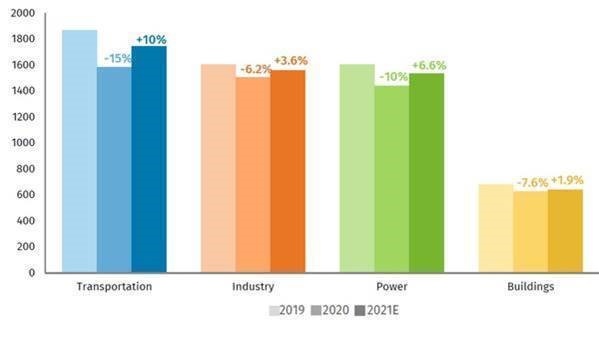
2020 Emissions Grew: While we expected GHG emissions in the US would increase as we recovered from COVID, they increased 6.2% relative to 2020 (all sectors), largely due to an increase in coal-fired power generation. Emissions by major emitting sector, in million metric tons CO2e and % change:
IN THE NEWS
SW Gas Rolls Out RNG Project – Southwest Gas announced the completion of a pipeline interconnection to supply Renewable Natural Gas (RNG) from the Victor Valley Waste Wastewater Reclamation Authority (VVWRA) in San Bernardino County, California to its natural gas distribution system. As part of its continuous efforts to reduce greenhouse gas emissions, Southwest Gas is partnering with SoCal Biomethane, a subsidiary of Anaergia, and North Sky Capital to bring RNG to market through a Public-Private Partnership. Anaergia’s subsidiary will upgrade raw biogas made from anaerobically digesting food waste along with organic material from VVWRA’s wastewater treatment process, creating pipeline quality RNG. That RNG is expected to be injected into the Southwest Gas system later this month. Once fully in production, the facility could divert more than 6,000 metric tons of methane, which is equivalent to 1.5 million CO2 tons, per year.
NREL Says 6TW of Battery Storage is Needed – A new study from NREL suggests that decarbonizing the grid by 2050 could require up to a 6 terawatt of battery storage and 6.5 hours of storage duration. Researchers suggest that by 2050, in a setting where 94% of our electricity comes from renewable sources, approximately 930 GW of energy storage power and six and a half hours of capacity would fully cover the United States’ demand for electricity. The NREL report is its sixth paper – Grid Operational Impacts of Widespread Storage Deployment – in their Storage Future Series. The purpose of the document is to analyze some of the effects of energy storage on the power grid as it evolves toward five unique scenarios in 2050. Good detail here.
Companies Call for Passage of BBB Energy Provisions – More than 260 companies that employ workers in the clean energy industry are making the economic case for passage of the stalled Build Back Better Act. In a letter to Democratic leaders, the companies argued that each month of delay on the bill is an estimated $2 billion in lost economic activity. “That means missed economic opportunities in energy transition communities. That means fewer jobs in domestic mills producing steel for solar and wind projects,” the letter said. “And it means a delay in building the American manufacturing base and workforce into a global clean energy powerhouse.”
SEWC Report: Offshore Wind to Generate Billions for North Carolina Economy – A new analysis shows that constructing 2.8-gigawatts of offshore wind off North Carolina’s coast by 2030 will result in a net economic benefit of up to $4.6 billion for the state’s economy. The North Carolina Offshore Wind Cost-Benefit Analysis was conducted by the Southeastern Wind Coalition (SEWC) with support from Environmental Entrepreneurs (E2), and was informed by peer-reviewed literature, reports, and public data addressing various elements of offshore wind development. The study synthesized these findings with a Jobs and Economic Development Impact (JEDI) simulation into a comprehensive analysis of the net economic benefits of offshore wind for the state of North Carolina. The analysis also incorporated benefits realized from cost reductions the federal clean energy Investment Tax Credit (ITC) extension will yield, as well as the quantitative benefits to the state from reduced carbon emissions. These will result in an additional benefit of $2.1 billion and $8.4 billion, respectively. Economic benefits are an important factor in determining the state’s future generation mix, and ensures that the full value of a technology can be considered. This report incorporates that factor in evaluating offshore wind’s economic potential, a calculation which has, until now, been notably absent in modeling of the state’s energy mix.
ON THE SCHEDULE THIS WEEK
WASHINGTON AUTO SHOW – All this week, the Washington Auto Show Is at the Washington Convention Center. See the brands that are set to display a range of concept, luxury, electric, hybrid, exotic and historic cars across 750,000 square feet of floor space in the Walter E. Washington Convention Center. The 2022 highlights include an EV Pavilion designed to educate show visitors on what the future of mobility looks like, from electric vehicles to charging stations to three-wheeled fun utility vehicles to buses.
Forum to Look at Africa, Hydro, Climate – Today at Noon, the Columbia University Center on Global Energy Policy holds its third event of a webinar series that seeks to foreground the heterogeneity of perspectives found around the continent on what climate means in different African contexts and how more than one billion Africans are already living with extraordinary climatological variability and constraints on the use of natural resources. A panel drawn from Southern Africa will reflect on how to rethink some of the linkages between hydropower, water insecurity and law in the region.
Chamber to Host Initial Egypt Forum – The Chamber will hold a forum today and tomorrow as the first part of the run up to COP 27 in Egypt. With Egypt serving as the official host of the UN COP 27 Climate Summit in 2022 and given its role as a leader in the largest energy producing region of the world, this forum will focus on ways in which governments and the private sector can work together leveraging technology and innovation to address the climate challenge across the economy. Among the speakers with be John Kerry and DOE Undersecretary David Turk. Chamber CEO Suzanne Clark will also moderate a discussion with Kerry and the Egyptian Foreign Minister.
C2ES Looks at Global Stocktake – The Center for Climate and Enviro Solutions (C2ES) is working closely with the Environmental Defense Fund to examine the GST process to offer insights on how the Global Stocktake can deliver meaningful outcomes and recommendations to improve the process. Tomorrow at 10:00 a.m., C2ES holds a webinar to spotlight the first of a series of papers on the, exploring how the UNFCCC can address emerging gaps and challenges on equity and implementation, as well as to deliver a path for increased ambition. A lynchpin of enhanced ambition under the Paris Agreement, the Global Stocktake (GST) is the first official checkpoint to assess Parties’ collective progress towards achieving the purpose of the Agreement and its long-term goals. Translating the GST into increased ambition will mark a critical test for Paris Agreement’s effectiveness.
Forum Looks at Energy Transformation – The Peterson Institute for International Economics holds a discussion tomorrow at 10:00 a.m. on transforming energy systems economics and policies. The event will focus on the deployment of low-carbon alternatives to fossil fuel use. Steven Fries will present his new book, Transforming Energy Systems: Economics, Policies and Change, that examines market developments and policies that advance and guide innovation and deployment of low-carbon alternatives to fossil fuel use. Fries is senior associate fellow at the Institute for New Economic Thinking at Oxford University and former chief economist at Shell and the UK Department of Energy and Climate Change.
FERC Commissioner to Address RFF – Resources for the Future (RFF) holds a forum tomorrow at Noon with FERC Commissioner Allison Clements. RFF President/CEO Richard Newell will sit down with Clements to discuss her decades-long career in energy law, policy, and regulation across the public and private sectors, as well as the priorities she has set for her five-year term as FERC commissioner. Their conversation will touch on a variety of topics, including grid resilience and modernization, environmental justice and equity, and the Biden administration’s clean energy agenda.
DOE Holds Community Solar Summit – DOE’s National Community Solar Partnership (NCSP) will host its second Annual Summit “To 5 Million and Beyond: Community Solar’s Pathway to Success” tomorrow at 11:00 a.m. NCSP is a coalition of over 800 stakeholders working to expand access to affordable community solar. NCSP recently announced a new target to power the equivalent of 5 million households with community solar by 2025, realizing $1 billion in energy bill savings. At the summit, NCSP and DOE leadership will discuss the plan to reach this new target, how to overcome barriers to equitable deployment, and what achieving it will mean for the community solar industry. Speakers will include Kelly Speakes-Backman, Principal Deputy Assistant Secretary for the DOE Office of Energy Efficiency and Renewable Energy, and Jahi Wise, White House Senior Advisor for Climate Policy and Finance. They will be joined by speakers from the solar industry and state and local governments across America, including Katherine Hamilton, Chair of 38 North Solutions, who will discuss the pivotal role community solar plays in their renewable energy goals.
ACP Forum Looks at Offshore Wind Grid – Tomorrow at 2:00 p.m., the American Clean Power Association holds a forum with experts from Anbaric Development Partners and DNV come together to discuss key topics related to the offshore grid concept, including planning, technology compatibility and interoperability, infrastructure and supply chain, industry collaboration, and more.
The energy sector undoubtedly plays a crucial role in accomplishing the 1.5 C° climate change threshold target, and offshore wind energy is expected to be a major contributor to the energy transition. Many regional and global experts see a planned offshore grid as a way forward, but this solution presents advantages, challenges, and complexities that will be dissected in our panel discussion.
Forum to Look at Challenges in Disruptive World – On Wednesday, The US Institute for Peace (USIP), in partnership with the Alliance for Peacebuilding, kickstarts PeaceCon@10 with a high-level keynote and panel discussion. The discussion will address the relationship between climate change, conflict, and fragility, and consider strategies for the international community to address the peace and security implications of these issues as well as the ongoing pandemic. Following a series of breakout sessions hosted by the Alliance for Peacebuilding, participants will re-join USIP for a fireside chat with a closing keynote speaker.
Forum Tackles Ukraine Energy Challenge – The German Marshall Fund of the United States holds a discussion on strengthening the security resilience of Ukraine on military, energy and cyber issues. Speakers from the region will also discuss how the European Union, United States, NATO and other partners can support Ukraine’s National Resilience System.
Forum to Look at Nuclear Energy Supply – The Nuclear Energy Institute holds its Nuclear Fuel Supply Forum on Wednesday at Noon to explore policy issues related to nuclear fuel at the half-day Nuclear Fuel Supply Forum. Speakers from key government agencies and organizations that shape policy and evaluate the direction of the markets will present their latest insights on the future of the industry.
Forum to Look at Greenflation – On Wednesday at Noon, the Environmental Law Institute and leading experts host an in-depth economic discussion about greenflation, carbon regulations, ESG practices, and more. Speakers include C2ES expert Doug Vine, Columbia Climate School professor Urvashi Kaul and Kirkland’s Sara Orr.
Forum to Look at Trade, Carbon Mechanisms – On Wednesday at 12:30 p.m., the Atlantic Council and the Eurasia Group holds a discussion with an this expert panel on the key transatlantic trade policy priorities in 2022. Confirmed speakers include USTR general counsel Greta Peisch, European Commission director at Directorate General for Trade Rupert Schlegelmilch, and Atlantic Council non-resident senior fellow Clete Willems.
Forum Looks at Report on Russian Gas – On Wednesday at 1:00 p.m., the Progressive Policy Institute holds a virtual educational webinar on how the European Union’s reliance on imports of methane-heavy Russian gas is undermining international climate goals and funding a geopolitical crisis. The briefing will dive deep into PPI’s Paul Bledsoe’s recent report, entitled “The Role of Natural Gas in Limiting European Union Emissions: Key Opportunities to Cut Methane, Coal and CO2.”
Forum to Look at Infrastructure, Climate Jobs – On Wednesday at 2:00 p.m., Brookings Metro and the Council for Adult and Experiential Learning (CAEL) will co-host an event to examine how regional and federal stakeholders can leverage the opportunity of the IIJA implementation to address needed talent development in the skilled trades and other climate-related occupations. The event aims to highlight the wide range of careers available and explore how industry leaders need to be involved in ongoing hiring and training efforts. Regional stakeholders, including higher education institutions, workforce development boards, and employers, will all play a critical role in a successful IIJA implementation. Speakers will identify major challenges in implementation, opportunities to test new solutions, and other considerations facing these leaders in the months and years to come.
SEIA Forum to Support Diversity Supply Chain – On Wednesday at 2:00 p.m., the Solar Energy Industries Association holds a virtual networking event to meet with and learn more about diverse-owned businesses partners in the solar industry. SEIA launched the Diverse Suppliers Database last year to connect buyers throughout the supply chain with diverse-owned businesses.
NASEO Looks at EV Buildout – The National Assn of State Energy Officials holds a webinar on Wednesday at 2:00 p.m. to look at different approaches to EV corridor infrastructure build-out, from public-private partnership models, to single-vendor statewide awards. During this webinar, states will explore the strategies they used to identify the best methods for infrastructure buildout along key corridors, with a focus on public-private partnership models, as well as siting and analytical tools to prioritize EV infrastructure locations.
Forum Looks at Electrification Issues – The Stanford Woods Institute for the Environment is convening a webinar on Wednesday at 3:30 p.m. that highlights some of the latest research on building electrification. The conversation will feature remarks from Senator Martin Heinrich (D-NM), a leader on electrification in Congress. It will also include a panel of science and technology experts discussing options, progress, and barriers for building decarbonization. Topics include: cutting-edge energy system technologies, efficient building best-practices, reducing household appliance methane emissions, and resulting financial implications for consumers. The conversation will focus not only on the technology but also on assuring that the transition puts a priority on equity and justice.
Forum Looks at Hydrogen, Other Innovations – The Baker Institute’s Center for Energy Studies holds a forum on Wednesday at 4:00 p.m. to investigate new technologies are required to accelerate the energy transition. At this webinar, Pradeep Venkataraman, the senior manager of Mitsubishi Heavy Industries, and Ken Medlock, the senior director of the Baker Institute Center for Energy Studies, will discuss why creating the hydrogen ecosystem is a pivotal step in changing how we produce and deliver energy. They will also consider why leveraging existing technical experience and knowledge of hydrogen will be critical to the success of this vital and complex effort.
Forum to Look at Trade, Climate Nexis Report – The Konrad-Adenauer-Stiftung and E3G will online discussion on new report on climate, trade and development pathways to Transatlantic Thursday at 10:00 a.m. The report by E3G and published by the Konrad-Adenauer-Stiftung USA explores the interconnectivity of three distinct policy areas: climate, trade and development. Critical components of the discussion are how trade can play an essential part in addressing the larger challenge of climate change and its impact on developing countries. Experts will provide their perspectives on the report’s findings. Emphasis is on the relevance of transatlantic cooperation for finding and promoting answers to the climate-trade-development nexus. Other aspects on the agenda are the current geopolitical landscape and actionable pathways towards a climate- and development-aligned trade regime. The experts will also present national and international solutions to carbon leakage while promoting climate-friendly trade policies.
ACP Forum to Look at Energy Storage – America’s Clean Power holds a forum on Thursday at Noon on the future of long duration energy storage. This virtual roundtable, moderated by ACP’s VP of Energy Storage Jason Burwen, will feature opening remarks by ACP CEO Heather Zichal and a discussion of technologies and their applications to decarbonize power systems. This webinar will be co-hosted by ACP and members of the Long Duration Energy Storage (LDES) Council, with McKinsey & Company, as knowledge partner of the Council, providing insights. Council members will share insights from their inaugural report, where the implications of LDES technologies for energy flexibility and the clean energy transition as well as the background behind the formation of the LDES Council will be discussed. Key findings of the report will be shared, including US-specific insights, followed by a live plenary panel discussion with representatives from Council members. The panel will also take questions from the audience. The report is the result of months of research and collaboration of Council members. From extensive modelling and exploration, projections show that 1.5-2.5 TW and 85-140 TWh could be deployed globally by 2040, with USD 1.5-3 TN investment, storing up to 10% of all electricity consumed.
ELI Addresses Clean Transportation – On Thursday at Noon, ELI and expert panelists hold an in-depth exploration of where the transportation sector is headed in the coming years, including the opportunities and challenges on its way reduce its environmental impact. Telsa’s Yesenia Villasenor is among the speakers.
Forum to Looks Utilities, Climate – Energy Central holds a PowerSession on The Future of Utilities and Climate Change Goals on Thursday at 2:00 p.m. Now that COP26 has ended with soft and hard commitments, in this PowerSession will host panelists to discuss what we really need from world leaders and utilities to achieve the target of 1.5-degree warming by 2100.
Forum Set on Natural Disasters – On Thursday at 2:00 p.m., the Atlantic Council’s Adrienne Arsht Latin America Center as part of a new partnership with the US Department of State, is bringing together regional organizations to advance an inclusive conversation on health and natural disasters in anticipation of the ninth Summit of the Americas. Speakers will share ideas on ways to create a stronger hemispheric response that better prepares the entire region for pandemics and natural disasters, with a focus on vulnerable communities.
Forum to Look at Utilities, Future – Energy Central holds a forum on Thursday at 2:00 p.m. looking at the future of utilities and their climate goals. From the foundations of the Paris climate agreement to the results of COP26, this PowerSession will look at the evolution of climate [response] [action] and what’s next for utilities. The discussion will cover new technologies, operating models, risks, and opportunities—including the transition out of fossil-generated electricity and the new job opportunities that will emerge.
FERC Clements to Speak at R St on Transmission – The R St. Institute holds a conversation on Thursday at 3:00 p.m. how to level the transmission field, which could create hundreds of billions of dollars in net benefits to consumers and unlock clean energy. Areas to explore include independent transmission planning and oversight, equal rate treatment between suppliers and proper implementation of competitive processes under FERC’s Order 1000. FERC Commissioner Allison Clements will keynote while panelists include Industrial Energy Consumers Paul Cicio, Harvard Electricity Law Institute’s Ari Peskoe and SPP’s Keith Collins.
WCEE Forum Looks at Women Leaders – On Thursday at 4:00 p.m., the Women’s Council on Energy & Environment (WCEE) and Google for a two-part virtual series featuring practical information and skill building for careers in energy and environment. You do not need to be a member of WCEE to participate. This page is to register for the first event in the series, click here to register for the Feb. 3 networking event. Women from Google and WCEE will discuss their career paths, the many directions you can take in energy and environmental fields, and offer practical advice on career planning and goal setting.
USEA to Discussion DOE Transmission Initiative – The US Energy Assn holds a presser on Friday at 11:00 a.m. with a panel of experts to talk about DOE’s new transmission initiative "Building a Better Grid". They will be questioned by a panel of knowledgeable reporters. USEA Acting Executive Director Sheila Hollis will give opening remarks, and Llewellyn King, who organized this briefing, will moderate. Panelists will include EEI’s Phil Moeller, Tri-State G&T CEO Duane Highley, Southwest Power Pool CEO Lanny Nickell. Reporters on the panel will be our friends Rod Kuckro and Ken Silverstein, as well as Markham Hislop of Energi Media.
Forum to Interview DHS Official – On Friday, January 28 from 11:00 a.m., the Center for a New American Security (CNAS) will host Deputy Secretary John Tien in his first in-depth public conversation since stepping into his role, to discuss current homeland security threats and challenges, and, one year into the Biden Administration, the department’s priorities for strengthening the effectiveness of its operations while adapting to a threat landscape that has evolved substantially since the department’s creation. This conversation is the first in a new CNAS speaker series, Safe@Home, which focuses on challenges to homeland security such as international and domestic terrorism, political violence against government officials, mass shootings and gun violence, pandemic preparedness and response, climate related emergency management, cybersecurity and response, and related issues.
IN THE FUTURE
Forum to Feature Navajo Renewable Exec – Next Monday at 11:00 a.m., the Atlantic Council Global Energy Center which will host Dr. Suzanne Singer, co-founder of Native Renewables, where she will discuss the latest advancements in providing off-grid photovoltaic systems to rural Indigenous communities in the Navajo Nation.
Energy Economists to Discuss EV Build Out – Next Monday at Noon, the US Energy Economists host their January forum on the EV infrastructure buildout, featuring TeraWatt Infrastructure, an EV infrastructure project developer and long term owner of high-powered charging for commercial fleets. In this webinar, David Schlosberg, VP of Solutions at TeraWatt, will discuss the opportunity and challenge of scaling EV charging infrastructure across the country - including powering up the grid, deploying distributed energy systems, advancing regulatory policy and establishing new business models in transportation. David will also address the opportunities for transportation electrification afforded by the IIJA, and the role the private sector will play in building out the necessary infrastructure of the future.
Forum to Look at Climate with Book Author – On Tuesday February 1st at Noon, the Environmental Law Institute and experts in the field will discuss the science of climate change, sustainable designs, green policies, and so much more. ELI will first talk with author Bill Caplan as he discusses his new book published by ELI Press – “Thwart Climate Change Now: Reducing Embodied Carbon Brick by Brick.” Caplan will discuss three primary threads he wrote about: the urgent reality of now, misinformation and the green and sustainable palliatives, and reducing embodied carbon in the 2020s. Following that, expert panelists will convene with the author to tackle embodied on carbon emissions, design and policy issues and the best strategies to slow the pace of climate change within the coming decade. Our friend Maxine Joselow of the Washington Post moderates.
EPIC Hosts Climate One-on-One – On Tuesday February 1st at 12:30 p.m., the Energy Policy Institute at the University of Chicago (EPIC) will be hosting Sue Biniaz, Deputy to Special Presidential Envoy for Climate John Kerry, who played a critical role in both the forming of the Paris Agreement and in the latest COP26 climate talks. Biniaz will talk with EPIC journalism fellow and The New York Times climate reporter Lisa Friedman for a conversation on the successes and setbacks from COP26 as well as the future of international climate diplomacy.
BPC Releases Climate Smart Ag Recommendations – The Bipartisan Policy Center hold a forum on Tuesday February 1st at 1:00 p.m. to release BPC’s Farm and Forest Carbon Solutions Task Force consensus report. The event features a conversation with Secretary of Agriculture Tom Vilsack on the efforts to scale public and private investments in climate-smart agriculture and forestry. Task Force Chairs Heidi Heitkamp and Saxby Chambliss will also speak in a Fireside Chat with BPC’s Jason Grumet.
Senate Enviro Looks at Recycling Issues – The Senate Environment Committee holds a hearing on Wednesday February 2nd at 10:00 a.m. to examine legislative proposals to improve domestic recycling and composting programs.
Senate Energy Meets with Nominations -- The Senate Committee on Energy & Natural Resources will convene a hearing on Thursday at 10:00 a.m. to consider the nominations of Maria Robinson to be an Assistant Secretary of Energy (Office of Electricity), Joseph DeCarolis to be Administrator of the Energy Information Administration and Laura Daniel-Davis to be an Assistant Secretary of the Interior (Land and Minerals Management).
Forum to Look at Small Nuclear – The Global America Business Institute holds a forum on Wednesday February 2nd at 10:00 a.m. looking at cooperative opportunities in the global small modular reactor arena. Speakers are experts Milt Caplan and Andrew Paterson.
NASEO Looks at EV Buildout – The National Assn of State Energy Officials continues it webinar series in on Wednesday February 2nd at 1:00 p.m. to look at engaging communities, industry and other partners throughout the EV planning and program design process to ensure that EV infrastructure programs adequately address the needs of drivers. States have taken a variety of approaches to solicit input before, during, and after the EV planning process, from launching statewide stakeholder engagement initiatives to project-specific, targeted community outreach. This webinar will highlight different strategies states have taken to meaningfully engage stakeholders and built-out EV infrastructure in an effective and equitable manner.
Group Looks at Energy Market Design – The NYU Institute for Policy Integrity and EDF hold a forum on Thursday February 3rd at 1:00 p.m. on energy market design. This webinar will discuss ongoing policy questions and the latest research on how different market designs could affect clean energy outcomes. FERC’s Valerie Teeter, Penn State’s Chiara Lo Prete and UMich’s Catherine Hausman speak.
NARUC Winter Meetings Set – The National Assn of Regulatory Utility Commissioners holds it Winter Policy Summit Meeting on February 14 to 16th in DC.
Ethanol Conference Set – The Renewable Fuels Association holds the National Ethanol Conference (NEC) in New Orleans on February 21st to 23rd. Since 1996, the NEC has been recognized as the ethanol conference for the latest, timely information on marketing, legislative and regulatory issues facing the industry. With numerous networking opportunities, more business meetings are conducted and contacts made at this conference than at any other ethanol conference.
Biden to Deliver State of the Union – In the latest SOTU Speech ever, the President will address a joint Session of Congress on March 1st.