
Energy Update: Week of January 20th
Energy Update - January 20, 2026

Friends,
How about those Hoosiers!!! Fernando Mendoza bulldozed his way into the end zone in the 4th quarter to allow the Indiana fight off the Miami Hurricanes 27-21, putting the finishing touch on a rags-to-riches story, an undefeated season and the school’s first national football title. What a great game, and kudos to Miami for making it a battle to the end. And one other reminder: this is the third straight, different Big Ten team to win the national title.
Last week was a crazy week with all the actions on offshore wind, Venezuela and Greenland. This week, the Senate is out for the MLK Holiday, but House comes back to vote on a resolution to overturn a BLM rule on public lands in Minnesota. More importantly, it will start to finish its work on budget funding given another potential partial government shutdown at the end of the month. Last week, the Senate overwhelmingly sent to the president’s desk an appropriations minibus package that funds the Commerce, Energy, Interior, EPA and Justice through September 30th. Six of the 12 spending bills have now cleared Congress. The House passed another two-bill package that would fund the State and Treasury, which includes the IRS. Currently, Homeland Security funding remains a clear stumbling block (for obvious reasons).
Hearings this week include two House Resources hearings on Wednesday in international conservation and the one-year anniversary of the Outdoor Recreation Act. Also Wednesday, the full House Energy Committee will approve a piecemeal overhaul of the Clean Air Act items, moving a half-dozen bills that would cumulatively amount to the biggest makeover of the landmark environmental law in more than 35 years. On Thursday, House Energy looks at TSCA/chemical safety laws while House Resources talks deep sea mining, featuring our friend Gerard Barron. Finally, FERC holds it January meeting on Thursday with Midwest ISO tariffs and New England Power Generators’ complaints on the agenda.
This week, there will be a significant focus on the World Economic Forum in Davos with Trump headed there midweek. He has already caused a ruckus with the Greenland focus and leaking some of French President Macron’s texts. One thing to note is the ABSENCE of nearly any talk of climate issues (which our friend Amy Harder highlighted late last week in Axios). It is not just a sop to Trump, but a recognition of the reality that many nations are facing on energy politics, reliability and affordability. Semafor is on the ground in Davos and holding events.
Today, CSIS hosts EIA head Tristen Abbey on the January STEO at 1:30 p.m. POWERGEN 2026 is set for today to Thursday in San Antonio, TX, looking at powering the data center boom.
And in DC on Thursday, it is the annual DC Policy Day at the Washington Auto Show. I will be there on the morning sessions. It is always interesting to hear where the auto policy stands – especially now with the Trump Administration implementing a much different approach that the previous administration. The Atlantic Council also discusses Venezuela and oil markets, FCHEA holds a moderated panel session on Capitol Hill where industry leaders will delve into hydrogen and fuel cell technologies featuring our friend Erin Lane of Plug Power and ZETA holds a webinar vehicle economics featuring an Edmunds expert.
On Friday, the Center for the National Interest hosts a special online panel discussion of the Trump administration’s policy toward Greenland.
Well, it officially has been one year of Trump II as of as of Noon today. I am sure we will have three more years of the hectic/frenetic pace. And to top that off, the President is expected in the WH briefing room any moment. Call with any questions.
Best,
Frank Maisano
(202) 828-5864
Quarter to C. (202) 997-5932
FRANKLY SPOKEN
“It is widely recognized, including by the current administration, that there is a pressing need for additional electric generation in PJM’s region to meet rising demand and ensure the reliability of the interstate transmission grid. CVOW is a large project in the PJM region that will provide such generation. It has been in planning and development for many years. Given the size of the project and the long lead times associated with development of alternatives, further delay of the project will cause irreparable harm to the 67 million residents of this region that depend on continued reliable delivery of electricity.
A PJM filing in the h CVOW offshore wind case heard last Friday
ON THE PODCAST
AZ Grid Experts Talk Innovation – As electricity demand continues to rise, electric companies are using new strategies and tools to help plan for the future. On this episode of EEI’s Electric Perspectives, Arizona Public Service (APS) Director of Grid Modernization Jasdeep Singh and KloudGin CEO and Co-Founder Vikram Takru discuss APS' shift to a product-oriented model for grid modernization and how technology platforms are streamlining operations and improving safety. The conversation highlights impactful grid projects in Arizona, strategies to keep customer bills as low as possible, and the innovations that will shape grid planning in the years to come.
FUN OPINIONS
Yergin: Making Venezuela Come Back on Oil – In an op-ed in the Wall Street Journal, CERA Week founder and oil expert Dan Yergin writes a longtime oilman told him the other day “no one was paying any attention to Venezuelan oil two weeks ago, but now everyone is.” Venezuela today is very different from Saddam Hussein’s Iraq, and 2025 is not 2003. But similar questions will be on the agenda before billions of dollars of investment start to flow again into Venezuela, and the answers will have to be worked out.
FROG BLOG
Axios Interviews Energy Secretary on Venezuela – In a exclusive interview with Axios, Energy Secretary Chris Wright said the US is looking to secure oil and critical minerals deals with Venezuela in the next few weeks ahead of a trip to Caracas. The deals could give the U.S. exclusive access to key resources while helping finance the reconstruction of Venezuela's ailing economy. Wright told Axios: "Our hope is that later this year, with bringing some stability with Venezuela, with some help from American assistance, commercial help — no money from our government, no subsidies — but by getting a more stable business environment, we'll see growing production out of Venezuela that'll increase dramatically."
FUN FACTS
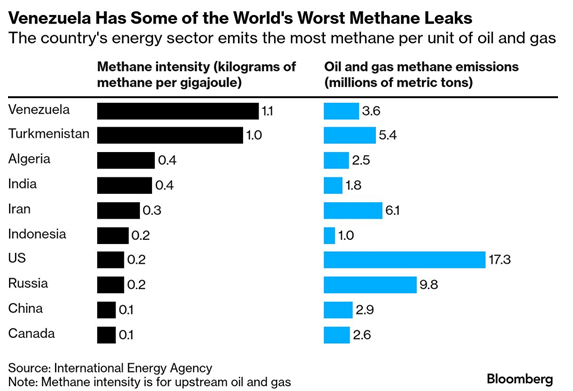
Venezuela Methane Leaks are a real challenge: Methane leaks in Venezuela underscore the major challenge with its infrastructure and the investment required. Roughly 13 billion cubic meters of Venezuela’s natural gas is flared, vented or leaked into the atmosphere every year, wasting about $1.4 billion of potential revenue. Also important note how good the US is on this issue
IN THE NEWS
Offshore Wind Projects Score Major Wins, Restart Work – Three separate judges last week allowed construction to resume on offshore wind projects off the coasts of New England, New York and Virginia that the Trump Administration attempted to block.
Turn Forward Executive Director Hillary Bright:
“Today’s ruling in Virginia marks the third time in a row that a court has allowed one of the five offshore wind projects suspended in December to resume construction. This is good news for stressed power grids on the East Coast — and also for the ratepayers who will ultimately benefit once these projects are completed. Each project suspended by the U.S. government could provide enough power for hundreds of thousands of American homes. At a time of rapidly growing electricity demand, the potential impact on our power supplies is enormous. Yet the reverse is also true — if these projects are not allowed to advance, stressed grids along the populous East coast are more likely to experience reliability issues and see ratepayer bills soar. The Administration wants power-hungry AI to help fuel economic growth and also seeks to solve household affordability issues. Offshore wind aligns with both those goals, bringing utility-scale power to busy coastal regions and shoring up electricity grids gradually growing overtaxed by demand.
With two more projects still stalled over undefined claims regarding national security — and those allowed to proceed still in litigation — we hope the Administration soon comes to understand the immense benefits that these nearly complete power sources can bring to our nation’s energy and national security.”
Statement from Commander Kirk Lippold, USN (Ret.)
“The claim that these stop-work orders are necessary for national security is not just misleading—it is reckless. As someone with firsthand experience with real national security threats, I can say unequivocally that halting nearly complete large-scale energy projects that are on target to boost regional grid reliability and reduce Americans’ power costs weakens our nation’s security.
Despite claims that offshore wind projects harm national security, the issues regarding degraded radar performance and other environmental factors are well known and have been addressed and mitigated for years. Military and defense experts were involved from the beginning and throughout the vetting and approval of these projects. We should not be wasting precious defense budget money and time casting doubt on work that has already been done.
National security rests in part on the rule of law, predictability, and trust in our institutions. Heavy-handed executive actions undertaken without due process undermine the stability that both our economy and military depend on to operate effectively. Asserting the false claim of national security to undo legally approved projects erodes our nation’s credibility and diminishes the real national security threats many of us have spent our careers defending against.”
PJM Quote from Filing in CVOW case heading for a hearing tomorrow:
“It is widely recognized, including by the current administration,3 that there is a pressing need for additional electric generation in PJM’s region to meet rising demand and ensure the reliability of the interstate transmission grid. CVOW is a large project in the PJM region that will provide such generation. It has been in planning and development for many years. Given the size of the project and the long lead times associated with development of alternatives, further delay of the project will cause irreparable harm to the 67 million residents of this region that depend on continued reliable delivery of electricity.
Former Defense Clearinghouse head David Belote – In a filing for Friday’s Dominion Energy lawsuit, David Belote, the first Executive Director of the DoD’s Military Aviation and Installation Assurance Siting Clearinghouse, serving from July 2010 to June 2012, wrote: .
Wind turbine interference, one of many types of unwanted radar energy or clutter, is a long-studied and well-understood issue. In their analyses, NORAD and 84 RADES determine how interference from the spinning blade will impact a radar’s ability to detect and display targets, and consider suitable mitigation options, such as overlapping coverage from adjacent radars that form NORAD’s overall radar picture. NORAD then assesses the concordant risk to nearby population centers, military facilities, and DoD operations not only from the specific impact of a single wind project, but also the cumulative effect of all turbines within the radar’s field of view.
Belote added that Interior’s stop-work order is premature because it did not fully avail itself of a well-understood, fully vetted Clearinghouse mission compatibility evaluation, and it lacks any possible rational basis in national security.
Further, BOEM’s order is overbroad in stopping construction activities that have minimal to no effect on NORAD’s surveillance mission. DoD’s coastal defense capabilities are not impaired while vessels like Charybdis install tower components and turbine blades. And several other offshore components (e.g., offshore substations, subsea cables) do not significantly impair radar surveillance. Resumption of construction, as over the past two years, in parallel with DoD’s, NORAD’s, and the Navy’s longstanding and effective collaboration with DEV in the Clearinghouse process, presents negligible overall national security risk (and none with respect to radar interference).
The Clearinghouse is DoD’s centralized office to coordinate the Department’s evaluation of energy and transmission projects for potential impacts on homeland defense and military testing and training, with the specific evaluations done by the military services and bases that could potentially be affected by the development. The Clearinghouse’s mission also included identifying and implementing mitigation strategies that would allow for energy development while safeguarding critical military operations and assets.
API Comments – When asked by a reporter on about whether API would back offshore wind in order to get a permitting deal. Sommers said his group is working with trade groups for alternative energy.
“It’s time for both sides to put their weapons down,” he said. “We’re going to need… a lot more energy going forward, and that means all sources of energy. We are not in competition with each other.”
US Chamber Permitting, Offshore Wind – Here is a blog post from the US Chamber global Energy Institute head Marty Durbin that discusses this topic:
The default statute of limitations to challenge a federal permit is currently six years, creating a cloud of uncertainty over projects long after they have successfully navigated the permitting gauntlet. A change in an administration has also brought approved projects to a halt. This was the case when the Biden Administration overturned permits granted by the first Trump Administration for the Keystone XL Pipeline and an Alaska critical minerals project known as Ambler Road. It is also the case now with the Department of Interior’s recent pause on five large offshore wind projects that were previously permitted, under construction and, in some cases, nearly completed. America would be more secure and more prosperous with the oil that should be flowing through the Keystone XL pipeline, the critical minerals that should be mined in Alaska, and the electrons that should be produced by these new energy assets.
EIA Underscores Energy Sector Challenge for Oil, Electricity – In its first energy forecast for 2026, EIA forecasts a slight decline in U.S. oil production in 2027, with this year's levels basically flat compared to 2025."With sustained lower crude oil prices, we expect crude oil production will decrease as the slowdown in drilling activity will outpace increases in drilling productivity," EIA said. On the electricity side, EIA projects U.S. consumption rising 1% this year and then jumping 3% in 2027, with — you guessed it — data centers adding upward pressure. Power prices are slated to rise again alongside demand, though the amount depends on whether we're talking about residential, commercial or industrial customers. The agency sees residential prices rising roughly almost 4% this year and another nearly 3% in 2027.
PJM Issues Same Warning on Demand – PJM’s 2026 Long-Term Load Forecast Report confirms the same trend EIA reported: significant growth in electricity demand over the next 20 years but slightly decreases the expected load growth for near-term years compared with last year’s report. The 2026 Long-Term Load Forecast Report anticipates lower peak demand in the near term through 2032 due to updates to the electric vehicle and economic forecasts as well as improved vetting of requested adjustments for data centers and large loads. For example, the updated load forecast for summer 2026 predicts a drop in peak electricity use attributed to large loads (-0.7%), economic activity (-0.5%) and EVs (-0.1%) compared to the PJM 2025 Long-Term Load Forecast Report.
White House, Governors Call For PJM Action – The White House and a bipartisan group of Governors urged the largest U.S. electric grid to conduct an emergency power auction to protect against rolling blackouts as energy demand from data centers grows faster than the country can build new generation plants. The National Energy Dominance Council announced an agreement with governors across the Mid-Atlantic region to urge PJM to make electricity more affordable for residential customers and strengthen grid reliability by building more than $15 billion of reliable baseload power generation. The agreement urges PJM to accelerate development of reliable power generation by providing 15-year revenue certainty for new power plants, protect ratepayers by limiting the amount existing power plants can be paid in the PJM capacity market and require data centers to pay for the new generation built on their behalf. See the White Fact Sheet HERE. Our friend Rob Gramlich said this a very new and unique approach for a region that was stuck without good options, but this has been a concern he raised in 2020. He added the principle of new large loads paying their fair share is gaining consensus across states, industry groups, and political parties, but it is not clear how this new program would actually work or fit into existing electric industry structure and State and Federal law/regulations. Significant changes to Federal and/or State law could be needed to lawfully implement this concept. I have some additional thoughts from my colleague Scott Segal which I can send if you are interested.
PJM Drops its Demand Plan – On the same day as the White House event, PJM released its proposal for how to handle an influx of data centers driving up energy prices in the region. The plan would improve its load forecasting process and allow data centers to either bring their own generation or connect to the wider grid provided that they are the first to curtail their energy use during emergencies. The board is also considering an emergency capacity auction not unlike what the Trump administration is asking it to do and asking its members for feedback on a Trump-backed price collar extension.
ON THE SCHEDULE THIS WEEK
CSIS Hosts EIA on Energy Outlook – Today at 1:30 p.m., the CSIS Energy Security and Climate Change Program holds a discussion and presentation on the U.S. Energy Information Administration’s (EIA) January 2026 Short-Term Energy Outlook (STEO) with Sean Hill, Senior Economist, EIA. Tristan Abbey, Administrator, EIA, will provide opening remarks. The January 2026 STEO extends EIA’s forecasts for global energy markets through December 2027 for the first time. Following the presentation, there will be a panel discussion featuring former EIA head Adam Sieminski and others..
Group Looks at WOTUS Rule – Today at 4:00 p.m., the Federalist Society for Law and Public Policy Studies holds a virtual discussion featuring an analysis of the new proposed 'Waters of the United States' rule, A panel of experts will detail what is in the rule, provide analysis and perspective on the rule and explain what changes the agencies should make for any final rule.
Davos Economic Forum Set – The World Economic Forum's 56th Annual Meeting will be held this week in Davos, Switzerland. The event gathers leaders across geographies, industries and generations under the theme A Spirit of Dialogue. The meeting embodies an attitude of openness and cooperation that is core to the Forum’s work. Discussions are centered around five key global challenges: cooperation in a contested world, unlocking new sources of growth, investing in people, deploying innovation responsibly, and building prosperity within planetary boundaries. Semafor holds events each day with CEO Signal Editor Andrew Edgecliffe-Johnson interviewing global leaders like GE Vernova CEO Scott Strazik to examine how executives are resetting priorities, reassessing risk and redefining resilience.
Power Conference Set for Texas – POWERGEN 2026 is set for today to Thursday at the Henry Gonzales Convention Center in San Antonio, TX. The event will look at powering the data center boom. Load growth has become the defining challenge for the power generation industry. From utilities and IPPs to EPCs and OEMs, every stakeholder is racing to deliver new capacity and POWERGEN will be where all aspects are discussed.
House Energy Marks Up Clean Air Act Reforms – On Wednesday at 10:15 a.m., the House Energy and Commerce Committee has a markup for a half-dozen bills that would makeover piece of the Clean Air Act. See the list of bills HERE.
House Resources Panel Looks at Outdoor Recreation Act at One Year – The House Natural Resources Federal Lands Subcommittee holds a hearing tomorrow at 10:15 p.m. on the one-year anniversary of the Expanding Public Lands Outdoor Recreation Experiences Act.
House Resources Panel Takes on International Conservation – The House Natural Resources Oversight and Investigations Subcommittee holds a hearing tomorrow at 2:00 p.m. on U.S. leadership and national security in international conservation.
House Energy Looks at Chemical Laws – The House Energy and Commerce Environment Subcommittee holds a hearing on Thursday at 2:00 p.m. focused on legislative proposal to modernize America's chemical safety law, strengthen critical supply chains, and grow domestic manufacturing.
House Resources Addresses Deep Sea Mining – The House Natural Resources Energy and Mineral Resources Subcommittee holds a hearing on Thursday at 2:00 p.m. examining the regulatory and statutory barriers to deep sea mining. Witnesses include Metals Company CEO Gerard Barron, Impossible Metals CEO Oliver Gunasekara and NOIA’s Erik Milito.
Hydrogen Forum Heads to Hill – The Fuel Cell & Hydrogen Energy Association holds a moderated panel session on Thursday at 1:00 p.m. in 2045 Rayburn where industry leaders will delve into how hydrogen and fuel cell technologies are proven and ready to meet America's energy challenges and growing power demand while creating new jobs, manufacturing, and export opportunities across the country. This event will be held in cooperation with the American Energy Dominance Caucus. Our friend Erin Lane of Plug Power is among the speakers.
Washington Auto Show Features Policy Day Focus – The Washington, D.C. Auto Show is renowned as the nation’s premier “Public Policy Show,” offering a one-of-a-kind opportunity to connect with the key figures driving the future of the automotive industry. This 10-day consumer event kicks off on Thursday with an exclusive gathering of automotive leaders, government officials, and media representatives, where they come together to discuss the current state of the U.S. auto sector and its future initiatives. Public Policy Day serves as a vital platform for engaging in discussions on the most pressing issues facing the automotive industry, including cutting-edge technology, environmental regulations, and innovative mobility solutions. The full show runs from January 23rd to February 1st.
Forum Look at Vehicle Economics, EVs – The Zero Emission Transportation Association Education Fund holds a webinar discussion on Thursday at 2:00 p.m. looking at how vehicle economics have changed in recent years and what those shifts mean for the future of the industry. In this webinar, Jessica Caldwell, Head of Insights at Edmunds, will join ZETA’s Corey Cantor for a data-driven discussion on how vehicle economics have changed in recent years and what those shifts mean for the future of the industry. Drawing on the latest industry data, the conversation will explore the forces influencing vehicle costs, including market dynamics, technology transitions, and growing global competition.
Atlantic Council Forum Looks at Post Maduro Venezuela Oil Issues – On Thursday at 3:00 p.m., the Atlantic Council’s Adrienne Arsht Latin America Center, joined by the Global Energy Center, will host an in-person deep dive discussion on Venezuelan oil reserves, the state of the country’s energy infrastructure, and the strategic role Venezuelan oil could play in global markets. The event will explore the current landscape of Venezuela’s oil sector, examining the condition of its oil infrastructure and the policy and investment considerations shaping reengagement.
FERC Open Meeting Set – On Thursday at 10:00 a.m., FERC holds it monthly Open Meeting.
Event to Focus on Greenland – On Friday at 9:00 a.m., the Center for the National Interest hosts a special online panel discussion of the Trump administration’s policy toward Greenland. The session will feature three impressive speakers—Alexander Gray, CEO of American Global Strategies, and two Center for the National Interest Senior Fellows, Elizabeth Buchanan and Martha Miller.
IN THE FUTURE
NCEA Energy Report Set for Release – The National Center for Energy Analytics will release its new report, Energy Delusions and the Return of Realism: A Critique of Oil “Scenarios” in the IEA World Energy Outlook 2025, on Tuesday January 27 at 10:00 a.m. during an event on Capitol Hill and online. This briefing will examine the assumptions behind the IEA’s oil-market forecasts and their implications for policy, investment, and energy security. Former EIA head Adam Sieminski is one of the authors of the report.
CEN Forum Looks at Energy Going Forward in 2026 – On Tuesday January 27th at Noon, the Conservative Energy Network holds a forward-looking policy briefing on what to expect in 2026. The event will focus on a clear understanding of the 2026 energy policy environment and practical guidance for engaging where it matters most. Speakers will include SAFE’s Skip Bates, CRES’s Christina Baworosky, Niskanan’s Rachel Levine and James Ritchotte of Americans for a Clean Energy Grid.
EESI to Address Wildfire Innovations – On Tuesday January 27th at 3:00 p.m., the Environmental and Energy Study Institute (EESI) and the Federation of American Scientists (FAS) hold a briefing on emerging solutions to tackle the wildfire crisis, and the federal policy strategies for getting these solutions into the field. This briefing will highlight efforts to address this crisis, including wildfire preparedness, response, and recovery policies and innovations in the United States. Panelists will identify evidence-backed approaches—from smart zoning and upgraded building codes to fuels management and early detection—and the role of federal policy in supporting the rapid development and cost-effective implementation of these tactics at scale. Attendees will leave this briefing with an understanding of how to strengthen wildfire mitigation efforts, bolster community wildfire resilience, ease the strain on emergency services, and save taxpayer dollars.
Multi-Group Transportation Workshop Set – The 2026 Transportation Engineering, Economics, and Policy (TEEP) Workshop is organized jointly by the University of Maryland, Carnegie Mellon University, Cornell University, University of Michigan and Resources for the Future and will be held on January 30th. This one-day event highlights interdisciplinary research on the economic, equity, environmental, and health implications of new technologies and policies, and features discussions with policy experts on the future of US transportation policies.
HVACR Expo Set for Vegas – The Air Conditioning, Heating and Refrigeration Institute is set for Las Vegas on February 2nd to 4th. The AHR Expo will take over Orlando for a fast-paced week of learning, reconnecting, perusing and demoing everything new coming to market in HVACR. Topics spanning industry sectors included tariffs, regulation updates, A2Ls, AI, equipment design and more.
NARUC Winter Meetings Set for DC – On February 9th to 11th at the Westin Downtown in DC, the National Assn of Regulatory Utility Commissioners (NARUC) holds its Winter Policy Summit. Speakers include FERC Chair Loretta Swett, Commissioner Judy Chang, NERC’s Jim Robb, AGA CEO Karen Harbert, NRECA CEO Jim Matheson, EEI CEO Drew Maloney and Duke Energy Florida/Midwest CEO Louis Renjel.
Offshore Wind Conference Set for NYC – The International Partnering Forum (IPF), a major offshore wind conference organized by Business/wind advocacy group Oceanic on February 9th to 12th in New York City at the Sheraton Times Square. The event is where marine renewable technology meets execution, especially now with wind under pressure from the Trump Administration. U.S. and global leaders in wave, tidal, floating solar, and large-scale ocean energy projects will speak about turn ideas into action on projects, ports, vessels, grid, and transmission.
National Ethanol Conference Set – The National Ethanol Conference will be held on February 14th to 16th in Orlando. NEC is the most widely attended executive-level conference for the ethanol industry. Past events have welcomed industry leaders from across the United States and 20 countries. Since 1996, the Renewable Fuels Association’s NEC has been recognized as the ethanol conference for the latest, timely information on marketing, legislative, and regulatory issues facing the industry. Our friends Kevin Book and API’s Wil Hupman are among the speakers, along with ethanol industry experts.
BCSE, BNEF to Roll Out 2026 Sustainability Factbook – The Business Council on Sustainable Energy and Bloomberg New Energy Finance will roll out the 2026 Sustainability Factbook the week of February 18th. Details to come. The Sustainable Energy in America Factbook provides valuable year-over-year data and insights on the American energy transformation.
Carbon Forum Set for San Diego – The Carbon Solutions Forum is set for Wednesday and Thursday, February 18th and 19th in San Diego. The event will examine what early CCS projects are revealing and how execution strategies are shifting. Our friend Jon Dearing of National Cement will be on CCUS and integrating carbon capture into energy and industrial facilities. EPA’s Scott Mason and DOE’s Valerie Reed are also speakers.
State of the Union Set – House Speaker Mike Johnson invited Trump to give the State of the Union address on February 24th.
Yergin, Pascal Discuss Chamber Copper Report – On Tuesday February 27th on Capitol Hil, the US Chamber holds an in-person Critical Minerals Working Group briefing featuring S&P experts Dan Yergin and Carlos Pasquel. The session will highlight the release of S&P’s study, “Copper in the Age of AI: Challenges of Electrification.” This important new study analyzes the global outlook for copper supply and demand through 2040, focusing on copper’s essential role in meeting the growing requirements of electrification, digitalization, and technologies such as AI, data centers, electric vehicles, and defense.
EPSA Competitive Power Summit Hosts Danley, Rosner – The Electric Power Supply Assn holds its 5th annual Competitive Power Summit on March 3rd at the Grand Hyatt. The event features a day of expert panels and featured speakers discussing critical issues facing competitive power and the U.S. electric system, as well as what it takes to build what’s needed at the pace required to keep power both reliable and cost-effective. Headline speakers include DOE’s James Danley and FERC Commissioner and former Chair David Rosner.