
Energy Update: Week of January 1st
Energy Update - January 02, 2024

Welcome to 2024! Hope you had a great holidays and enjoyed the time with family and friends. This week will be slow as we get back into action and try to recover from the OT Michigan-Alabama Rose Bowl game. What an amazing game… HAIL!!! Now, the Wolverines will play Washington next Monday after the Huskies held off a late charge from the Texas Longhorns in the Sugar Bowl. Those games were both great…but I won’t speak to many of the other bowl games undercut by players opting out, transfers, etc. Something needs to be done that’s for sure.
Of course, we ended 2023 with a bang with the SAF tax credit (punting model discussion to March) and supply chain manufacturing tax guidance (tougher for EVs) and finally, hydrogen tax credit guidance coming out on December 22nd, the Friday before Christmas. That last was not very good for hydrogen, that’s for sure. More below. Over the holiday weeks, we also heard about oil/gas production hitting record levels, despite the Biden Administration’s mixed signals on regulatory policy, which shows when consumers DEMAND, that demand is usually met. It is also important to remember that this production is the 18-month outgrowth of the demand for more production in May of 2022 and COVID recovery. Happy to discuss more.
While this week will be getting back into the swing of things, next week there are a bunch of really important events that set the stage for 2024. On Wednesday January 10th API holds its annual State of American Energy, which is always a great event, especially in a political year. The following day, Thursday Jan 11th, the Chamber hosts its annual State of American Business. The week starts off with the Transportation Research Board’s annual meeting.
Congress still has budget work to do with a January 19th deadline looming for several agencies. Under the stopgap bill passed in November, Congress is staring down two cutoff dates in January and February to keep the government funded. But with just over two weeks to go to the first, lawmakers continue to clash over next steps amid deep divides on spending.
2024 will be a crazy year with the Presidential and Congressional elections and continued implementation of the IRA and its clash with American’s energy reality. Also in the way, will be political rhetoric that always infects the silly season of politics. There will lots of non-facts tossed around about energy politics from both sides… and generally those claims will be overblown and sometimes short on hard facts. As you know, we are always a good resource to test the hard truth on energy issues. While January gets us rolling with previews, also remember the first major energy event of the year in March 19-23: CERA Week!!!
Let go 2024. The Iowa Caucuses are just a couple weeks away. Call with questions.
FRANKLY SPOKEN
"President Biden has been dragged kicking and screaming from his initial keep-it-in-the-ground strategy towards a more pragmatic policy,” McNally said, noting the administration was “mugged by the reality of high gas prices and Russia’s invasion of Ukraine.”
Former White House Economic Council Advisory Bob McNally in CNN story on record oil and gas production.
ON THE PODCAST
Climate Key Stories for 2023 – For the last episode of Climate News Weekly for 2023, the team is reviewing the top climate space stories of 2023 according to its series regulars Julio Friedmann, Dina Cappiello and Darren Hau. Climate Now Host James Lawler and Managing Producer Emma Crow-Willard moderate a conversation spanning the latest COP28 deal, new developments in methane regulation and tracking, the climate crises that struck the world, EV growth and more.
FUN OPINIONS
Critical Minerals are More Than Batteries – In an op-ed in Real Clear Energy, former Rio Tinto CEO and current SAFE Center for Critical Minerals Strategy Co-Chair Tom Albanese write the world is becoming increasingly electric and connected, transitioning towards a future powered by batteries and running on electronics that will require an ever-growing supply of critical minerals. There is a tremendous opportunity to re-shore and ally-shore, especially from Canada, so the U.S. and its allies are not dependent on nations who do not share our interests. It is imperative that effective government intervention can ensure economic production and extraction critical minerals and materials to ensure supply chain resiliency for greater economic and national security benefits.
WSJ Editorial: Biden Hydrogen Tax Policy is Bomb for Industry – In an editorial, the Wall Street Journal board writes President Biden’s climate policy contradictions keep piling up. Witness the family feud that blew up late last week between the renewables lobby and green groups over the Biden Administration’s new proposed rules for the Inflation Reduction Act clean hydrogen tax credit. Under Treasury’s rules, few hydrogen projects would qualify for the tax credit. This may be good for taxpayers. But it undermines the Administration’s goal of using the tax credit to boost manufacturing and employment in areas that have drawn little green energy investment.
FROG BLOG
Chamber: Business Leading the Way on Climate – In a blog post, the US Chamber’s Marty Durbin writes while some are hailing the COP 28 agreement as historic and strong, others see it as full of loopholes and short of what is needed. There is no question the final communique is significant. But to focus only on the negotiated agreement ignores the enormous commitments announced during the conference that make COP28 one of the most consequential COPs in recent memory.
FUN FACTS
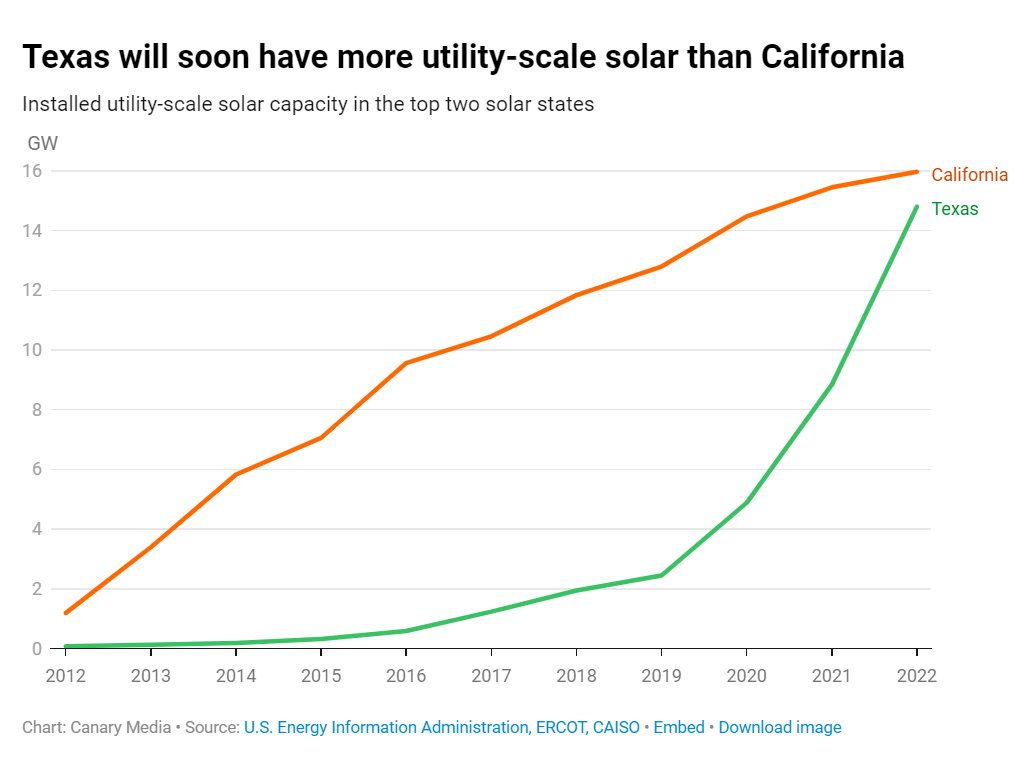
Texas v. California Solar: In the case of Texas v California for solar, the chart shows California on the brink of losing its spot as the U.S. leader in utility-scale solar — and to Texas. Since this chart was made in February 2022, the Lone Star State has officially surpassed California. Our friend and Texas Media energy expert Russell Gold writes on X that TX has consolidated all the heavyweight energy belts: (sun, wind, gas & oil.) He adds in 2024, they’ll “defend the title against George Foreman.”
IN THE NEWS
Oil, Gas Hitting Record Levels – As climate Change messages continue to ring loudly around the world (especially after the COP meeting in December), the surprising reality is the United States is pumping oil at a blistering pace and is on track to produce more oil than any country has in history. This runs counter to the Administration’s support for enviro calls to eliminate oil production. EIA says the United States is set to produce a global record of 13.3 million barrels per day of crude and condensate during the fourth quarter of this year. That’s just above the Donald Trump-era record of 13.1 million set in early 2020 just before the Covid-19 crisis sent output and prices crashing.
Hydrogen Tax Credit Favors Enviros – The Friday before Christmas, the Biden administration released its highly-anticipated proposal for doling out billions of dollars in tax credits to hydrogen producers which may in the end undercut in a massive effort to build out an industry that some hope can be a cleaner alternative to fossil fueled power. The proposal, part of Inflation Reduction Act passed last year, outlines a tiered system to determine which hydrogen producers get the most credits, with cleaner energy projects receiving more, and smaller, but still meaningful credits going to those that use fossil fuel to produce hydrogen. One contentious issue in the proposal was how to deal with the fact that clean, electrolyzer hydrogen draws tremendous amounts of electricity. Few want that to mean that more coal or natural gas-fired power plants run extra hours. The guidance addresses this by calling for producers to document their electricity usage through “energy attribute certificates” — which will help determine the credits they qualify for.
Marty Durbin, head of the U.S. Chamber of Commerce’s Global Energy Institute said:
“This guidance will stunt the growth of a critical industry before it has even begun” and his organization plans to advocate during the public comment process “for the flexibility needed to kickstart investment, create jobs and economic growth, and meet our decarbonization goals.”
The American Petroleum Institute said in a statement that “hydrogen of all types” is needed and urged the administration to foster more flexibility for hydrogen expansion, not less.
The Fuel Cell & Hydrogen Energy Association includes more than 100 members involved in hydrogen production, distribution and use, including vehicle manufacturers, industrial gas companies, renewable developers and nuclear plant operators. Frank Wolak said it’s important the industry be given time to meet any provisions that are required for the top tier of the credit.
“What we can’t have is an industry that is stalled because we have imposed requirements that the marketplace is not ready to fulfill,” Wolak said, particularly with the time it takes to bring new renewable resources online. If the guidance is too restrictive, he said, “you’ll see a much smaller, if not negligible growth in this industry and a failed opportunity to capitalize on the IRA.”
Gulf Lease Sale Attracts Strong Interest – The Bureau of Ocean Energy Management's recent auction of drilling rights to some 73 million acres in the US Gulf of Mexico generated more than $382.2 million in winning bids from 26 offshore oil operators, the highest total since 2015. Despite calling the auction "a positive step," American Petroleum Institute Vice President of Upstream Policy Holly Hopkins urged the administration to rethink its "shortsighted" energy strategy, pointing to the absence of scheduled offshore sales in 2024.
“From issuing the weakest 5-year program for offshore leasing in U.S. history to repeatedly delaying congressionally-mandated lease sales, the Department of the Interior continues to demonstrate its willingness to ignore the clear and growing need to expand American energy leadership and reduce reliance on foreign energy sources. Beyond the sale that was postponed today, there will be no offshore sales until 2025 – the longest gap in offshore sales since 1966. The U.S. oil and natural gas industry stands ready to support the nation's energy security through reliable, lower carbon-intensive energy produced here in the U.S. Gulf of Mexico, but the Interior Department’s inconsistent policies undermine the certainty needed to invest in future production.”
In September, the Biden administration issued a final 5-year program for federal offshore leasing that included 3 offshore lease sales over the next 5 years, the lowest number of lease sales in the history of the program. Lease Sale 261 is the final offshore lease sale mandated by the Inflation Reduction Act and is the only offshore sale scheduled to take place until 2025. According to the U.S. EIA, Gulf of Mexico federal offshore oil production accounts for 15% of total U.S. crude oil production and federal offshore natural gas production in the Gulf accounts for 5% of total U.S. dry production. The U.S. Gulf of Mexico produces some of the lowest carbon intensity barrels in the world. Constrained production in this basin could be replaced by higher carbon intensity barrels from elsewhere in the world. In addition to today's news, NOAA recently denied the petition for rulemaking to impose speed limits on all vessels operating in the Rice's whale core habitat area in the Gulf of Mexico. NOAA concluded that there were a series of actions needed, including conservation tasks, drafting a species recovery plan, and conducting a quantitative vessel risk assessment before NOAA would even consider a rulemaking on the vessel restrictions. Interior conducted none of these actions in their attempt to target oil and gas vessels through placing vessel restrictions as lease stipulations in Lease Sale 261, as well as issuing a Notice to Lessees recommending various restrictions on oil and gas vessels.
EPA Gives Permit Authority to Louisiana on CCS – EPA has formally granted Louisiana state primacy in the permitting and regulation of wells and projects involving the underground sequestration of carbon dioxide (CO2). The move promises to accelerate the permitting and construction of wells to store carbon dioxide captured from oil refineries, ethanol plants and other industrial facilities, after expanded subsidies in last year’s climate law supercharged interest in the activity. Carbon capture advocates have sounded the alarm about a growing backlog of carbon dioxide injection well applications, with 172 now pending before the EPA. LA Gov John Bel Edwards:
“Finding alternative means of harnessing our traditional fuel sources at the same time we expand our options for alternative fuel sources to the point they are market-ready, available and affordable is probably the great challenge of our generation and some of the most important work we can do for future generations. While CO2 sequestration is not the only strategy available for carbon management, it is the most mature and market-ready tool available in the near term.”
API President and CEO Mike Sommers:
“We commend EPA for granting Louisiana the ability to advance carbon capture projects that are critical for reducing emissions, boosting local economies and strengthening U.S. energy leadership. Louisiana plays a critical role in developing, refining and transporting America’s abundant energy resources, and the state’s commitment to engaging local communities and protecting the environment make it best positioned to accelerate this innovative technology. This is an important step toward a lower-carbon, more energy-secure future.”
COP 28 Round up – Our friends at POLITICO summed up the COP 28 meeting in Dubai:
- The United Nations climate talks ended with an agreement by nearly 200 nations to transition away from fossil fuels — the first-ever call to ditch the primary driver of climate change. But the deal fell short of the “phaseout” of fossil fuels some countries were calling for.
- Finalizing the framework for a fund paying developing countries for irreversible climate loss and damage on the first day got negotiations off to a good start. But rich countries’ unwillingness to commit more money to help developing nations transition to cleaner energy sources undermined more aggressive calls to end reliance on fossil fuels.
- COP28 President Sultan al-Jaber faced more heat than a Dubai summer entering the talks over his primary job as the head of the United Arab Emirates’ national oil company. Even as the COP28 team said during the talks that “phaseout” language was infeasible, he still shepherded a result that earned praise from many corners.
- The countries secured a robust “global stocktake” at COP28 that kept the Paris climate agreement's emissions reduction goals within reach, but the next two years of talks will show just how serious they are about solving climate change.
ON THE SCHEDULE THIS WEEK
Federal Society Conference Sets Agenda for 2024 – The Federalist Society for Law and Public Policy Studies holds its 25th annual Federalist Society Faculty Conference on Thursday and Friday. The conference takes place under the general aegis of the AALS Annual Meeting, with our events and speakers cross-listed in the AALS Annual Meeting Program. Panels and meals are to be held in the Westin Washington DC Downtown. The event features a luncheon panel on the role of markets in an era of climate change and grid reliability challenges on Friday at 12:30 p.m. Speakers include NRG’s Travis Kavulla, (also a lecturer at the University of Chicago Law School), SMU Dedman School of Law Professor James Coleman and Harvard Law Schools lecturer Director of the Electricity Law Initiative Ari Peskoe.
IN THE FUTURE
Transportation Conference Set – The National Academies hosts the Transportation Research Board’s (TRB) Annual Meeting starting next Monday to Thursday. TRB’s Annual Meeting attracts thousands of transportation professionals from around the world. The program covers all transportation modes, with sessions and workshops addressing topics of interest to policy makers, administrators, practitioners, researchers, and representatives of government, industry and academic institutions.
State of American Energy Event Set – The American Petroleum Institute holds its annual State of American Energy Forum on Wednesday January 10th at Capital Turnaround. API’s Mike Sommers will discuss the state of the industry and the event will also feature panels with experts and Congressional Leaders.
State of American Business Set – The US Chamber of Commerce holds its annual State of American Business Address on Thursday January 11th at 11:00 a.m. Chamber President/CEO Suzanne P. Clark will celebrate the power of American businesses discussing the innovation and impact of America’s free enterprise system that enables businesses to serve customers, solve problems, and strengthen society.
Forum Looks at Climate, AI – On Tuesday January 17th, the Center on Global Energy Policy at Columbia University’s School of International and Public Affairs holds a discussion of how artificial intelligence (AI) can help reduce greenhouse gas emissions. David Sandalow, lead author of the Artificial Intelligence for Climate Change Mitigation Roadmap, which was released earlier this month, will explore that topic along with seven of the report’s co-authors. The Artificial Intelligence for Climate Change Mitigation Roadmap is the 12th roadmap released as part of the ICEF Innovation Roadmap Project. Information on previous roadmaps can be found in this booklet.
Washington Auto “Public Policy Show” Set – The Washington, D.C. Auto Show public policy day will be held on Wednesday January 18th at Noon. The policy day advances the show’s 10-day consumer event which runs to January 29th. The policy day is an exclusive look at the people and policies shaping the U.S. auto industry. Geared toward automotive industry leaders, government officials, and esteemed media contacts, this event encompasses special announcements, fireside chats, and panel discussions focusing on the current state of the country’s essential automotive sector and its future initiatives.
USEA Holds State of Energy – USEA holds its 20th Annual State of the Energy Industry Forum from Noon to 4:00 p.m. on January 23, 2024 at the National Press Club. The forum brings together CEOs from Washington’s leading energy trade associations where they outline their policy objectives and priorities for the upcoming year.