
Energy Update: Week of Jan 20
Energy Update - January 20, 2025

Friends,
First off, let me thank all of you for your birthday wishes late last week for my making another trip around the sun. I am so grateful for all of you and your kindness. And it is not only is there a change of power in the White House today, but also at POLITICO’s Morning Energy where James Bikales hands over the reins to Catherine Morehouse. Congrats to both Catherine and James and JB, I am proud to score the ME trivia win on your last day!!!!
Welcome to MLK Day which also happens to be Inauguration Day… Whether you like it or not, here with go with Trump Part II. At it is starting with a bang. Yesterday, Trump Advisor Stephen Miller offered details to House and Senate GOP leadership about executive orders the incoming administration plans to issue in coming days in three buckets: immigration, energy policy and overhauling federal government operations. While not going into massive detail, Punchbowl reported there are still a lot of moving parts.
As you can imagine, I always start with energy although I suspect this is probably #3 on the President Agenda behind immigration and government reform. Miller said expect energy orders to halt spending on the “Green New Deal” (even though there isn’t one) and other climate-related IRA priorities from the Biden administration; speed construction of pipelines; deal with energy permitting, push to repeal the LNG pause and get projects moving; turnback President Biden’s offshore ban and open up offshore drilling; attempt to limit offshore wind; repeal rules on electric vehicles; open the ANWR and other key area in Alaska. Finally, in his Second Inaugural address, Trump said he would declare a national emergency related to energy, but it remains unclear what exactly that means. Bracewell’s Scott Segal addresses the emergency declaration below.
So, whether it happens today, tomorrow or later in the week, we will be ready to address your questions on energy, provide good resources, statements and background. Also, we expect some Senate action on energy nominees with votes expected as early as Thursday. Last week, EPA nominee Lee Zeldin, DOE nom Chris Wright and Interior appointee Doug Burgum all cruised trough hearings last week with only minor policy questions/challenges. Of course, we had a few clow…I mean, protesters that interrupted the hearings and were arrested. But overall, the hearing were cordial, substantive and fair, and I expect all will be approved with some Democratic votes. Also, the House is expected to vote on the Fix our Forests Act this week (Rules Committee tomorrow at 4:00 pm).
One other important event this week on Thursday: The US Energy Assn holds its 21st annual State of the Energy Industry Forum from 10:30 a.m. to 5:00 p.m. at the National Press Club. The event features the heads of most trade associations heads to talk about their policy and technology agenda for the year.
I can’t leave this space without a requiem for my fellow Detroiters after watching the Lions get run over by rookie sensation Jayden Daniels and the revamped Washington Commanders over the weekend. The Commanders played a perfect offensive game and the Lions just made too many mistakes. There is always next year still, but I still remain a jaded, MI-native skeptic until they can put it together. We had this problem with the Pistons in the 80s and the Red Wings in the 90s, so maybe there is still hope. So, I continue to adopt my Trump policy strategy, I just still won’t be jumping in until I actually see the goods (in this case, the Vince Lombardi trophy going down Grand River Ave).
Ohio State-Notre Dame TONIGHT for the College Football National Championship!!!! Honestly, as a Midwesterner from Michigan, I don’t know who to root for. I want them both to lose and win and the same time…
We are tracking the energy movements so call with questions. Best,
Frank Maisano
(202) 828-5864
C. (202) 997-5932
FRANKLY SPOKEN
“In our time, President Trump’s energy dominance can be America’s ‘big stick’ that is leveraged to achieve historic prosperity and world peace yesterday. The Department of the Interior, in cooperation with U.S. Congress, this committee, and the states, will play a pivotal role in achieving the outcomes to make the world safer and America even better for our children, grandchildren, and generations to come.”
Doug Burgum, President-elect Donald Trump’s nominee to head the Department of the Interior, in his opening statement to lawmakers at his confirmation hearing.
ON THE PODCAST
LA Times Climate Podcast Debuts – Our friend Sammy Roth of the Los Angeles Times has a new climate podcast every Thursday that dives deep with scientists, energy leaders, legislators, activists and journalists who are experts on today's climate challenges and solutions. They’ll discuss the everything from electric cars to renewable energy to the difficulties of phasing out fossil fuels. This week, Sammy is joined by Kelly Sanders, an engineering professor at USC and former White House advisor on energy policy. They talk about what the fires mean for the future of Los Angeles, and how the city might adapt as the planet heats up and the climate crisis worsens.
FUN OPINIONS
Burgum is ‘Get it Done’ Guy – In an op-ed in the Washington Reporter, North Dakota Rep. Julie Fedorchak writes new Interior Secretary appointee and Energy Council Chair Doug Burgum is the “Get It Done Guy” for U.S. energy dominance. As demand for energy reaches record-highs, America needs a level-headed, experienced businessman at the helm — someone who can partner with President Trump to invest in an all-of-the-above energy strategy. This means giving room for renewables to grow while also unlocking the full potential of domestic energy production. Doing so will help reduce America’s debt, lower energy prices for hardworking families, reduce global emissions, and bolster national security.
FROG BLOG
DOE’s Wright on a Mission to Stop Energy Poverty – In a blog past in RealClearEnergy, PERC CEO Brian Yablonski writes DOE Nominee Chris Wright is on a mission to improve lives through energy. Chris Wright is a thought leader in the energy industry known for his genuine, down-to-earth approachability coupled with an infectious enthusiasm to improve human lives. He would be the first to say that improving human lives means responsibly stewarding our land, water, and wildlife. Chris deeply believes a healthy environment is also part of the improved human condition.
FUN FACTS
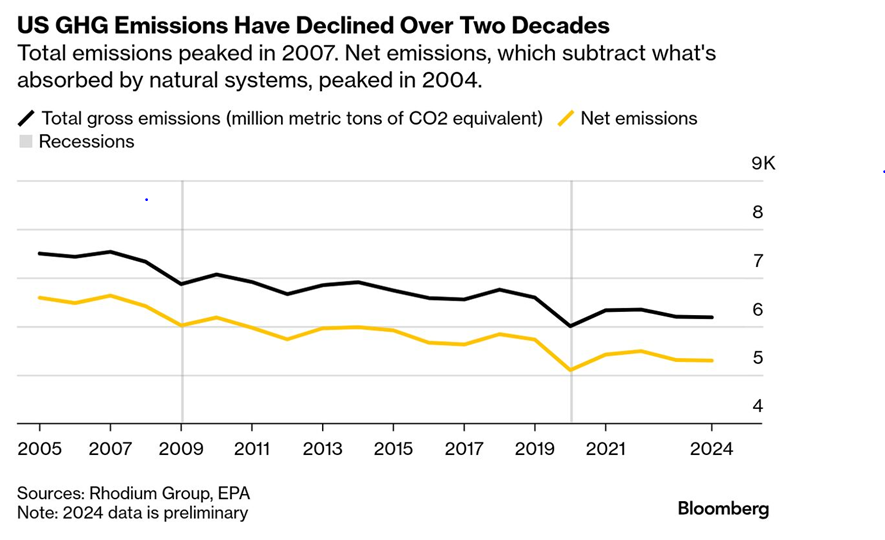
US Emissions Continue to Decline: Total gross US emissions peaked in 2007 and have been largely declining ever since according to Rhodium Group Charts. It is important to note that two years in particular standout — 2009 and 2020 which were marked by economic recessions. These dips show how energy and economic growth are so intimately intertwined.
IN THE NEWS
Trump EOs will Cover Energy – President-elect Donald Trump is expected to quickly implement executive actions on immigration, energy policy and federal government operations to check off dozens of campaign policy priorities. Yesterday, Trump advisors pledged to issue “close to 100” executive orders on his first day in office.
Here are the bullets from the Administration’s Day One Action related to Energy:
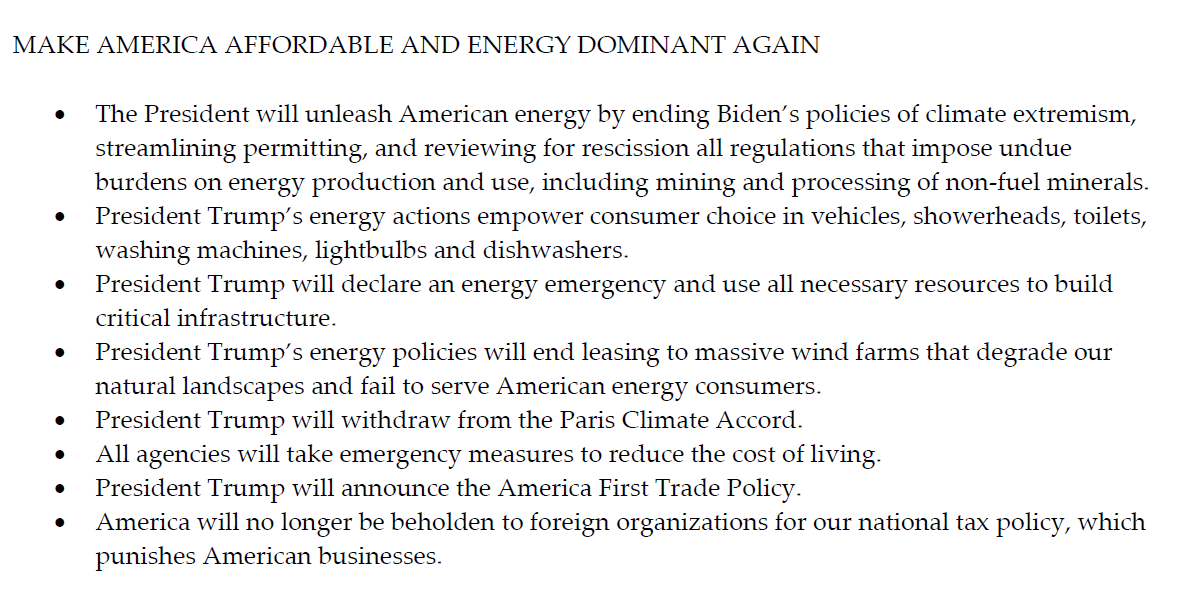
National Energy Emergency – One of the items Trump has talked about is a national emergency energy. My Bracewell colleague Scott Segal said President Carter used the declaration of an energy emergency as a means to address the substantial energy challenges in his Administration, including the after-effects of the 1973 oil embargo and the 1979 oil shock. These crises underscored the United States’ dependence on foreign oil and the need to enhance domestic energy production and conservation. As you will recall, Carter framed the energy crisis as “the moral equivalent of war.” By contrast, under today’s circumstances, we have relative energy abundance if we can maintain it. And while the energy system is more efficient today, electricity consumption is likely to increase due to artificial intelligence, crypto currency and manufacturing on-shoring. A couple of questions Segal poses and answers:
Why did Carter use this emergency authority? First, to encourage conservation and efficiency. The Carter declaration allowed his Administration to promote energy conservation through measures like encouraging fuel-efficient vehicles, better home insulation, and reduced energy consumption in businesses and homes. It also provided a basis to advance renewable energy sources but also to allow for increased use of coal and nuclear power. Mostly though, Carter used emergency authority to mitigate immediate shortages by implementing gasoline rationing and allocation schemes among various regions of the U.S.
What can the Trump Administration learn from the Carter Administration in terms of advancing regulatory reform? The Carter Administration did use emergency authority to expedite energy projects by compelling regulatory relief in certain cases. While not per se reliant on declared emergency authority, Carter at the same time pushed for adoption of the Natural Gas Policy Act of 1978, which deregulated natural gas prices to incentivize increased production. The act itself contained emergency authority to address critical supply shortages in the natural gas market. Emergency provisions were sometimes also invoked to streamline permitting processes for energy projects, including power plants, pipelines, and coal facilities. The context of the emergency also allowed the Carter Administration to accelerate the development of the SPR as a buffer against future energy disruptions.
Bottom line: the Carter Administration tried to strike a balance between using emergency powers to address immediate crises and maintaining long-term environmental and regulatory standards. While regulatory relief was occasionally used to expedite critical projects, Carter’s broader strategy emphasized transitioning to a more sustainable and independent energy system, rather than relying solely on emergency measures. So, emergency authority was deployed by to diversify the portfolio of energy sources, whereas the Trump Administration may be more narrowly focus on just increasing fossil fuel production.
China Coal Investment Continues – China Energy Investment Corp., the country’s biggest power producer, hit record coal output last year while also achieving its renewable buildout target ahead of schedule. China's mostly coal-powered thermal generation ticked up 1.5% in 2024, official data showed on Friday, defying expectations that coal generation was peaking. The data highlighted the challenges in phasing out coal-fired power while supplying China's energy-hungry industries and advancing the electrification of its economy.
API, States Move to Block Biden Last-Minute Drilling Ban – API joined with the states of Alabama, Alaska, Georgia, Louisiana and Mississippi in filing a challenge to the Biden administration’s ban on new oil and natural gas leasing across millions of acres of federal waters.
“Today we’re taking action to reverse this politically motivated decision and ensure our nation’s vast offshore resources remain a critical source of affordable energy, government revenue and stability around the world,” API Senior Vice President and General Counsel Ryan Meyers said. “As we move forward with a legal challenge, we continue to urge Congress and the incoming administration to use every tool at their disposal to restore a pro-American energy approach to federal leasing.”
According to EIA, U.S. offshore production accounts for 14% of total U.S. crude oil production, or nearly 2 million barrels of oil per day. Robust offshore oil and natural gas development could generate over $8 billion in additional government revenue by 2040. America’s offshore resources are not only significant for our energy security, but also generate among the lowest carbon-intensive barrels produced anywhere in the world. Reversing this politically-motivated decision should be a top priority for the Congress. API has also urged the incoming administration to draft a new 5-year offshore leasing program, changing course from the weakest offshore program in history under the Biden administration
ON THE SCHEDULE THIS WEEK
Presidential Inauguration Set – The 60th Presidential Inauguration will be held today. The ceremony was moved inside to the rotunda because of weather.
World Economic Forum Set – The World Economic Forum will be held in Davos this week starting today. There will be numerous events there including programming form Semafor and Axios.
Brookings Talks Climate Mitigation – On Wednesday at 10:00 a.m., the Governance Studies at Brookings hold a conversation on domestic climate migration in the United States. Experts will explore how U.S. communities are vulnerable to climate change, what steps are being taken at a federal, state and local level to prepare localities to adapt to climate risks and what preparations for climate change be structured to help address longstanding inequities of wealth, health and opportunity. Our friend, Abrahm Lustgarten is on the panel.
CSIS checks Japan Economic Outlook – The Center for Strategic and International Studies holds a discussion on Wednesday at 4:00 p.m. looking at Japan’s Energy Outlook for 2025. The event features a conversation with Ken Koyama, Chief Economist and Senior Managing Director of the Institute of Energy Economics, Japan (IEEJ). Dr. Koyama will present highlights from the IEEJ Outlook 2025, which provides global energy supply and demand projections to 2050. The IEEJ's work seeks to address challenges for the simultaneous achievement of energy security and decarbonization. Following the presentation, Dr. Koyama will join our friends Ruth Liao (LNG Reporter, Bloomberg News) and Dustin Meyer (Senior Vice President of Policy, Economics and Regulatory Affairs, API) for a panel discussion on the key takeaways of the outlook.
Forum Look sat US-China Climate Talks – The Wilson Center holds a discussion on Thursday at 10:00 a.m. on US-China climate relations. At this meeting, speakers will weigh in on what’s next for US-China climate relations. Joanna Lewis (Georgetown University) and Cecilia Springer (Boston University Global China Initiative) will explore the potential opportunities that exist for the United States and China cooperation or coordination in the climate space. Kate Logan (Asia Society Policy Institute) will discuss China’s growing climate finance to the Global South, how it differs from financing from developed countries, and what this may mean for US-China climate relations.
USEA to Host State of Energy Industry – The US Energy Assn holds its 21st annual State of the Energy Industry Forum on Thursday from 10:30 a.m. to 5:00 p.m. at the National Press Club.
IN THE FUTURE
Climate Policy Forum Set – EESI’s first Climate Camp briefing will be held on Wednesday January 29th at 2:00 p.m. in 2168 Rayburn and serve as an interactive refresher on the drivers of climate change and the latest deployable solutions to address the challenge. The briefing will cover climate concepts and terminology—from types of greenhouse gases to renewable energy technologies—to help you identify policy solutions at the intersection of these issue areas. At this briefing, panelists will showcase tools—like the EN-ROADS simulator, co-developed by MIT Sloan and Climate Interactive—that staff can use to easily digest climate data and generate policy ideas. They will also highlight federal agency resources essential to understanding the climate challenge and innovative solutions to address it.
Washington Auto Policy Day, Show Set – The Washington Auto Show will be held from January 31st to February 9th at the Washington Convention Center. The Washington, D.C. Auto Show is renowned as the nation’s premier “Public Policy Show,” offering a one-of-a-kind opportunity to connect with the key figures driving the future of the automotive industry. This 10-day consumer event kicks off with an exclusive gathering of automotive leaders, government officials, and media representatives, where they come together to discuss the current state of the U.S. auto sector and its future initiatives. This year, speakers include Presidential advisors Ali Zaidi and Alex Jacquez, DOE’s David Turk, DOT’s Polly Trottenberg, Joint Office of Energy and Transportation Gabe Klein, and a Congressional panel with Reps. Debbie Dingell, Mike Kelly, Marcy Kaptur, Bob Latta and Roger Williams.
BNEF Summit Set for SF – The annual Bloomberg New Energy Finance San Francisco Summit is set for February 4th and 5th at The St. Regis Hotel. The BNEF Summit provides the ideas, insights and connections to formulate successful strategies, capitalize on technological change and shape a cleaner, more competitive future. Tom Steyer is among the Keynote Speakers.