
Energy Update: Week of Jan. 13
Energy Update - January 13, 2025

Friends,
First off, our thoughts are with our friends and families, as well as all the communities impacted by the wildfires in Southern California. Some areas are completely devastated, others impacted and some areas, nothing at all. I was chatting with hydrogen trade association folks in Long Beach this morning where they are hosting their annual hydrogen symposium and the air quality in Long Beach is great and it is sunny and perfect. Yet, just 25 miles or so away, parts of Malibu and Palisades are decimated. Some good news: better weather has allowed fire crews to get on top of some areas and utilities like SoCal Gas are already starting to restore some gas service (which is an arduous process). Some bad news: high winds, which are among the most significant drivers of the fires, are expected to return tomorrow.
This will be a super busy week in Congress with the Trump energy/environment team heading to the Senate for confirmation hearings. Of course, after hitting send on the e-mail version of this update, we received news that Gov. Doug Burgum’s hearing to be Interior Secretary — originally set for tomorrow — has been delayed to Thursday. Still on Wednesday, the Chris Wright DOE hearing will be in Senate Energy and Thursday the Zeldin EPA hearing in Senate Environment.I discussed this on Sirius XM P.O.T.U.S.’s Julie Mason Show on Friday. Check it out HERE.
Other action includes a House Ways/Means tax hearing (which is certain to discuss EV tax credits and other IRA programs) and FERC’s first 2025 Open Meeting on Thursday, where people will be watching current Chair Willie Phillips closely.
Other key events this week include this morning’s Atlantic Council event with Dan Yergin (which you can see HERE), API’s State of Energy tomorrow morning, the Chamber’s State of American Business forum release on Thursday and SAFE’s Center for Critical Minerals Strategy releases a new report in a Thursday webinar that explores the complex landscape of critical minerals project financing—and the gaps between the mining industry’s challenges and current public funding mechanisms to secure future mineral supplies.
Finally, As I mentioned earlier, the Fuel Cell& Hydrogen Energy Assn is holding its hydrogen summit in Long Beach after the recent 45V tax guidance rules were announced and the US Conference of Mayors is in DC Thursday through Sunday for its 93rd Winter Meetings, which has a number of energy and climate discussions. Detroit Mayor Mike Duggan leads a discussion on economics, while Columbia MO Mayor Barbara Buffaloe leads the environmental discussion and Columbia SC Mayor Dan Rickenmann leads the Clean Energy Tax credits discussion. Mayor Buffaloe and Phoenix Mayor Kate Gallego also lead a climate discussion on Saturday.
Call with questions. Best,
Frank Maisano
(202) 828-5864
C. (202) 997-5932
FRANKLY SPOKEN
““It really is a perfect storm for natural gas — rising demand, rising power prices, and increased risk around traditional renewables. It’s really easy to see why people are pivoting to natural gas in this climate.”
Scott Wilmot, an energy analyst at Enverus, discussing natural gas with Utility Dive.
ON THE PODCAST
Unregulated Highlights Trump 2025 Actions – In this episode of The Unregulated Podcast, Tom Pyle and Mike McKenna discuss the first big stories of 2025 and outline Trump’s first moves as inauguration day creeps closer.
2024 Temperature Look back with Bloomberg Green Reporters – In December, Europe’s Copernicus weather service announced that it was “virtually certain” that 2024 would be the hottest year ever. What’s more, the global average temperature last year appears to have surpassed 1.5C for the first time, blowing past a threshold that’s taken on enormous significance in the fight against climate change. Does that mean governments, corporations, and activists recalibrate their climate goals? Bloomberg Zero Podcast host Akshat Rathi speaks with our friends Eric Roston and Zahra Hirji of Bloomberg Green about what this new reality means.
FUN OPINIONS
Europe Energy Situation is a Crisis– In an essay in Foreign Policy, Columbia Center on Global Energy Policy founding director and former Obama NSC official Jason Bordoff writes Europe’s energy situation this winter offers a stark reminder that its energy crisis, caused by Russia’s cessation of most gas pipeline exports, is far from over. In the last two weeks of 2024, European gas prices surged to levels roughly twice what they were in February. If the Trump administration wants to use LNG exports to bolster the United States’ energy dominance, it should refrain from politicizing energy exports and strengthen efforts to reduce the carbon footprint of U.S. gas production as more countries, particularly in Europe, scrutinize that impact. Additionally, in today’s era of rising domestic electricity demand, the Trump administration should ensure energy prices stay low for U.S. firms and households—a key element of the country’s competitive advantage—by making it easier to build new infrastructure through permitting reform and supporting the rapid expansion of a diverse mix of energy sources that include not only oil and gas, but also renewables and nuclear power.
FROG BLOG
Informative Blog Post on LA Fires – In an interesting, thoughtful Substack/City Journal Blog post, Breakthrough Institute climate scientist Patrick Brown offers some real insight on the causes and potential solutions to the LA wildfire disaster. Many are looking for a clear culprit to blame for this disaster, with climate change being one of the most popular. The fires, however, are the result of both natural and human factors. Climate change may have played a role, but other, more direct causes warrant our attention. Devastating events prompt people to search for villains, but reality is more complicated. Climate change may be making fires more dangerous, but it isn’t meaningfully affecting California’s high winds and drought. In any case, the effects of global emissions reductions on fire activity are indirect and will not be realized in the short term.
FUN FACTS
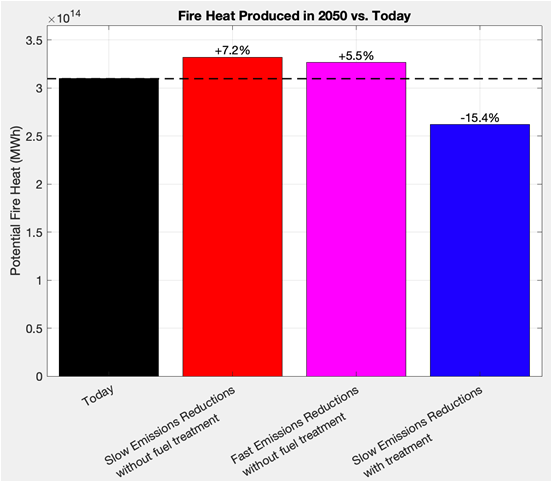
Fire Suppression, Emissions reduction can work together: How effective would proactive vegetation reduction be in the face of continued warming? Breakthrough Institute research looks at conditions over the course of a fire, warms the background climate, and simulates vegetation reduction to see how future warming and fuel treatments would simultaneously affect a fire. Below is what this looks like when applied to the weather in the Los Angeles area this week.
IN THE NEWS
Treasury Releases 45Z Guidance – The Treasury Department and the Internal Revenue Service on Friday released are long-awaited guidance on what fuels and production methodologies are eligible for the Clean Fuels Production Credit (Section 45Z). Ethanol and corn groups said they were pleased that the Biden administration released the guidance before leaving office, but said it is late and incomplete and leaves final decisions up to the Trump administration. The soybean industry said it was pleased that the guidance restricts the importation of used cooking oil. “Section 45Z provides a tax credit for the production of transportation fuels with lifecycle greenhouse gas (GHG) emissions below certain levels,” Treasury noted. “The credit is in effect in 2025 and is for sustainable aviation fuel (SAF) and non-SAF transportation fuels.” Renewable Fuels Association President and CEO Geoff Cooper, said the guidance is a potential step in the right direction, but much work remains to be done before clean fuel producers, farmers and consumers can fully benefit from the 45Z program.
“Unfortunately, today’s guidance does not provide the certainty or flexibility that ethanol producers were looking for, and many questions remain unanswered,” Cooper said. “We do not believe this guidance alone will spur the investment, innovation, and job creation in the clean fuels sector that Congress and the administration intended. It simply isn’t bankable, investible, or otherwise actionable for the vast majority of biofuel producers.”
Agencies Deputies Named – Also on Friday, President Trump nominated the deputies for Interior, EPA and Energy. Katharine MacGregor, David Fotouhi and James Danly for the deputy slots at the Interior Department, Environmental Protection Agency and Energy Department, respectively. He also named Steven Gill Bradbury for deputy transportation secretary. He was the agency's general counsel during Trump's first go-round.
RFF Report Says GHG Rules Would do a Little Better – In 2024, the US Environmental Protection Agency finalized regulations that limit greenhouse gas emissions from coal-fired power plants and new natural gas–fired power plants. These regulations could reduce emissions from the US power sector by 73 to 86 percent below 2005 levels by 2040, according to a new article in the journal Science that reviews modeling of emissions reductions done by RFF and partner institutions. While emissions are projected to decrease by 60 to 83 percent without the regulations, the regulations increase the probability that emissions will decrease more steeply. “The rules could have the largest impacts on reducing installed coal capacity and generation, which historically have been the largest source of power-sector carbon dioxide and conventional air pollutants,” write the authors of the article.
AHRI Urges Confirmation of Wright, Zeldin – As Senate hearings get underway to evaluate the nomination of Chris Wright to lead the DOE and Rep. Lee Zeldin to head EPA, the Air-Conditioning, Heating, and Refrigeration Institute (AHRI) urged their nomination’s approval by the Senate Energy and Senate Environment Committees, followed by swift approval by the full United States Senate. While AHRI has a good working relationship with DOE, the past several years have been challenging for manufacturers, which have had to contend with a large number of increasingly stringent energy efficiency standards for the products and equipment they make. Wright’s reputation as a thoughtful American energy advocate and the likelihood that DOE, under his leadership, will promulgate Congressionally mandated efficiency standards that meet the law’s requirement to not only be technically feasible but economically justified, ensuring consumer access to affordable lifesaving heating, air-conditioning, refrigeration, and water heating products.
“The current regulatory process is more than 40 years old and is overdue for significant reform. We welcome Chris Wright’s nomination and look forward to working with him and his team on sound regulatory policy and other issues of vital importance to our industry,” said AHRI President and CEO Stephen Yurek.
Zeldin is expected to oversee one of our industry’s top policy priorities – the refrigerant transition
“The importance of a seamless and timely transition to the next generation of refrigerants cannot be overstated. It is vital for manufacturers and consumers alike, so we welcome Rep. Zeldin’s nomination and we look forward to working with him and his team not only on the refrigerant transition, but also on other issues of vital importance to our industry.”
ON THE SCHEDULE THIS WEEK
Yergin to Headline Event on World Energy – This morning at 10:00 a.m., the Atlantic Council’s Global Energy Center hosted Daniel Yergin, vice chairman of S&P Global and a Pulitzer Prize-winning author, in a discussion on the key drivers shaping the future energy system and what they mean for the world energy outlook. In this conversation, Yergin discussed the dynamic year ahead for the global energy landscape and discuss what enduring lessons can be learned from his book The Prize.
Forum Looks at US, China Energy Relations – Today at 11:30 a.m., the John L. Thornton China Center at Brookings will host a high-level discussion on the evolving dynamics of U.S.-China relations on climate change and green technology. Panelists will share key insights and policy recommendations from their recent research, addressing critical topics such as U.S.-China export bans on vital minerals and technologies, investments in clean energy and innovation, and decisions from policymakers in Washington and Beijing to secure global leadership in the emerging green economy. Former WSJ reporter and Stanford Doerr School of Sustainability editor Jeff Ball, as well as Brookings experts David Edelman and Samantha Gross are panelists.
CAP to Look at State Decarb Efforts – The Center for American Progress holds a virtual discussion today at 1:30 p.m., on state policy efforts to decarbonize the production of construction materials and lessons learned from policy implementation. CAP’s recent report, State Efforts To Decarbonize Key Industrial Sectors, analyzes these states’ actions so far and provides policy recommendations moving forward.
API Holds State of Energy – The American Petroleum Institute's State of American Energy will be held tomorrow morning at The CAPITAL TURNAROUND. It is the annual kick-off event for the industry’s policy agenda.
Forum Looks at Climate Finance – Tomorrow at 9:00 a.m., the Global Energy Center will host a forward-looking conversation on the critical role of financial guarantees in scaling private investment in emerging markets and developing economies (EMDEs) in 2025 and beyond. This session will consider the future of using guarantees for climate investing in 2025 and beyond, including how they may be deployed without an EMDE guarantee, the impacts that COP29 outcomes and new US leadership may have on climate finance flows, and updates on our Emerging Market Climate Investment Compact (EMCIC) project.
Senate Energy Hosts Burgum – The Senate Energy Committee hosts a conformation hearing for Interior Secretary nominee Doug Burgum tomorrow at 10:00 a.m.
House Tax Writers Open Discussion on Trump Tax Law – The House Ways and Means Committee holds a hearing tomorrow at 10:00 a.m. on the desire to make the 2017 Trump tax package permanent. While not totally in our wheelhouse, this will be interesting to see how the IRA clean Energy tax provisions are mentioned.
Hydrogen Group Holds Annual Meeting in Long Beach – The 2025 Hydrogen & Fuel Cell Seminar is being held tomorrow to Thursday at the Long Beach Convention Center in Long Beach, California. The Seminar combines high-level plenary and keynote talks, technical and commercial breakout sessions covering the top hydrogen and fuel cell applications and research areas. Here is the full list of speakers.
Semafor Hosts Hern for Small Biz Discussion – Semafor will host a forum tomorrow at 9:00 a.m. featuring Rep. Kevin Hern, co-chair of the bipartisan Congressional Small Business Caucus, and Trump campaign economic adviser Stephen Moore. They will discuss what's ahead for U.S. small businesses as President-elect Trump and Congressional Republicans eye tax cuts, regulatory reform and more.
Senate Energy Hosts Wright – The Senate Energy Committee hosts a confirmation hearing for Energy Secretary nominee Christopher Wright Wednesday at 10:00 a.m.
USEA Looks at 2025 Utility Challenges – The US Energy Association holds a virtual press briefing on Wednesday at 11:00 a.m. on the rough road ahead for electric utilities in 2025. This promises to be a year when the utilities will be stressed as never before with rising demand, worsening weather, and no quick fixes. It will be yet another year for utilities to tighten their seatbelts and make do with what they have. Speakers include NERC CEO Jim Robb, Cal ISO CEO Elliot Mainzer, President and CEO, Tri-State Gen CEO Duane Highley, Karen Wayland of the GridWise Alliance, Midwest ISO’s Ted Vatnsdal and Portland GE CEO Maria Pope.
Vought Heads to Senate Homeland Security – The Senate Homeland Security and Governmental Affairs Committee holds a hearing on Wednesday at 1:00 p.m. on the nomination of Russell Vought, whom Trump has picked to lead the Office of Management and Budget.
Forum Looks at Columbia River Basin – The Environmental and Energy Study Institute (EESI) holds a briefing on Wednesday at 2:00 p.m. about climate adaptation, resilience, and mitigation strategies in the Columbia River basin. This briefing will also discuss the outcomes of the Uncommon Dialogue, which brought together tribes, national and local government, the hydropower industry, and river conservation stakeholders to identify shared approaches to steward river health and safety while ensuring hydropower operations provide clean, affordable energy. Panelists will also discuss the role of federal investments in the Columbia River’s resilience and health, including Inflation Reduction Act and Infrastructure Investment and Jobs Act funding.
Chamber Preps for State of American Business – The US Chamber will hold its annual State of American Business forum on Thursday releasing a video of its 2025 agenda. At this year's State of American Business (SOAB), the U.S. Chamber underscores a similar truth—all business is local. This is the annual opportunity to hear directly from Chamber President/CEO Suzanne Clark and other business leaders about the most pressing issues impacting the American business community this year. The 2025 State of American Business address will be streamed live at https://www.uschamber.com/. The program will begin streaming on Thursday morning. Sign up to get the link delivered directly to your inbox when the program goes live.
Senate Environment Hosts Zeldin – The Senate Environment Committee hosts a confirmation hearing for EPA Administrator nominee Rep. Lee Zeldin Thursday at 10:00 a.m.
SAFE to Release New Critical Minerals Report – SAFE’s Center for Critical Minerals Strategy hosts a webinar and report release on Thursday at 11:00 a.m. The event will explore the complex landscape of critical minerals project financing—and the gaps between the mining industry’s challenges and current public funding mechanisms to secure future mineral supplies. Speakers will discuss the intersection of public financing, market distortions, and strategic partnerships in developing robust critical minerals projects. SAFE’s Center for Critical Minerals Strategy’s new report, "Resources for Resources: Funding Critical Minerals Supply Chains” examines how U.S. government policies and financing mechanisms can be strengthened to address this investment gap while continuing to drive a “race to the top” in global mineral supply chains.
Forum Looks at China Critical Minerals – The Institute for Policy Studies holds a discussion on Thursday at 2:00 p.m. looking at critical raw materials and the impact of U.S.-China competition. Washington and Beijing are competing for access to lithium, cobalt, nickel, and other valuable minerals. How will this dynamic change when Donald Trump takes office?
Wilson Forum Looks at China Rare Earth Policy – The Wilson Center's China Environment Forum holds a virtual discussion on Thursday at 2:00 p.m. on shifts in China's rare earths policy. The event features a conversation with Cory Combs (Trivium China) and Jessica DiCarlo (University of Utah) to explore how China is shaking up the governance of its domestic rare earth production in response to the global demand for clean energy technologies.
IN THE FUTURE
Presidential Inauguration Set – The 60th Presidential Inauguration will be held on Monday January 20th in Washington, D.C. The ceremony will be held on the west front of the U.S. Capitol.
World Economic Forum Set – The World Economic Forum will be held in Davos on January 20th to January 25th. There will be numerous events there including programming form Semafor and Axios.
USEA to Host State of Energy Industry – The US Energy Assn holds its 21st annual State of the Energy Industry Forum on January 23rd from 10:30 a.m. to 5:00 p.m. at the National Press Club.
Climate Policy Forum Set – EESI’s first Climate Camp briefing will be held on Wednesday January 29th at 2:00 p.m. in 2168 Rayburn and serve as an interactive refresher on the drivers of climate change and the latest deployable solutions to address the challenge. The briefing will cover climate concepts and terminology—from types of greenhouse gases to renewable energy technologies—to help you identify policy solutions at the intersection of these issue areas. At this briefing, panelists will showcase tools—like the EN-ROADS simulator, co-developed by MIT Sloan and Climate Interactive—that staff can use to easily digest climate data and generate policy ideas. They will also highlight federal agency resources essential to understanding the climate challenge and innovative solutions to address it.
Washington Auto Policy Day, Show Set – The Washington Auto Show will be held from January 31st to February 9th at the Washington Convention Center. The Washington, D.C. Auto Show is renowned as the nation’s premier “Public Policy Show,” offering a one-of-a-kind opportunity to connect with the key figures driving the future of the automotive industry. This 10-day consumer event kicks off with an exclusive gathering of automotive leaders, government officials, and media representatives, where they come together to discuss the current state of the U.S. auto sector and its future initiatives. This year, speakers include Presidential advisors Ali Zaidi and Alex Jacquez, DOE’s David Turk, DOT’s Polly Trottenberg, Joint Office of Energy and Transportation Gabe Klein, and a Congressional panel with Reps. Debbie Dingell, Mike Kelly, Marcy Kaptur, Bob Latta and Roger Williams.