
Energy Update: Week of February 3rd
Energy Update - February 03, 2025

Friends,
All hail Punxsutawney Phil, that furry but not-always-accurate groundhog, who was the center of attention yesterday before record-sized crowds at the annual Groundhog Day observance in Gobbler’s Knob, Pennsylvania. Phil saw his shadow which means six more weeks of winter on the way, although as USA Today researched, Phil isn’t always in the money.
The hits keep coming with the new Administration. On Saturday, President Trump dropped his 25% tariffs on Canada and Mexico (with the exception of 10% on Canadian energy) and 10% on China. I have a full work up below with timing, stats, details, background and resources, but my colleague Josh Zive is following closely and can be a great resource for you on tariff questions, background, context and impacts. Joshua C. Zive: joshua.zive@bracewell.com
This week, there is a hearing in the House Energy Committee on Wednesday on the Trump Energy agenda. On Thursday, a House Judiciary subpanel holds a hearing on California fires and the consequences of overregulation.
Other events around town include tomorrow an Atlantic Council discussion on U.S.-Canada Energy Cooperation (good timing) and ConservAmerica’s discussion with Trump environment whisperer Ed Russo. Then on Thursday, ConservAmerica explores the growing legal and policy debate over the federal government’s large landholdings, the Cato Institute holds a virtual forum on Thursday at 1:00 p.m. on exploring energy policy in the Trump Administration, featuring our friends Travis Fisher and WaPo’s Evan Halper and the Atlantic Council hosts IEA head Fatih Birol on the role of nuclear energy in the future.
Some exciting, big news this morning: leading Sustainable Aviation Fuel (SAF) producer Gevo completed its acquisition of Red Trail Energy ethanol in North Dakota, expanding its burgeoning portfolio of energy assets. Red Trail Energy, based in Richardton, ND has an ethanol production plant, carbon capture and sequestration assets and pore space.
Finally, kudos to our Bracewell Environmental, Lands and Resources (ELR) colleagues who were named one of Law360’s 2024 Environmental Practice Groups of the Year. The annual award program recognizes the lawyer teams behind the litigation wins and significant matters that resonated throughout the legal industry in 2024.
I am in Cabo de San Jose this week (but working some) and am hoping Mexico allows me out of the country. I may have to stay here!!! Also, I was forced to watch the Grammys in Spanish so I really don’t know everything that the winners were saying, but I could tell that Trevor Noah was very funny. Super Bowl LIX on Sunday…Get your Super Bowl Football pool squares!!!! We are tracking the energy movements and staff changes, so continue to call with questions.
Best,
Frank Maisano
(202) 828-5864
C. (202) 997-5932
FRANKLY SPOKEN
“I have seen the benefits of clean energy firsthand again in my district through investments in offshore wind, which has not only brought significant economic gains and job growth but is benefiting our United States Navy bases. Upgrading and improving our military bases continues to be a top priority of mine as a Navy veteran, and offshore wind has allowed us to harness the power of America’s renewable energy to support the countless military installations along the Atlantic coast.”
U.S. Representative Jen Kiggans (VA-02), a U.S. Navy veteran, testified in front of the House Ways and Means Committee on the importance of offshore wind in strengthening our national security.
ON THE PODCAST
Yergin, Rice Talk NatGas in Advance of CERA Week – In this episode of the CERAWeek Podcast, Daniel Yergin, CERAWeek Chairman, speaks with Toby Rice, President and CEO of EQT Corporation, about the current dynamics of the natural gas market as we move into 2025. As the energy landscape evolves, the conversation previews some of the topics that will be explored in March at CERAWeek 2025.
Reporters Check Agenda in Trump II Energy – President Trump wasted no time in making good on a long list of energy-related campaign promises. This week on the Columbia Energy Exchange podcast, Bill Loveless talks with reporters Jennifer Dlouhy of Bloomberg and Maxine Joselow of the Washington Post about the year ahead and the stories they’re chasing. Topics include the likely near- and mid-term impacts of these seismic shifts in policy and how the executive orders are likely to play out in Congress and the courts.
FUN OPINIONS
McKenna: Tariffs Will Hurt – In his column in the Washington Times, former Trump energy advisor wrote on Friday that tariffs on Canadian oil will increase gasoline prices in America.
Permitting is Essential, Trump Must Get it Done – In an op-ed in The Hill, ConservAmerica’s Jeff Kupfer writes permitting reform is key to unleashing American energy, Kupfer says we need to make common-sense changes to the relevant laws and continue to uphold a reasonable level of environmental scrutiny and still include reasonable, predictable and enforceable timeframes so that key investments will not be left stranded by targeted litigation. “Permitting reform has been on the agenda for years. Now is the time to make it happen. It’s the best way to unleash America’s full energy potential, benefiting all Americans for decades to come.
FROG BLOG
MIT: Stronger Construction Protects Resilience, Saves Lives – In an opinion piece in RealClearEnergy, MIT Concrete Sustainability Director Randolph Kirchain says policymakers should pursue stronger construction to save lives, homes and long-term spending. The building and infrastructure stakeholders, including policymakers, insurance companies, code officials, and developers should take advantage of the opportunity to lead by example: incentivizing stronger construction as a cost-effective approach to disaster preparedness. Current policies for disaster response prioritize repair and recovery over long-term solutions, burdening taxpayers and straining government budgets.
FUN FACTS
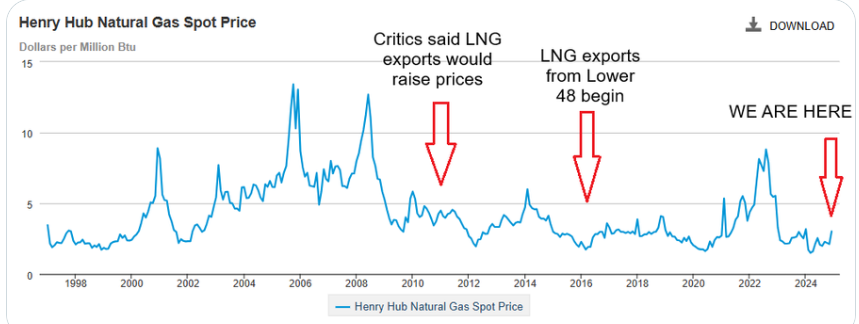
No Evidence That Exports Hurt Prices: The historical view of the Henry Hub spot price shows little impact on price from additional exports.
TARIFFS IN THE NEWS
Tariffs Explained – The President has decided to move forward with tariffs on Canada and Mexico. On Saturday, Canada was hit with a 25% tariff across the board with an exception on energy which is 10%, Mexico was hit with a 25% tariff across the board including energy, and China a 10% tariff across the board. They are taking effect tomorrow and would be in place until the fentanyl overdose issue is sorted. Canadian Prime Minister Justin Trudeau and Mexican President Claudia Sheinbaum announced the Canadian and Mexican retaliation on Saturday evening hitting the US with equal tariffs.
Hard to put into real terms the economic, political and diplomatic impacts (there are so many) of this move, but let me outline a couple points per energy sector:
Refining/Crude
Tariffs and taxes that limit crude oil or refined product imports will raise costs for consumers and manufacturers, and also threaten U.S. energy security. And while it sounds counterintuitive, simply drilling for more U.S. shale oil is not a viable substitute for much of what we import.
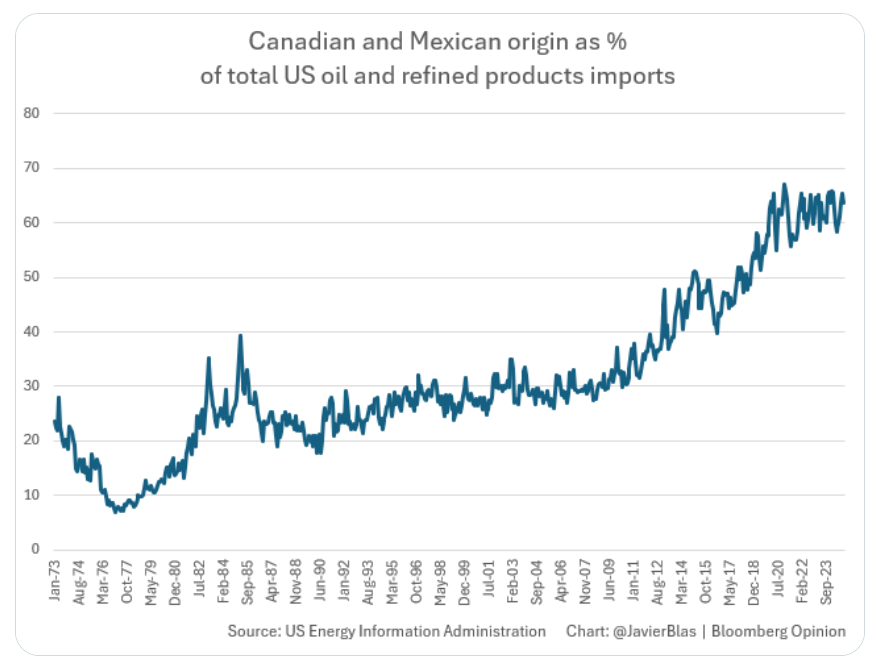
About 60% of the crude oil that runs through U.S. refineries is extracted right here at home. However, our refineries run on many different types of crude oil, some of which we don’t produce here or can’t economically transport. In those cases, we use imports. Nearly 70% of our crude oil imports come from Canada (60%) and Mexico (7%). Using the right types of crude oil keeps costs down and maintains energy security.
The amount of crude oil U.S. refineries process greatly exceeds U.S. crude oil production. The United States is producing a record amount of crude oil (~13.4 million barrels per day), while U.S. refineries need about 16.5 million barrels per day to maintain current production levels.
- Many refineries need heavier crude oil to maximize flexibility of gasoline, diesel and jet fuel production. Today, most crude oil produced in the United States is light, including much of what’s produced in the Permian and Bakken. Light crudes are not good replacements for the heavy crude oil we get from Canada and Mexico.
- Re-tooling refineries to process solely U.S. crude oil (light crude) would cost billions — a risky investment that would take decades to permit, construct and eventually pay off.
- We lack the infrastructure (like pipelines) needed to cost effectively supply U.S crude oil and refined products to every region. Even if the economics of re-tooling our facilities worked, it can take close to a decade to permit and build pipelines in the United States.
Why are tariffs and taxes on oil imports bad for the United States?
Import tariffs and taxes would increase the cost of producing gasoline, diesel and jet fuel and compromise our energy security.
- Raising the cost of heavier crude oil would increase the cost of manufacturing fuel.
- Forcing refineries to process oil they weren’t designed for would cause them to reduce production and potentially shut down.
- Tariffs on North American imports could spur retaliatory actions and make our exports less attractive.
- Most American-made gasoline, diesel and jet fuel stays right here in the United States where it’s used by American consumers and fuels the U.S. economy. Of the total gasoline, diesel and jet fuel we export, Mexico and Canada purchase 43%. And nearly all of what we export stays in the Western Hemisphere.
API CEO Mike Sommers: “Energy markets are highly integrated, and free and fair trade across our borders is critical for delivering affordable, reliable energy to U.S. consumers. We will continue to work with the Trump administration on full exclusions that protect energy affordability for consumers, expand the nation’s energy advantage and support American jobs.”
Good contacts: API (Justin Prendergast PrendergastJ@api.org) and AFPM (Jamie Zarraby JZarraby@afpm.org)
Gas Price Impacts
Patrick De Haan of GasBuddy wrote on X on Sunday: “As a result of Trump’s tariffs, expect fuel prices, including diesel, heating oil, jet fuel, gasoline and propane to rise slightly, primarily in the Great Lakes, Midwest, Rockies and Northeastern U.S. in the days ahead. The impact will be localized but an estimated 5-20 cents per gallon.”
Cement
It is important to remember that cement is a foundational piece of everything we build in the US from roads and bridges to buildings and energy projects. (remember, every well we “drill baby drill,” has to be cemented). Canada and Mexico account for 27% of U.S. cement imports and nearly 7% of U.S. cement consumption. In 2023, the U.S. imported five million metric tons (MMTs) of cement from Canada and two MMTs from Mexico. Texas and Arizona each represent roughly 30% of Mexican imports’ port of entry followed by California and Florida (20% each), reflecting 5% of cement consumption in these states. Canadian imports enter through New York (28%), Michigan (26%), Washington (14%), and New England (11%), with the remaining 20% spread across Montana, North Dakota, and other Great Lakes states. Canadian imports may account for up to 36% of cement consumption in these combined states.
A functioning market for North American cement is essential to realize the President’s objectives. If trade policy recognizes the need to address the unique situation of oil and gas flowing across North American borders, cement is likewise a critical ingredient to achieve U.S. objectives. Comments from the Portland Cement Association:
The availability of affordable cement and concrete is vital to meet our country’s infrastructure needs and for the oil and gas sector’s expansion, Mexico and Canada play a crucial role in stabilizing U.S. supply. Any disruption in these imports could delay energy projects, increase costs, slow infrastructure development, and hinder energy production goals - all at the expense of unleashing American energy dominance. The flow of cement from Canada and Mexico into the United States is vital to meet our nation’s energy, national security and all other infrastructure needs.
Good Contacts: Frank Maisano or Remi Braden (RBraden@cement.org)
Natural Gas
A tariff imposed on natural gas imports from Canada would lead to increases in natural gas commodity costs in the United States, shifts in sources of natural gas supply, adjustments to pipeline flows, changes in natural gas demand, and other potential disruptions. Responses from Canada could include retaliatory tariffs and possible disruption of flowing gas supplies into and out of the United States. Tariffs placed simultaneously on natural gas, oil, and electricity, in addition to other products, could create a compounding effect of additional costs. Ultimately, tariffs are taxes on imported natural gas that increase costs for natural gas consumers. Key
Statistics
- 9% of US natural gas supplies are sourced from Canada (2023)
- A 25% tariff would lead to at least $1.1 billion in additional costs to natural gas consumers
The US and Canada operate an integrated natural gas network, with daily trade ensuring supply flexibility and stability. Canadian imports provide critical gas supply to regions without direct access to major US production basins. Natural gas imports from Canada are critical for winter supply reliability and are a vital component of a reliable supply portfolio for many US regions. Trade with Canada is essential to balance the North American natural gas market and ensure reliable and stable production and supply on both sides of the border.
Good Contact: Emily Carlin, AGA, ECarlin@aga.org
Electricity
Who knows how the tariffs will apply to electricity generation which if very hard to determine, but certainly states like NY, Ohio, Pennsylvania and Michigan, as well as regions like the Northeast, Southest and the Northwest will feel the pinch if it sustains. Utility companies typically pass along the cost of purchasing energy sources like natural gas directly to customers.
Best Contact: Scott Segal, scott.segal@bracewell.com
Mining, Critical Minerals
We import over 50% of its critical minerals, with some estimates stating that over 80% of the country's critical mineral supply comes from foreign sources; for 12 critical minerals, the US is completely reliant on imports, while for another 31, the import reliance is greater than 50%.
Key points about US critical mineral imports:
- High import reliance: The US is heavily reliant on imports for most of its critical minerals, with over half of its consumption coming from foreign sources.
- Complete import dependence: For 12 critical minerals, the US is entirely reliant on imports.
- Significant reliance on China: China is a major supplier of critical minerals to the US, often dominating the import market for several key minerals.
As for uranium, tariffs will apply to Canadian imports to the U.S. which will pass along the cost of the tariffs to their U.S. utility customers.
Good Contacts: SAFE’s Center for Critical Mineral Security, Leslie Hayward (lhayward@secureenergy.org). On Uranium, Nima Ashkeboussi (Nima.Ashkeboussi@gle-us.com) and Andrew Shaw (andrew.shaw@bracewell.com)
HVACR Manufacturing
The Air-Conditioning, Heating, and Refrigeration Institute (AHRI), whose members manufacture a wide variety of energy efficient heating, cooling, water heating, and commercial refrigeration equipment, is a global industry whose products must be able to travel across international borders. The industry expressed grave concern regarding the tariffs being placed by the Trump Administration on imports from Canada and Mexico.
AHRI and its member companies are committed to innovating and manufacturing products and equipment that are essential to the health, safety, comfort, productivity, and well-being of the American people. Our industry supports more than 700,00 jobs here in America, and we are very concerned that the announced tariffs could not only jeopardize existing jobs but could prevent the industry from increasing American employment for the foreseeable future.
In addition to potential job losses, the announced tariffs will almost certainly raise the cost of products and equipment essential for maintaining health-affirming residential and commercial heating, cooling, and water heating as well as keeping food and medicines at optimal temperatures for human health and safety. Rising costs of these products disproportionately affect those least able to afford increases, including those on the margins, the elderly, and even America’s middle class, which has been buffeted by price increases and inflation for the past several years.
THE REST OF THE NEWS
Gevo Completes Purchase of ND Ethanol Plant – Leading Sustainable Aviation Fuels producer Gevo has acquired the ethanol production plant and CCS assets of Red Trail Energy for $210 million. The acquired assets include the plant, pore space and their experienced operational personnel. In addition to creating another strategic option for economic and competitively advantaged SAF facilities, this acquisition is expected to contribute $30 million to $60 million to Gevo annually. The acquired assets are being renamed “Net-Zero North.” Gevo Chief Executive Officer, Patrick Gruber:
“This transformational acquisition marks the start of Net-Zero North. Looking forward, this is a great site to expand the plant to produce SAF, along with other additional co-located projects. The proven CCS site will allow us to permanently sequester biogenic carbon to produce US products with the highest quantity and quality of carbon abatement to address a growing global market demand. Net-Zero North is a key step on our path to becoming self-sustaining and profitable as a company in advance of our South Dakota project coming online.”
Zeldin, Burgum Confirmed, Wright on Deck – The Trump Green team is almost entirely in place. EPA Administrator Lee Zeldin was approved 56-43 on Wednesday, Interior Secretary Doug Burgum was approved 79-18 on Thursday, while no votes on Friday pushed Energy Secretary nominee Chris Wright’s final vote to this evening.
EPA Resets Science Advisory Panels – the Just like Biden Team, President Trump’s EPA team dismissed all members of its boards of outside advisers on science and clean air. Biden’s EPA chief, Michael Regan, installed a new slate at CASAC when he took office in 2021. The CASAC provides independent expertise to EPA staff during statutorily required reviews of ambient air quality standards for lead, ozone and four other pollutants; the SAB offers scientific and technical advice on a range of issues.
Report Blasts IEA Over Focus – The International Energy Agency's former oil industry and market chief criticized the agency's focus on the global energy transition in a report released last week, saying the IEA should concentrate on oil and gas supplies. IEA has been under fire for a shift in recent years toward a focus on clean energy policy. The report, written by the IEA's former head of oil industry and markets, Neil Atkinson, and Mark Mills, director of think tank the National Center for Energy Analytics, identifies 23 assumptions made by the agency that led to what it calls a flawed conclusion that global oil output would peak by 2030, and that no new oil and gas investment was needed.
BNEF: Clean Energy Transition Hits New High – A new report from BloombergNEF says the Investment in the energy transition hit a new high last year. It rose to more than $2 trillion for the first time. The report analyzed spending on clean tech deployments, supply chain investments, equity funding and debt issuances. BloombergNEF’s Energy Transition Investment Trends 2025 finds that investment in the energy transition is higher than ever, but growth has slowed. China invested most and drove the majority of the growth in 2024, eclipsing the US, the EU, and the UK. Investment in mature technologies is growing globally, while investment in emerging technologies is struggling.
ON THE SCHEDULE THIS WEEK
Washington Auto Policy Day, Show Set – The Washington Auto Show started last Friday and will continue through Sunday at the Washington Convention Center. The Washington, D.C. Auto Show is renowned as the nation’s premier “Public Policy Show,” offering a one-of-a-kind opportunity to connect with the key figures driving the future of the automotive industry.
BNEF Summit Set for SF – The annual Bloomberg New Energy Finance San Francisco Summit is set for tomorrow and Wednesday at The St. Regis Hotel. The BNEF Summit provides the ideas, insights and connections to formulate successful strategies, capitalize on technological change and shape a cleaner, more competitive future. Tom Steyer is among the Keynote Speakers.
Appeals Court Hears Louisiana CCS Authority – The U.S. Court of Appeals for the 5th Circuit (in NOLA) will hold oral argument from critics of the EPA’s decision to grant Louisiana primary authority to permit carbon storage wells in the state. The Biden EPA granted permission to Louisiana after long delays in permitting and legal battles. They also recently awarded permitting authority to West Virginia before leaving office
POLTICO Forum Hosts Navarro on Trade Issues – Politico holds a First 100 Days Forum tomorrow at 9:00 a.m. in the Columbus Club looking at Trump’s trade policy agenda to counter China, recent tariffs on Mexico and Canada and responses. The event features White House trade counselor Peter Navarro, as well as Reps. Linda Sanchez (D-CA) and Adrian Smith (R-NE).
Forum Looks at US-Canada Energy – Tomorrow at 10:00 a.m., the Atlantic Council holds a discussion on U.S.-Canada Energy Cooperation. (Good Timing) The Council’s Global Energy Center will host Canadian Minister of Energy and Natural Resources Jonathan Wilkinson for a discussion on advancing bilateral energy cooperation amid the changing North American political landscape.
FP Hosts Trump Impacts on Global Policy – Foreign Policy hosts forum tomorrow at 11:00 a.m. assessing Trump’s early moves that affect global policy, such as tariffs. FP Live will bring together three seasoned observers on three continents: the Financial Times columnist Ed Luce; former Singaporean diplomat Kishore Mahbubani; and director of Italy’s Istituto Affari Internazionali, Nathalie Tocci.
Forum Focuses on Energy Transition – The Inter-American Dialogue holds a virtual discussion tomorrow at 10:00 a.m. on frontiers of the energy transition, The event will delve into the disparate aspects of the energy transition, analyzing green hydrogen, offshore wind, critical minerals, sustainable mobility, smart grids, energy integration, and the aspects of a just transition.
ConservAmerica Hosts Trump Environment Advisor Russo – Tomorrow at Noon, ConservAmerica will hold a discussion with Ed Russo on his thoughts and perspectives on environmental protection and conservation and the role of the Task Force he will lead for President Trump. Trump has tapped his long-time environmental advisor Russo to lead a new White House Environmental Task Force. An author and self-styled “environmental crusader,” Russo will have a prominent platform to identify and promote an array of environmental policies, priorities, and innovative approaches to advance the President’s environmental agenda. Former EPA official Brent Fewell moderates.
Forum Looks at Climate Resilient Housing – Tomorrow at 2:00 p.m., the Urban Institute holds a forum on building a climate-resilient manufactured housing stock. The event features leaders from the manufactured housing sector who will discuss innovations, opportunities, and barriers at the federal, state, and local levels to preserve and produce safe and affordable manufactured homes.
House Energy Looks at Trump Energy Agenda – The House Energy and Commerce Energy Subcommittee holds a hearing on Wednesday at 10:15 a.m. focused on the Trump energy agenda.
RFF Hosts Fossil Fuel Worker Discussion – On Wednesday, Resources for the Future holds a webinar where study authors Jacob Greenspon and RFF Fellow and Director of the Equity in the Energy Transition Initiative Daniel Raimi will discuss their analysis and demonstrate a new interactive data tool that allows users to examine which jobs offer the best match for workers in a variety of occupations that are heavily concentrated in fossil fuels. After the presentation, Myles McCormick from Financial Times will moderate a panel discussion featuring workforce experts from academia, industry, and policy, followed by an interactive question and answer session with the online audience.
RMI Feasibility Forum on Industrial Heat Decarbonization – RMI hosts a forum on Wednesday at 11:00 a.m. with leaders from across the industrial heat ecosystem as they discuss critical lessons learned in managing project costs, the evolution of business models in industrial heat decarbonization projects, and practical strategies to accelerate the deployment of sustainable heat solutions.
House Judiciary Looks at California Fires – The House Judiciary Subcommittee on the Administrative State, Regulatory Reform, and Antitrust will hold a hearing on Thursday at 10:00 a.m. on California 2fires and the consequences of overregulation. The hearing will examine the real impacts of regulatory policy on the prevention of natural disasters, particularly in the case of California's wildfires. This hearing will also address how excessive regulation on insurance and permitting serves as a roadblock to those recovering from disaster. Witnesses include Steve Hilton, R Street’s Steven Greenhut and Edward Ring, Director of Water and Energy Policy at the California Policy Center.
Atlantic Council Hosts Birol to Discuss Nuclear – On Thursday at 10:00 a.m., the Atlantic Council will host a FrontPage conversation featuring IEA head Fatih Birol on the role of nuclear energy in the future. Following the release of the IEA’s new report—The Path to a New Era for Nuclear Energy—Birol will share his insights on the global nuclear energy ecosystem and outline the crucial elements needed for nuclear power to play a larger role in the future energy landscape. He will also discuss the role of nuclear energy in supporting domestic energy production in the United States and in achieving the energy goals of the new US Congress and administration.
Forum Looks at Western Public Lands Debate – ConservAmerica holds a webinar on Thursday at 12:00 p.m. designed to provide a better understanding of the history of public lands in the U.S. and the growing legal and policy debate over the federal government’s large landholdings. The discussion will also explore policy issues affecting wildlife and critical natural resources, as well as the social and economic implications to gateway communities. Panelists include American Lands Council CEO Jennifer Fielder, David Willms of the National Wildlife Federation and former ConservAmerica President Rob Sisson.
Trump Energy Agenda Highlighted – The Cato Institute holds a virtual forum on Thursday at 1:00 p.m. on exploring energy policy in the Trump Administration. This conversation with WaPo’s Evan Halper; Travis Fisher, Cato’s director of energy and environmental policy studies; and Joshua Loucks, a Cato research associate in tax and energy policy, will examine energy policies under the new administration and the impact they will have on Americans.
Forum Looks at Water in Central Asia – On Friday at Noon, The Atlantic Council’s Eurasia Center and the International Tax and Investment Center hold a discussion on a new report, "Water insecurity in Central Asia: The imperative for regional and international cooperation." The report details the developing water crises in Central Asia and outlines strategies to combat water insecurity in the region.
IN THE FUTURE
GreenBiz 2025 Set for Phoenix – GreenBiz 2025 will be held on Monday February 10th to Wednesday, February 12th in Phoenix, AZ. GreenBiz, the annual gathering of sustainability professionals, RMI will host a panel on how organizations can secure the capital needed to fund decarbonization efforts in line with climate goals, what factors investors and lenders look at when evaluating the climate-related opportunities, and more.
USEA Event to Look at Trump Agenda – The US Energy Assn holds its February virtual press briefing on Tuesday February 12th at 11:00 a.m. on understanding the Trump Energy Agenda. As usual, a panel of senior reporters who cover energy will question a panel of experts, this time on the president's energy plans. The experts include my colleague Scott Segal, NRDC’s Bob Deans and NEMA’s Spencer Pederson. Reporters will include WSJ’s Jennifer Hiller, WaPo’s Even Halper and E&E’s Pete Behr.
RFF Workshop Looks at Costs, Benefits – On Thursday February 13th, Resources for the Future (RFF) is hosting a virtual workshop on retrospective analyses of the benefits and costs of specific environmental regulations. The webinar features the presentation of papers examining a variety of rules that affect major industrial sectors. In addition, the morning session examines possible alternative institutional arrangements to support/promote the effort to embed the practice of retrospective analysis within the agencies. Bracewell’s Jeff Holmstead is among a number of great speakers.
The Green Ammonia Innovation Ecosystem Forum Set – RMI hosts a webinar on Wednesday February 19th at 10:00 a.m. to explore innovation within the green ammonia space. The event highlights large corporate case studies and groundbreaking startups developing low-carbon solutions, such as water electrolysis, plasma-catalytic synthesis, or technologies that can work at much lower temperature and pressure. It also details how entities like RMI’s Third Derivative are accelerating innovation in the field.
BCSE, BNEF Release Energy Factbook – The Business Council for Sustainable Energy and Bloomberg New Energy Finance will release its annual clean energy Factbook on February 19th at 2:00 p.m. a report filled with data on the progress of the energy efficiency, natural gas, and renewable energy sectors. More on this as we get closer.
NAS Panels Look at SCOTUS Decisions on Air – On Friday February 21st, my Bracewell colleague will be participating in a panel discussion at the National Academies of Science (NAS) to discuss the implications of recent Supreme Court decisions, including Loper Bright, on EPA and other federal agencies responsible for protecting human health and the environment.
ACORE Holds Policy Forum – The 2025 ACORE Policy Forum is set for February 26th and 27th in Washington DC. Topic include rising electricity demand , manufacturing and digital infrastructure buildout, domestic and global clean energy supply chains and permitting roadblocks limiting our ability to deploy critical transmission lines and clean energy projects. The ACORE Policy Forum will be a two-day event for the first time.
CRES to Host Geothermal Exhibition – CRES will host Geothermal House DC MAGMA on March 4th at Top of the Hill from 11:00 a.m. to 7:00 p.m. featuring a mix of panels, virtual reality experiences and networking, followed by a reception. MAGMA stand for: Making America Geothermal: Modern Advances. The event will feature how next generation geothermal can bolster U.S. energy security, creating economic growth and high-quality energy jobs, while providing clean baseload power supported by U.S. supply chains. Geothermal House is a unique, immersive educational experience, featuring live programming, a ‘Journey to the Center of the Earth’ virtual reality experience, geothermal themed food and drinks, spotlights on the movers and shakers building and funding the future of geothermal energy, and a few surprises in between.
CERA Week – The Energy Week of all weeks, CERA Week, will be Held on March 10th to 14th in Houston. We will see you at the Starbucks in the Frank Maisano CERA “Office.”
Third SAFE Summit Set Focused on Critical Minerals, Energy Security – SAFE holds its 3rd annual SAFE Summit on Tuesday April 1st.
EPSA Competitive Power Summit Set – The Electric Power Supply Association holds its Competitive Power Summit on Wednesday April 2nd at the Grand Hyatt Washington. Speakers include PJM CEO Manu Asthana, Vistra CEO Jim Burke, Pennsylvania PUC Chair Steve DeFrank, NY ISO Rich Dewey and many more.