
Energy Update: Week of February 22
Energy Update - February 22, 2021
Friends,
Hope you survived last week. I usually mention Mardi Gras, but because of the lack of parades and celebration this year and everything else going on, it snuck up on me and I forgot to mention it. I hope you still got a chance to enjoy some King Cake before Ash Wednesday.
It is going to be a crazy week, so let's jump right in. The biggest hearing this week is tomorrow’s Senate Energy Committee hearing with Interior nominee Deb Haaland. Given her somewhat progressive views on oil/gas and federal lands and relative inexperience – as well as the Biden Admin’s early moves to limit oil/gas leasing, the hearing will be a significant bellwether to watch. Expect tough questions from Barrasso, Daines and other Republicans. But I would also expect tough questions from Manchin. And while it's not a disqualifier, I can't imagine Manchin's move to oppose OMB nom Neera Tanden can be seen as a helpful sign. It certainly increases the pressure on Haaland to perform well.
Several other nominees are in the spotlight this week including AG nominee Merrick Garland today (Senate Judiciary), HHS nom Xavier Becerra tomorrow (Senate HELP) and Wednesday (Senate Finance) and Thursday U.S. Trade Rep Katherine Tai (also Sen. Finance). Finally, expect a full Senate vote on USDA Sect Vilsack as early as tomorrow, with several others like Granholm (energy/TX), Regan (EPA) and Cardona (Education/re-opening schools) all competing for limited floor space.
It is also busy on the hearing front. Tomorrow, House Transportation’s Environment Subpanel holds a hearing on wastewater infrastructure, while on Wednesday Senate Environment holds a hearing on transportation and climate change. Also Wednesday, House Approps MilCon/Veterans subpanel will look at PFAS issues, while on Thursday House Ag looks at climate change impacts on ag/forestry, House Financial Services looks at corporate climate/ESG issues and House Approps Energy panel looks at climate innovation with our friend Rich Powell of ClearPath.
Outside hearings, budget/COVID action is likely to conclude this weekend with the key votes on the final package. Action launches today in the House Budget Committee. The margins are tight and one vote in the Senate and a couple votes in the House can make a huge difference. Sticking points for both progressives and moderate Democrats include the cost of the package, $15 minimum wage and a host of other issues. We will also be watching how much Republicans can stay united. (Probably made easier by the fact that Democrats so quickly went all-in alone)
And it is not only busy budget time…Tomorrow, you will want to keep an eye on the Biden bilateral meeting with Canadian PM Justin Trudeau (Keystone) and a Thursday Biden virtual meeting with governors during the NGA winter meetings. Finally, on Sunday at CPAC in Orlando, Donald Trump returns to the stage for his first real comments since November.
Other good events this week include Wednesday forums from Our Energy Policy on energy storage and an ACCF conversation with Joe Manchin and finally, in a timely event, the Atlantic Council Global Energy Center holds a webinar on Wednesday afternoon on grid reliability and resilience amid increasingly severe weather events, like that affecting the state of Texas with Rob Gramlich, speakers from Georgia Power and PGE, as well as UT-Austin’s Michael Webber. Then Thursday, CSIS/BloombergNEF holds a webinar on a new report on clean energy supply chains and China, while CRES holds a forum to review of the “Energy Act of 2020” and discussion on what its passage means for clean energy and climate action ahead.
Finally, there are two really interesting issues we are tracking this week as well. First, as almost everyone is, we are watching Texas as temperatures rise back into the 70s and it moves out of its recent freeze. Everybody is writing lots of roundups and all of a sudden, the Democratic-led Congress seems to be interested in reliability (much more than before when California faced this problem last August), but I would urge you to focus on two key issues: weatherization of generation assets and the politics of grid management. The first is a simple solution which was recommended to TX 10 years ago; the second much more difficult to address.
The other issue is a really interesting story co-authored by my friend Eric Wolf and his colleague Rebecca Rainey on the growing rift between progressives and unions and how they look at the environmental challenges facing the Administration. This disconnect was evident is last week’s meeting with Biden and some labor leaders.
Mark your calendars for NEXT TUESDAY’s BPC event with Reps. David McKinley and Kurt Schrader who will talk about their bipartisan climate legislation. Hope you all remember to stay safe & healthy and get those vaccine shots if you can!
Best,
Frank Maisano
(202) 828-5864
C. (202) 997-5932
FRANKLY SPOKEN
“It's pie-in-the-sky bulls--t about these green jobs being good middle-class jobs, because they're not.”
LIUNA President Terry O’Sullivan, in relatively blunt comments to POLITICO before a Meeting with President Biden and labor unions leaders. Union leaders say the renewable industry is well out of its infancy and should come to the table and engage in collective bargaining like other mature industries.
ON THE PODCAST
Plug Power CEO Talks EVs, Hydrogen – In this edition of Bracewell’s Clean Energy Transition Podcast series within The Lobby Shop, the team covers the latest in hydrogen energy technology, including the current and potential applications of hydrogen power, storage options, how the US can effectively fund and implement this technology, and much more. Scott Segal, co-head of PRG, facilitates this conversation with guest speakers Andy Marsh, President and CEO of Plug Power, a provider of clean hydrogen and zero-emission fuel cell technology, and Tim Urban, PRG Partner and leader in clean energy tax policy. The full podcast series is now live on Spotify, Apple Podcasts, SoundCloud, and Stitcher.
FUN OPINIONS
Durbin: Biden’s Climate Opportunity – In an opinion piece in The Hill, Marty Durbin, head of the US Chamber’s Global Energy Institute says the Biden Administration’s path to climate success is in 2020 Energy law which is exactly the “kitchen sink” approach to climate technology solutions we need. Durbin adds what is not well appreciated, however, is that these ambitious energy transition goals are highly dependent on technologies that simply don’t exist commercially today. “In order to effectively address the global climate challenge, there is broad recognition that the development, commercialization, and deployment of new technology will be the primary factor that determines how quickly and at what cost greenhouse gas emissions can be reduced.”
FROG BLOG
CONCA: TX Shows we Have Work to Do to Improve Resilience – A new blog post in Forbes by Columnist Jim Conca says Texas’ energy mix of mostly natural gas and wind did not do well with this week’s extreme cold snap and snow. In this cold snap, gas used for heating increased dramatically, removing much of it from generating electricity, some pipelines froze up and couldn’t deliver, and there just isn’t enough pipeline capacity to begin with. He also suggests that the US up its nuclear game, given the nuclear shutoff was small and only related to a warning light caused by frozen water.
IN THE NEWS
Sustainable Energy in America Factbook Shows Resilient Clean Energy Growth in 2020 – Faced with COVID-19 pandemic and sharp economic contraction, the U.S. clean energy sectors showed strong resilience in 2020, continuing a decade-long growth trend, BloombergNEF (BNEF) and the Business Council for Sustainable Energy (BCSE) find in their annual joint report. The ninth edition of the Sustainable Energy in America Factbook tells the story of American energy efficiency, natural gas and renewable energy in a volatile year. This story is told for the first time with over 130 slides and data visualizations that put 2020 performance in the context of past years. The economic disruption caused a massive drop in national greenhouse gas emissions. Energy demand for electricity and transportation fell by 3.8% and 14.4%, respectively, supporting the 9% year-on-year decline in harmful greenhouse gas emissions for the United States. This fall in emissions (see Figure 1) is the most significant on record and puts the United States on track to meet its 2025 Paris Agreement commitment, though energy demand and emissions are expected to rebound with widespread vaccinations in 2021.
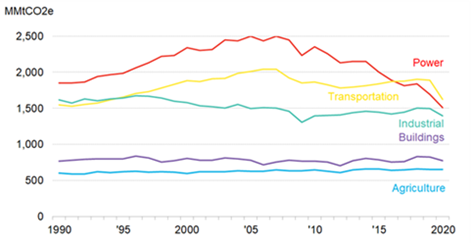
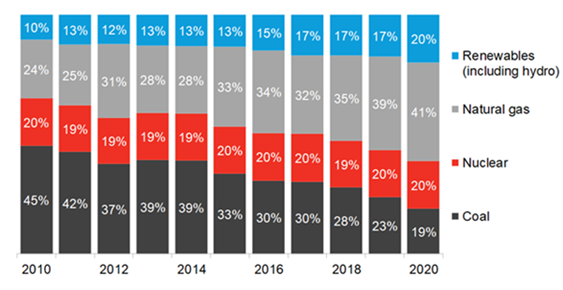
The impacts of cleaner electricity generation will persist. Figure 2 shows that natural gas and renewable generation continued to expand their share of the resource mix. A record 33.6 GW of wind and solar capacity was added to the grid this year.
The full 2021 Sustainable Energy in America Factbook is available for download at www.bcse.org/factbook.
Notable clean energy statistics from the pandemic year include:
Power Generation
- Renewables’ contribution to the power grid set another record, rising 11% year-on-year. Renewable energy generated a fifth of U.S. power in 2020.
- Power from all zero-carbon sources (renewables plus nuclear power) set another record, meeting 40% of demand. This was despite a decline in nuclear output.
- Natural gas remained the largest source of U.S. power generation at 41%, though its 2019-2020 growth was slower than 2018-19.
- Coal-fired power’s contribution slipped to 19% from 45% a decade ago on weak demand and competition for lower-carbon power sources. Coal plants continued to retire rapidly.
- A record 33.6GW of wind and solar combined was built. Records were also set for each individual technology. Wind enjoyed its strongest year ever with 17.1GW constructed while solar bested its previous 2016 high with 16.5GW completed.
Emissions
- Total U.S. emissions sank 9% to end 2020 20% below 2005 levels as result of the pandemic. The U.S. got on track to meet its Paris Agreement goal but 2021 emissions will rebound with economic recovery.
- CO2 emissions from road, rail, and aviation fell furthest (-14%) but transportation remains the highest emitting sector. Lower travel rates were responsible for the decline.
Demand
- U.S. energy “productivity” (GDP / total energy consumption) rose, but not primarily for positive reasons as economic hardship prompted many consumers to cut back consumption.
- Natural gas demand dipped 0.8% year-on-year, the first decline since 2009. Power sector demand and exports rose but industrial, commercial and residential demand all fell.
Corporate and Sub-National Action
- Corporate decarbonization commitments grew. 65 companies joined the RE100 initiative to expand renewables use, 59 joined EP100 pledging to improve energy productivity.
- But companies signed fewer contracts in 2020 to buy clean power. Corporate power purchase agreements (PPA) for wind/solar slowed to 11.9GW due to pandemic worries.
- Renewable thermal energy is expanding. At the close of 2020, 26 states had acted to promote the use of renewable natural gas for thermal heating in homes and businesses.
American clean energy businesses went above and beyond during the pandemic to protect their customers and employees, from fuel cell manufacturers who refurbished ventilators in their facilities, to utilities and technology providers who implemented careful distancing and quarantine measures to maintain service, to and propane companies provided space heating for pop-up COVID-19 testing and evaluation sites. The sectors’ performance in a year of unprecedented challenges reflects millions of Americans’ ingenuity and dedication.
Union Workers, Manufacturers Ask EPA for COVID-Related RFS Relief – In a broad-based show of concern over the increasingly dire fate of refineries due to the pandemic, over 3000 union members, refinery workers, manufacturers and others are urging EPA to grant temporary relief from Renewable Fuel Standard (RFS) obligations. In the past year alone, eight US refineries have announced closures that strain the nation’s network of critical fuels, resulting in a direct loss of more than 3,500 refiner jobs and tens of thousands of related jobs, coupled with nearly 19 billion gallons of refined fuel products like gasoline, jet fuel and home heating oil taken off the market. Skyrocketing prices for RFS compliance credits, known as Renewable Identification Numbers (RINs), have significantly increased costs for refiners even as revenues shrink. RINs prices have increased over 600% since January 2020.
EPA is considering requests from a bipartisan group of U.S. governors and the National Wildlife Federation to waive RFS obligations due to the unprecedented drop in demand for refined products related to the pandemic. The agency’s comment period closes February 18, 2021, at midnight. Below are excerpts of some of the comments received by EPA:
Pennsylvania Gov. Tom Wolf: “Since my previous petitions were filed, conditions have continued to deteriorate. The number of East Coast facilities that have closed has increased to eight and Pennsylvania now has only one remaining large refinery, Monroe Energy’s Trainer facility. In an SEC filing last week, Monroe Energy’s parent company reported an operating loss at the refinery of $216 million in 2020 with $172 million of the loss attributable to RINs expenses. Notably, these costs imposed by the RFS had increased by over a hundred million dollars from 2019, when Monroe’s RINs compliance cost was $58 million.”
United Steel Workers: “The decrease in fuel demand caused by the COVID-19 pandemic, combined with skyrocketing compliance costs from the unregulated renewable identification number (RIN) market, have put a number of the workplaces we represent on an unsustainable course and threatened their viability.”
Delaware County (PA) AFL-CIO Council: “With only three large refineries remaining on the East Coast, we must take proactive steps to protect these facilities, and the family supporting union jobs they provide, as they are major economic drivers in the northeast. The ongoing pandemic has further magnified this issue, and unless something is done soon, this unsustainable trajectory will lead to even more refinery closures.”
Study Highlights Offshore Wind Opportunities – A study commissioned by the New York State Economic Research and Development Authority (NYSERDA) has identified opportunities for mariners to supplement their income in US offshore wind. The study, compiled by Renewables Consulting Group (RCG), concluded that as the offshore wind industry grows, the option for mariners to supplement their income will become available during all phases of a project’s lifecycle. Based on current north eastern US offshore wind commitments alone, the study shows that offshore wind can support 2600 job years of supplemental work for fishermen and other mariners. The vast experience of the north eastern maritime industry is well-known and interested mariners should be considered for jobs in this growing industry, said RCG.
Congress Renews AV Bill Push – Lawmakers on Capitol Hill are renewing their efforts to pass legislation that would create federal safety and security standards for AVs, according to a report in The Hill. The outlet quoted a spokesperson for Senator John Thune (R-SD), a longtime leader for federal AV legislation, as saying he “remains committed to advancing bipartisan automated vehicle legislation this Congress.” Similarly, the office of Senator Gary Peters (D-MI), who previously joined Thune in co-sponsoring autonomous vehicle legislation, added that he “looks forward to working with manufacturers, advocates, his colleagues in Congress and the Biden Administration on the best path forward to establish a strong federal framework that will usher in the safe deployment of self-driving vehicles.”
ON THE SCHEDULE THIS WEEK
MOST EVENTS SCHEDULED ARE NOW ONLINE WEBINARS
Event to Look at Electrification of Transportation – The Transportation & Climate Initiative (TCI) holds a forum today at 1:00 p.m. on transportation electrification policies. TCI is a regional collaboration of 12 Northeast and Mid-Atlantic states and the District of Columbia that seeks to improve transportation, develop the clean energy economy, and reduce carbon emissions from the transportation sector.
NREL Speakers to Address COVID, HVACR – Today at 1:00 p.m., DOE hosts a forum on the energy impact of major HVAC system operation guidance to reduce transmission of COVID-19 inside buildings across the U.S. commercial building stock. Speakers will discuss the energy implications of (1) 100% outdoor air ventilation rates, (2) installing MERV-13 filters or better, (3) disabling demand control ventilation, and (4) HVAC flushing mode operation. Analysis of these measures using ComStock provides a national view of the energy implications for various commercial building types in all U.S. climate zones. This is a subject that AHRI and ASHRAE have long been addressing in seminars. Speaker from NREL will address the topic.
Dallas Fed Chief to Address Oil, Gas – The International Energy Forum (IEF) holds a webinar today at 9:00 p.m. featuring Dallas Fed Reserve President & CEO Robert Kaplan. Kaplan will discuss COVID-19 Impacts on the US Oil and Gas Sector, supply resilience and export potential
Conference Looks at Resilient Economy – The Aspen Ideas RESET Conference will hold a web event today and tomorrow to looking at rebuilding a resilient economy for all.
Smart Energy Summit Set – The Smart Energy Summit will host virtual sessions tomorrow and Wednesday to discuss energy management, solar and microgrids. The summit agenda features leaders from utilities, state and national regulators, telecom and security companies, retailers, and OEMs.
Haaland Heads to Senate Energy – The Senate Energy and Natural Resources Committee holds a hearing tomorrow at 9:30 a.m. the nomination of Rep. Deb Haaland, (D-NM), to be Interior secretary.
Event Looks at NOCs in Latin America – Tomorrow at 10:00 a.m., the Council of the Americas and Rice University's Center for Energy Studies hold a webinar on the future of national oil companies in Latin America. The webinar will feature a keynote by Felipe Bayón, president and CEO of Ecopetrol, who is leading the transformation of the Colombian NOC.
IAEA Director Headline Forum on Nuclear Future – The Nuclear Threat Initiative holds a webinar tomorrow at 11:00 a.m. with International Atomic Energy Agency Director Rafael Mariano Grossi on nuclear in the new decade.
House Transpo Looks a Wastewater – The House Transportation Water Resources and Environment Subcommittee hearing tomorrow at 11:30 a.m. on the urgent need for investment in America's wastewater infrastructure. Among the list of witnesses will be LIUNA’s David Mallino, Lima OH Mayor David Berger on behalf of the US Conference of Mayors and Buffalo Sewer Authority GM O.J. McFoy, on behalf of the National Association of Clean Water Agencies.
GWU to Host Climate Talk – The George Washington University hosts a forum tomorrow at Noon that features a panel discussion hosted by the Master of International Affairs Program (and the Global Energy and the Environment Concentration) and the Latin American and Hemispheric Studies Program. In light of the Biden Administration’s Executive Order on Tackling the Climate Crisis at Home and Abroad, the event brings together faculty climate experts from different regional and policy perspectives on development, diplomacy, and defense.
C2ES Forum Looks at Nature-Based Solutions – The Center for Climate and Environmental Solutions (C2ES) holds a webinar tomorrow at 1:00 p.m. that will examine how companies can approach using nature-based solutions to reduce their greenhouse gas emissions, including the most effective use of resources when investing in nature-based solutions, understanding the growing role of carbon removal in reaching net-zero emissions, and the criteria companies should consider when selecting projects. The webinar will also explore how to leverage natural solutions to reduce emissions within and outside a company’s value chain. Our friend Shawn Patterson of DTE Energy is among the panelists.
Berkeley Labs Team to Look at Solar Market Valuations – The DOE’s Lawrence Berkeley National Lab will hold a web event tomorrow at 1:00 p.m. to will highlight the historical contribution to reliability, trends in market value, and impacts on the bulk power system of solar deployed in the U.S. through the end of 2019. The scope of this analysis includes the seven organized U.S. wholesale power markets and ten additional utilities, and is based on historical hourly solar generation profiles for each individual plant larger than 1 MW or county-level aggregate profiles for smaller solar. It will start with an overview summarizing the current state of solar deployment and review practices of determining solar’s capacity credit, assess solar’s energy and capacity value and conclude with an analysis of solar’s overall system impact, ranging from altered price patterns to increasing ramp rates.
Argonne to Look at Energy Storage – The Argonne National Laboratory holds its director's special colloquium tomorrow at 3:00 p.m. focused on energy storage for a changing world. SUNY-Binghamton’s Stanley Whittingham, 2019 Nobel Prize winner for development of the lithium Ion battery will keynote. Former DOE official Melanie Kenderdine and Green Mtn Power CEO Mary Powell with also speak on a panel after.
Power, Gas M&A Forum Set – S&P Global Market Intelligence holds its 34th Annual Power and Gas M&A Symposium 2021 on Wednesday. The Symposium provides a forum for senior executives and analysts come to together to discuss the important topics related to M&A and investments.
Webinar to Look at CCS on Middle East/Gulf Region – The Global CCS Institute holds a webinar Wednesday at 6:00 a.m. (3pm in the Gulf) featuring global and regional experts that will share their knowledge with an audience of Gulf region energy, industrial and climate change stakeholders. After a global roundup presented by the Global CCS Institute, executives from ADNOC, Aramco and others in the region will describe their CCS projects in operation and in planning, and how CCS fits into their strategic business plans.
Forum to Address China Energy Finance Strategies – Boston University’s Global Development Policy Center and the Inter-American Dialogue hold a webinar discussion on Wednesday at 9:00 a.m. looking at China’s overseas funding to Latin America and global energy projects. The Global Development Policy Center will present updates to its China’s Global Energy Finance Database, an interactive data project that exhibits financing for global energy projects by China’s two global policy banks—the China Development Bank (CDB) and the Export-Import Bank of China (CHEXIM). Following that, the Global Development Policy Center and the Inter-American Dialogue will discuss updates to the China-Latin America Finance Database, a joint project first launched in 2012 that also tracks loans from CDB and CHEXIM to Latin American and Caribbean governments and state-owned enterprises.
Senate Enviro to Look at Transportation, Climate Issues – The Senate Environment Committee holds a hearing on Wednesday at 10:00 a.m. on investing in transportation while addressing climate change, improving equity and fostering economic growth and innovation. Witnesses will include Michigan Gov. Gretchen Whitmer, Maryland Gov. Larry Hogan, Denver Mayor Michael Hancock and Victoria Sheehan, president, American Association of State Highway and Transportation Officials, and commissioner, New Hampshire Department of Transportation.
New Report Highlights Grid Enhancements – The WATT Coalition holds a webinar on Wednesday at 10:00 a.m. looking at an in-depth report by The Brattle Group studying the impacts of Grid-Enhancing Technologies to accelerate renewable development. Select Climate Committee Chair Kathy Casto and a panel of experts (including for FERC Commissioner Nora Brownell) on transmission planning and operations to explore how Grid-Enhancing Technologies can unlock new clean energy potential.
Forum to Look at Green Recovery – The World Resources Institute and World War Zero hold an event on Wednesday at 11:00 a.m. discussing what a green and equitable recovery in the United States should look like with climate and energy experts. As the United States looks to rebuild from the economic recession brought on by the COVID-19 pandemic, federal lawmakers have an opportunity to ensure that we build back better, in ways that create millions of well-paying jobs, spur billions in economic growth, and advance a low-carbon economy. The event will look at how Congress and the Administration can do that. Speakers include former EPA head Carol Browner, WRI’s Dan Lashof, AFL-CIO Exec Brad Markell and NPR climate reporter Neela Bannerjee.
Columbia Panel to Look at Hydrogen – On Wednesday at Noon, Columbia University’s Center on Global Energy Policy will host a panel of exceptional policy, technology, and commercial experts to discuss how hydrogen can be made and used today in service of economic growth and rapid decarbonization, Panelists will include Out friend Jack Brouwer of U.C. Irvine and Director of the National Fuel Cell Research Center & Advanced Power and Energy Program, former DOE Official Julio Friedmann, National Grid’s Sheri Givens, NYSERDA’s John Lochner and Kristine Wiley, Executive Director of the Hydrogen Technology Center.
Forum to Look at Energy Storage – OurEnergyPolicy holds a forum on Wednesday at Noon the state of long duration energy storage. Battery-driven energy storage systems are already being sold around the world to utilities and to homeowners with rooftop solar. However, studies suggest that energy storage for not just hours but for days and even weeks will be necessary to address the seasonal variation of expanded wind and solar power distribution. The forum will look at what technologies could step up to the plate as solutions, and how can we expedite their development.
ACCF Chats with Manchin – The American Council for Capital Formation holds a webinar on Wednesday at Noon featuring a conversation with Sen. Joe Manchin.
NREL to Discuss Solar Report – On Wednesday at 12:00 p.m., NREL holds a webinar to discuss key findings from its new “U.S. Solar Photovoltaic System and Energy Storage Cost Benchmark” report on cost declines in PV and energy storage.
Wilson Forum Looks at Enviro, Conflict Issues – The Woodrow Wilson Center's Environmental Change and Security Program and the Environmental Peacebuilding Association holds a webinar Wednesday at Noon looking at environment, peace and conflict and the opportunities and risks for the new Administration.
ELI Panel to Talk Climate Migrants – The Environmental Law Institute holds a forum on Wednesday at Noon focused on protecting immigrants from adverse impacts of climate change. Expert panelists to explore these questions and the opportunities and challenges to increase protections for climate migrants.
CALSTART POLICY Conference Set – The 2021 CALSTART Policy Summit will be held tomorrow and Wednesday starting at 1:00 p.m. as a virtual event focused on meaningful discussion of forward-thinking solutions to achieving California’s ambitious climate goals and zero-emission vehicle targets. This year’s event will focus on how the state can achieve goals recently set by Governor Newsom’s Executive Order and CARB’s Advanced Clean Trucks regulation.
House Approps to Look at PFAS, Military – The House Appropriations Military Construction and Veterans Affairs Subcommittee holds hearing on Wednesday at 2:00 p.m. looking at impact of PFAS Exposure on Service Members. Witnesses include Richard Kidd, deputy assistant secretary of Defense for environment and energy resilience and Terry Rauch, director of research and development at DOD.
Atlantic Forum to Look at Resilience, Reliability with Grid – The Atlantic Council Global Energy Center holds a webinar on Wednesday at 4:00 p.m. for a public conversation as experts discuss grid reliability and resilience amid increasingly severe weather events, like that affecting the state of Texas, and the ongoing energy transition. Speakers will include our friends Rob Gramlich, Georgia Power’s Bentina Chisholm Terry and UT-Austin’s Michael Webber.
CCS Forum to Look at Europe – The European Commission will be hosting EU Industry Week, and the Global CCS Institute is holding a webinar on Thursday at 8:00 a.m. to discuss Europe’s 2050 net-zero target and the role CCS will play in decarbonizing industry. Industry accounts for a significant portion of the world’s emissions and decisive action is being taken to try to change that. This online session will convene European-based industry leaders to discuss the current state of climate action plans in energy intensive sectors, and assess how those plans can support Europe’s overall effort to reach net-zero climate targets.
IRENA to Release White Paper n 100% Renewables – On Thursday at 9:30 a.m., the IRENA Coalition for Action releases a white paper “Companies in transition towards 100% renewable energy: Focus on heating and cooling,” showcases that many companies have already successfully integrated high shares of renewables into their heating and cooling operations. This webinar will gather public and private sector stakeholders to discuss key opportunities and challenges faced by companies setting and implementing corporate renewable energy heating and cooling targets, including how policies can be designed to effectively encourage the use of renewable heating and cooling in industry. Discussions will include successful examples of companies that are transitioning to 100% renewable energy and have set ambitious renewable energy targets for their heating and cooling operations.
USTR Rep to Head to Senate – The Senate Finance Committee will hold a Confirmation hearing on Thursday for the nomination hearing for Katherine Tai to be US Trade Rep. Tai is former chief Trade Counsel for the House Ways & Means Committee.
Forum to Look at China Supply Chain Report – The Center for Strategic and International Studies and Bloomberg New Energy Finance hold a webinar on Thursday at 10:00 a.m. featuring a new report, "The Role of Industrial Policy and Trade in Shaping Clean Energy Supply Chains." The report traces the history of clean energy manufacturing and trade over the last 15 years, focusing on solar photovoltaics (PV), wind, and lithium-ion batteries used in electric vehicles (EVs). The conversation will center on the report's lessons about the interaction between industrial policy, trade barriers and the development of clean energy supply chains.
CRES to Discuss December 2020 Major Energy Law – Citizens for Responsible Energy Solutions holds a CRES Forum on Thursday to review of the “Energy Act of 2020” and discussion on what its passage means for clean energy and climate action ahead. Opening remarks will be from House Science Minority Staff Director Josh Mathis and then a panel that includes ClearPath’s Jeremy Harrell, ACEEE’s Neal Elliott and Amy Farrell of the American Clean Power Association.
ELI to Discuss Montreal Protocol Issues – The Environmental Law Institute will host a forum on Thursday at 12:00 p.m. to discuss protection of the ozone and climate under the Montreal Protocol. Expert panelists intimately involved in the development, creation, and facilitation of the Montreal Protocol will connect for a roundtable discussion to commemorate the success of this significant agreement, including how they successfully collaborated across multiple administrations, highlighting the challenges faced, and extrapolate lessons that can be applied to future global agreements and environmental governance. Speaker s include NRDC’s David Doniger, IGSD’s Durwood Zaelke and former Pew Climate exec Eileen Claussen, among others.
DOE Hosts Solar Webinars – The U.S. Department of Energy Solar Energy Technologies Office (SETO) holds a webinar series on Thursday and Friday at Noon to learn about DOE’s work to develop and demonstrate technologies that enable solar plus energy storage and demand response. Utilities, researchers, and solar industry stakeholders are encouraged to attend to learn how these projects optimized the overall performance of solar energy systems by connecting them with storage and demand-response technologies. These webinars will feature presentations from several organizations that demonstrated the use of smart inverters in conjunction with smart buildings, smart appliances, and utility communication and control systems.
House Ag to Look at Climate, Forestry – The House Agriculture Committee holds a hearing on Thursday at 12:30 p.m. focused on climate change and the US agriculture and forestry sectors. Discussions will almost certainly look at the "Growing Climate Solutions Act," which Committee member Abigail Spanberger introduced as a companion to bipartisan Senate legislation by Agriculture Chairwoman Debbie Stabenow and Mike Braun.
House Approps Panel Talks Climate Innovation – The Appropriations Committee’s panel on Energy and Water holds a hearing is Thursday at 2:00 p.m. on energy innovation. Our friend Rich Powell of ClearPath and Breakthrough Energy’s Robin Millican will be among the witnesses.
House Banking Committee Looks at ESG, Climate – A House Financial Services Committee panel holds a hearing Thursday at 2:00 p.m. on climate change and social responsibility. The hearing will focus on urging more sustainable corporate board and investor decisions.
Forum Looks Building Electrification – The New Buildings Institute holds a webinar on Thursday at 2:30 p.m. on building electrification technologies. NBI’s Cathy Higgins and Alexi Miller discuss new research on market-ready and emerging electrification products and their role in supporting California program and policy objectives for building decarbonization. This session will cover the three key areas of the Building Electrification Technology Roadmap: 1) characterizing the status of building electrification technologies; 2) identifying roadblocks to adoption; and 3) providing targeted, near- and long-term actions needed to support building electrification.
Forum Looks at Innovation, Racial Equity – On Thursday at 3:00 p.m., the Information Technology Industry Council holds a virtual discussion on using innovation to advance environmental justice and racial equity.
Moler to Headline New Discussions Series – On Thursday at 4:00 p.m., the Center on Global Energy Policy for Columbia Energy holds its first Straight Talk, a new discussion series hosted by for DOE official David Hill and former FERC Commissioner Cheryl LaFleur, both affiliated with the CGEP program. The series will focus on frank, practical, bipartisan discussions on how to make change happen in the energy world. Each episode will focus on a different topic related to energy and climate change, and will include a special guest. In the premier episode, Cheryl and David will host Betsy Moler, former FERC Chairman and Deputy Secretary of Energy, who led or was involved in every major change in the electricity and natural gas worlds for several decades--including some that were transformative and others that did not move forward. The discussion will focus on what makes policy change successful, and what we can learn from past successes and failures to advance today's efforts on energy and climate change.
ABA to Look at Climate, Minority Communities – The American Bar Association holds a virtual discussion on Friday at 11:00 a.m. looking at climate effects on communities of color.
GW Continues International Forum Series – On Friday at 11:30 a.m., George Washington University and the Security and Sustainability Forum holds its 5th webinar in the Leadership in Our Time webinar series. Mauro Petriccione will be interviewed by Atlantic Council Senior Fellow, Ambassador András Simonyi. Petriccione is the Director General for Climate Action, in charge of overseeing the climate elements of the European Green Deal. Topics will include the European Green Deal, challenges Europe faces to meet its net-zero ambitions for 2050, milestones of this journey, the role of government and private sector and European policies for a climate-friendly post-COVID-19 recovery.
EESI Climate Camp Turns to Decarb High-Emissions Sectors – The Environmental and Energy Study Institute (EESI) continues its Climate Camp online briefing series on Friday at 2:00 p.m. looking at Federal policy to decarbonize high-emission sectors. They will go over the basics of the legislative process, highlighting key areas and opportunities for achieving near-term and long-term carbon reductions through policy.
IN THE FUTURE
BPC Forum Looks at McKinley-Schrader Legislation – The Bipartisan Policy Center hosts a conversation next Tuesday at 10:00 a.m. with Reps. David McKinley (R-WV) and Kurt Schrader (D-OR) to discuss their legislative priorities and upcoming opportunities for spurring energy innovation and reducing power sector carbon emissions. Their Clean Energy Future through Innovation Act of 2020 established the first bipartisan proposal to accelerate the development and commercialization of clean energy technologies and establish clear and durable standards for their use in the electric power sector. Following the discussion with the representatives, Xcel’s Jeff Lyng and Brad Markell of the AFL-CIO will provide their reactions and discuss their perspectives on how CES policies can advance the energy transition, support job creation and economic recovery, and strengthen America’s infrastructure.
Energy Economists Talk Climate Trading Markets – Next Tuesday at Noon, The US Energy Economists host a forum on market-based approaches to climate change are currently being used in 12 states that account for more than a quarter of the US population and a third of GDP. Former NCAC-USAEE President and President of Powerhouse, Elaine Levin, will host featured expert Dr. Michael Walsh of Incubex to discuss market base incentives to climate change, and the differences between the separate markets and whether they are working.
New Report Looks at Nuclear Waste – The Center on Global Energy Policy will host a webinar on Tuesday March 2nd at 1:30 p.m. addressing the U.S. nuclear waste program and the policy options outlined in a new report by Columbia CGEP research scholar Matt Bowen. The report explains how the US reached its current standstill over Spent Nuclear Fuel (SNF) and High-Level Nucelar Waste disposal, and discusses how the nation might restructure its approach moving forward. Following the report presentation, a panel of experts will discuss various aspects of U.S. SNF and HLW management. Speakers include Sandia National Laboratories Senior Manager of Nuclear Engineering Fuel Cycle Evaristo “Tito” Bonano, former House Energy panel chair and RFF President Phil Sharp and Melanie Snyder, Program Manager of Nuclear Waste Transportation and Disposition on the Western Interstate Energy Board.
New Atlantic Council Report Looks at US-Korea Energy – On Wednesday March 3rd at 6:00 p.m., the Atlantic Council Global Energy Center will launch of the new report and hold a conversation about how the United States and South Korea can leverage their shared interests in nuclear energy research and development and advanced technology to strengthen bilateral trade and exports to third-party countries. The new Atlantic Council report, “Advancing US-ROK Cooperation on Nuclear Energy,” examines opportunities for bilateral collaboration to revitalize the nuclear energy industry in each country.
Columbia SIPA Women’s Forum Set – On Thursday March 4th the Center on Global Energy Policy's Women in Energy (WIE) program hold a forum featuring a panel of experts to discuss the policies, finance, and leadership skills that will be needed to drive the energy transition in the United States, and how the leadership of women will shape the transition. With this event, we’re honored to welcome Tufts University and the Massachusetts Institute of Technology (MIT) to the WIE network. By joining the WIE network, the Climate Policy Lab, an initiative at Tufts University's Fletcher School, and the MIT Energy Initiative (MITEI) will bring WIE programming such as roundtables, site visits, and professional development workshops, to their students, alumni, and the broader Boston area, and support WIE’s mission to bring more opportunities to women who want to work in the energy sector. It will be the first joint Tufts University, MITEI, and Columbia University Women in Energy event.
CSIS to Look at India Energy – The CSIS Energy Security & Climate Change Program is holding a discussion on Thursday March 4th at 12:30 p.m. to address IEA’s India Energy Outlook 2021. The report examines pathways out of the COVID-19 crisis, as well as longer-term trends, exploring how India’s energy sector might evolve to 2040 under a range of scenarios. The event will begin with a brief overview by Tim Gould on the India Energy Outlook 2021, followed by a presentation of the report's findings by Peter Zeniewski and Siddharth Singh.
Forum to Look at Solar – GreenBiz holds a webcast on Thursday March 4th at 1:00 p.m. to discuss solar and its potential to amplify the sustainability and biodiversity benefits of solar. In this webcast, energy advocates and buyers will tell how they are using procurement to accelerate innovation in the solar industry and realize additional environmental lift for their projects and brands. Elysa Hammond of Clif Bar will be among the speakers.
Duke Policy Discussion Groups Continues – On Friday, March 5th at 10:00 a.m., the Duke in DC Beyond Talking Points series continues its events to discuss the results of the 2020 election and what can we expect next in Washington, D.C. As our new and returning elected officials get to work, experts are outlining their top considerations for Congress and the next administration on the chief policy issues facing the United States. The Series gathers researchers to discuss the current policy environment, provide recommendations for Congress and President Joe Biden and forecast what to expect from the executive and legislative branches in 2021.
Manchin, FERC’s Clements Head Line ACORE Policy Forum – On March 10-11, the ACORE Policy Forum will convene leaders from across the U.S. government and the renewable energy industry for a deep dive on climate policy, grid advocacy, and their expectations for progress at the federal and state levels. Keynote speakers Joe Manchin and FERC Commissioner Alison Clements will provide an outlook for executive, regulatory and legislative action over the coming year.
RFF hosts bp’s Looney – On Thursday, March 11th at 2:15 p.m., Resources for the Future (RFF) holds a Policy Leadership Series event with bp CEO Bernard Looney. Since stepping into the role of CEO a year ago, Bernard has set a new ambition for bp to get to net-zero by 2050 or sooner and launched a new strategy which will see the company pivot from an international oil company to an integrated energy company. RFF President and CEO Richard G. Newell will discuss a range of energy and climate issues with Bernard, including bp’s recent ambition to help the world achieve decarbonization goals and the role of “greening” companies in the energy transition.