
Energy Update: Week of February 18th
Energy Update - February 18, 2025

Friends,
Hope you had a great President’s Day weekend. I really enjoyed watching both US-Canada 4 Nations hockey game on Saturday (US won 3-1 to secure a spot in Thursday’s Final which turns out will be a rematch) and the SNL50 Celebrations on Friday (the concert) and Sunday (the reunion show). Pretty amazing to see all those great legends both on the show and musical guests. You should definitely watch the replays. And William Byron won the Daytona 500 on Sunday, but the highlight may have been President Trump taking a lap in The Beast.
On Friday, the President officially announced his national energy dominance council to steer U.S. energy policy and bolster domestic production, underscoring his commitment to energy independence and economic growth. Led by Interior Secretary Doug Burgum, with Energy Secretary Chris Wright as vice-chair, the council will coordinate federal energy initiatives, streamline permitting and address regulatory barriers.
In a letter today, more than 110 Trade Associations, Hydrogen Hubs and companies urged Congress and the Administration to continue support for the 45V hydrogen tax credit as they propose next year’s budget. The letter’s signatories represent the full breadth of the hydrogen industry—spanning associations, business groups, Hydrogen Hubs, and corporate entities—all united in a common cause. FCHEA initiated and led this effort, but it shows the industry speaking with one voice, unambiguously delivering a powerful message to our elected officials: robust and stable federal incentives are essential for a thriving hydrogen industry in the U.S.
The biggest event this week is tomorrow’s presser on the BCSE/BNEF 2025 Sustainable Energy in America Factbook. The report features great data on the energy transition that will be important to the policy and political discussion in Congress and with the Administration, including the increase in energy demand driven by AI and data centers and how siting and permitting processes are impacting project development. It will include data that will explain key energy trends, as well as the impact of policy and market changes on sustainable energy development and deployment. Come in person or attend virtually.
Also this week, keep your eyes open on Wednesday when ConservAmerica is planning to release a report from the Brattle Group that looks at the dramatic projected growth of US electricity demand and the (mostly negative) implications for electricity rates, economic growth and jobs if the current tax incentives are eliminated.
Congress continues to battle through the budget. It will be a brutal battle with only a one-vote margin in the House. The Senate passed its first draft late last week and Senate Majority Leader John Thune may begin floor action on the budget resolution as soon as TODAY. Of course, it is not hard to get distracted by the DOGE and agency job cuts which are starting to spread far and wide. On a personal note, I would just add that I was in the middle of the 1995 Republican House takeover led by Speaker Newt Gingrich (with a 26-seat majority) and I am reading/hearing many of the same budget cuts issues I was hearing back then. That is why I say it is important to stay focused on what Congress is trying to do in its 2026 Budget process, as that will really set the tone for what is possible on spending reductions. One big hearing this week: the Senate Environment looks into permitting on Wednesday.
Finally, congrats to Monty the Giant Schnauzer, who won the highly-coveted Best in Show prize at the 149th annual Westminster Kennel Club Dog Show (which returned to Madison Square Garden this year for the first time since the COVID pandemic). Spring training is underway. Call with questions.
Best,
Frank Maisano
(202) 828-5864
C. (202) 997-5932
FRANKLY SPOKEN
“Exporting American LNG strengthens the U.S. economy and supports American jobs while bolstering energy security around the world, and I am proud to be working with President Trump to get American energy exports back on track.”
Energy Secretary Chris Wright announcing a new export authorization for the Commonwealth LNG project proposed for Cameron Parish, Louisiana.
ON THE PODCAST
Navarro Talks Trads with NYT – In today’s episode of the NYT’s The Daily, our friend and NYT Trade reporter Ana Swanson interviews Peter Navarro, a senior White House adviser whose writings have influenced Trump’s tariff views. In Navarro’s conversation, he says that the strong economic performance and the low inflation during Trump’s first term — when he imposed tariffs on China — show that tariffs don’t have the downsides many economists forecast.
Energy Gang Talks Clean Hydrogen – In a recent Energy Gang Podcast, host Ed Crooks is joined by Dr Melissa Lott, Partner General Manager in Energy Technologies at Microsoft, and Austin Knight, Vice President for hydrogen at Chevron New Energies discuss the role of hydrogen in the low-carbon energy system of the future. Hydrogen is not a one-size-fits-all solution, but it could help us tackle some of the toughest challenges in decarbonization. It may be expensive, but in some sectors, it looks like a more cost-effective solution for achieving net zero than any other option.
FUN OPINIONS
Wright Joins Bloomberg in First Major Interview – In his first major interview, Energy Secretary Chris Wright joined Bloomberg TV’s Alix Steel and Scarlet Fu to discuss the Trump DOE agenda. Wright highlighted LNG, oil and gas development, nuclear, uranium production, generation and transmission and a host of other topics in the 13-minute sit down.
FROG BLOG
Shah: Don’t Undermine Clean Energy Progress – In a blog on LinkedIn, former DOE Loan Office head Jigar Shah writes terminating or materially delaying federal contracts and awards will inject uncertainty into the current and future investment landscape and undermine faith in the U.S. government. The investor community must take immediate action to communicate the direct economic impacts of these directives on their portfolios and the overall market.
FUN FACTS
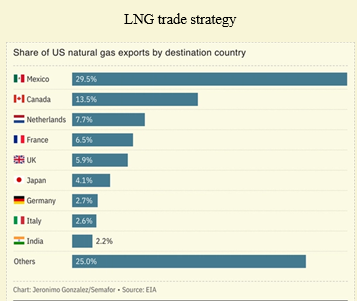
LNG Exports can Avoid Trump Tariffs: A growing number of countries are lining up to buy liquified natural gas from the US, in large part to avoid becoming a target for tariffs
IN THE NEWS
Major Hydrogen Players Say Preserve 45V Tax Credit – In a letter today, more than 100 Trade Associations, Hydrogen Hubs and companies urged Congress and the Administration to continue support for the 45V hydrogen tax credit as they propose next year’s budget. The letter’s signatories represent the full breadth of the hydrogen industry—spanning associations, business groups, Hydrogen Hubs, and corporate entities—all united in a common cause, including API, the American Chemistry Council, ACORE, the Business Council for Sustainable Energy, US Chamber of Commerce, CRES and Clean Energy Buyers Association, among many more. FCHEA initiated and led this effort, but it shows the industry speaking with one voice, unambiguously delivering a powerful message to our elected officials: robust and stable federal incentives are essential for a thriving hydrogen industry in the U.S. FCHEA President & CEO Frank Wolak:
“Creating and growing a hydrogen market is essential for increasing our domestic energy supply and strengthening U.S. energy security. Hydrogen’s versatility and reliability position the sector to support industrial corridors across the country, expand our energy economy, and leverage our natural resources. In order to fully realize these benefits, we need to preserve the accessibility of the 45V tax credit. Congress and the Trump Administration can provide the regulatory certainty needed to security American energy dominance and ensure we are positioned as a global hydrogen leader.”
Kendall Stephenson, Senior Manager, Policy, Global Energy Institute, U.S. Chamber of Commerce adding that the section 45V credit for production of clean hydrogen has the potential to drive economic growth and create thousands of new manufacturing jobs here in America.
“This potential has only increased with the release of final Treasury regulations recognizing the crucial role of natural gas as an enabler of the hydrogen economy. Maintaining the section 45V credit will attract the necessary investments to scale this industry, send market signals to increase domestic gas production, and supply industries in the U.S. and around the world a clean and versatile energy source. We look forward to working with the new administration to implement the final regulations.”
Sgamma Nominated to Head BLM – President Trump nominated Kathleen Sgamma, the president of the Denver-based Western Energy Alliance, to head the Bureau of Land Management, which governs the use of around 245 million acres of federal land in the West. Of course, those of us who have followed the oil and gas industry for all these years know Kathleen as a credible, knowledgeable industry advocate who understands energy policy, markets and politics. Sgamma’s nomination fits very well into the President’s current energy team because – just like her immediate boss Interior Secretary Doug Burgum and Energy Secretary Chris Wright – she is uniquely qualified; understands the issues BLM is facing clearly and knows the stakeholders on both sides. She will be a strong voice for the Administration’s energy agenda and understands that conservation and energy can co-exist in a rationale policy. In fact, she and Wright speak the same language as fellow M.I.T. alums. I’m sure, my friends in environmental community are NOT going to like Kathleen, but I would urge you to look through the rhetoric. Kathleen has been a strong supporter of initiatives to expand conservation and understands the necessary public lands balance between preserving land, respecting cultural and native issues and promoting energy opportunities.
Energy Dominance Council Officially Announced – President Trump signed an executive order today to establish a national energy dominance council today to steer U.S. energy policy and bolster domestic production, underscoring his commitment to energy independence and economic growth. Led by Interior Secretary Doug Burgum, with Energy Secretary Chris Wright as vice-chair, the council will coordinate federal energy initiatives, streamline permitting and address regulatory barriers. Positioned within the executive office, the council will shape policy across all energy sectors, including oil, gas, and electricity, with a focus on strengthening U.S. competitiveness in artificial intelligence through reliable power supply. Trump’s energy agenda prioritizes fossil fuels, aiming to reverse Biden-era regulations while leveraging a mix of government and private sector input to achieve energy dominance. The council mirrors past presidential energy task forces and is expected to play a key role in reshaping federal energy policy under a potential second Trump administration. It is clear, this Administration is focused on domestic energy production and projecting that dominance into the world’s energy markets. The Biden Administration used this tool to focus on climate. The Trump team is using this “whole-of-government” approach to focus aggressively on advancing energy production to expand our global reach, create jobs and economic opportunities and improve our energy security.
Partnership to Push Ethanol-to-Jet SAF – Gevo and jet fuel company Axens have formed a new strategic alliance to accelerate development and commercialization of sustainable aviation fuel (SAF) from ethanol. The goal of the alliance is to leverage Axens’ best-in-class and commercialized Jetanol™ technology and Gevo’s real-world experience, substantially de-risked technologies, plant integrations, and pre-engineered systems to the ETJ space. The parties are also combining their technical resources to accelerate commercialization of Gevo’s patented, next-generation ethanol-to-olefins (“ETO”) technology for further process and cost improvements.
IEA Says Electricity Will Boom – The International Energy Agency released its 2025 electricity report today, offering up analysis and forecasts on consumption through 2027. In the report, the agency estimated that demand will grow around 4% annually over the next two years. The surge in energy demand is primarily being driven by increased electrification of vehicles, data center construction and operation, and rising demand for air conditioning, IEA said. The agency said the trend toward higher electricity demand will be most predominantly seen in China, where consumption is projected to rise by around 6% through 2027. Similarly, the U.S. is anticipated to see major growth in electricity demand, with consumption expected to grow by the equivalent of California’s current power consumption.
Germany Set to Scale Down Climate Ambitions – Bloomberg reports that Germany has spent billions in subsidies to cut carbon emissions by two-thirds by the end of the decade. But at a time when climate concerns remain largely unresolved, Europe’s biggest economy is set to scale back those efforts – and cede its position as the bloc’s frontrunner in the energy transition. In a final push before Germans head to the polls on Feb. 23, the conservatives and Social Democrats have promised to reduce energy prices – a key issue for voters — but been light on details. “It’s not clear to me how this is supposed to work financially,” said Julia Metz, Program Lead Climate and Industrial Policy Germany at think tank Agora Energiewende. Reaching net neutrality will cost €93 billion annually through 2030, according to her organization, and “will not work without government incentive programs.”
Commonwealth LNG Permit Approved – DOE said Friday it has granted export authorization for the first approval of new LNG export project in Louisiana since they were put on hold by former President Biden a year ago. The project, which is being developed by Commonwealth LNG, is proposed for Cameron Parish, and would be able to export 9.5 million metric ton per annum of natural gas as LNG to countries that do not have a free trade agreement with the US. The authorization conditionally grants Commonwealth LNG authorization to export LNG to non-FTA countries from its Cameron Parish LNG project. In the order, DOE finds that LNG exports from Commonwealth LNG are likely to yield economic benefits to the United States, diversify global LNG supplies, and improve energy security for U.S. allies and trading partners over the course of the export term through 2050. DOE expects to issue a final order to Commonwealth LNG later this year.
SAFE Event at Munich Security Conference Focuses on Raw Material Supply, Security – Resilient critical minerals supply chains are crucial to Europe’s, the United States’, NATO’s and other allied nations’ security. While energy transition and technological needs have dominated the debate, military needs must become a priority. Recent export bans coming out of China have heightened the necessity to address this issue, as the country currently supplies large shares of many essential military components. On Friday, SAFE’s Center for Critical Minerals Strategy, the European Initiative for Energy Security (EIES) and its Energy Security Leadership Council held an exclusive event on the sidelines of the Munich Security Conference, Plowshares into Swords: Rethinking Raw Material Supply & Recycling for National and Economic Security. The dinner convened European and American leaders at the intersection of defense, energy, finance and minerals sectors to discuss the role that government, defense agencies, and financial institutions should play in building domestic and resilient supply chains that meet military and civilian needs. Leaders noted the key role recycling plays in reducing dependence on imports and strengthening domestic supply chains. Key takeaways from the event include:
- Defense agencies and procurement play a crucial role in ensuring secure critical mineral supply chains, but the success of their policies depends on market structure and demand dynamics. For certain minerals, the commercial sector is needed to drive sufficient demand to justify final investment decisions in essential projects.
- Defense agencies must intervene directly to ensure the supply of minerals with low commercial demand but essential defense applications, as has been done to boost domestic beryllium and titanium in the US.
- Other minerals – such as gallium or bismuth – are not directly mined but obtained as by-products of other industrial metals, with supply being therefore dictated by broader market dynamics, presenting both challenges and opportunities.
- Strengthening supply chains requires recognizing the linkages between civilian and military applications and ensuring that strategies account for both national security needs and broader industrial demand.
- Recycling policies limit exposure to geopolitical risks – including export restrictions from China - and can simultaneously benefit the defense and civilian industrial base.
ON THE SCHEDULE THIS WEEK
The Green Ammonia Innovation Ecosystem Forum Set – RMI hosts a webinar tomorrow at 10:00 a.m. to explore innovation within the green ammonia space. The event highlights large corporate case studies and groundbreaking startups developing low-carbon solutions, such as water electrolysis, plasma-catalytic synthesis, or technologies that can work at much lower temperature and pressure. It also details how entities like RMI’s Third Derivative are accelerating innovation in the field.
Carbon Forum Set – Energy Dialogues hosts energy leaders and carbon experts on Wednesday and Thursday in San Diego, California for the Carbon Solutions Forum. The event will explore the path to a lower-carbon energy future and the opportunities and challenges that lie ahead for the sector. Speakers will include for CFR expert David Victor, DOE Carbon official Ashleigh Ross, CARB Rajinda Sohata and many more.
Senate Environment Looks at Permitting – The Senate Environment Committee holds a hearing on Wednesday at 10:00 a.m. focused on improving the federal environmental review and permitting processes.
BCSE, BNEF Release Energy Factbook – The Business Council for Sustainable Energy and Bloomberg New Energy Finance will discuss its annual clean energy Factbook tomorrow at 2:00 p.m. in an embargoed presser. Each year, the Factbook provides comprehensive information and analysis on major energy facts and trends from the previous year. The Factbook includes energy statistics on market growth and contraction and analysis of trends in energy efficiency, natural gas, renewable energy, and other energy segments. The 2025 Factbook will look back on year-on-year dynamics, including the increase in energy demand driven by AI, data centers, and manufacturing, as well as how siting and permitting processes are impacting project development. Energy industry leaders will talk about how their businesses and the U.S. economy adjusted to changing circumstances and answer questions about the report and its findings. Speakers include BCSE’s Lisa Jacobson, BNEF’s Thomas Rowland-Rees, AGA’s Richard Meyer, ASE’s Paula Glover, NHA’s Malcolm Woolf, Sempra’s Allison Hull and many more.
EESI Looks at Colorado River – The Environmental and Energy Study Institute holds a virtual briefing on Wednesday at 2:00 p.m. focused the Colorado River. This briefing will focus on the role of federal policy in supporting stakeholders across the West as they address the impacts of drought and water stress through effective water conservation, measurement, and allocation. Panelists will discuss the importance of collaboration between tribes, industry, communities, and local and federal government to restore river vitality and ensure equitable water availability for generations to come.
Forum Looks at Geothermal – The Atlantic Council’s Global Energy Center and ClearPath holds discussion on Thursday at 10:00 a.m. on geothermal energy advancements and policy pathways. This event is part of a broader initiative supported by ClearPath to promote the development and deployment of enhanced geothermal systems across the United States. This event will focus on overcoming these barriers and exploring next-generation geothermal technologies to drive energy security and achieve critical economic and environmental goals. Speakers include a Keynote conversation with Colorado Gov. Jared Polis and a panel with experts including our friend Morgan Bazilian.
Forum to Release Global Energy Agenda – The Atlantic Council Global Energy Center will host an event on Thursday at 3:30 p.m. to launch a new edition of the Center’s annual flagship report, the Global Energy Agenda. DOE Undersecretary for Infrastructure Steve Winberg will Keynote.
NAS Panels Look at SCOTUS Decisions on Air – On Friday, my Bracewell colleague Jeff Holmstead will be participating in a panel discussion at the National Academies of Science (NAS) to discuss the implications of recent Supreme Court decisions, including Loper Bright, on EPA and other federal agencies responsible for protecting human health and the environment.
Forum Looks at Trump 2.0 Energy – On Friday at 11:30 a.m., the GW Security and Sustainability Forum holds a forum that delves into potential risks to the rule of law and administrative governance in the newly elected Trump 2.0 administration, particularly in light of recent Supreme Court rulings affirming presidential immunity for official acts.
Forum Look at Energy Transition – On Friday at Noon, Georgetown University's Program on the Political Economy of Latin America holds a discussion on the challenges of energy transition in Latin America and the Caribbean.
IN THE FUTURE
Axios to Host STEM Event – On Tuesday February 25th at 7:30 a.m. in The Showroom, Axios hosts an event convening policy and tech leaders for conversations looking at how the U.S. is working to maintain science and technology leadership in an increasingly competitive global landscape and new era of AI. We’ll discuss the importance of investing in training the next generation of STEM leaders, shoring up scientific education and building the infrastructure necessary for the U.S. to lead in the quest for new discoveries in science and technology. House Science Chair Brian Babin and ranking Dem Zoe Lofgren lead the discussion.
Forum Looks at Latin Mining – Resources for the Future (RFF) holds the “Lessons in Mining Sustainability in Latin America" webinar next Tuesday February 25th at 2:00 p.m. There will explore advances in sustainability around mining and community engagement in Latin America, some of the challenges in achieving these improvements, and what the rest of the world can learn from the Latin American experience.
CSIS Looks at Nuclear Blueprint – On Tuesday February 25th at 4:00 p.m., CSIS hosts for a discussion with former Deputy Undersecretary of Defense for Environmental Security Sherri Goodman, former Deputy Secretary of Energy Daniel Poneman and former Secretary of Energy Dan Brouillette on their new report with the Commission on Nuclear Energy and American Leadership: Nuclear Energy & American Leadership: A Blueprint for the Future.
ACORE Holds Policy Forum – The 2025 ACORE Policy Forum is set for February 26th and 27th in Washington DC. Topic include rising electricity demand , manufacturing and digital infrastructure buildout, domestic and global clean energy supply chains and permitting roadblocks limiting our ability to deploy critical transmission lines and clean energy projects. The ACORE Policy Forum will be a two-day event for the first time.
CSIS Launches Critical Minerals Book – On Thursday February 27th, the CSIS Critical Minerals Security Program will launch of a new policy book, Critical Minerals and the Future of the of the U.S. Economy. This event feature a discussion around policy recommendations for the most pressing challenges facing minerals security. The event will feature keynotes from Senator John Hickenlooper (D-CO) and Senator Todd Young (R-IN).
CSIS Hosts GM, Vale Metals Experts– On Friday February 28th at 10:00 a.m., the CSIS Critical Minerals Security Program holds a conversation with Vale Base Metals' Emily Olson and General Motors' Jasper Jung on the bilateral U.S.-Canada mineral relationship and its role in driving a competitive U.S. auto industry.
CRES to Host Geothermal Exhibition – CRES will host Geothermal House DC MAGMA on March 4th at Top of the Hill from 11:00 a.m. to 7:00 p.m. featuring a mix of panels, virtual reality experiences and networking, followed by a reception. MAGMA stand for: Making America Geothermal: Modern Advances. The event will feature how next generation geothermal can bolster U.S. energy security, creating economic growth and high-quality energy jobs, while providing clean baseload power supported by U.S. supply chains. Geothermal House is a unique, immersive educational experience, featuring live programming, a ‘Journey to the Center of the Earth’ virtual reality experience, geothermal themed food and drinks, spotlights on the movers and shakers building and funding the future of geothermal energy, and a few surprises in between.
CSIS Looks at Energy, AI – The CSIS Energy Security and Climate Change Program holds a conversation on March 5th with Vivian Lee, Managing Director and Partner at Boston Consulting Group (BCG) and Shanu Mathew, Portfolio Manager and Research Analyst at Lazard Asset Management. Vivian and Shanu will discuss the state of AI electricity demand, the implications of DeepSeek, the trend towards colocation, prospects for nuclear, and other key dynamics at the intersection of AI and electricity.
Forum Looks at Trump 2.0- Energy – On March 6th, the GW Security and Sustainability Forum holds a forum, part three of a series on Trump 2.0. To discuss, SSF will host one of the most respected voices in sustainability, energy, and societal resilience - Richard Heinberg. Heinberg is a Senior Fellow of Post Carbon Institute and the author of many award-winning books on energy and the environment.
CERA Week – The Energy Week of all weeks, CERA Week, will be Held on March 10th to 14th in Houston. We will see you at the Starbucks in the Frank Maisano CERA “Office.”
BCSE to Discuss AI in Forum – On Wednesday March 12th, the Business Council for Sustainable Energy (BCSE) will hold a roundtable discussion on what is needed next to boost energy supply and strengthen the grid. The event will look at the state of AI technology with AI experts and industry leaders – including key topics such as grid optimization and congestion solutions, data centers and industrial energy generators, utility partnerships and accelerating innovation:
Plastic Recyclers Head to DC for Conference – The Plastics Recycling Conference will take place March 24th to 26th at National Harbor, Maryland. The event brings together over 2,600 industry leaders to discuss the latest advancements in plastics recycling. This year’s agenda features sessions on market trends, innovations in sorting and processing technology, and policy developments shaping the industry. Speakers include executives from major brands, policymakers, and sustainability experts tackling challenges like integrating recycled content, scaling advanced recycling, and regulatory and legislative shifts. For the first time, the event will also host a concurrent Textile Recovery Summit, focusing on the intersection of plastics and textile recycling, with discussions on circularity, material innovation, and infrastructure development. This expanded programming highlights the evolving landscape of materials recovery and offers attendees a broader perspective on sustainable solutions.
Third SAFE Summit Set Focused on Critical Minerals, Energy Security – SAFE holds its 3rd annual SAFE Summit on Tuesday April 1st and 2nd. Speakers include Hyundai CEO José Muñoz, Schneider Electric’s Aamir Paul, ACP’s Jason Grumet and many more.
EPSA Competitive Power Summit Set – The Electric Power Supply Association holds its Competitive Power Summit on Wednesday April 2nd at the Grand Hyatt Washington. Speakers include PJM CEO Manu Asthana, Vistra CEO Jim Burke, Pennsylvania PUC Chair Steve DeFrank, NY ISO Rich Dewey and many more.