
Energy Update: Week of December 20th
Energy Update - December 20, 2021
Friends,
Whether or not you are a fan of Sen. Joe Manchin, yesterday was an interesting day. While he ruffled official Washington with his clear opposition to the Administration’s Build Back Better Budget Reconciliation Plan, our political and policy experts didn’t see much new in Manchin’s comments. In fact, our own Liam Donovan pointed out that the crash and reset on BBB was likely inevitable and now creates a better lane to return in January and really look for solutions that can be achievable…and maybe even bipartisan (although with our current political environment and tight margins, it is highly unlikely).
The White House response in a statement from Jen Psaki was a little tone deaf as well, pretty much blasting Manchin as a liar. Manchin has been pretty clear where he has been and, in fact, as Liam said, this reset could be helpful that it happened now rather than in January or February. Manchin pushed back more this morning on WV Metro News and it popular Talkline program with the legendary Hoppy Kercheval.
What does this mean for climate provisions in the BBB? Time will tell, but many of the provisions will likely re-emerge in one way or another given they are generally supported despite the politics. Perhaps it also creates a real lane for a better approach as argued by House Energy Chair Frank Pallone, Reps. McKinley and Schrader and Congressional conservatives like John Kurtis and Dan Crenshaw that suggest a legislative approach that can garner bipartisan interest in addressing climate solutions. The bottom line: the road to climate successes was paved in December 2020 when Congress passed the most significant climate legislation ever. These climate provisions – for the most part – are popular and will find a way to resurface.
Only one big event this week: a USEA two-day event on hydrogen provisions emerging from the recent Bipartisan Infrastructure Act and BBB Bill. The webinar will consist of four panels over a two-day period and feature Air Liquide’s David Edwards, FCHEA head Frank Wolak and Plug Power’s Sanjay Shrestha tomorrow, and my Bracewell colleague Tim Urban on tax issues Wednesday.
Also, there is a new analysis for the North American Building Trades Union (NABTU) that says only two of the 18 most prevalent natural gas and oil industry jobs are reasonably transferable to the 18 most in-demand renewable energy jobs. Good details below.
Remember to mark your calendars for the second week of January for key “State of” events from API, AGA, the US Chamber and USEA.
No update next week and probably on January 2. We will be paying attention in case anything happens.
Please enjoy the holidays with family and friends and re-charge for 2022. And above all, be careful out there with COVID issues re-emerging in force. Make sure you do your best to stay safe and healthy.
Best,
Frank Maisano
(202) 828-5864
C. (202) 997-5932
FRANKLY SPOKEN
“Over the past 10 years there have been three certainties in life: death, taxes and lower prices for solar panels. It’s not so evident that is the case today."
Nick Parsons, head of research at Switzerland-based investment firm ThomasLloyd Group in the Wall Street Journal in a story about inflation impacting clean energy
ON THE PODCAST
Political Climate on Clean Energy Journalism w Amy Harder – In this episode of the Political Climate podcast, host Julia Pyper, along with co-hosts Brandon Hurlbut and Shane Skelton, speak to our friend Amy Harder about some of the latest clean energy trends and challenges in the race to net-zero emissions. A longtime climate and energy journalist, Harder is used to covering — and continues to cover in her role as executive editor at Cipher, a recently launched news publication backed by Bill Gates’ Breakthrough Energy. Listen and subscribe to Political Climate on Apple Podcasts, Spotify, Stitcher or wherever you get podcasts. Follow on Twitter at @Poli_Climate.
FUN OPINIONS
WSJ Manchin Saves Democrats – In an editorial in the Wall Street Journal, the board takes on Manchin’s position in Build Back Better saying it is a service to the country, sparing Americans from huge tax increases and new entitlements that would fan inflation and erode the incentive for Americans to work. “Paradoxically, it is also a blessing for Democrats if they get the message, and it offers President Biden a chance to reboot. The silver lining for Democrats is that this gives them a chance to face political reality before they leap off a cliff. The Democratic left must now confront the limits of their power. Mr. Sanders and Elizabeth Warren thought they could bully their agenda through a 50-50 Senate, though they had both lost to Mr. Biden in the 2020 primaries. Their failure to narrow their ambitions doomed the bill.
FROG BLOG
Banning Oil/Gas Exports Is Bad Policy – In a Forbes column, energy expert Robert Bryce says the New York City Council passed a measure that will nearly double winter heating costs for residents of NYC. Bryce: "the hard reality is that natural gas bans will act as a regressive energy tax on poor and middle class.” He concludes that the City’s ban on gas is not just atrocious public policy, it is dangerous public policy. “Attempting to electrify everything, including heating and cooking, is a recipe for increased inequality, decreased energy security, and decreased societal resilience. That’s a dubious trifecta.”
FUN FACTS
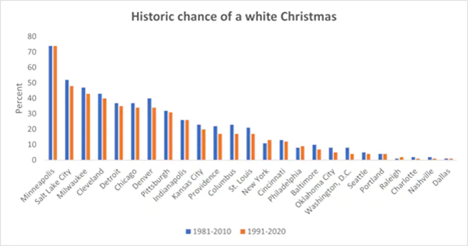
White Christmas: The Washington Post analyzed NOAA’s white Christmas data in the 25 biggest cities, from Seattle to D.C., and, unsurprisingly, found declines in most of them.
- 18 of the 25 cities saw their chance of a white Christmas decrease; Denver and Columbus saw the largest drops (six percentage points). D.C.’s odds of a white Christmas plummeted from around 8 percent to just a little over 4 percent.
- Four cities’ chances were unchanged (Minneapolis, Indianapolis, Portland and Dallas)
- Three saw their chances increase, but only by one or two percentage points (New York, Philadelphia and Raleigh)
IN THE NEWS
All Manchin, All The Time – Here is Bracewell’s take on the latest Manchin Twist:
Yesterday, Senator Joe Manchin (D-WV) indicated to Brett Baier of Fox News Sunday that he is currently a “no” on the Build Back Better Act, President Biden’s sweeping economic agenda.
Liam Donovan’s Bottom Line:
It goes without saying that opposition from Joe Manchin dooms the Build Back Better reconciliation package, at least in its current iteration. Whether Democrats can regroup and offer a slimmed down, reconfigured form of the Biden agenda that can pass muster with the West Virginia Senator remains to be seen. At some level, the flare-up isn't particularly surprising. The House passed Bill was always nonstarter with Manchin, and key changes were universally understood to be required. But clearly President Biden and progressives had held out hope that they could compel Manchin's support with only marginal tweaks. Today's escalation reflects Manchin's exasperation with the fact that his copartisans have not heeded his consistent warnings and clear concerns regarding the size and scope of the bill. Think of his Fox News appearance, and the lengthy statement his office had at the ready, as a bazooka across the bow. But it also underscores the guiding principle we have long espoused--anything that happens via reconciliation will be on Manchin's terms. Failure to accept this simple reality is a recipe for futility. As President Biden and his congressional allies gaze into the legislative abyss in the coming weeks, they'll have to rethink their strategy and come up with a new approach to woo Manchin and salvage their agenda in the new year.
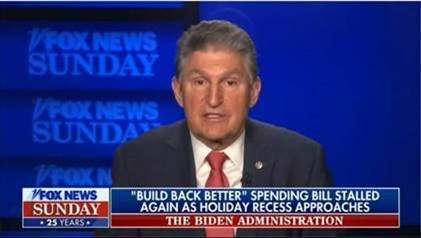
View Full Video HERE.
Brett Baier: Senator, you are at the center of this negotiation with the President over his social spending and tax bill, the Build Back Better bill, that is not coming up in the Senate before the new year, in part and largely because of your reservations about it. Currently, the leadership doesn’t have the votes it needs. So, today, right now, what is the state of play?
Senator Manchin: Well Brett, this is a mammoth piece of legislation and I have had my reservations from the beginning when I heard about it five and a half months ago. I have been working diligently every day and every minute of every day. I have been meeting with everyone, whether it be President Biden, Majority Leader Schumer, their staff, whether it be Nancy Pelosi, all of my colleagues from all different parts of the political spectrum, from the right and the left. I have done everything humanly possible. You know the concerns that I’ve had, and I still have these concerns. Where I am at right now, the inflation that I was concerned about is not transitory, it is real and it is harming every West Virginian, and it is making it almost difficult for them to continue, to go to their jobs. The cost of gasoline, the cost of groceries, the cost of utility bills, all of these things are hitting them in every aspect of their life. You start looking and then you have the debt that we are carrying at $29 trillion, you have the geopolitical unrest that we have, the Covid variant, and that is wreaking havoc again and people are concerned. I’ve been with my family, I know everyone is concerned. When you have these things coming at you the way they are right now, I’ve always said that if I can’t go home and explain it, I can’t vote for it. I cannot vote to continue with this piece of legislation. I just can’t. I’ve tried almost everything humanly possible. I can’t get there.
Brett Baier: You’re done. This is a no.
Senator Manchin: This is a no on this legislation. I have tried everything I know to do and the President has worked diligently, he has been wonderful to work with. He knows I’ve had concerns and the problems I’ve had. The thing we should all be directing our attention towards is this Covid variant that we have coming back at us in so many different ways. It is affecting our lives again. We have inflation that could really harm a lot Americans, and especially those who are most needy and are having a hard time struggling right now. I think that is where our attention needs to be directed towards immediately. This has been going on for five and a half months.
From Friday and Liam’s Take – President Biden and congressional Democrats bowed to an increasingly clear reality this week, acknowledging that consideration of their signature Build Back Better (BBB) legislation would slip into the new year. Loyal readers of this space will not be surprised by the development, as the Christmas goal has been on shaky ground at best since Congress returned from the Thanksgiving break. While the nominal reason for the delay is that the parliamentary process will not conclude in time, the fact is that Democrats do not yet have the consensus needed to move forward. And with longstanding concerns from Senator Manchin made new again in the form of the duration of the expanded Child Tax Credit, agreement remains as elusive as ever.
So what does it mean?
This should not change your outlook on the likelihood of passage. The surprise here isn’t Joe Manchin, who has been remarkably consistent in his concerns and demands. The idea that he could be pressured into simply going along with the rest of the caucus and settling for minor changes on an abbreviated timetable was always suspect. There is a deal to be had, as ever, but it will be on Manchin’s terms. The quicker Biden and the rest of the party come around to this realization, the sooner they’ll move a bill.
Failure is not an option. Progressives won’t love it, and acceptance may require another very public cycle of grief as we saw in the fall, but at this point the House is resigned to passing whatever can clear the Senate; corralling Bernie Sanders (e.g.) as the 50th vote for a Manchin-centric bill is a far easier proposition than the inverse. This is the last best chance for Democrats to capitalize on their trifecta, and a(nother) trillion dollar bill is better than nothing, contrary to some of the rhetoric coming from the far left. Manchin is the only Democratic Senator who can abide failure, but if that were his objective, he could have stopped the bill in its tracks at any point throughout the year. The fact that more granular negotiations on specific provisions continue to play out is a good sign that Manchin wants to get to yes and is not seeking to torpedo the effort altogether.
Congress can (and does) legislate in election years. One of the biggest tropes in Washington is that nothing gets done in a campaign year, but when the balance of power and circumstances align, Congress has been known to do big things. From the CARES Act just last year, to the Affordable Care Act in 2010, to Welfare Reform in 1996, there is ample evidence that a motivated majority can work its will. Democrats will need time to work their way through the current impasse, but otherwise such calendar considerations are incidental.
Timing. The most obvious waypoint on the horizon is the need to fund the government by February 18. Democrats will want to get it done by then, if not well in advance, in order to make room for negotiations on a broader spending package. The White House will also have to navigate the President’s first State of the Union address—smooth passage would render the speech a prime time victory lap, while further delay would turn it into an opportunity to make the hard sell, both to the viewing public, and the Members in the room. It should be noted that the timetable also has serious administrative implications, with questions of retroactivity already on the minds of taxpayers.
Unknown unknowns. Perhaps the biggest risk in delay is that it allows for events to intercede. The latest COVID surge serves as a good reminder that we remain at the mercy of factors beyond our control.
At the end of the day, there is simply no reason that Democrats can’t satisfy Manchin, strike a deal, and take the win. Exactly when that happens is almost entirely up to President Biden, who will need to sign off on the terms and sell them to the rest of the party.
EPA today announced its final rule for greenhouse gasses for light-duty vehicles, the most stringent to date. The standards, which will apply to model years 2023-2026, are projected to avert over 3 billion tons of carbon dioxide emissions, equivalent to the majority of nationwide emissions in 2019, between now and 2050.
Union Study Says Not Many Oil, NatGas Jobs Transferable to Renewables – The North American Building Trades Union and API released a new study that found that only two of the 18 most prevalent natural gas and oil industry jobs are reasonably transferable to the 18 most in-demand renewable energy jobs. Key details from the study:
- Quality and Pay: A number of renewable energy jobs, such as those in wind and solar, are more likely to use less-skilled workers, or those from a narrower selection of trades, compared to natural gas and oil construction and maintenance projects. Currently, many readily available renewable energy jobs typically do not have comparable pay with natural gas and oil jobs – meaning that many transitioned workers likely would face pay cuts.
- Requirements: Many natural gas and oil workers would face significant challenges in transitioning to a number of renewable energy jobs that have lower skillset and education requirements.
- Availability: The most prevalent natural gas and oil jobs employ 10 times as many workers as there are average annual job postings for the most in-demand renewable energy occupations. Even when skills and quality are aligned, there may not be sufficient concentrations of renewable energy jobs in the top regions where natural gas and oil jobs are located.
Cruz Secures Vote on Nordstream 2 – Late Friday, the Senate locked up an agreement to confirm around three dozen nominees for ambassadorships and senior State Department positions, ending a stalemate between Sen. Ted Cruz and Majority Leader Chuck Schumer. The agreement between Cruz and Schumer also sets up a vote in January on Nord Stream 2, the Russia-to-Germany natural gas pipeline. Cruz had been slow-walking dozens of foreign policy nominees over the Biden administration’s decision to waive sanctions on the pipeline, forcing Schumer to use valuable floor time on the nominees or cut a deal with Cruz. Cruz agreed to lift his holds on 32 nominees in exchange for the Senate voting in early January on his legislation to sanction the pipeline, which the U.S. opposes but decided not to sanction in order to preserve relations with Germany.
Western Reliability Problems This Summer – The North American Electric Reliability Corp (NERC) said in a study that there is a high probability of insufficient resources and energy to serve electricity demand as early as summer 2022 in many parts of the Western Interconnection, which includes California and other states in the U.S. West. The study projected that California, parts of the northwestern and southwestern United States and the Midcontinent Independent System Operator (MISO) areas could experience capacity shortfalls and periods of insufficient energy due to declining reserve margins and generator retirements over the next 10 years.
ON THE SCHEDULE THIS WEEK
Forum to Look at Building Collapse – The Environmental Law Institute holds a forum today at Noon on the collapse of the Champlain Towers South Condominium Complex in Surfside, Florida questions raised about climate change and how environmental impacts may cause structural damage to coastal buildings. Expert panelists will hold in-depth exploration of the risks to coastal communities and buildings from the climate crisis and an analysis of the collapse that occurred in Surfside, Florida.
USEA to Discuss Hydrogen – The US Energy Assn (USEA) and Orrick are co-hosting a two-part series of webinars on tomorrow at 2:00 p.m. and Wednesday at 3:00 p.m. on hydrogen provisions emerging from the recent Bipartisan Infrastructure Act and the pending Build Back Better Bill. The webinar will consist of four panels over a two-day period. The panels will be on (1) the national strategy for hydrogen; (2) an in-depth analysis at electrolysis options; (3) the evolution of the Hydrogen Economy; and (4) tax incentives for hydrogen production and storage. Representatives from the Fuel Cell & Hydrogen Energy Association, NEL, NREL, Plug Power, Princeton University, and leading advisory firms will participate the in panels. Moderators will be Peter Connors; Partner; Orrick, Herrington & Sutcliffe; and Michael Moore, Program Director, United States Energy Association. Air Liquide’s David Edwards, FCHEA head Frank Wolak and Plug Power’s Sanjay Shrestha are among the speakers tomorrow, while my Bracewell colleague Tim Urban speaks on tax issues on Wednesday.
IN THE FUTURE
State of American Business Set – The US Chamber hosts its annual 2022 State of American Business on Tuesday January 11th.
Forum to Look at Clean Energy Initiatives – On Tuesday January 11th at Noon, the Historically Black Colleges and Universities Clean Energy Initiative (CEI) and the National Association of State Energy Officials are partnering to host the first in a series of discussions to examine and advance opportunities for HBCUs and State Energy Offices to forge new partnerships, relationships, and innovations. The events will look at in the context of upcoming federal and state investments across key sectors – the electric grid, renewable energy, energy efficiency, transportation, and agriculture. Presentations and facilitated conversations will unpack the workforce, economic development, and equity implications of state planning, policy design, and implementation of clean energy and climate solutions.
API Hosts State of Energy – The American Petroleum Institute and Energy Citizens hosts its 13th annual 2022 State of Energy forum on Wednesday January 12th at 10:00 a.m. The event will shine a light on the role of American energy in building a better future. In a virtual setting, they will discuss the actions and initiatives the U.S. natural gas and oil industry is taking to protect American jobs, maintain our energy security and keep us globally competitive.
Forum Looks at Extreme Weather – The Environmental and Energy Study Institute (EESI) holds a briefing on Wednesday January 12th at 11:00 a.m. looking at federal policies and programs supporting innovation in weather forecasting, an essential capability to help communities prepare for and adapt to extreme weather. During this briefing, experts will discuss the policies and programs that guide public-private partnerships, emerging weather forecasting technologies, and new business models enabling the government to more effectively tap into private-sector innovation across the weather forecasting value chain. Former NOAA Administrators Kathy Sullivan and Timothy Gallaudet are among the speakers.
AGA to Release Net Zero Vision – On Thursday January 13th, the American Gas Assn will holds its annual new Chair briefing where they will roll out a major new Net Zero vision and policy.
USEA Hosts State of Energy Industry – The US Energy Assn holds its 2022 State of the Energy Industry Forum on Thursday January 20th. The annual event features CEOs from nearly every major trade association as they share their policy objectives and priorities for 2022.
EV Charging Summit Set – The National EV Charging Summit will be held on January 20th and is part of a year-long effort to stand up an unprecedented coalition to support federal action on a national charging network for light-, medium- and heavy- duty vehicles. The National EV Charging Initiative brings together automakers, power providers, electric vehicle and charging industry leaders, labor, and public interest groups to signal they are ready, willing, and able to act now. Members are collaborating to accelerate shovel-ready charging infrastructure projects that will put people to work, infuse the economy with billions of dollars of investment, and increase access to clean transportation.
Forum to Look at Nuclear Energy Supply – The Nuclear Energy Institute holds its Nuclear Fuel Supply Forum on January 26th at Noon to explore policy issues related to nuclear fuel at the half-day Nuclear Fuel Supply Forum. Speakers from key government agencies and organizations that shape policy and evaluate the direction of the markets will present their latest insights on the future of the industry.
Ethanol Conference Set – The Renewable Fuels Association holds the National Ethanol Conference (NEC) in New Orleans on February 21st to 23rd. Since 1996, the NEC has been recognized as the ethanol conference for the latest, timely information on marketing, legislative and regulatory issues facing the industry. With numerous networking opportunities, more business meetings are conducted and contacts made at this conference than at any other ethanol conference.