
Energy Update: Week of December 18th
Energy Update - December 18, 2023

Happy holidays to all… This our last report for 2023! Hard to believe the year went so fast. But we had a lot going on.
First, let’s check in on what happened late last week with SAF tax guidance. The IRS issued initial parameters on a tax incentive under the IRA targeting qualifications for a tax credit for sustainable aviation fuels. The IRA created a new tax incentive for the sale and mixture of sustainable aviation fuel for this year and next. There has been a significant debate how to track the lifecycle emissions of SAF, with environmental, aviation and biofuels groups divided. This is important and our friends at Gevo, one of the largest current SAF producers in the Industry, can provide a sense of the impacts. Happy to connect you this week.
For this week, we expect the IRS to deliver on tax guidance for hydrogen with the 45V tax credit. There has been a lot of ink spilled already on this issue so we are looking forward to what actually will come out. All indications are to expect something Friday (of course). We will be ready to help with background, impacts, contexts and comments.
EPA 111 power plant rule comments are due this week so expect a flurry of comments there. And as a result of the order issued by the 5th Circuit on Nov. 14, BOEM has scheduled Lease Sale 261 for Wednesday. Remember, Interior cancelled this sale in 2022, but then Congress required them to hold it through IRA. Then, Interior attempted to impose vessel restrictions and remove acreage AND continued to delay the sale, claiming it was because of litigation. This is on top of last week’s final 5-year plan announcement, which API blasted as step in the wrong direction that “fails to meet the energy needs of the American people and could threaten to increase reliance on foreign energy sources.” Finally, Rystad Energy says in a new analysis that in less than a decade, the US has become the largest exporter of LNG in the world. The study adds that despite recent progress in shoring up energy security following Russia’s invasion of Ukraine, Europe could still face a looming natural gas supply gap in the coming decades.
The Senate remains in only to try and lock up Ukraine, Israel and border funding, which the House most likely will take up when it returns in January. The House also passed an extension of Federal Aviation Administration authorization through March 8, which the Senate must match.
Finally, with COP wrapping up last week, tomorrow at 10:00 a.m., POLITICO, E&E News and POLITICO EU reporters discuss the takeaways from this two-week conference. Then Thursday, Reuters Events holds discussion to explore the challenges and opportunities of grid transmission for offshore wind with our friend Rob Gramlich.
Finally, I have added a couple of new podcasts today from the Madam Policy COP 28 in 8 series. They are very interesting podcasts that give you some great perspective on the just completed COP 28 meeting from key players at the event.
Have a great holidays and enjoy the time with family friends. We will see you in 2024.
FRANKLY SPOKEN
“The energy transition starts and begins with metals. You can’t build the renewables or the EVs or the batteries without them, so seabed mining offers some attraction.”
Julian Kettle, a senior vice president at the energy research firm Wood Mackenzie in a Houston Chronicle article on deep sea mineral collection.
ON THE PODCAST
C&EN Podcast Looks ta Deep Seas Minerals – In its Stereo Chemistry podcast, Chemical & Engineering News reporter Priyanka Runwal chats with host Craig Bettenhausen about the complex issue of potato-sized nodules of valuable minerals that are more or less up for grabs. You can also read Runwal’s initial story here.
Madam Policy Cop 28 in 8 Series – The COP28 in 8 series is a series where we have 8-minute conversations with the women involved with COP28 in Dubai.
Business Leader Has be to More than 20 Cop meetings – President of the Business Council for Sustainable Energy and policy powerhouse Lisa Jacobson joins Madam Policy from Dubai for the 28th UN Climate Change Conference, or COP28. Lisa talks about BCSE’s role as a 65-member trade association representing the energy efficiency, natural gas, and renewable energy industries on the world stage. We also hear more about BCSE’s Sustainable Energy in America Factbook, the invaluable resource for government officials, stakeholders, and thought leaders.
SAF Advocate Lindsay Fitzgerald Joins Madam Policy Podcast from COP 28 – Top advocate for renewables and GEVO Vice President of Government Affairs Lindsay Fitzgerlad joined Madam Policy’s COP 28 in 8 series upon her return from COP28, sharing her insight and wisdom! As a leading renewable chemicals and advanced biofuels company, GEVO’s commitment to sustainability was front and center at COP28. Join host Dee Martin as she talks to Lindsay about her “aha” moment when the polices she’s been championing were embraced by US and foreign leaders at the COP. Want to learn more about the role of sustainable aviation fuel (SAF) in decarbonizing air travel? The role of sustainable agriculture in lower emissions?
FUN OPINIONS
Duncan: Reliable Power Important Priority as We Get Greener – In an op-ed in Fox News Opinion, House Energy, Climate and Grid Security Subcommittee chairman Jeff Duncan writes most of my colleagues and I support renewable energy from sources like wind, solar, geothermal, and, potentially, hydrogen. We also support clean, renewable energy that comes from one of the oldest sources of energy production — hydropower. Renewables will be a part of our energy matrix, but they must work in tandem with always-on baseload power generation. This is due to renewables’ ability to only generate power intermittently, not 24/7/365. From households to municipalities to manufacturing, America relies upon always-on, always available electricity 24 hours a day, seven days a week, 365 days a year. Let’s be clear, we cannot put all our eggs into the basket of renewable generation without having significant, always available generation. Today, that means we should focus on replacing retiring power plants with adequate natural gas generation to meet our growing nation’s power needs and do so in a way that our utilities can provide affordable electricity for their customers.
FROG BLOG
McGinn: Expanding Grid Capacity Is Mission Critical – In a blog in Stars & Stripes, retired Vice Admiral and assistant secretary of the Navy for Energy, Installations and Environment Dennis McGinn writes it is mission critical to expand US electric grid capacity. Studies show the nation’s aging and balkanized electric grid is increasingly vulnerable and inadequate in the current threat environment.
In recent years, extreme weather, saboteurs and cyberattacks have threatened domestic energy infrastructure, the economy and American lives. And despite requirements for energy security and mission readiness, the military is not immune to these threats. More than 98% of Department of Defense installations are reliant on the civilian electric grid for power.
FUN FACTS
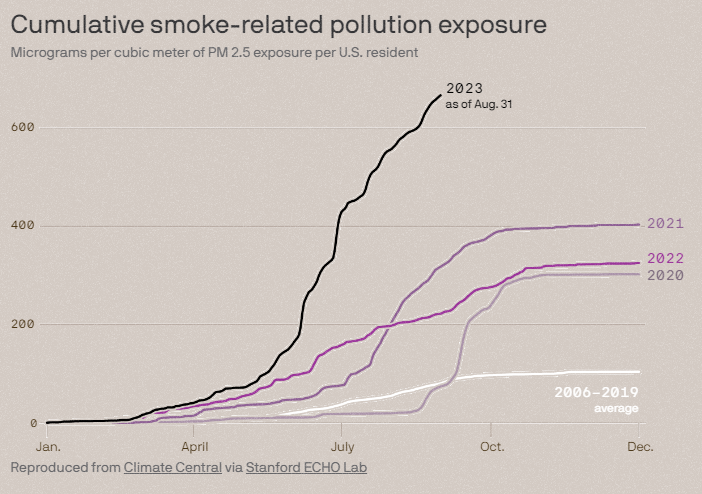
Canadian Wildfire Impact on Air Pollution: The 2023 wildfire season more than doubled the previous record for fire-related air pollution in the U.S. The average American was exposed to 66% more air pollution than in 2021, the second most polluted year, driven by the worst wildfires in Canada’s history, according to data from the Stanford Environmental Change and Human Outcomes Lab. Axios put the data together and has more here:
IN THE NEWS
SAF Model Changed for Lifecycle Analysis Hinted by Treasury – US Treasury issued initial parameters on a tax incentive under the IRA targeting qualifications for a tax credit for sustainable aviation fuels. The Inflation Reduction Act created a new tax incentive for the sale and mixture of sustainable aviation fuel for this year and next. There has been a significant debate how to track the lifecycle emissions of SAF, with environmental, aviation and biofuels groups divided. Here are comments from Gevo CEO Patrick Gruber:
Today’s guidance is a much-needed step forward for SAF investment and innovation. Designating GREET for the 40B credit sets an accurate, science-based precedent for transparent carbon accounting across the SAF supply chain, from farm fields to the end use of the fuel. The details and certainty matter. Therefore, we look forward to reviewing the complete GREET update upon release to ensure it maintains the data-driven integrity, especially on indirect emissions, necessary to support SAF investment, properly value agriculture’s contributions and cut aviation emissions. We also thank the Administration for its advocacy for climate-smart agriculture and the tools and policies that recognize and account for U.S. farmers’ stewardship of the land and contribution to cleaner flight,”
SAF with greenhouse gas emissions that are least 50% lower than conventional aviation fuel will qualify for tax credits created by the Inflation Reduction Act (IRA). The current Argonne National Laboratory Greenhouse Gases, Regulated Emissions and Energy use in Technologies (GREET) lifecycle analysis method and model, with its Carbon Calculator for Land Use Change from Biofuels Production (CCLUB) and its Feedstock Carbon Intensity Calculator (FD-CIC) tools, enables more precise measurement of SAF carbon intensity, accurately counting carbon reduction benefits of agricultural feedstocks at the field level. Treasury is expected to release a final GREET model that will be used for the tax credit no later than March 1, 2024. Happy to connect you with Gevo if you want to follow up on the details.
Interior Releases 5-Year Oil, Gas Drilling Plan – The Interior Department released the smallest offshore oil program in U.S. history Friday, a move that’s already provoked both outrage from Congressional Republicans and disappointment from climate activists who had urged the president to take more dramatic action. Over the next five years, the Interior Department will hold just three oil auctions of drilling rights in the Gulf of Mexico, where most of the nation’s oil and gas production occurs. The agency first announced its plans for the next five years of offshore drilling in September. API’s Holly Hopkins said this final 5-year program fails to meet the energy needs of the American people and could threaten to increase reliance on foreign energy sources.
“Demand for affordable, reliable energy is only growing, yet the administration is choosing to limit future production in a region that plays a critical role in powering our nation and supplies among the lowest carbon-intensive barrels in the world. This program is a step in the wrong direction for U.S. energy security and will only make it harder to meet growing energy demand over the long-term.”
For 45 years, the Interior Department has been required to prepare a five-year offshore leasing program that will best meet America’s energy needs for the ensuing five-year period, detailing a schedule for regular oil and natural gas lease sales, including in the Gulf of Mexico. Interior released the final five-year program for federal offshore leasing in September, but the program is required to be reviewed by Congress for 60 days before it is finalized. Interior’s final five-year program was nearly 500 days late and outlines a maximum of three potential oil and gas lease sales – the fewest oil and gas lease sales in history – in the Gulf of Mexico Program Area scheduled in 2025, 2027 and 2029. 2024 will be the first year since 1966 without an offshore lease sale.
New Study: U.S. LNG Critical to Addressing European Supply Gap – Speaking of oil/gas, LNG and the 5-year plan, Rystad Energy says in less than a decade, the US has become the largest exporter of LNG in the world, establishing America as a cornerstone of global energy security and driving local economic development in a new analysis for API and the International Association of Oil and Gas Producers (IOGP) The study adds that despite recent progress in shoring up energy security following Russia’s invasion of Ukraine, Europe could still face a looming natural gas supply gap in the coming decades.
California Extends Diablo Nuclear Plant – The State of California’s energy regulators voted to allow the Diablo Canyon nuclear plant to operate for an additional five years. CPUC extended the shutdown date for the state’s last functioning nuclear power facility through 2030 instead of closing it in 2025 as previously agreed. Separately, the federal Nuclear Regulatory Commission will consider whether to extend the plant’s operating licenses. The news is certain to offend environmental activists who want to plant closed.
DOE Releases Infrastructure Funding for Carbon Capture – The Department of Energy announced $890 million from the bipartisan Infrastructure Investment and Jobs Act (IIJA) to developers of three large-scale carbon capture projects in North Dakota, California and Texas. Projects selected for award negotiation include:
- Baytown, TX Carbon Capture and Storage Project: The Baytown Carbon Capture and Storage Project plans to capture CO2 from the Baytown Energy Center, a natural gas combined-cycle power plant. The CO2 will be transported using new and existing pipelines and sequestered in storage sites on the Gulf Coast. The project is evaluating the use of greywater cooling to minimize freshwater consumption by reusing wastewater. Calpine leads this project and has partnerships with Minority-Serving Institutions to support equitable job access and workforce development. Calpine plans to develop a Community Benefits Agreement and will include third party monitoring and validation of its Community Benefits Plan to support accountability and transparency.
- Project Tundra Center, ND: Project Tundra is a carbon capture system that will be developed adjacent to the Milton R. Young Station, a coal-fired power plant near Center, North Dakota. The captured CO2 will be safely and permanently stored in saline geologic formations beneath and surrounding the power plant. Project Tundra is led by the project sponsors of Dakota Carbon Center East Project LLC, which includes Minnkota Power Cooperative and TC Energy, and was formed to facilitate investment in and development of Project Tundra. Planning has already begun for the Community Benefits Agreements and other related agreements with impacted communities. Other related workplace and environmental concerns are being addressed, which support rural quality of life issues while also allowing for responsible project development. Project sponsors have engaged organized labor to discuss the prospect of negotiating a Project Labor Agreement and are committed to the continued engagement of stakeholders throughout the development process.
- Sutter Decarbonization Project Yuba City, CA: The Sutter Decarbonization Project will demonstrate and deploy a commercial-scale carbon capture system at the Sutter Energy Center, a 550-megawatt natural gas combined-cycle power plant. The project will then transport the CO2 and sequester it permanently and safely more than a half a mile underground in saline geologic formations. This project will be the first in the world to deploy an air-cooling system at a carbon capture facility, which will eliminate the use of cooling water and significantly minimize freshwater usage—a critical concern of the local community.
Treasury Releases Advanced Manufacturing Tax Credit – The U.S. Treasury Department issued guidance on the Advanced Manufacturing Production Tax Credit saying the new Section 45X provides a credit for the production (within the United States) and sale of certain eligible components, including solar and wind energy components, inverters, qualifying battery components and applicable critical minerals. ACP said in the last 16 months alone, the U.S. clean energy sector has announced 112 new or expanded U.S.-based utility-scale solar, wind, and energy storage manufacturing facilities—equivalent to a U.S. facility being announced every four days. These facilities will create more than 41,000 new American jobs across the country.
“Today’s guidance is a critical next step for U.S. manufacturers as they work to make announced facilities a reality. By creating and expanding supply chains to make clean energy technologies here at home, we will strengthen America’s energy security, create good-paying American jobs, and boost the nation’s economy.”
ON THE SCHEDULE THIS WEEK
Forum Targets COP, Climate, Food Security – The CSIS Global Food and Water Security Program holds a forum today at 11:00 a.m. on COP28 outcomes, including the importance of investing in small-scale producers to support global food security. CSIS welcomes U.S. Special Envoy for Global Food Security Dr. Cary Fowler and IFAD Associate Vice President for External Relations and Governance Satu Santala, joined by Director of the CSIS Sustainable Development and Resilience Initiative Noam Unger for this panel discussion.
E&E, POLITICO Reporters Discuss Cop 28 Takeaways – The COP28 Summit ended on December 13th, as negotiators hashed out the details on what to do about the future of fossil fuels, the role of nuclear, and where pledges stand to support climate-vulnerable developing countries. Tomorrow at 10:00 a.m., POLITICO, E&E News and POLITICO EU reporters discuss the takeaways from this two-week conference.
DOE Tackles Thermal Energy – Tomorrow at 11:00 a.m., DOE holds a forum on using thermal energy in commercial buildings. Thermal energy storage can contribute to both energy savings and load flexibility in buildings and is an effective way to improve a building’s system and loads. Join to learn more about thermal energy storage and gain insights from example projects exploring this opportunity.
Forum Looks at COP28 Global Stocktake – The AU Institute for Carbon Removal Law and Policy holds a forum tomorrow at 1:00 p.m. on carbon dioxide removal developments at COP28. COP28 addressed carbon removal including language in the First Global Stocktake under the Paris Agreement, major announcements of new funding for carbon removal initiatives, and a large number of events focused on the role of carbon removal in the climate response portfolio.
DOE Talks Geothermal – DOE holds a forum tomorrow at 1:00 p.m. on developing state regulations for georthermal projects. NREL researchers to discuss the recent report "Topics and Considerations for Developing State Geothermal Regulations."
Forum Looks at Workforce Issues – The Aspen Institute holds a virtual discussion tomorrow at 2:00 p.m. on the role of local workforce investment boards in fostering an innovative, agile and equitable workforce development ecosystem. The forum will focus on Alamo County, Texas.
Reuters Looks at Grid Integration for Offshore Wind – On Thursday at 11:00 a.m., Reuter Events holds discussion to explore the challenges and opportunities of grid transmission for offshore wind with our friend Rob Gramlich and FERC’s Kathleen Ratcliff. Topics Include using integration technologies like HVDC transmission and VSC technology to improve grid reliability and facilitate widespread offshore wind energy incorporation into the existing structure, enhancing the alignment of regulations and markets to support the development of a resilient and efficient offshore wind transmission network and engaging stakeholders to build support for transmission infrastructure.
IN THE FUTURE
State of American Energy Event Set – The American Petroleum Institute holds its annual State of American Energy Forum on Wednesday January 10, 2024 at Capital Turnaround. API’s Mike Sommers will discuss the state of the industry and the event will also feature panels with experts and Congressional Leaders.
State of American Business Set – The US Chamber of Commerce holds its annual State of American Business Address on Thursday, January 11th at 11:00 a.m. Chamber President/CEO Suzanne P. Clark will celebrate the power of American businesses discussing the innovation and impact of America’s free enterprise system that enables businesses to serve customers, solve problems, and strengthen society.
USEA Holds State of Energy – USEA holds its 20th Annual State of the Energy Industry Forum from Noon to 4:00 p.m. on January 23, 2024 at the National Press Club. The forum brings together CEOs from Washington’s leading energy trade associations where they outline their policy objectives and priorities for the upcoming year.