
Energy Update: Week of August 21st
Energy Update - August 21, 2023

Friends,
I hope you are enjoying August…I definitely have been enjoying the lighter traffic, despite new construction on the old “Dave Thomas” Circle (Florida and NY Aves.) It was a good couple weeks with the EPA Power plant rule comment deadline and the one-year anniversary of the IRA and its clean energy provisions and now we are keeping our eyes the rain in California.
Just a short mid-August note this week as the President heads to Hawaii today to address the challenges ahead and the calls from activists for a climate emergency declaration. Since before Biden took office, we have been noting the pressure from activists to declare such an emergency.
Emergency power is a special, temporary authority that a president is supposed to invoke only in a crisis. The idea is to empower the President to respond quickly to urgent, mostly unforeseeable circumstances by creating exceptions to the rules that might otherwise constrain the executive branch. The National Emergencies Act, enacted nearly 50 years ago, requires presidents to formally declare an emergency in order to activate special emergency powers and imposed certain procedural formalities when invoking such powers. Every president since has declared at least one national emergency during his term in office, and 41 are still in effect today, according to a report from the Brennan Center for Justice at New York University School of Law.
Of course, there would be political, Congressional and likely legal ramifications to any such action, and it is still not clear what actions the President could take. It is certainly not clear what unintended energy/market consequences any action would have.
Finally, related to Hawaii, I wanted to forward a link to a very good article by the Wall St. Journal reporters Katherine Blunt, Jim Carlton and Dan Frosch on the causes and impacts of the wildfires on Maui. Of course, Katherine has written the book on wildfires, literally. Her book, California Burning: The Fall of Pacific Gas and Electric--And What It Means For America's Power Grid, is a national bestseller and explores PG&E’s role in countless wildfires — including the one that destroyed the town of Paradise — and the human cost of infrastructure failure. Given her background, expertise and reporting, I take her views seriously. I highly recommend reading this piece on Hawaii and this terrible tragedy.
A couple of interesting announcements recently including EEI appointing former Energy Secretary Dan Brouillette as its new head and Commerce’s Friday finding on solar tariff circumvention. And don’t expect much talk of climate the first Republican debate on Wednesday, but I do think the IRA (including clean energy spending), the culture war arguments that have emerged and Biden’s energy policy waffling will come up some. Our political experts happy to discuss.
Hope you are maybe enjoying the beach or the woods and NOT working, but if you are, call with questions.
FRANKLY SPOKEN
“Make no mistake, the IRA is exactly the kind of legislation that in normal political times both political parties would proudly embrace because it is about putting the interests of Americans and West Virginians first. Going forward I will push back on those who seek to undermine this significant legislation for their respective political agenda, and that begins with my unrelenting fight against the Biden Administration’s efforts to implement the IRA as a radical climate agenda instead of implementing the IRA that was passed into law.
“This country needs leadership and my hope is that elected leaders in both parties and in the White House put down their political swords, stop playing to the ideological extremes and focus on the very goal of this legislation - to help our hard working families and build a better, stronger and more secure nation for this generation and the next.”
Senate Energy Chair Joe Manchin on the anniversary of the IRA.
ON THE PODCAST
Solar Panel Challenges, IRA Benefits – In the year since the Inflation Reduction Act supercharged clean energy manufacturing, rarely does a week go by without a new solar factory notice. Rich incentives have led to unprecedented investments. But making solar panels is really hard. Not only does it require a lot of energy, but complicated global supply chains leave profit margins razor thin. And existing technology is bumping up against theoretical efficiency limits. Industry heavyweights see perovskite solar cells as the heir apparent to the crystalline chemistries that currently dominate global supply. They're betting that perovskites will offer a domestically produced, higher-efficiency, flexible, and cheaper alternative. The perovskite revolution is not without its detractors, though. Sizeable achievements are needed to take perovskites from labs to commercial viability. Episode 57 of the Factor This! podcast features Joseph Berry, a Senior Research Fellow at the National Renewable Energy Laboratory, and Paul Warley, the CEO of Ascent, a company working to commercialize perovskites for agriculture and space applications to discuss.
FUN OPINIONS
3 Additional Ways To Advance Climate Goals – In a column in Forbes, contributor Ankit Mishra writes agricultural innovation, sustainable infrastructure development in cities and green upskilling can play a key role in helping the U.S. reduce its GHG emissions to 2030 targets.
FROG BLOG
BCSE: Clean Energy entering a New Era – BCSE’s Lisa Jacobson has a great blog on the anniversary of the IRA saying clean energy has entered a new era. It has changed the clean energy landscape faster than many of us could have expected, creating the market signals and incentives for the clean energy transition to become hard-wired into the U.S. economy.
FUN FACTS
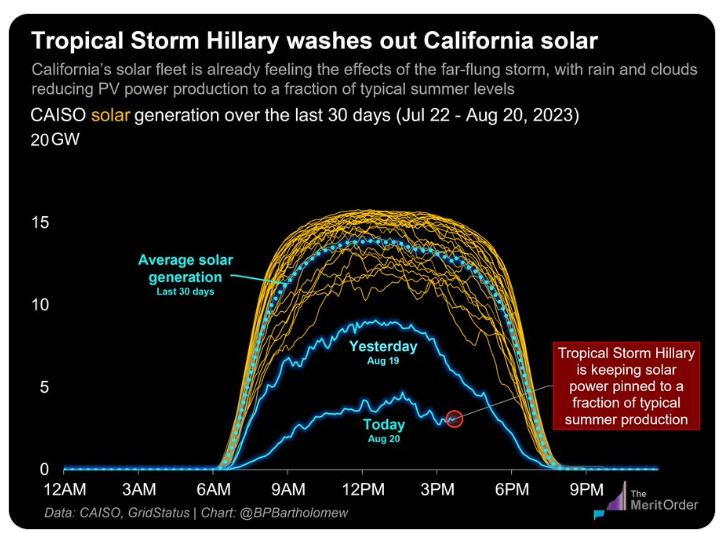
Proof that SoCal is the Sunniest Place Around – Tropical Storm Hillary is taking its toll on California solar production today (from CAISO):
IN THE NEWS
Commerce Issues Solar Tariff Finding – Our friends a POLITICO and other others report Commerce’s final determination on Friday that companies are skirting solar tariffs by funneling products through four Southeast Asian countries did little to settle the long-running division on the topic. The finding, announced during the same week as the one-year anniversary of the Inflation Reduction Act, now paves the way for new duties in June 2024, when Biden’s two-year tariff moratorium ends. Our friend Greg Wetstone of ACORE says the decision “directly undermines” Biden administration efforts to accelerate the deployment of renewable energy, as the solar industry “needs continued access to imported components until U.S. manufacturing capabilities are fully ramped up.” SEIA’s Abby Hopper said “Commerce is out of step with the administration’s clean energy goals, and we fundamentally disagree with their decision.”
EEI Names Former Energy Secretary as Next Head – EEI said Dan Brouillette has been selected as its President and CEO, effective October 1, 2023, following a comprehensive search process. Brouillette will become EEI President and CEO on January 1, 2024, and will succeed Tom Kuhn, who previously announced his plans to step down on December 31, 2023. Brouillette said EEI is a preeminent voice helping to guide the nation’s energy policy, and I believe the leadership role it performs has never been more important than it is today. “I have long admired the determination of EEI and its member companies to deliver clean, reliable, and resilient energy in the most affordable and inclusive manner possible. In my former role as U.S. Secretary of Energy, I witnessed firsthand EEI’s relentless dedication to these goals, and I am excited to now work with the EEI team in support of their member companies, their customers, and our country.” Brouillette currently serves as president of Sempra Infrastructure, a leading global energy transition company. Prior to joining Sempra, Brouillette served as the 15th US Secretary of Energy. He served as the President’s primary advisor on energy and nuclear weapons matters and was a member of the President’s National Security Council as well as the Vice President’s National Space Council. Brouillette also served as U.S. Deputy Secretary of Energy, the chief operating officer of the department. Brouillette is the only person ever to be confirmed by the U.S. Senate to serve in both roles. In the private sector, Brouillette has held leadership positions at USAA, where he served as a senior vice president and corporate officer, and at Ford Motor Company, where he was a vice president and served on its North American Operating Committee.
DOE Awards $34 Million to Advance Clean Hydrogen at Universities – DOE awarded nearly $34 million to 19 industry- and university-led research projects that will advance cutting-edge technology solutions to make clean hydrogen a more available and affordable fuel for electricity generation, industrial decarbonization, and transportation. Electricity generated from clean hydrogen will help reach the Biden-Harris Administration’s goals of achieving a zero-carbon American power sector by 2035 and a net-zero emissions economy by 2050. Hydrogen is a clean fuel that can be used in a fuel cell or a gas turbine to create electricity with only water and heat as byproducts. Clean hydrogen can be produced from zero-emissions electricity generated by wind, solar, geothermal, and nuclear, as well as from conversion of leak-tight natural gas and sustainably sourced biomass with carbon capture and storage. However, currently more than 95% of the roughly 10 million metric tons of hydrogen produced in the United States comes from natural gas without the capture and geologic storage of carbon dioxide, which results in significant emissions. This is why advancing clean hydrogen production is important to help address climate change. DOE’s National Energy Technology Laboratory (NETL), under the purview of DOE’s Office of Fossil Energy and Carbon Management (FECM), will manage the selected projects. Projects will focus on:
- Developing technologies that could help produce clean hydrogen at lower cost and with less energy.
- Exploring ways to produce hydrogen using biomass, effluent waters from oil and natural gas development and production, and other wastes.
- Expanding options for safe and efficient hydrogen transport and storage across the nation.
A detailed list of the selected projects can be found here.
ON THE SCHEDULE THIS WEEK
Forum to Look at Air Capture – American University’s Institute for Carbon Removal Law and Policy holds a forum today at 1:00 p.m. featuring Octavia Carbon. The company, based in Kenya, is seeking to develop the first Direct Air Capture facility in the Global South, as well as the cheapest Direct Air Capture hub in the world.
Forum Looks at Renewable Integration – Tomorrow at 1:00 p.m., Clean Energy States Alliance holds a forum on leveraging Federal funding for transmission technologies and renewable energy integration. Panelists will explain the potential of transmission technologies - dynamic line ratings, advanced power flow control & topology optimization - to enable the grid to deliver cleaner, lower-cost generation as well as the federal funding available to support their deployment.
Forum Looks at Fossil Fuel Report – The International Institute for Sustainable Development holds a forum on Wednesday at 7:00 a.m. on how the G20 can veer from record fossil fuel support. The issue of fossil fuel subsidies is notoriously absent in this year’s G20 agenda ahead of the Delhi Summit in September. With extreme weather events increasingly ravaging the globe, there is an urgent need to shift public financial flows away from them.
WRI Looks at Scope 3 Emissions – The World Resources Institute holds a forum on topline findings from its Corporate Standard and Scope 3 Surveys on Wednesday at 10:00 a.m. Speakers will review Greenhouse Gas Protocol stakeholder input collected via four online surveys between November 2022 and March 2023, on the Corporate Standard, Scope 2 Guidance, Scope 3 Standard, and Market-Based Approaches.
Forum Looks at Africa, Climate – The Women of Color Advancing Peace, Security and Conflict Transformation holds a virtual discussion Wednesday at 11:00 a.m. on the regional effects of climate change in Africa. The event will focus on the various effects of climate change that have led to food insecurity, desertification flooding and displacement.
Kerry Expected to Address Yale Conference – The 2023 Annual Conference of Global Research Alliance for Sustainable Finance and Investment (GRASFI), the leading international research conference on sustainable finance, will be held on Wednesday to Friday at Yale in New Haven (CT). With the climate emergency in plain sight, the importance of sustainable finance and investment is unmistakable. Climate Advisor John Kerry is expected to offer closing address to the conference. Net-zero finance will be at the core of the conference, and our opening plenary will confront the views of Ilana Seid, Ambassador of Palau to the United Nations, Jane Ambachtsheer, Global Head of Sustainability at BNP Paribas Asset Management, and Brad Lander, Comptroller of New York City. The conference will also feature a debate on the "anti-ESG" movement with Mindy Lubber, CEO and President of Ceres, and Saker Nusseibeh, CEO of Federated Hermes International. The last plenary will provide much needed market insights on the investors' key research needs with Elizabeth Seeger, Member of the International Sustainability Standards Board (ISSB).
C2ES Talks Offshore Wind, Communities – The Center for Climate & Energy Solutions holds a webinar on Thursday at 1:00 p.m. looking at how offshore wind can boost local economies. Local communities stand to gain tremendous economic benefits from investments in offshore wind infrastructure, local workforce, and manufacturing capacity but the U.S. must invest in a domestic offshore wind supply chain and workforce. Building on insights from two recent roundtables C2ES hosted in Virginia and Louisiana, this webinar will explore the opportunities the domestic offshore wind industry brings to American communities and the steps we need to take to make sure we are ready to realize them.
USEA Looks at IRA Tax Credit Monetization – On Thursday at 2:30 p.m., the US Energy Assn holds an event on the IRA tax credit monetization. The presentation will cover the IRA’s new transfer and elective payment rules. Importantly, taxpayers may now sell tax credits to other taxpayers under the transferability provisions. The ability to sell tax credits will allow taxpayers who cannot currently use the tax credits to offset their own taxes to transfer those credits to taxpayers who can.
IN THE FUTURE
Wilson to Look at China’s Methane Mitigation – Next Tuesday August 29th at 9:00 a.m., the Woodrow Wilson Center’s Cultivating US and Chinese Climate Leadership on Food and Agriculture project holds a chat (over tea!) with long-time CEF friend Dr. Hu Tao (Lakestone Institute for Sustainable Development). Tao will talk about his unique energy transition work on methane mitigation from food waste and manure in rural and urban China. Tao also has his hands on the pulse of the new voluntary climate emissions trading scheme and will share how the CCER could mitigate agricultural methane.
Forum Looks at Climate Change, Conflicts – On Tuesday August 29th at 10:00 a.m., the Middle East Institute and the International Committee of the Red Cross (ICRC) are holding a panel on the intersection of armed conflict and climate change and the impact on vulnerable communities in the Middle East. Experts will discuss ways that different governmental and civil society sectors can collaborate on climate action for those most affected — particularly with respect to water security, local development, humanitarian diplomacy, and climate financing.
Climate Week NYC – Climate Week NYC starts on Sunday September 17 with the Opening Ceremony. On Monday and Tuesday, September 18-19, Climate Group hosts The Hub Live, Climate Week NYC’s interactive program for innovative solutions, technologies and ideas that drive forward climate action now.
Critical Mineral Forum Set – The Colorado School of Mines and the Payne Institute for Public Policy are hosting their annual Critical Minerals Symposium on September 21 and 22nd in Golden, CO to convene world-class experts from government, business, investment and academics to engage in thoughtful discussion regarding the opportunities and challenges that lie ahead for the production and use of critical minerals, both internationally and domestically. The transition to a low carbon future will require an enormous amount of metals and minerals. Many of the key technologies, from renewable energy to electric vehicles, are witnessing dramatic growth. Critical minerals will become the backbone of the modern economy. However, the increase in demand for critical minerals will have profound impacts on the dynamics of trade, markets, and create new geopolitical challenges. Building on a long history of leadership in this area, Colorado School of Mines Critical Minerals Symposium will address these issues and more.
Clean Energy Week – National Clean Energy week will be held on September 25th to 29th. National Clean Energy Week is a celebration of the policies, industries, and innovations that power our daily lives while producing no or very little greenhouse gas emissions.
Natural Gas Conference Set – Hart Energy LIVE's second America’s Natural Gas conference will be held on September 27th in Houston and will focus on gas growth potential from the Marcellus and Haynesville to gas fairways in the Permian, Eagle Ford, and Gulf of Mexico. This conference unites American gas and energy players with world-leading influential experts, policymakers, decision-makers and business leaders to share their views on the significant issues shaping the global energy agenda.